Taking an archaeological perspective on the past, Jeffrey S. Girard traces native human habitation in northwest Louisiana from the end of the last Ice Age, through the formation of the Caddo culture in the tenth century BCE, to the early nineteenth century. Employing the results of recent scientific investigations, The Caddos and Their Ancestors depicts a distinct and dynamic population spanning from precolonial times to the dawn of the modern era.Girard grounds his research in the material evidence that defined Caddo culture long before the appearance of Europeans in the late seventeenth century. Reliance solely on documented observations by explorers and missionaries—which often reflect a Native American population with a static past—propagates an incomplete account of history. By using specific archaeological techniques, Girard reveals how the Caddos altered their lives to cope with ever-changing physical and social environments across thousands of years. This illuminating approach contextualizes the remnants of houses, mounds, burials, tools, ornaments, and food found at Native American sites in northwest Louisiana. Through ample descriptions and illustrations of these archaeological finds, Girard deepens understanding of the social organization, technology, settlement, art, and worldviews of this resilient society. This long-overdue examination of an often-overlooked cultural force provides a thorough yet concise history of the 14, 000 years the Caddo people and their predecessors survived and thrived in what is now Louisiana.
eBook - ePub
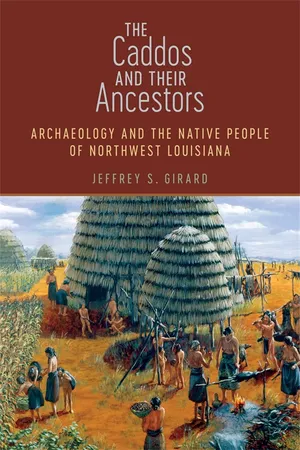
The Caddos and Their Ancestors
Archaeology and the Native People of Northwest Louisiana
- 160 pages
- English
- ePUB (mobile friendly)
- Available on iOS & Android
eBook - ePub
The Caddos and Their Ancestors
Archaeology and the Native People of Northwest Louisiana
About this book
Information
Topic
SozialwissenschaftenSubtopic
Nordamerikanische Geschichte1
___________
ARCHAEOLOGY AND HUMAN HISTORY IN NORTHWEST LOUISIANA
When I first began research in Louisiana in the early 1990s, I made several presentations to school groups and sometimes asked the children if they knew the name of the American Indian people who inhabited northwest Louisiana (including Caddo Parish) prior to the nineteenth century. Sadly, relatively few could answer the question—familiar tribal names like Cherokees and Apaches came up most often. History classes made little reference to American Indians, and what was mentioned was of such a generic nature that little substantive knowledge was conveyed. Fortunately, school curricula have since changed, and today information on the American Indian past is routinely included.1 Still, few people have much understanding of the early human past in Louisiana, a past that actually stretches back at least thirteen thousand years into the waning centuries of the Pleistocene geological era, when climate and landscape conditions differed markedly from modern times.
Written records only provide information regarding the last few centuries of at least twelve millennia of human existence in the Americas. For most of this long span of time, our knowledge comes exclusively through archaeology. For northwest Louisiana, we can trace strong continuities in artifact styles, patterns of settlement, and other cultural aspects of the Caddo people from the eighteenth century back at least to the tenth century. Prior to this, the archaeological record looks different, not necessarily because the Caddos were a new group of people who migrated in from elsewhere, but due to widespread changes that appear across much of the eastern portions of the continent at that time. After a brief glimpse offered by the somewhat enigmatic accounts of the sixteenth-century De Soto expedition, written references to the Caddos begin only in the late seventeenth century, and even then all writing was done by outsiders with limited understanding of Caddo culture. The ancient Caddos or their ancestors left no written record of themselves or their past.
Archaeologists investigate the human past through study of the material remains of human activity. Note that the focus is on the human past—archaeologists do not pursue, or study, the fossilized remains of dinosaurs or other animals and plants. Archaeology is most closely related to the disciplines of history and anthropology, whereas the study of fossil remains is in the domain of paleontology, a subject with direct connections to geology and biology. Methods and techniques from geology and biology are important in archaeological research, however, as are those from physics and other scientific as well as humanistic subjects.
A common misconception is that archaeology simply entails digging up old artifacts. Although archaeologists do study artifacts, of equal (or greater) importance are features, or the alterations to the landscape resulting from past human activities. These alterations include moving earth to form mounds and embankments; construction of houses and other structures; and digging pits for cooking, deposition of trash, or burial of the dead. It is the contexts of artifacts—their spatial relationships, environmental settings, and associations with archaeological features—that are crucial to the study of past human activities.
The basic data used in archaeological research are fragile and constantly being degraded and, in many instances, destroyed. Because data lie in the ground, modern alterations to the landscape significantly impact research. In fact, for archaeology, the process of doing research changes the record being studied. Places containing archaeological remains (sites) are essentially destroyed as they are excavated. What if reading a book caused the words to fall off the page and the book to crumble? In order to retain information, one would need to take very good notes. The same is true with archaeological research. It is not possible to put a site back after it has been excavated or artifacts removed from the surface. However, much can be learned if investigation takes place in a systematic and controlled manner, and all techniques and findings are recorded in notes, drawings, maps, and photographs (fig. 2). An undocumented collection of artifacts taken from the ground makes no more sense than a jumbled collection of words displaced from a book. The individual specimens, like individual words, constitute bits of information. But the story they tell relies on order and context.
Archaeological research differs from historical research in its emphasis on the study of material things rather than written documents. Most of the human past took place in times and places where no written records are available. These contexts, in which the archaeological record is the only record of what life was like, are commonly referred to as prehistory. There are no set boundaries to prehistory—written records extend back thousands of years in some areas such as the Middle East and Egypt. In northwest Louisiana, historic records begin with the De Soto expedition in 1540–41, but are essentially absent again for more than 150 years until Spanish and French colonists began to arrive in the late seventeenth century. Archaeological research does not end when written records begin. It is becoming increasingly clear that studies of relatively recent periods of time have the potential to greatly expand our understanding of the past, particularly concerning issues and peoples often poorly represented in historical inquiries.

FIGURE 2. Students from Northwestern State University excavating and recording information at the Fish Hatchery 2 site in Natchitoches Parish
Although specific goals of archaeological research vary widely and rest upon a diverse array of theoretical premises and methods, most efforts are directed toward the following objectives:
1. Reconstructing past activities. At the most basic level is the attempt to understand archaeological data in terms of activities that constituted the daily lives of peoples in the past. Such activities include what kinds of foods were consumed and how they were prepared; what kinds of houses and other structures and facilities were built and used; and information about tools, containers, ornaments, clothing, and other items used by past peoples.
2. Examining past social, economic, religious, and political organization. On a slightly more abstract level are questions about past human relationships—how people were interconnected to meet environmental challenges and to interact with one another.
3. Understanding past worldviews. Of increasing concern in recent research are attempts to understand what people in the past thought about themselves, the natural world, and their place in the cosmos. How did these views relate to their organizations, technologies, and other aspects of life?
4. Understanding and explaining change. Understanding the dynamics of the past is a traditional concern of archaeological research. Archaeological data constitute a record of changes in worldviews, systems of organization, and human activities. A key aspect of research involves placing archaeological contexts in chronological order and constructing theories about how and why changes occurred.
Although the archaeological record is a contemporary phenomenon, it accrued over the course of several millennia, and it is important that we slice it into intervals of time that are small enough to be meaningful in terms of past human behavior. In some rare cases it is possible to isolate small-enough segments to interpret the record at a chronological resolution that we can almost relate to what was happening as if we had traveled back in time and were describing ongoing activities. The famous Pompeii site in Italy is probably the most extreme example—where the sudden burial of the city under volcanic lava and ash preserved buildings, objects, and even some of the people themselves. That situation is unique, however, and we almost always have to interpret sites that were abandoned, left to the elements to slowly decay, and, if we are fortunate, became buried by river deposits or sediments washing down from higher elevations. In much of the uplands of Louisiana, surfaces that existed several thousand years ago remain at or near the present surface. Not only does this situation result in the decay of most organic materials due to natural weathering processes, but exposure of surfaces results in the mixing together of materials from use of the landforms over long periods of time. It often is difficult, or impossible, to make sense of data in terms of short-term human behavior. Later in this book, I discuss the Conly site in Bienville Parish, where the remains of a large camp occupied approximately 7,500 years ago were buried relatively quickly by river alluvium, thus preserving normally perishable materials and precluding the possibility of later activities altering the record.
Even the Conly site, however, appears to have been used (perhaps intermittently) over the course of several centuries. The archaeological record is the fallout of debris from intervals of human activity that vary in length. Redundancy in the kinds and spatial loci of activities results in distinctive patterns in the archaeological record. Different kinds of use of space produce different patterns. For example, a group of mobile hunter/gatherers may have inhabited the same ridge for a period of weeks or months on an annual basis, constructing hearths and temporary shelters. However, there might not have been anything on the ridge to constrain their use of space, and over the course of several yearly visits, remains of hearths and shelters would form archaeological features scattered randomly across the extent of the ridge. In contrast, a group of people living in the same space for longer periods might build more permanent structures and other facilities that organize their use of space. Certain activities, and discarding of debris, always took place in particular areas. Relative to the earlier scenario, a spatially organized archaeological record would result. It is for these reasons that archaeologists carefully record the spatial proveniences of everything that they find. Obviously in some cases, such as plowed fields, spatial relationships of artifacts are altered long after the materials are left behind by the people who used them. However, even in plowed fields, archaeological features often are found intact below the plowed sediments.
Anthropologist Eric Wolf wrote a book about European colonial expansion after the fifteenth century titled Europe and the People without History.2 The concept of “people without history” is particularly apt because it is often inferred that portions of the earth other than Europe and connected parts of Asia and North Africa had relatively unchanging pasts in precolonial times. Cultural “others” have been objects of study in disciplines such as anthropology that focus on the conditions and ideas of contemporary peoples rather than on how those conditions and ideas developed through time. In schools and museums, American Indians are sometimes studied as part of “natural history” along with the landscape, plants, and fauna. The result is a static concept of the American Indian past in our popular imagination with little appreciation of the profound changes that took place over the centuries and how these changes were the products of both local events and more widespread regional interactions.
By the mid-twentieth century, archaeologists had developed ways to order the archaeological record into sequences—in other words, with enough research, it became possible to place things in relative chronological order. Determining sequences is partly based on a concept known as stratigraphy, or the simple idea that some landforms build up sediments through time, and thus the deeper we go below the ground surface, the older the materials. These situations generally are in river bottoms, where sediments suspended in water are deposited as floodwaters recede, constructing what are known as natural levees. Different flooding events sometimes leave sediments of varying color and texture that are readily identifiable. Long intervals between floods leave stable surfaces upon which vegetation grows and human groups place their camps or villages. Organic materials incorporated into such stable surfaces form dark-colored bands that we refer to as buried soils.
Unless there has been some sort of disturbance, the oldest occupations are found in the lowest strata that bear artifacts. Thus, in digging we encounter the past backward—the most recent occupations first, then we go back in time. However, determining how sequences related to calendar years was largely guesswork (some of which was found to be remarkably accurate!) until techniques such as radiocarbon dating and dendrochronology became refined in the later twentieth century, so that now we have much better interpretations of the age of archaeological sites.
Radiocarbon dating is of primary importance in northwest Louisiana. What is it, and what exactly does it date? The first thing to know is that, just as the name implies, the technique concerns carbon, the basic element of all life. Most carbon is carbon-12 (or C-12), a stable form found in all living things. Cosmic rays from the sun, however, produce an unstable “radioactive” form of carbon called carbon-14 (or C-14). Plants absorb C-14 through photosynthesis; animals obtain it by eating plants. The ratio of C-14 to C-12 atoms is very small, but it is the same in all living things. C-14 is unstable and diminishes at a known rate—approximately half decays over a span of 5,730 years (the “half-life”). Solar radiation keeps the C-14 / C-12 ratio in the atmosphere constant (with minor, but important, exceptions noted below). However, once a living organism dies, it no longer receives C-14 from the atmosphere, and thus the C-14 / C-12 ratio diminishes. Since this decay occurs at a known rate, measurement of the C-14 / C-12 ratio in charcoal or other organic material provides a measure of the elapsed time since the organism died. After about ten half-lives (in the range of 60,000 to 80,000 years), C-14 amounts are too small to be counted reliably, and thus other dating techniques must be used. Fortunately, this remote time is long prior to the earliest evidence of any human presence in North America.
Counting C-14 atoms is carried out in a radiocarbon laboratory. The most efficient way that this is done today is by a technique known as Accelerated Mass Spectrometry, or AMS. The procedure is subject to statistical uncertainty, and results are reported as an interval rather than an exact age in years—for example, “700 ± 30 years BP (before present)” means that there is a 66.7 percent chance that the true date lies somewhere between 670 and 730 years ago (one standard deviation); and there is a 95 percent chance that it lies between 640 and 760 years ago (two standard deviations). A complicating factor, however, is that we now know that the percentage of C-14 in the atmosphere has varied a little over time, and thus radiocarbon years are not exactly the same as calendar years. The discrepancy is greater the further we go back in time. On the positive side, we also know the degree of this variation by taking radiocarbon samples from wood that has been dated through dendrochronology. Calibration curves have been produced whereby we can translate radiocarbon years into calendar years. For example, using the CALIB method of calibration (there are others, but results are similar), a radiocarbon age of 700 ± 30 BP likely would fall somewhere in the AD 1271–1297 interval.
Note that what generally is dated is charcoal, or perhaps bone or shell—it must be something organic. We cannot get radiocarbon dates from stone or pottery (unless organic material has been preserved on them). In order to date nonorganic artifacts, we must establish an association between the datable material and other things. In other words, we must infer that they were left behind at the same general time. If objects are removed from an archaeological site without proper recording of their contexts and associations, they cannot be reliably dated.

FIGURE 3. Timeline of general cultural periods in Louisiana
From our present perspective, we can look back and organize the human past into a sequence of periods within which we are able to make generalizations about the ways people interacted with other people and the landscape. In Louisiana and the southeastern United States in general, we commonly recognize five major divisions: the Paleoindian period (ca. 11,500–8000 BC), the Archaic period (ca. 8000–500 BC), the Woodland period (ca. 500 BC–AD 900), the Mississippian period (ca. AD 900–1650), and the Historic period (ca. AD 1650 to present) (fig. 3). These periods can be subdivided in various ways depending on the amount and nature of evidence for different regions. The earliest periods are of great length and encompass intervals when changes appear to have taken place very slowly, social interactions were few and sporadic, and similar lifeways prevailed across vast areas. Through time we see greater diversity, a faster tempo of change, and more connections between groups. Although our notion of these trends may partly reflect the greater amount of information available for more recent times, an overall rise in population through time along with escalating numbers and frequencies of linkages and interdependencies between people across the landscape undoubtedly took place.
2
___________
The Earliest Peoples of Northwest Louisiana (ca. 11,500–500 BC)
When did the first people arrive in Louisiana, and where did they originate? These are difficult questions, and the answers continue to be vigorously debated. Research on the earliest period of human settlement presents many challenges, in part, due to the nature of the environment.1 Although many areas of the state are dominated by upland landforms of sufficient age to contain evidence of these early peoples, most sites in upland settings are located on stable or eroding surfaces where artifacts from later occupations have become mixed with those of earlier times. Exposure of the surfaces for millennia greatly limits or precludes preservation of features with charcoal or other organic materials. The opposite problem relates to the major river floodplains. Massive sediment depositi...
Table of contents
- Cover
- Title Page
- Copyright Page
- Dedication
- Contents
- Preface
- Acknowledgments
- 1. Archaeology and Human History in Northwest Louisiana
- 2. The Earliest Peoples of Northwest Louisiana (ca. 11,500–500 BC)
- 3. The Woodland Period and Early Mounds in Northwest Louisiana (ca. 500 BC–AD 900)
- 4. Beginnings of Caddo Culture (ca. AD 900–1300)
- 5. Organization of the Caddos in Precolonial Times (ca. AD 1300–1700)
- 6. Caddos and Colonials (ca. AD 1700–1760)
- 7. Transitions to Modernity (ca. AD 1760–1835)
- Notes
- Glossary
- References
- Index
Trusted by 375,005 students
Access to over 1.5 million titles for a fair monthly price.
Study more efficiently using our study tools.
Frequently asked questions
Yes, you can cancel anytime from the Subscription tab in your account settings on the Perlego website. Your subscription will stay active until the end of your current billing period. Learn how to cancel your subscription
No, books cannot be downloaded as external files, such as PDFs, for use outside of Perlego. However, you can download books within the Perlego app for offline reading on mobile or tablet. Learn how to download books offline
Perlego offers two plans: Essential and Complete
- Essential is ideal for learners and professionals who enjoy exploring a wide range of subjects. Access the Essential Library with 800,000+ trusted titles and best-sellers across business, personal growth, and the humanities. Includes unlimited reading time and Standard Read Aloud voice.
- Complete: Perfect for advanced learners and researchers needing full, unrestricted access. Unlock 1.5M+ books across hundreds of subjects, including academic and specialized titles. The Complete Plan also includes advanced features like Premium Read Aloud and Research Assistant.
We are an online textbook subscription service, where you can get access to an entire online library for less than the price of a single book per month. With over 1.5 million books across 990+ topics, we’ve got you covered! Learn about our mission
Look out for the read-aloud symbol on your next book to see if you can listen to it. The read-aloud tool reads text aloud for you, highlighting the text as it is being read. You can pause it, speed it up and slow it down. Learn more about Read Aloud
Yes! You can use the Perlego app on both iOS and Android devices to read anytime, anywhere — even offline. Perfect for commutes or when you’re on the go.
Please note we cannot support devices running on iOS 13 and Android 7 or earlier. Learn more about using the app
Please note we cannot support devices running on iOS 13 and Android 7 or earlier. Learn more about using the app
Yes, you can access The Caddos and Their Ancestors by Jeffrey S. Girard in PDF and/or ePUB format, as well as other popular books in Sozialwissenschaften & Nordamerikanische Geschichte. We have over 1.5 million books available in our catalogue for you to explore.