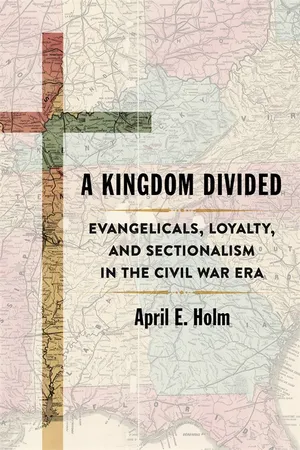
A Kingdom Divided uncovers how evangelical Christians in the border states influenced debates about slavery, morality, and politics from the 1830s to the 1890s. Using little-studied events and surprising incidents from the region, April E. Holm argues that evangelicals on the border powerfully shaped the regional structure of American religion in the Civil War era.
In the decades before the Civil War, the three largest evangelical denominations diverged sharply over the sinfulness of slavery. This division generated tremendous local conflict in the border region, where individual churches had to define themselves as being either northern or southern. In response, many border evangelicals drew upon the "doctrine of spirituality," which dictated that churches should abstain from all political debate. Proponents of this doctrine defined slavery as a purely political issue, rather than a moral one, and the wartime arrival of secular authorities who demanded loyalty to the Union only intensified this commitment to "spirituality." Holm contends that these churches' insistence that politics and religion were separate spheres was instrumental in the development of the ideal of the nonpolitical southern church. After the Civil War, southern churches adopted both the disaffected churches from border states and their doctrine of spirituality, claiming it as their own and using it to supply a theological basis for remaining divided after the abolition of slavery. By the late nineteenth century, evangelicals were more sectionally divided than they had been at war's end.
In A Kingdom Divided, Holm provides the first analysis of the crucial role of churches in border states in shaping antebellum divisions in the major evangelical denominations, in navigating the relationship between church and the federal government, and in rewriting denominational histories to forestall reunion in the churches. Offering a new perspective on nineteenth-century sectionalism, it highlights how religion, morality, and politics interacted—often in unexpected ways—in a time of political crisis and war.
eBook - ePub
A Kingdom Divided
Evangelicals, Loyalty, and Sectionalism in the Civil War Era
- 288 pages
- English
- ePUB (mobile friendly)
- Available on iOS & Android
eBook - ePub
About this book
Information
Topic
Historia— 1 —
WATCHMEN ON THE WALLS OF ZION
The Evangelical West
Cincinnati Methodist Thomas Morris knew he played a vital role in God’s plan for the United States. “Providence has placed some of us as watchmen on the walls of Zion in the great ‘Valley,’” he wrote in 1834. The Ohio Valley, Morris continued, “is already peopled with millions of fallen, yet rational beings; and. . . may be some day, as populous as the Chinese empire.”1 The region was indeed rapidly expanding. By the 1830s, the greater Ohio Valley boasted sufficient economic strength and a population large enough for its occupants to consider themselves distinct from their neighbors to the east.
White evangelical Christians in the Ohio Valley forged a particularly strong regional identity because of the West’s strategic importance for their mission to evangelize the nation. The major evangelical denominations carried that mission into the West and created institutions to advance it in the Ohio Valley. The 1837 Presbyterian schism resulted from disputes over this effort to evangelize the West. In the 1830s, the possibility of sectional division between northern and southern evangelicals seemed remote. As evangelical churches took root and flourished in the West, clergy concentrated on winning the region for Christ. Eventually, however, the very growth and institution-building that made churches strong, swiftly growing, and popular also rendered them vulnerable to fractures over slavery and sectionalism.
Evangelical conceptions of the West as both symbol and site of the nation’s future were of more significance than pinpointing its exact boundaries. Historians have defined the antebellum West in various ways—as a frontier, a border, an economic system, and a sphere for the growth of federal influence.2 For evangelicals, however, it was a physical space where national growth and Christ’s cause were inextricably intertwined. Evangelism was patriotism. In the 1820s, evangelical interest thus focused on the Ohio Valley region.
The Ohio River begins in western Pennsylvania and flows westward to the Mississippi, forming part of the borders of what are now West Virginia, Ohio, Kentucky, Indiana, and Illinois. It drains most of Tennessee, parts of Maryland and Virginia, and small areas of other states. At the southern tip of Illinois, the Ohio joins the Mississippi, which flows south along the eastern border of Missouri. The Ohio River served as a natural extension of the Mason-Dixon Line, which had marked the border between Pennsylvania and Maryland—and the divide between slavery and freedom—since the eighteenth century. The Ohio River did not always demarcate a significant cultural divide, however. Residents of the western valley of the Ohio—both north and south of the river—shared much in common despite their different labor systems.3
In the late eighteenth century, the first white Americans arrived from the upland South to settle in the Ohio Valley region. Hailing from Virginia, Maryland and North Carolina, they moved westward and north into Tennessee and Kentucky, displacing Native American inhabitants. While southerners led the way, settlers from New England and the Mid-Atlantic states soon followed. Most of these immigrants were not large plantation owners. Rather, they sought to establish farms and gain the independence that came with land ownership.4
Yankees and southerners who had settled in the West did not forget their regional origins, but their common interests and frequent interactions gave rise to a new western ideal: “manly, politically astute, and egalitarian.”5 Several elements of western life helped to forge this identity. The Ohio River itself, as a transportation route and communication system, unified residents more than it divided them. In addition, westerners were drawn together by a common political culture that valued local control and rejected the elitism and paternalism associated with the East. Matthew Salafia argues that westerners “developed a regional counternarrative that emphasized a tradition of compromise” in contrast to both North and South. Westerners also united against the East to defend economic interests, such as access to markets through internal improvements and the need for access to banks and credit.6
White westerners on both sides of the Ohio River shared a racist anxiety about the growth of the black population in the region. This is not to say that western views of slavery were monolithic. Despite early talk of abolishing slavery in Kentucky, whites living south of the Ohio and in Missouri embraced the institution. For their part, many residents of free western states associated slavery with the eastern elite and opposed its expansion into the region. Most of all, they feared that slavery nearby would mean the presence of free blacks who would threaten the western ideal of an egalitarian white society. Westerners in free and slave states generally shared an abhorrence of free blacks and abolitionists—both threatened the existing racial hierarchy in the region. This fragile racist consensus could not withstand the sectional conflict of the late 1840s and 1850s.7
The region was hardly homogenous or static. Latent differences in the population never disappeared entirely and would eventually contribute to later conflicts. Nonetheless, a recognition of western distinctiveness—and a sense of being above the fray of sectionalism—survived into the middle of the century. “Say to the Northern and Southern cadets,” wrote a Missourian to his son at West Point in 1858, “that you belong to neither section—that you are a true son of the great West.”8
THE SECOND GREAT AWAKENING
From the 1790s to the 1830s, America’s major evangelical denominations rapidly expanded during a tide of evangelism and revivals we now know as the Second Great Awakening. Both the deism that thrived among the Revolutionary generation and New England Calvinism lost ground to the energetic, upstart evangelicals, particularly Methodists and Baptists. Presbyterians also adopted evangelical tactics. By the end of the Second Great Awakening, Richard Carwardine argues, “evangelical Protestantism was the principal subculture in American society.”9 Unlike their Calvinist forebears, nineteenth-century evangelicals believed that through an experience of conversion—being “born again”—and living a continued life of morality, any sinner could achieve salvation and eternal life in heaven. The message of salvation for all greatly appealed to the unsettled and changing American population.10
Baptists, Methodists, and Presbyterians all shared an imperative to evangelize which inspired missions to the West. The Methodists were the most zealous and organized group to pursue this missionary mandate, and they did so with great success, helping to produce a pervasive evangelical culture in the United States. “Methodists,” argues Nathan Hatch, “injected vernacular Christianity into the bloodstream of America, faith incarnate in popular culture.” Methodism’s power and appeal derived from the use of vernacular preaching to spread a message of grace: God did not predestine a select few to heaven and condemn all others to damnation. The use of popular language and the message of possible redemption for all appealed powerfully to nonelites and the emerging middle class.11
The spectacular growth and popularity of Methodism compelled other denominations to adopt Methodist missionary methods. These methods included the use of itinerant clergy and lively, emotional preaching—both of which helped to quickly form new congregations. Baptists and Presbyterians adopted these methods, and Methodists served as their “example, prod, and guide,” argues Donald Matthews. “The constant visitation of evangelical preachers and their preaching the same values, norms, and vision of society throughout the United States helped create a distinct moral community.”12
Missionaries from all three denominations placed particular emphasis on the importance of evangelizing the West and building institutions there. However, in the early years, it was difficult to obtain funds and secure ministers to take positions, and the denominations competed fiercely, sometimes in the face of local hostility. The internal organizational structure of each denomination—Presbyterian, Methodist, and Baptist—affected their responses to these challenges and the institutions they built. For this reason, it is worth discussing the structure of each group individually.
Methodists
Following the flood of conversions that took place during the Second Great Awakening, Methodists enjoyed enormous popularity. From 1820 to 1830, the number of Methodists in the United States doubled, rising from a quarter-million to a half-million adherents. By the middle of the nineteenth century, the denomination claimed 1.5 million members and was the largest religious organization in the country.13 Part of this success was due to its hierarchical structure.
Methodist evangelism depended on the circuit rider, an itinerant preacher assigned to a set of communities within a region. These preachers rode these “circuits” on a regular basis, ministering to the people who lived in the area. This approach to evangelism was well suited to the sprawling Ohio Valley region. But by the 1830s and 1840s, the itinerant model began to wane as Methodism became more respectable and established. As towns grew and prosperous residents built handsome brick and stone churches, some larger communities were appointed permanent ministers. Nevertheless, the romantic vision of the hearty itinerant survived late into the nineteenth century, as did the effectiveness of the Methodist system of spreading religion.14
The circuit riders and ministers received their appointments from regional bodies called “conferences,” which met once a year. These “annual conferences” did not necessarily follow political borders. Rather, they were designed to best meet the needs of the areas they served. This meant that the bounds of some of the conferences, particularly in the West, crossed state lines. The Ohio Conference, for example, included a large portion of western Virginia and only the southern half of Ohio itself. The Baltimore Conference contained most of Maryland, but also the central third of Pennsylvania and a generous portion of northern Virginia, while the Philadelphia Conference included eastern Pennsylvania, all of Delaware, and Maryland’s eastern shore.15
A bishop presided over each annual conference. Bishops held the highest rank in the Methodist Church. Methodist bishops were active public figures who communicated regularly with one another. They traveled extensively to attend multiple conferences each year. At the 1852 General Conference, for example, Bishop Matthew Simpson reported, “It was arranged for me to take Western Virginia, Pittsburgh, and Erie Conferences and to accompany Bishop Janes to Ohio and Cincinnati and if convenient to Missouri and to go in fall of 1853 to California.”16 This Episcopal leadership structure knit the church together and formed the ties that connected North and South, making Methodism a truly national denomination.
Every four years, Methodist bishops and other prominent denominational figures convened for a General Conference, which made major decisions about doctrine and policy. The General Conference was one of the few nongovernmental assemblies that convened at the national level in the nineteenth century.17 As such, the conference was one of the first places, outside of Congress, where conflict over slavery had material consequences.
Baptists
In the early decades of the nineteenth century, Baptist Church membership also flourished. Like the Methodists, the Baptists practiced an emotional, personalized faith, but they emphasized the primacy and centrality of individual congregations. This decentralized structure made organizing missions difficult. In the mid-eighteenth century, some Baptist congregations began to form regional associations for this purpose. Missionary associations did not have authority over their constituent congregations, which were at liberty to join and leave as they saw fit.18 Still, Baptist congregations remained distrustful of centralized organizations in a way that Methodists, by virtue of their structure, were not.
The value of missionary associations soon became evident to wary congregations, however. In 1845, the General Association of Baptists in Kentucky sent an agent on a journey of 2,820 miles, during which he “visited about 30 counties, attended five associations,” and collected nearly fifteen hundred dollars in contributions from formerly dubious Kentuckians. These funds were to be used to send missionaries to underserved parts of the state. The Kentucky Association served as a clearinghouse to assist in distributing the products of ecumenical religious presses. The association urged missionaries to sell inexpensive theological books and Baptist newspaper subscriptions to “as many families as possible.” Missionaries also carried “religious tracts for gratuitous distribution among the destitute.” All of these activities would have been impossible to coordinate at the congregational level.19
By the early nineteenth century, Baptists were keenly aware of the extraordinary success of the more hierarchically organized Methodists. In response, they introduced a new kind of organizational body: the society.20 Reflecting their commitment to congregational autonomy, society members joined as individuals. Even so, Baptist evangelization was hampered by this aversion to national institutional organizations. For foreign missions, this problem was resolved in 1814 through the creation of the General Missionary Convention of the Baptist Denomination in the United States for Foreign Missions.
To coordinate missionary efforts across the nation, Baptists established the American Baptist Home Mission Society (ABHMS) in 1832. It organized funding and appointed missionaries...
Table of contents
- COVER
- TITLE PAGE
- COPYRIGHT PAGE
- DEDICATION
- CONTENTS
- ACKNOWLEDGMENTS
- INTRODUCTION: A Kingdom Divided
- 1. WATCHMEN ON THE WALLS OF ZION: The Evangelical West
- 2. THE GREAT SECESSION: Slavery and Schism on the Religious Border
- 3. COMBUSTIBLE MATTER: Conflict on the Border after Division
- 4. MORAL AND POLITICAL THUNDERSTORMS: National Politics and Border Evangelicals
- 5. WORSHIPPING UNDER THE SHADOW OF THE FLAG: Wartime Conflict and Federal Response
- 6. ALMOST LIKE FOUNDING AN EMPIRE: Union Victory and Religious Reconstruction
- 7. A FIRE IN THE FRONT AND A FIRE IN THE REAR: Border Realignment and the Failure of Reunion
- 8. AN APPEAL TO THE FUTURE: Memory of War and Failure of Reunion
- CONCLUSION: The Right as God Gives Us to See the Right
- NOTES
- BIBLIOGRAPHY
- INDEX
Trusted by 375,005 students
Access to over 1.5 million titles for a fair monthly price.
Study more efficiently using our study tools.
Frequently asked questions
Yes, you can cancel anytime from the Subscription tab in your account settings on the Perlego website. Your subscription will stay active until the end of your current billing period. Learn how to cancel your subscription
No, books cannot be downloaded as external files, such as PDFs, for use outside of Perlego. However, you can download books within the Perlego app for offline reading on mobile or tablet. Learn how to download books offline
Perlego offers two plans: Essential and Complete
- Essential is ideal for learners and professionals who enjoy exploring a wide range of subjects. Access the Essential Library with 800,000+ trusted titles and best-sellers across business, personal growth, and the humanities. Includes unlimited reading time and Standard Read Aloud voice.
- Complete: Perfect for advanced learners and researchers needing full, unrestricted access. Unlock 1.5M+ books across hundreds of subjects, including academic and specialized titles. The Complete Plan also includes advanced features like Premium Read Aloud and Research Assistant.
We are an online textbook subscription service, where you can get access to an entire online library for less than the price of a single book per month. With over 1.5 million books across 990+ topics, we’ve got you covered! Learn about our mission
Look out for the read-aloud symbol on your next book to see if you can listen to it. The read-aloud tool reads text aloud for you, highlighting the text as it is being read. You can pause it, speed it up and slow it down. Learn more about Read Aloud
Yes! You can use the Perlego app on both iOS and Android devices to read anytime, anywhere — even offline. Perfect for commutes or when you’re on the go.
Please note we cannot support devices running on iOS 13 and Android 7 or earlier. Learn more about using the app
Please note we cannot support devices running on iOS 13 and Android 7 or earlier. Learn more about using the app
Yes, you can access A Kingdom Divided by April E. Holm in PDF and/or ePUB format, as well as other popular books in Historia & Historia de la Guerra de Secesión. We have over 1.5 million books available in our catalogue for you to explore.