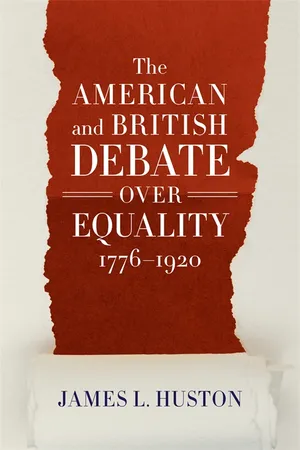
Historians have long contested the degree to which the central tenet of the Declaration of Independence—that all men are created equal—has manifested itself in American society and national policy. According to James L. Huston, many historians have focused too intently on class differences, slavery, and inequalities arising from ethnicity, sexuality, and gender, while overlooking important areas where notions of equality flourished during the century and a half after the Declaration's signing. In The American and British Debate Over Equality, 1776–1920, Huston examines the egalitarian communities in rural northern America, particularly those enclaves that differed from the openly aristocratic cities and towns of the British Isles. In the aftermath of the American Revolution, British and American writers alike recognized that a growing philosophical rift divided the two nations: whereas Great Britain continued to embrace the inequality of its hierarchical class system, the United States professed allegiance to democratic ideals of equality—limited though these were by racial and gender norms of the day. Huston argues that the two countries engaged in an intellectual debate during the next century and a half over which ideal—equality or inequality—worked best in promoting social stability, political hegemony, and economic success. Exploring the effects of equality and inequality on many aspects of American life, he examines civil behavior, social customs, treatment of others, politics, education, religion, economic opportunity, and general public optimism. Drawing from decades of publications by American and British writers, Huston reveals the rhetorical strategies contemporary observers employed in defending or rejecting the organization of a society around broader notions of human equality. The American and British Debate Over Equality, 1776–1920 informs the modern debate over equality and inequality, not by theorizing and philosophizing, but by offering a glimpse into the practical applications of a functioning egalitarian society as compared to one that extolled monarchy and institutionalized inequality.
- 288 pages
- English
- ePUB (mobile friendly)
- Available on iOS & Android
eBook - ePub
The American and British Debate Over Equality, 1776–1920
About this book
Information
Subtopic
Economic HistoryIndex
History1
THE TRUMPET SOUNDETH FOR EQUALITY
The Enlightenment and the American Revolution
The idea of equality has had a strange history. Until the eighteenth century in Europe, philosophers recognized a notion of human equality based on all people belonging to the same species and facing the same fate (death and then judgment by the deity), but in regard to earthly affairs and especially political affairs, inequality was everywhere the standard in theory and practice. The breaking point came in the Enlightenment when the gross inequalities of material life came under attack. The diatribes against the artificiality of European monarchs, aristocrats, and court life flowed across the Atlantic and affected the thinking of the individuals who would lead the American Revolution. That thinking became enshrined in the Declaration of Independence, and before long the American republic became not only an experiment in republicanism but also in egalitarianism. But the Americans also inherited another feature of the Enlightenment: though it was easy to describe inequality, it was less easy to define equality. In the end, what survived was only an imprecise idea of equality; precision was much greater when it came to inequality.
THE LONG WESTERN EUROPEAN TRADITION OF INEQUALITY
When today one hears about the traditions of western European civilization, it is seldom mentioned that this tradition included a distinct defense of inequality as being the appropriate political and social standard for any society to function rationally. The celebrated philosophers, Aristotle and Plato, in the fifth and fourth centuries BCE, rationalized inequality for Greek society, explicitly denouncing democracy in political affairs. When Christianity came to Europe in the form of the Catholic Church, its structure mirrored the social orders of monarchy, aristocracy, and commons (i.e., the pope, archbishops, and finally the laity). The prominent theologian St. Augustine accepted inequality in the political and economic world, even though in the spiritual world all were equal in the eyes of God. Martin Luther, during the Protestant Reformation, distinctly favored strong government in the hands of the few, although John Calvin added doctrines that could nourish an idea of some earthly equality. The Italian city-states had philosophers who wrote about republican equality, but their equality was limited to citizens engaged in public affairs and did not rule out slavery or aristocracy as being part of society. From 600 BCE to about 1500 CE, the standard for Europe was inequality in religion, politics, and society; the sanctioning of equality for humans was strictly limited to the dead.1
THE ENLIGHTENMENT AND EQUALITY
The first breach in the domination of the ideal of inequality as the guide for western European life arose with the intellectual movement known as the Enlightenment, which commenced with the scientific revolution of the seventeenth century that allowed individuals the possibility of breaking away from religion as a means to explain the physical world.2 The catchphrases of the Enlightenment were logic, reason, and nature. Its enemies became superstition, religion in general, and finally the political establishment of Europe. However, there were (as there always are) complications. Scholar Jonathan Israel divides the Enlightenment philosophers into radicals, moderates, and actually, Anglo-Americans. The radical Enlightenment arose out of the Dutch republican experiment and ultimately stressed equality and democracy. Moderate Enlightenment thinkers, including Voltaire, were not convinced of the superiority of the ideals of equality and democracy, and wanted to reform society (that is, make it more rational) by educating people and convincing princes of the merit of Enlightenment principles. The Anglo-American Enlightenment was different because of Isaac Newton and John Locke; rather than attack mysticism and religion, they argued for the supremacy of Christian teaching, making the English Enlightenment much more traditional than the thinking on the continent. Intellectual historian Ellen M. Wood questions some of these generalizations, arguing instead that the centralized nature of England allowed a different kind of political philosophy to appear (basically, Locke on property, progress, and representative government), while France, because of its peculiar civil service and its political failure to centralize, came to trumpet democracy and equality, as seen in the first stages of the French Revolution.3
Scholars have not accorded “equality” a prominent element in their writings on the Enlightenment. For example, Peter Gay, one of the Enlightenment’s premiere historians, did not bother to investigate the philosophical discussion about the subject. The governing scholarly disposition seems to be that the Enlightenment thinkers were largely elitists, and most feared the masses and distrusted giving them power. In political terms, equality implied democracy, and democracy, while it might be legitimated as a branch of government, was never to be allowed to be government’s only mechanism. Nonetheless, outright expressions favorable to equality arose during the eighteenth century and were probably made possible by the intellectual disillusionment with monarchs and aristocrats. The simple truth was that it was theoretically true that if one could find a person of outstanding wisdom and virtue, that person as king would produce a golden age for his people. And if aristocracies could indeed be composed of the “best” people, who also had virtue and wisdom, then local government would be superb and the people would obtain perfect justice. But after several centuries of rule by monarchs and aristocrats, virtue and wisdom among them was undetectable; they ruled ruthlessly, engaged in war, and plundered their people. They ruled by passion, and their passions reflected their intentions to gratify their self-interests by violently imposing their will on others. One of the ways that equality (and democracy) came to be acceptable to philosophers was the realization of the utter failure of monarchy and aristocracy to live up to their theoretical pretensions; the gap between reality and theory had become too wide to be bridged.4
The idea of equality probably received its greatest impetus from the English Civil War when the Levellers (1647–1648) argued for an expanded suffrage, a natural equality, and, in the work of James Harrington, a limitation on great estates. The Levellers lost, but the idea of human equality then sprang up in some unlikely places. Thomas Hobbes began his treatise Leviathan by postulating that all men were born equal, and one did not much differ in talent from another. But to get out of the destructive chaos of life in the jungle, humans gave up their natural equality by consenting to government by kings. John Locke did not accept the alienation of natural rights in the manner of Hobbes (that is, purchasing security and stability by selling their equality), and instead insisted that not only were men born equal (in the state of nature) but they kept their natural rights to life, liberty, and property when they consented to form governments—and governments could not trespass those natural rights without inciting, justifiably, rebellion. To some extent, Hobbes, and by that route Locke, were influenced by the writings of Baruch Spinoza (1632–1677), who argued that people never gave up their natural equality.5
By the mid-eighteenth century, advocates for human equality became more outspoken. Locke had compromised human equality by letting property rights and inheritance trump other rights—ultimately he defended the great landed gentry—but others became more assertive that the aristocrats and monarchs had gone too far in plundering their people and living in ostentatious and unjustifiable luxury. Francis Hutcheson (1694–1746), the founder of the Scottish Common Sense school, believed in natural equality in the enjoyment of civil rights and attacked all forms of slavery; he criticized Locke’s origin of property rights and justified the limitation of property aggregations—that is, he theoretically accepted some sort of “agrarian” law. Claude Helv’tius and d’Holbach attacked the existing social order and its superficiality. When Guillaume Thomas Raynal as general editor put together the Historie Philosophique (six volumes, 1770), it included a diatribe by Diderot against European imperialism, a denunciation of the extremes of wealth and poverty in Europe, and a declaration of universal human rights. The triumph of the principle of equality was fully expressed by Condorcet in 1795, an equality that embraced women as well as non-Europeans.6 Some of this writing may have set the stage for Jean Jacques Rousseau and his insistence that the invention of private property was the source of human inequality. Rousseau eventually drifted away from most Enlightenment philosophers in his creation of the “general will” to guide society, a belief that the common citizens would reach a unanimous consensus about proper institutions and policies. Most Enlightenment writers insisted on freedom of expression and not the potential censorship arising from a consensus imposed by the masses.7
Among scholars of the Enlightenment, Jonathan Israel is one of the few who investigated the subject of equality, and he produced a chapter on the topic. He concluded that the radicals desired equality before the law (Spinoza) and held the aristocracy in contempt for its privileges; he summarized that radicals held that all humans had a “moral equivalence” that each member of a society had to acknowledge, and that only among equals would one obtain the “reciprocity” of relationships that constituted a good society. And Israel noted that nowhere in the Western world save for the United States after 1776 and France after 1789 did equality before the law exist.8 For a standard by which one might compare European Enlightenment ideas about equality with those of the American Revolution, one could take the entry of “Egalité” from the Encyclopédie, volume 5, 1755, by Chevalier de Jaucourt. He stated that all men were naturally equal by having a common humanity, and any social inequality that did exist did not exempt any person from “treating their fellow beings as the natural equals they are.” Obviously, slavery was a violation of natural law and rights. However, equality among men did not mean an absolute equality; what was meant was “natural equality” because people have different conditions, abilities, and distinctions; “natural or moral equality is not opposed to these.”9
Why did some Enlightenment philosophers come to advocate an idea of human equality and argue its practical implementation as a social standard for European societies? The answer has to lie in their observation of the wreckage that inequality—i.e., aristocracy and monarchy—made of the societies in which they lived. Monarchs generally ruled politics, but aristocrats ruled society. The aristocrats obtained privileges; on the continent, they escaped taxation; everywhere, the sons of aristocrats became the officeholders in government and the officers in the military. Europe had a divided justice: one set of rules and punishments for the nobility, another set for commoners. In England only the aristocracy could openly bear arms. All common people had to bow and scrape before their superiors; their persons were not to be touched; in England, the aristocrats demanded a deference that was extreme. And then there was the disparity in wealth and landholdings. A considerable peasant proprietorship existed in most of the European nations, but nevertheless the great estates of the aristocracy contained the bulk of the land. In England, the peasantry and yeomen were disappearing as the aristocrats and gentry consolidated land ownership among themselves. In France, the peasants were taxed to the breaking point in order to allow the aristocracy to live in luxury at Versailles and to support a large bureaucracy. In England, the landed magnates in the eighteenth century exhibited their wealth by building astounding country estates, buying up blocks of London real estate, and wallowing in ostentatious leisure. And everyone, especially the few Americans who traveled overseas, noticed the misery of the common people.10
Given the social and economic divisions in England and the rest of Europe, it was hardly any wonder that a reaction to such chasms emerged. Aristocratic inequality almost naturally evoked a desire among many for its opposite, democratic equality. This polarity also explains the amorphous definition of equality: many writers could be quite explicit about what they disliked about aristocratic inequality, but negatives added together could not build a positive and exact definition of equality.
THE DECLARATION OF INDEPENDENCE
The first paragraph of the Declaration of Independence trumpeted the Americans’ intention to break free of the British Empire. The second paragraph encapsulated the principles that the Americans hoped would become the foundation of their nation:
We hold these truths to be self-evident: That all men are created equal; that they are endowed by their Creator with certain unalienable rights; that among these are life, liberty, and the pursuit of happiness; that, to secure these rights, governments are instituted among men, deriving their just powers from the consent of the governed; that whenever any form of government becomes destructive of these ends, it is the right of the people to alter or to abolish it, and to institute new government, laying its foundation on such principles, and organizing its powers in such form, as to them shall seem most likely to effect their safety and happiness. Prudence, indeed, will dictate that governments long established should not be changed for light and transient causes; and accordingly all experience hath shown that mankind are more disposed to suffer, while evils are sufferable, than to right themselves by abolishing the forms to which they are accustomed. But when a long train of abuses and usurpations, pursuing invariably the same object, evinces a design to reduce them under absolute despotism, it is their right, it is their duty, to throw off such government, and to provide new guards for their future security. Such has been the patient sufferance of these colonies; and such is now the necessity which constrains them to alter their former systems of government. The history of the present King of Great Britain is a history of repeated injuries and usurpations, all having in direct object the establishment of an absolute tyranny over these states. To prove this, let facts be submitted to a candid world.
Immediately following these principles came a list of actions that Jefferson and members of the Continental Congress believed proved the intent of the British realm to impose despotism upon the American colonies. Most people have lingered over and debated the inordinately long first sentence in the second paragraph, in which Jefferson seemed to derive ideas of natural law, philosopher John Locke’s listing of human rights as life, liberty, and property, the justice of revolution/rebellion, and the recognition that governments rested on the consent of the people and not on the caprice and power of a king or aristocracy. Although it is not much commented on, the fourth sentence of the second paragraph yields a stunning summary of why most populations have accepted rule by the governing clique, even though that rule exhibited unfairness and injustice.
Ever since 1776, writers have immediately seized on the phrase “all men are created equal” and wondered how the Continental Congress could have approved such an assertion.11 Colonial America did not have the aristocratic order everywhere found in Europe, but it certainly had inequality. The Virginia planters acted as a gentry, deference was a hallmark of the society, the urban poor lived in misery in the American port cities, some merchants were extremely wealthy, women were strictly subordinate to men, colonists coveted the land of the tribes of North America and had no compunction about killing Native Americans when they resisted encroachment, and, most obviously, slavery existed everywhere in the colonies and composed a major part of the population in the colonies (states) beneath the Mason-Dixon line.12 Because of these blatant inequalities, the Declaration made no sense as a declaration for egalitarianism. Thus it has become commonplace among historians to assert that the congressmen who voted to adopt the Declaration must have had a restricted sense of equality, such as citizen equality before the law, equality in the sense of belonging to the same species and the same gender, equality in the chances for improving their condition without being hindered by government favoritism, and equality restricted to members of their own ethnicity. Michal Ja...
Table of contents
- Cover
- Title Page
- Copyright Page
- Contents
- Preface
- Introduction: A Word Lost in a Definitional Fog
- 1. The Trumpet Soundeth for Equality: The Enlightenment and the American Revolution
- 2. The Fortress: The Defense of Inequality, 1750–1820
- 3. The Duel Begins
- 4. Equality, Manners, and Civility
- 5. Education and Religion
- 6. Politics and Equality: Democracy as Curse
- 7. American Inequalities
- 8. Different Paths: The United States and Great Britain, 1865–1920
- Conclusion: The Revival of the Aristocratic Ethos
- Notes
- Sources
- Index
Trusted by 375,005 students
Access to over 1.5 million titles for a fair monthly price.
Study more efficiently using our study tools.
Frequently asked questions
Yes, you can cancel anytime from the Subscription tab in your account settings on the Perlego website. Your subscription will stay active until the end of your current billing period. Learn how to cancel your subscription
No, books cannot be downloaded as external files, such as PDFs, for use outside of Perlego. However, you can download books within the Perlego app for offline reading on mobile or tablet. Learn how to download books offline
Perlego offers two plans: Essential and Complete
- Essential is ideal for learners and professionals who enjoy exploring a wide range of subjects. Access the Essential Library with 800,000+ trusted titles and best-sellers across business, personal growth, and the humanities. Includes unlimited reading time and Standard Read Aloud voice.
- Complete: Perfect for advanced learners and researchers needing full, unrestricted access. Unlock 1.5M+ books across hundreds of subjects, including academic and specialized titles. The Complete Plan also includes advanced features like Premium Read Aloud and Research Assistant.
We are an online textbook subscription service, where you can get access to an entire online library for less than the price of a single book per month. With over 1.5 million books across 990+ topics, we’ve got you covered! Learn about our mission
Look out for the read-aloud symbol on your next book to see if you can listen to it. The read-aloud tool reads text aloud for you, highlighting the text as it is being read. You can pause it, speed it up and slow it down. Learn more about Read Aloud
Yes! You can use the Perlego app on both iOS and Android devices to read anytime, anywhere — even offline. Perfect for commutes or when you’re on the go.
Please note we cannot support devices running on iOS 13 and Android 7 or earlier. Learn more about using the app
Please note we cannot support devices running on iOS 13 and Android 7 or earlier. Learn more about using the app
Yes, you can access The American and British Debate Over Equality, 1776–1920 by James L. Huston in PDF and/or ePUB format, as well as other popular books in History & Economic History. We have over 1.5 million books available in our catalogue for you to explore.