Winner of the Jules and Frances Landry Award
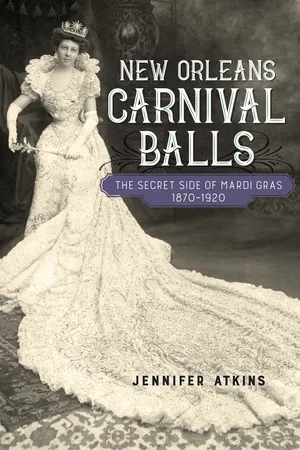
Mardi Gras festivities don't end after the parades roll through the streets; rather, a large part of the celebration continues unseen by the general public. Retreating to theaters, convention centers, and banquet halls, krewes spend the post-parade evening at lavish balls, where members cultivate a sense of fraternity and reinforce the organization's shared values through pageantry and dance. In New Orleans Carnival Balls, Jennifer Atkins draws back the curtain on the origin of these exclusive soirees, bringing to light unique traditions unseen by outsiders.
The oldest Carnival organizations—the Mistick Krewe of Comus, Twelfth Night Revelers, Krewe of Proteus, Knights of Momus, and Rex—emerged in the mid-nineteenth century. These old-line krewes ruled Mardi Gras from the Civil War until World War I, and the traditions of their private balls reflected a need for group solidarity amidst a world in flux. For these organizations, Carnival balls became magical realms where krewesmen reinforced their elite identity through sculpted tableaux vivants performances, mock coronations, and romantic ballroom dancing. This world was full of possibilities: krewesmen became gods, kings, and knights, while their daughters became queens and maids. As the old-line krewes cultivated a sense of brotherhood, they used costume and movement to reaffirm their group identity, and the crux of these performances relied on a specific mode of expression—dancing.
Using the concept of dance as a lens for examining Carnival balls, Atkins delves deeper into the historical context and distinctive rituals of Mardi Gras in New Orleans. Beyond presenting readers with a new means of thinking about Carnival traditions, Atkins's work situates dance as a vital piece of historical inquiry and a mode of study that sheds new light on the hidden practices of some of the best-known krewes in the Big Easy.
- 264 pages
- English
- ePUB (mobile friendly)
- Available on iOS & Android
eBook - ePub
About this book
Information
NOTES
INTRODUCTION
1. The Mardi Gras, or Carnival, season is one of celebration, marking a festive period before Lent (when revelers are supposed to turn toward fasting and penitence in the weeks before Easter). Traditionally, the Carnival season begins on January 6, the Epiphany, also known as Twelfth Night, and culminates on Mardi Gras Day, the day before Ash Wednesday.
2. Scholarship does address Carnival balls as instrumental in Mardi Gras, but no work deals in depth with the actual dancing itself. Besides Karen Trahan Leathem’s 1994 dissertation, “‘A Carnival According to Their Own Desires’: Gender and Mardi Gras in New Orleans, 1870–1941” (Ph.D. diss., University of North Carolina at Chapel Hill, 1994), which provides a compelling argument about elite gender in Mardi Gras, other works that peripherally deal with Carnival balls include Phyllis Hutton Raabe, “Status and Its Impact: New Orleans Carnival, the Social Upper Class and Upper-Class Power” (Ph.D. diss., Pennsylvania State University, 1973); Karen Luanne Williams, “Images of Uneasy Hybrids: Carnival and New Orleans” (Ph.D. diss., Emory University, 1992); Benton Jay Komis, “A Reading of Cultural Diversity: The Island New Orleans” (Ph.D. diss., Harvard University, 1998); and Henry Arnold Kmen, “Singing and Dancing in New Orleans: A Social History of the Birth and Growth of Balls and Opera, 1791–1841” (Ph.D. diss., Tulane University, 1961).
3. For the purposes of this book, “old-line” refers to the oldest, most exclusive Mardi Gras organizations, all of which were formed between 1857 and 1890 as predominantly elite, white, Protestant, American, all-male clubs: the Mistick Krewe of Comus, Knights of Momus, Rex, Proteus, and the original Twelfth Night Revelers (TNR). As a side note, many of the younger men from Comus, Momus, Proteus, and Rex families formed additional, ball-only organizations in the 1890s. Though equally prestigious, these organizations are not fully characteristic of old-line krewes. They are called “tableaux societies,” further discussed in chapter 5.
4. “Dreams of Homer” was Comus’ 1872 theme; “The World of Audubon” was the 1873 theme for TNR.
5. The seriousness of play is a theory explored in depth by anthropologist/theorist Victor Turner in his seminal collection of essays From Ritual to Theatre: The Human Seriousness of Play (New York: PAJ, 1982). In this work, Turner argues that “play” constitutes symbolic action with multiple meanings and the possibility of maintaining social order, introducing new modes of “portraying or embellishing old models for living” and the potential for “cultural innovation, as well as the means of effective structural transformations within a relatively stable sociocultural system” (85).
6. None of Comus’ six founders were New Orleanians. Some of Rex’s founders were northerners, too (see Errol Laborde, Krewe: The Early New Orleans Carnival, Comus to Zulu [New Orleans: Carnival, 2007], 15–23, 51–55; and Errol Laborde, Marched the Day God: A History of the Rex Organization [Metairie, La.: School of Design, 1999], 7).
7. For Confederate army participation, see Report of Historical Committee M.K.C. 1857 to 1894, Comus ball booklet (New Orleans, December 1897), 8, in 1894 Comus folder, box 6, Carnival Collection, Louisiana Research Collection (LaRC), Tulane University; Laborde, Marched the Day God, 6; and James Gill, Lords of Misrule: Mardi Gras and the Politics of Race in New Orleans (Jackson: University Press of Mississippi, 1997), 59–77. For discussion of the old-line krewes’ support of nativist, conservative Democrat ideas, see Reid Mitchell, “Comus,” in All on a Mardi Gras Day: Episodes in the History of New Orleans Carnival (Cambridge: Harvard University Press, 1995), 65–81; and Gill, Lords of Misrule, 77–143.
8. William E. Greene, “Dancing and Deportment, Salutations,” in The Terpsichorean Monitor (E. A. Johnson & Co., Printers, 1889), 4.
9. Perry Young, Comus chronicler, writes that the Mistick Krewe of Comus faced “financial strain” in the late 1880s because its social club counterpart, the Pickwick Club, resided in “palatial new quarters on Canal Street.” To offset the strain, Comus did not parade between 1885 and 1890. During this time, however, Comus continued its dedicated tradition of balls: “The Pickwick Club gave carnival balls each year, of a lavishness and elegance never surpassed in the city. These were held in the spacious and luxuriously furnished home of the club. In 1885 it is said that there were 2000 guests at the ball. In 1886—the greatest ball ever given in New Orleans—there were bands and dancing on each of the four floors” (Perry Young, The Mistick Krewe: Chronicles of Comus and His Kin [New Orleans: Carnival, 1931], 168).
10. New Orleans Times-Democrat, January 12, 1890, 4, col. 1.
11. Perry Young’s version of this decision differs from other accounts in that Young states the Rex organization decided to visit only Proteus. Upon hearing the news, that year’s Rex (impersonating Urukh, king of Chaldea) displayed his unhappiness with the decision and announced that he would first visit Comus. This decree, according to Young, was part of the fuel for the fight on Canal Street (Young, The Mistick Krewe, 175).
12. Judith Lynne Hanna, To Dance Is Human: A Theory of Nonverbal Communication (Chicago: University of Chicago Press, 1987), 3.
13. Cynthia Jean Cohen Bull, “Sense, Meaning, and Perception in Three Dance Cultures,” in Meaning in Motion: New Cultural Studies in Dance, ed. Jane C. Desmond (Durham, N.C.: Duke University Press, 1997), 270.
14. Deidre Sklar, “Five Premises for a Culturally Sensitive Approach to Dance,” in Moving History/Dancing Cultures: A Dance History Reader, ed. Ann Dils and Ann Cooper Albright (Middletown, Conn: Wesleyan University Press, 2001), 30.
15. Gerald Jonas, Dancing: The Pleasure, Power, and Art of Movement (New York: Abrams, 1998), 164.
16. François Delsarte (1811–1871) was a French music teacher and aesthetic theorist who developed a system of elocution. The Delsarte System of Expression was grounded in a fixed relationship between physical and spiritual expression and sought to find the correlation between movement and meaning. James Steele Mackaye, Delsarte’s only known American student, incorporated Delsartean methods into American physical culture from 1870 on, and Mackaye’s students after him (notably Genevieve Stebbins) continued to draw on Delsartean principles in American performances and contexts, including in tableaux, gymnastics, breathing techniques (as a part of oration and wealthy parlor classes on deportment), and, eventually, as inspiration for the emergence of modern dance. Chapter 3 will discuss Delsartism, especially in its connection to tableau performance, in more detail.
1. “VIVE LA DANSE!”: BALLS AND MARDI GRAS IN NEW ORLEANS HISTORY
1. Perry Young, The Mistick Krewe: Chronicles of Comus and His Kin (New Orleans: Carnival, 1931), 60–61.
2. Report of Historical Committee M.K.C. 1857 to 1894, Comus ball booklet (New Orleans, December 1897), 8, in 1894 Comus folder, box 6, Carnival Collection, Louisiana Research Collection (LaRC), Tulane University.
3. New Orleans Daily Picayune, February 26, 1857, 1, col. 7.
4. See Mardi Gras in New Orleans and the Mistick Krewe of Comus, MCMXXIV (New Orleans: Mistick Krewe of Comus, 1924), PAM F 379. N5 M948 1924, Historic New Orleans Collection.
5. Henri Schindler, Mardi Gras Treasures: Invitations of the Golden Age (Gretna, La.: Pelican, 2000), 9.
6. Samuel Kinser, Carnival, American Style: Mardi Gras at New Orleans and Mobile (Chicago: University of Chicago Press, 1990), 17.
7. Arthur Burton La Cour, New Orleans Masquerade: Chronicles of a Carnival (New Orleans: Pelican, 1952), 10.
8. The two dances from this list most pertinent to old-line Carnival balls, the quadrille and waltz, will be discussed in chapter 5. For a thorough explanation and recorded video reconstr...
Table of contents
- Cover
- Title Page
- Copyright Page
- Dedication
- Contents
- Illustrations
- Acknowledgments
- Introduction
- ONE: “Vive La Danse!” Balls and Mardi Gras in New Orleans History
- TWO: “A Most Brilliant Assembly” Preparing for the Ball and Choreographing Class
- THREE: “The Age of Chivalry Is Not Passed and Gone”Tableaux Vivants during Reconstruction
- FOUR: “A Strange and Silent Group” Courtly Grand Marches and Quadrilles in the Gilded Age
- FIVE: “The Very Maddest Whirlpool of Pleasure” Ballroom Dancing in the Progressive Era
- Conclusion
- APPENDIX
- Notes
- Bibliography
- Index
Trusted by 375,005 students
Access to over 1.5 million titles for a fair monthly price.
Study more efficiently using our study tools.
Frequently asked questions
Yes, you can cancel anytime from the Subscription tab in your account settings on the Perlego website. Your subscription will stay active until the end of your current billing period. Learn how to cancel your subscription
No, books cannot be downloaded as external files, such as PDFs, for use outside of Perlego. However, you can download books within the Perlego app for offline reading on mobile or tablet. Learn how to download books offline
Perlego offers two plans: Essential and Complete
- Essential is ideal for learners and professionals who enjoy exploring a wide range of subjects. Access the Essential Library with 800,000+ trusted titles and best-sellers across business, personal growth, and the humanities. Includes unlimited reading time and Standard Read Aloud voice.
- Complete: Perfect for advanced learners and researchers needing full, unrestricted access. Unlock 1.5M+ books across hundreds of subjects, including academic and specialized titles. The Complete Plan also includes advanced features like Premium Read Aloud and Research Assistant.
We are an online textbook subscription service, where you can get access to an entire online library for less than the price of a single book per month. With over 1.5 million books across 990+ topics, we’ve got you covered! Learn about our mission
Look out for the read-aloud symbol on your next book to see if you can listen to it. The read-aloud tool reads text aloud for you, highlighting the text as it is being read. You can pause it, speed it up and slow it down. Learn more about Read Aloud
Yes! You can use the Perlego app on both iOS and Android devices to read anytime, anywhere — even offline. Perfect for commutes or when you’re on the go.
Please note we cannot support devices running on iOS 13 and Android 7 or earlier. Learn more about using the app
Please note we cannot support devices running on iOS 13 and Android 7 or earlier. Learn more about using the app
Yes, you can access New Orleans Carnival Balls by Jennifer Atkins in PDF and/or ePUB format, as well as other popular books in History & North American History. We have over 1.5 million books available in our catalogue for you to explore.