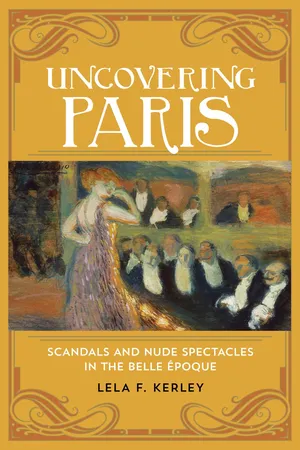
From 1889 to 1914 nude spectacles increased at an astonishing rate as a result of burgeoning artistic experimentation, the commercialization of the female body, and the rise of urban nightlife. In particular, artists' balls and music halls provided creative spaces in which women, artists, impresarios, and the illustrated press could cast the natural body as a source of sexual pleasure, identity, and reform. Emphasizing the role of erotic entertainment as an outlet and agent of modern sensibilities, Uncovering Paris: Scandals and Nude Spectacles in the Belle Époque offers a fresh approach to important topics of the period—Bohemian artists, the New Woman, and press censorship—and reinterprets them through the lens of la femme nue.
Having inherited her name from the pictorial female Nude and the Nude's real-life counterpart, the artist's model, la femme nue operated as a screen onto which various groups projected their artistic drives, sexual desires, monetary interests, and cultural anxieties. A struggle to define pornography and art, freedom and censorship, and public and private spheres ensued among artists, theater directors, and moral leagues as a century-long tradition of equating civilization with clothing broke down in the face of performative challenges. In posing, singing, acting, and dancing in naturalist presentations, the artist's model-turned-erotic entertainer engendered crises in ways of seeing the female body that contributed to and was indicative of a changing moral climate within which women were accorded more freedom to corporeally express themselves. Once denigrated and denounced as a sign of vulgar working-class sexuality, the revelation of female flesh became an integral aspect of twentieth-century French body culture.
Drawing upon a range of colorful commentaries, dramatic debates, and evocative photos, Lela F. Kerley highlights the importance of nudity in the redrawing of moral boundaries as she uncovers key moments that amounted to a "culture war" in the years leading up to World War I. Through an investigation of street riots, court cases, and anti-pornography campaigns, Uncovering Paris offers an interdisciplinary approach to the scholarship on Belle Époque sexual politics and a rich glimpse into the social construction of morality in Belle Époque France.
- 320 pages
- English
- ePUB (mobile friendly)
- Available on iOS & Android
eBook - ePub
About this book
Information
Subtopic
European HistoryIndex
HistoryPART I
PUBLIC BALLS
In 1895 the art critic and writer Gustave Coquiot defined the subject of his book Les bals publics “not as a ball open to everyone but rather as a market of women—with music.”1 While others might have described these events by their festive nature, colorful costumes, illuminated halls, or fanciful decorations, Coquiot looked past the artifice to describe what he saw as the very undercurrent of social and economic change in Belle Époque Paris: the commodification of female bodies under the guise of entertainment. In a 1901 portrait of Coquiot, Pablo Picasso captures his friend’s professional and perhaps personal interest in the subject as he sits on an embroidered fauteuil, grinning as a bevy of women in various states of undress perform in the background. This trend in showcasing feminine beauties for public consumption, while not new to those living in the closing decade of the nineteenth century, reached new heights of voyeurism and daring as artists and the illustrated press appropriated the traditional French fête to forward an alternate vision of French art and culture.
The explosion of nude spectacles in Paris by the 1890s had a great deal to do with earlier cultural forms and practices that had made such a craze possible. Part I highlights the Parisian public ball as one venue where female nudity outside the boudoir, the salon, and the Salon first gained a public following and popular support. The public ball, writes Theodore Zeldin, “was the expression above all of group consciousness, in which bodily movement and gesture, without speech, was the language used to assert the cohesion of the community.”2 Though nonverbal forms of communication have been a topic mainly for early modern historians examining festivals and religious processions, the assumption that literate, secular societies of the modern era abandoned pageantry after the development of new technologies discounts the way in which public balls transmitted cultural mores through official and unofficial acts of merrymaking. As Charles Rearick notes, bals publics continued to serve as “a way of teaching the people, more than a fifth of them still illiterate, new values and a new identity” well into the late nineteenth century.3
The bal public, which originated during the reign of Louis XV as a fashionable pastime of the aristocracy, slowly transformed into an improvised or periodic activity of the popular classes. While they lost their associations with religious holy days and social exclusivity following the Revolution of 1789, they continued to function as events at which one’s place within the social order was visibly affirmed. According to Richard Semmens, bals publics “were neither restricted to a select group of invited participants and observers, nor carefully planned out in advance,” yet they adhered to a standard repertoire that included some combination of dancing, drinking, and the display of costumes or masks as part of the fanfare.4 Bals populaires, bals de sociétés, bals de caractère, carnavals, fêtes, and mascarades, all variations of the bal public, afforded different groups in postrevolutionary France the opportunity to freely celebrate their corporatism and find “liberation from the constraints of daily life.”5
The most notorious bal public, the Bal de l’Opéra, exemplified the extreme manner in which the bourgeoisie showcased its wealth and social power by taking liberties reserved only for its members. Under the Second Empire, the Bal de l’Opéra acquired a reputation for encouraging scandalous behavior, a reputation owing in part to its popularization of the waltz and low-cut necklines, or decolletés. Competitions among female guests to wear the most revealing decolleté, according to the chronicler Georges Montorgueil, caused concern among moral prudes, who worried that the sight of “a corner of skin” would arouse “erotic furies” in men and lead them to commit “vulgar and obscene acts.”6
The bourgeoisie’s flouting of social mores and its failure to connect its own actions with the sexual commerce it condemned, at least publicly, in brothels and music halls, inspired the creation of bohemian balls in the 1880s. Though oriented toward entertainment and festivity, these balls contained an element of social critique that became increasingly pronounced over time. Jules Levy, a member of an eclectic group of artist-poets who ridiculed the sexual and moral hypocrisy of late nineteenth-century bourgeois society and the notion of noblesse oblige, founded the Bal des Incohérents in 1885. Sponsored by Le Courrier Français, the Bal des Incohérents enjoyed a decade of popularity as Paris’s antiestablishment ball, even after Le Courrier Français founded its own ball in 1888. Playing with the notion of fixed social and gender identities, the Bal des Incohérents encouraged guests to dress as inanimate objects or sexually ambiguous stock characters of the theater in order to expose the absurdity of bourgeois life. According to Rearick, these balls opened to a larger public “the freer world of artistic fantasy,” a world that sought the sexual freedoms of the upper echelons but without the duplicity.7
In their depictions of the mischief and chicanery, Parisian chroniclers identified gauloiserie as a salient feature of late nineteenth-century bals publics. “Any sketch of ‘vulgar Paris,’” wrote one British observer, “would be incomplete without some reference to the so-called bals publics.”8 More often than not, these balls occurred in quartiers inhabited by students and artists, neighborhoods known for their popular, sometimes perverse leisure attractions. Of these, Montmartre had established itself as a countercultural enclave by the 1890s, having overtaken the Latin Quarter as “a site where individuals banded together to try to push for new liberties and points of view.”9 The loose tongues, lax behavior, and tawdry gestural and vestimentary practices of self-identified bohemians represented performances, in life and in art, that attacked dominant cultural norms in a satirical, je m’en fous (I don’t give a damn) manner. Functioning as a kind of street theater for local inhabitants, Montmartroise festivals encouraged social cohesiveness through ribald jokes and pranks that insiders most appreciated.
Louis Morin, an artist and writer who documented Parisian life, dated the beginning of these festivals to the mid-1880s. Perhaps one of the most important chroniclers of his time, yet understudied, Morin provides a retrospective account of these balls for the period 1885 to 1900 that is indispensable for capturing the spirit of Bohemia. More than a history, his book Les carnavals parisiens reads like a manifesto for a revolution that at the time of its writing was already under way. Employing militaristic language, Morin compared the artists’ cause to changes already occurring within the area of modern dance. Just as an army of can-can dancers “reveal another, more pleasurable, amusing side of life under their dark dresses,” Morin concluded, so too were painters, writers, sculptors, and illustrators innovating through a variety of media to bear witness to the joie de vivre that enlivened the popular classes. Evident in the Chat Noir’s literary readings, Le Courrier Français’s fêtes, and the Beaux-Arts students’ Bals des Quat’z-Arts, a broader vision of art would eventually supplant an entire tradition and system of distinguishing official from nonofficial art. Morin argued that in order for all creative enterprises to be recognized as Art, the very definition of art had to be cleaved from moral underpinnings imposed upon it by external forces. Works currently being produced by the Académie, he declared, reflected mores that “are no longer suitable to our times; they have been made by the politician, by a religiously minded person who has been distracted from his true purpose, and by foreign and Protestant influences to which we no longer submit. We are suffocating from proprieties and prejudices in our narrow black suits, and here is where it [the Académie] all falls apart.”10
Morin’s critique not only voiced the mounting frustration that a younger generation of artists evinced with regard to the moralization of art but also pointed to their increasing influence on the production of “national art.” Their desire to radically transform the meaning of art through artists’ balls drew inspiration and received institutional support from satirical journals, which had grown in number and daring after the recent abolition of press censorship in 1881.
The artist’s right to freely express him- or herself was central to the kind of aesthetic reform undertaken by and within the illustrated press and its corresponding bals publics. Avant-garde literary and artistic papers pushed the limits of what was morally acceptable in both print and performance.11 Some of the most famous graphic artists of the day, such as Adolphe Willette, Jules Chéret, and Théophile-Alexandre Steinlein, worked for the so-called New Press, which promoted an edgy, avant-garde aesthetic that posed “a direct challenge, albeit tongue and cheek, to the art establishment.”12 As part and parcel of mid-nineteenth-century France’s fascination with literary realism and artistic naturalism, these papers encouraged artists to fabricate spicy scenes involving contemporary Nudes. The unconventional treatment of women’s bodies in the illustrated press eventually gave way to artists’ balls, with their Rabelaisian spirit and tradition of mimicking social elites, mocking the status quo, bending gender, and celebrating excess. As a physical site, the late nineteenth-century public ball acted as a forum where writers, painters, and students could collectively imagine an alternative social order while simultaneously launching attacks against an oppressive bourgeois system.13
With the creation of its own bal public, Le Courrier Français drew upon its predecessors’ use of artistic fantasy to play with the idea of art by blending high and low cultural forms together in the display of poster art and bodily exhibitions. In doing so, its editor, Jules Roques, transformed the traditional bal public into a form of commercial entertainment that readers could consume in print and in person for a nominal fee. Describing these carnivalesque festivals as a mixture of “spontaneous social theater and publicity stunts,” the historian Jerrold Seigel emphasizes the extent to which “commerce and publicity were important elements in the dances from the start.”14 Together, artists and the illustrated press promoted an avant-garde agenda to dismantle the entire edifice of bourgeois morality in order to create a more enlightened visual culture in which all forms of expression could flourish. In its quest to increase profits through subscription sales, Le Courrier Français provided artists with a space and forum where they could creatively experiment with the female body as living art in the last decade of the nineteenth century.
The Fête du Nu (Festival of the Nude), the most infamous yet least known of Le Courrier Français’s balls, radically redefined the nature of the bal public by making the erotic display of women’s bodies central to the event. Held at the Elysée-Montmartre in the spring of 1889, it was credited by Louis Morin with introducing the first “beauty contest” as a regular feature of fin-de-siècle balls.15 Unlike such contests in America and Great Britain, where the judging centered upon the contestants’ facial features, the Fête du Nu focused solely on the female contestants’ legs. Seated behind a large curtain so as to preserve the modesty of everyone concerned, fifteen women lifted their skirts and projected their bare legs through protrusions in the cloth. Similar to what one might see at a carnival or fair, the rest of the contestants’ bodies were caricatured on the fabric, creating what one observer called “the craziest thing that one could imagine.”16
The conflation of real bodies with the cartoonish sketches signified a blurring of boundaries between art and reality, as well as between the nude and the naked. Severed from the rest of their bodies by the curtain, the contestants’ legs functioned as fetishistic objects. In an article published just prior to the event, Le Courrier Français encouraged guests to fondle the legs in order “to make sure that there were no padded bodysuits” and to certify that what they were seeing was in fact the real thing.17 The transgressive act of physically displaying and mediating the encounter between woman as object and spectator as subject tinged the legs contest with erotic overtones.
To see and touch a part of the female anatomy traditionally cloaked by layers of material was an activity traditionally sanctioned to occur only within the hallowed walls of the École des Beaux-Arts and the École de Médecine. The journalist and editor of Le Gaulois, Emile Blavet, attested to the fact that students could “look them [undressed women] up and down and touch them, from head to toe, with a connoisseur’s eye and finger.” Like the artist and doctor who assessed female bodies as to “whether their figure is correct or defective,” the ball’s guests functioned as an amateur jury, dissecting, scrutinizing, and formulating an opinion about which was the most perfect lower appendage.18 Separating the face from the rest of the body with a curtain transformed the contestant’s body into an object of study analogous to the plaster molds, sculpted marble legs, and anatomical models that inhabited the artist’s studio and the medical college’s amphitheater.
This attention focused on the legs rather than on the face suggests an artistic, and possibly French, obsession with the female body that obviated recognition of female subjectivity. The anatomization of the female sex, which was shaped by, theorized, and reflected in fin-de-siècle art, literatur...
Table of contents
- Cover
- Title Page
- Copyright Page
- Dedication
- Contents
- List of Illustrations
- Acknowledgments
- Introduction
- Part I. Public Balls
- Part II. Music Halls
- Epilogue
- Notes
- Bibliography
- Index
Trusted by 375,005 students
Access to over 1.5 million titles for a fair monthly price.
Study more efficiently using our study tools.
Frequently asked questions
Yes, you can cancel anytime from the Subscription tab in your account settings on the Perlego website. Your subscription will stay active until the end of your current billing period. Learn how to cancel your subscription
No, books cannot be downloaded as external files, such as PDFs, for use outside of Perlego. However, you can download books within the Perlego app for offline reading on mobile or tablet. Learn how to download books offline
Perlego offers two plans: Essential and Complete
- Essential is ideal for learners and professionals who enjoy exploring a wide range of subjects. Access the Essential Library with 800,000+ trusted titles and best-sellers across business, personal growth, and the humanities. Includes unlimited reading time and Standard Read Aloud voice.
- Complete: Perfect for advanced learners and researchers needing full, unrestricted access. Unlock 1.5M+ books across hundreds of subjects, including academic and specialized titles. The Complete Plan also includes advanced features like Premium Read Aloud and Research Assistant.
We are an online textbook subscription service, where you can get access to an entire online library for less than the price of a single book per month. With over 1.5 million books across 990+ topics, we’ve got you covered! Learn about our mission
Look out for the read-aloud symbol on your next book to see if you can listen to it. The read-aloud tool reads text aloud for you, highlighting the text as it is being read. You can pause it, speed it up and slow it down. Learn more about Read Aloud
Yes! You can use the Perlego app on both iOS and Android devices to read anytime, anywhere — even offline. Perfect for commutes or when you’re on the go.
Please note we cannot support devices running on iOS 13 and Android 7 or earlier. Learn more about using the app
Please note we cannot support devices running on iOS 13 and Android 7 or earlier. Learn more about using the app
Yes, you can access Uncovering Paris by Lela F. Kerley in PDF and/or ePUB format, as well as other popular books in History & European History. We have over 1.5 million books available in our catalogue for you to explore.