In December 1860, South Carolinians voted to abandon the Union, sparking the deadliest war in American history. Led by a proslavery movement that viewed Abraham Lincoln's place at the helm of the federal government as a real and present danger to the security of the South, southerners—both slaveholders and nonslaveholders—willingly risked civil war by seceding from the United States. Radical proslavery activists contended that without defending slavery's westward expansion American planters would, like their former counterparts in the West Indies, become greatly outnumbered by those they enslaved. The result would transform the South into a mere colony within the federal government and make white southerners reliant on antislavery outsiders for protection of their personal safety and wealth. Faith in American exceptionalism played an important role in the reasoning of the antebellum American public, shaping how those in both the free and slave states viewed the world. Questions about who might share the bounty of the exceptional nature of the country became the battleground over which Americans fought, first with words, then with guns.
Carl Lawrence Paulus's The Slaveholding Crisis examines how, due to the fear of insurrection by the enslaved, southerners created their own version of American exceptionalism—one that placed the perpetuation of slavery at its forefront. Feeling a loss of power in the years before the Civil War, the planter elite no longer saw the Union, as a whole, fulfilling that vision of exceptionalism. As a result, Paulus contends, slaveholders and nonslaveholding southerners believed that the white South could anticipate racial conflict and brutal warfare. This narrative postulated that limiting slavery's expansion within the Union was a riskier proposition than fighting a war of secession. In the end, Paulus argues, by insisting that the new party in control of the federal government promoted this very insurrection, the planter elite gained enough popular support to create the Confederate States of America. In doing so, they established a thoroughly proslavery, modern state with the military capability to quell massive resistance by the enslaved, expand its territorial borders, and war against the forces of the Atlantic antislavery movement.
eBook - PDF
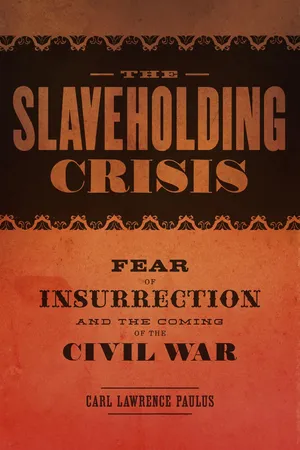
The Slaveholding Crisis
Fear of Insurrection and the Coming of the Civil War
- 326 pages
- English
- PDF
- Available on iOS & Android
eBook - PDF
About this book
Information
Subtopic
American Civil War HistoryIndex
HistoryTable of contents
- Cover
- Contents
- Acknowledgments
- Introduction: Expectations and Exceptionalism
- 1 The Haitian Revolution and Slaveholding Anxiety
- 2 “Fanaticism” and Southern Fears of Black Rebellion
- 3 Atlantic Abolitionism and American Exceptionalism
- 4 Proslavery Fear and the Rise of the Abolitionist Power
- 5 Texas Annexation and the Proslavery Promise
- 6 Wilmot’s Proviso and the Slaveholding Crisis
- 7 The Proslavery Turn against American Exceptionalism
- Epilogue: Fighting over Exceptionalism
- Notes
- Bibliography
- Index
Trusted by 375,005 students
Access to over 1.5 million titles for a fair monthly price.
Study more efficiently using our study tools.
Frequently asked questions
Yes, you can cancel anytime from the Subscription tab in your account settings on the Perlego website. Your subscription will stay active until the end of your current billing period. Learn how to cancel your subscription
No, books cannot be downloaded as external files, such as PDFs, for use outside of Perlego. However, you can download books within the Perlego app for offline reading on mobile or tablet. Learn how to download books offline
Perlego offers two plans: Essential and Complete
- Essential is ideal for learners and professionals who enjoy exploring a wide range of subjects. Access the Essential Library with 800,000+ trusted titles and best-sellers across business, personal growth, and the humanities. Includes unlimited reading time and Standard Read Aloud voice.
- Complete: Perfect for advanced learners and researchers needing full, unrestricted access. Unlock 1.5M+ books across hundreds of subjects, including academic and specialized titles. The Complete Plan also includes advanced features like Premium Read Aloud and Research Assistant.
We are an online textbook subscription service, where you can get access to an entire online library for less than the price of a single book per month. With over 1.5 million books across 990+ topics, we’ve got you covered! Learn about our mission
Look out for the read-aloud symbol on your next book to see if you can listen to it. The read-aloud tool reads text aloud for you, highlighting the text as it is being read. You can pause it, speed it up and slow it down. Learn more about Read Aloud
Yes! You can use the Perlego app on both iOS and Android devices to read anytime, anywhere — even offline. Perfect for commutes or when you’re on the go.
Please note we cannot support devices running on iOS 13 and Android 7 or earlier. Learn more about using the app
Please note we cannot support devices running on iOS 13 and Android 7 or earlier. Learn more about using the app
Yes, you can access The Slaveholding Crisis by Carl Lawrence Paulus in PDF and/or ePUB format, as well as other popular books in History & American Civil War History. We have over 1.5 million books available in our catalogue for you to explore.