In the aftermath of World War II, historical accounts and public commentaries enshrined the French Resistance as an apolitical, unified movement committed to upholding human rights, equality, and republican values during the dark period of German occupation. Valerie Deacon complicates that conventional view by uncovering extreme-right participants in the Resistance, specifically those who engaged in conspiratorial, anti-republican, and quasi-fascist activities in the 1930s, but later devoted themselves to freeing the country from Nazi control.
The political campaigns of the 1930s—against communism, republicanism, freemasonry, and the government—taught France's ultra-right-wing groups to organize underground movements. When France fell to the Germans in 1940, many activists unabashedly cited previous participation in groups of the extreme right as their motive for joining the Resistance.
Deacon's analysis of extreme-right participation in the Resistance supports the view that the domestic situation in Nazi-controlled France was more complex than had previously been suggested. Extending beyond past narratives, Deacon details how rightist resisters navigated between different options in the changing political context. In the process, she refutes the established view of the Resistance as apolitical, united, and Gaullist.
The Extreme Right in the French Resistance highlights the complexities of the French Resistance, what it meant to be a resister, and how the experiences of the extreme right proved incompatible with the postwar resistance narrative.
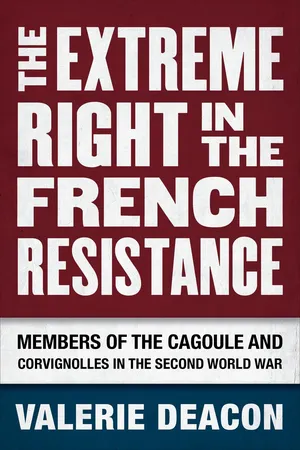
eBook - ePub
The Extreme Right in the French Resistance
Members of the Cagoule and Corvignolles in the Second World War
- 240 pages
- English
- ePUB (mobile friendly)
- Available on iOS & Android
eBook - ePub
The Extreme Right in the French Resistance
Members of the Cagoule and Corvignolles in the Second World War
About this book
Information
Subtopic
European HistoryIndex
HistoryNOTES
INTRODUCTION
1. Henry Rousso’s now very well known book The Vichy Syndrome offers an excellent introduction to these changes. For a more recent publication that deals with many of the official, or political, negotiations, see Olivier Wieviorka’s Divided Memory. For an analysis of the elaboration of resistance history by actors and historians (i.e., the historiographical construction of resistance memory), see Laurent Douzou’s La Résistance française or his edited collection Faire l’histoire de la Résistance.
2. Veillon, “Vichy Regime,” 174. Veillon goes on to encourage scholars to “identify a range of responses and behaviors, and ultimately, to sketch a typology of resistance groups and the political positions they adopted early in the struggle to free France” (174).
3. Both men and women chose such unique paths. This study focuses mostly on the men and does not attempt to tackle any of the very interesting gender analysis that could inform our understanding of both the extreme Right and the Resistance. For some additional work on the gender dynamics at play, see Deacon, “Fitting in to the French Resistance.”
4. In suggesting that we take seriously the role of the extreme Right in the Resistance and how that role was acknowledged or forgotten in the postwar years, I do not mean to throw the baby out with the bathwater. That I do not discuss the considerably larger communist resistance in this book should not be taken as a “problem of perspective.” It is simply a different history.
5. This is true too for the communists, though the Parti communiste français had only been banned since 1939. While the PCF certainly had some experience operating illegally, the cagoulards had had much more time to learn the lessons of secrecy.
6. The Action française was a monarchist and integral nationalist organization controlled for most of its existence by Charles Maurras, perhaps the Right’s most influential philosopher in the 1920s and 1930s.
7. A debate has been raging for decades about the true character of these leagues, particularly whether they represented a form of French fascism. Since it is not the goal of this work to add to that particular debate, I suggest as further reading the following: Soucy, French Fascism: The First Wave and French Fascism: The Second Wave; Rémond, Right Wing in France; Plumyène and Lasierra, Les fascismes français; and Machefer, Ligues et fascismes en France, among many others.
8. Pellissier, 6 février 1934, 320.
9. Colton, “Formation of the French Popular Front,” 12.
10. Jenkins, “Six Fevrier 1934,” 339.
11. See Millington, “February 6, 1934.”
12. Simmel, “Sociology of Secrecy,” 497.
13. See, e.g., Young, France and the Origins of the Second World War; and Young, “Preparations for Defeat.”
14. Jackson, France: The Dark Years, 113.
15. French communists had been put in an awkward position when the Soviet Union signed the Non-Aggression Pact with Germany. Though they still maintained an antiwar/national-defense line for some time, the official guidance from the Soviet Union was to advocate for an end to the war. The PCF was officially dissolved by decree on 26 September 1939.
16. Two excellent, rather different studies of pacifism in France are Ingram, Politics of Dissent; and Siegel, Moral Disarmament of France.
17. Irvine, “Domestic Politics and the Fall of France,” 91.
18. An excellent study of the exodus is Diamond, Fleeing Hitler.
19. Jackson, Fall of France, 101.
20. Sartre, Iron in the Soul, 22–23.
21. This has been shown by a number of studies, the most recent of which is Lee, Pétain’s Jewish Children, which highlights the various ambiguities in the Vichy regime in 1940–42 and the possibilities for coexistence between the regime and Jewish youth during that period. See Baruch, Servir l’état français, for a through study of the bureaucrats at Vichy and the ruptures and continuities therein.
22. Jackson, France: The Dark Years, 390.
23. The best discussion of how difficult this process was is found in Belot, La Résistance sans de Gaulle.
24. While some people deliberately left France, many others, particularly military men, found themselves in England only because of having been rescued from the shores of Dunkirk along with their British allies when they were forced to retreat.
25. Marcot, Leroux, and Levisse-Touzé, Dictionnaire historique de la Résistance, 248.
26. For more on the career of Jean Moulin, see Cordier’s three-volume Jean Moulin; and Péan, Vies et morts de Jean Moulin, among others.
27. Aglan, “Décision individuelle et discipline collective,” 339.
28. Dominique Veillon and Jacqueline Sainclivier remind us that agents who worked with these organizations were also classified according to a military hierarchy, usually using a three-class system: a P0 was an occasional agent; a P1 was an agen...
Table of contents
- Cover
- Title Page
- Copyright Page
- Contents
- Acknowledgments
- Introduction
- Historiography and Terms
- The Cagoule
- The Corvignolles
- Resistance at the Heart of Vichy
- From Vichy to Exile
- Rightist Gaullism
- Postwar Memories
- Conclusion
- Notes
- Bibliography
- Index
Trusted by 375,005 students
Access to over 1.5 million titles for a fair monthly price.
Study more efficiently using our study tools.
Frequently asked questions
Yes, you can cancel anytime from the Subscription tab in your account settings on the Perlego website. Your subscription will stay active until the end of your current billing period. Learn how to cancel your subscription
No, books cannot be downloaded as external files, such as PDFs, for use outside of Perlego. However, you can download books within the Perlego app for offline reading on mobile or tablet. Learn how to download books offline
Perlego offers two plans: Essential and Complete
- Essential is ideal for learners and professionals who enjoy exploring a wide range of subjects. Access the Essential Library with 800,000+ trusted titles and best-sellers across business, personal growth, and the humanities. Includes unlimited reading time and Standard Read Aloud voice.
- Complete: Perfect for advanced learners and researchers needing full, unrestricted access. Unlock 1.5M+ books across hundreds of subjects, including academic and specialized titles. The Complete Plan also includes advanced features like Premium Read Aloud and Research Assistant.
We are an online textbook subscription service, where you can get access to an entire online library for less than the price of a single book per month. With over 1.5 million books across 990+ topics, we’ve got you covered! Learn about our mission
Look out for the read-aloud symbol on your next book to see if you can listen to it. The read-aloud tool reads text aloud for you, highlighting the text as it is being read. You can pause it, speed it up and slow it down. Learn more about Read Aloud
Yes! You can use the Perlego app on both iOS and Android devices to read anytime, anywhere — even offline. Perfect for commutes or when you’re on the go.
Please note we cannot support devices running on iOS 13 and Android 7 or earlier. Learn more about using the app
Please note we cannot support devices running on iOS 13 and Android 7 or earlier. Learn more about using the app
Yes, you can access The Extreme Right in the French Resistance by Valerie Deacon in PDF and/or ePUB format, as well as other popular books in History & European History. We have over 1.5 million books available in our catalogue for you to explore.