In Surveying the Early Republic, Robert D. Bush contextualizes the firsthand account of Andrew Ellicott, the United States Boundary Commissioner appointed by President George Washington in 1796. Ellicott and his Spanish counterparts established the boundary line between the United States and Spanish territory in North America after the United States and Spain signed the Treaty of San Lorenzo, opening the door to navigation of the Mississippi River and the export of American goods from the Spanish-held port of New Orleans. Over the course of this multiyear surveying project (1796–1800), Ellicott found himself entangled in the politics of these frontier lands, including an insurrection by inhabitants who favored the United States against the existing Spanish regime. He also reported to his superiors on various rumors, plots, and political intrigues as well as on the secret activities of individuals in the pay of Spain, including U.S. Army General James Wilkinson.
Regrettably, the widespread acclaim that followed the publication of Ellicott's journal in 1803, a year prior to the commencement of Lewis and Clark's expedition, faded over time. In this first edited and annotated version of that journal, Bush illuminates the commissioner's day-to-day narrative of events in what later became the Mississippi Territory and thus deepens our understanding of early American expansionism. In addition, Ellicott's accounts of personalities, plots, counter-plots, and Indian affairs depict with unparalleled clarity the tumultuous diplomatic experiences faced by President John Adams's administration as it pushed the bounds of America's frontier. Bush's deft treatment of this valuable primary source provides a critical contribution to the study of the history of early America.
eBook - ePub
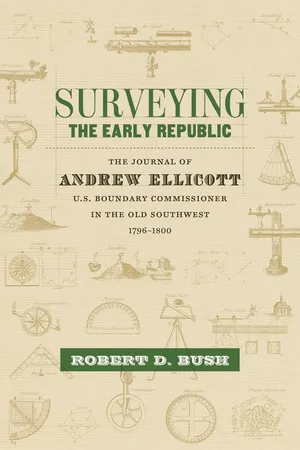
Surveying the Early Republic
The Journal of Andrew Ellicott, U.S. Boundary Commissioner in the Old Southwest, 1796-1800
- 296 pages
- English
- ePUB (mobile friendly)
- Available on iOS & Android
eBook - ePub
Surveying the Early Republic
The Journal of Andrew Ellicott, U.S. Boundary Commissioner in the Old Southwest, 1796-1800
About this book
Information
Subtopic
North American HistoryIndex
HistoryCHAPTER I.
The author leaves Philadelphia—arrives at Pittsburgh—obtains boats, and proceeds down the Ohio River to its mouth—some account of the river, adjoining country, and inhabitants.
September 16th, 1796, I took leave of my family about ten o’clock in the morning, and proceeded to Chester and dined; then rode to Wilmington and staid all night.—Thermometer was 78° in the afternoon.
17th, Left Wilmington at half past five in the morning, breakfasted at Christiana, dined at Elkton, proceeded to the Susquehannah, crossed the ferry and lodged at Havre de Grace.—Thermometer 60° in the morning, rose to 70°, fell to 62° in the evening. Autumnal squalls and showers in the afternoon—The water in the Susquehanna was 73°.
18th, Left Havre de Grace at five in the morning, breakfasted at Hartford, dined at Baltimore, lodged at my mother’s on Potapsco [Potapsco River in Maryland].—Thermometer 57° in the morning, rose to 68°.
The country from the Susquehannah to Potapsco, does not appear to be in a better state of cultivation, than it was twenty-six years ago. This disagreeable circumstance is no doubt principally owing to the system of domestic slavery, which yet continues to prevail in the southern states. Early impressions made upon the mind, and habits acquired in youth, are rarely obliterated, though condemned by daily experience.
That domestic slavery is wrong in a moral point of view is evident from the ordinary principles of justice: And that it is politically wrong may be deduced from the following facts. First, that a tract of country cultivated by slaves, is neither so well improved, rich or populous, as it would be if cultivated by the owners of the soil, and by freeman. Secondly, slaves cannot be calculated upon as adding to the strength of the community, but frequently the contrary, for reasons too obvious to detail. Notwithstanding those facts are constantly in view, they rarely produce the necessary effects upon minds early habituated to the custom of domestic slavery.1
19th, Remained at my mother’s.—Thermometer 55° in the morning, rose to 70° in the afternoon—Water in the river 57°.
20th, About 11 o’clock in the forenoon took leave of my mother, brothers and sisters, and rode to Reister’s town and got some refreshment, then proceeded about seven miles further and stayed all night.—Thermometer 51° in the morning, rose to 71°.
21st, Set out before sunrise, rode 10 miles and took breakfast, the morning was fine, and pleasant, went on to McCallester’s town and dined. The town is handsome, and appears to be improving, which is not the case with Reister’s town. The population of towns and villages, is generally very rapid till it becomes sufficient for the commerce of the surrounding country, and afterwards increases, or decreases with the general state of the improvement of the district, unless aided by something peculiarly favourable to its situation.
Left McCallester’s town at 3 o’clock in the afternoon, and rode to Oxford, where I stayed all night.—Thermometer 53° in the morning, rose to 78°.
22nd, Left Oxford before sunrise, rode twelve miles and took breakfast; and then proceeded to Shippensburgh. On the way crossed a spur of the Blue mountain, on which peaches were uncommonly plenty, and in great perfection. Dined at Shippensburgh, where I expected to meet our commissary Mr. Anderson, but found that he had not arrived.—Thermometer 63° in the morning, fell to 53° in the evening.
23rd, Walked out about half an hour before sunrise and perceived a fine hoar frost.—The thermometer was 40° on the outside of my window; but when placed on the ground among the grass it fell to 35°; it was then placed on a fence-rail which was covered with frost and fell to 34°; but upon scraping together a small quantity of the frost, and applying it to the bulb, the mercury immediately fell to 32°, because such frosts frequently appear when the thermometer stands 6 or 7 degrees above that point. This mistake must have arisen from supposing the degree of heat where the thermometer is suspended, and where the frost appears, to be the same; which upon experiment will be found not to be the case. After breakfast, walked out to the three large springs, being the principal sources of that fine stream of water passing through the town, and found water in each of them 51½°. In the afternoon the thermometer rose to 69°. The commissary not arriving, I set out about 3 in the afternoon, and rode to Strasburgh.—The water in the large spring in the town 51°.
24th, Left Strasburgh early in the morning. A very heavy hoar frost, vines, potato tops and corn leaves killed in the vallies between the mountains.2 Breakfasted at Dunn’s dined at Bird’s and stayed all night at Wild’s tavern at the foot of the Sideling Hill. Peaches in abundance along the road on the north sides of the hills. The frost the preceding night struck much more severely in the vallies, than on the mountains.—Thermometer in the morning on the outside of my window as at 35°, rose in the afternoon to 71°.
25th, Took an early breakfast, and rode to Hartley’s and dined, from thence proceeded to Ward’s and stayed all night.—Thermometer 35° in the morning, rose in the afternoon to 73°.
26th, Proceeded to the foot of the Alleghany mountain and breakfasted, ascended the mountain about 10 o’clock in the morning and proceeded to Stoy’s town and dined, then rode to Mr. Wells’ and stayed all night.—Thermometer 53° in the morning, rose to 71°, fell to 72° in the evening. The water in a good spring on the top of the mountain was 55°. The frost appeared to have fallen very partially on the mountains: in some places the vegetation was destroyed, and in others equally elevated, it was not touched.
A number of the farmers on the mountain were engaged in cutting their Buckwheat, and Oats; but Mr. Wells informed me that this was not common so late in the season. The summer on the mountain, is not sufficiently long to bring Indian corn to perfection.
27th, Left Mr. Wells’ before sunrise. A very heavy hoar frost: crossed the Laurel Hill, and took breakfast at Freeman’s tavern: crossed the Chestnut ridge, and dined at Baldrage’s [tavern]: proceeded from thence to Greensburgh, and stayed all night.—Thermometer 35° in the morning on the outside of my window; rose to 80° after crossing the Chestnut ridge.—The water, in a good spring at the base of the Laurel hill 58°, and in a spring on the west side of the Chestnut ridge 57°. It may appear singular, that the water which falls out of the west side of those mountains, should be the warmest that was examined on the road: whether it be owing to subterranean heat, or some other cause, is yet uncertain.—The coldest water in Greensburgh was 55°.3
28th, Cloudy: left Greensburgh at seven o’clock in the morning, and rode to Col. John Irwin’s and took breakfast, from then to McNair’s and dined. Left McNair’s in a heavy rain, which continued till I arrived at Pittsburgh—Thermometer 60°in the morning, rose to 68°.
The morning after my arrival at Pittsburgh I waited upon Major Craig, and found that he had two boats ready, one of them flat-bottomed, commonly called a Kentucky boat; the other a second hand keel-boat. These being insufficient he was requested to procure another, which he did in a few days, it was likewise a second hand one. After leaving Major Craig, I waited upon Col. Butler, and presented an order from the secretary of war [James McHenry] for a military escort: he gave me assurance, that the men should be ready by the time the waters were sufficiently high to descend the river. The wagons with our stores, instruments and baggage arrived on the 3rd of October.
On the 4th, I examined the state of the instruments, and found that some of them were injured by the jolting of the wagons; repaired them on the 5th. On the 6th, found the water in the Alleghany river 68°; that in the Monongahela 64°; and a few paces within the coal-pit, the temperature of the water was 51°.
On the 16th, there was a small rise of the water, and the three boats were sent off, but had not water to proceed more than three miles. On the 20th, Gen. [James] Wilkinson, and his family arrived, and he very politely gave his boat up to me; it was a second hand one, but the cabin was new and spacious. The 21st and 22nd, were spent in making some repairs to the boat, and on the 23rd, I went on board of it, and proceeded down the river to the others, and made such a distribution of the loading, that each vessel drew about the same water.
During my stay at Pittsburgh¸ the fogs were very heavy, every morning except two, and on those days we had rain.—Thermometer was at no time below 48° nor above 71°.
The town of Pittsburgh continues to improve, the situation is favourable, being on a point of land formed by the confluence of the Alleghany and Monongahela rivers, from which circumstance it enjoys a considerable trade.
24th, Got under way about 10:00 in the forenoon, but the water so low, that it was with difficulty we made eight miles.—Thermometer rose to 76°. The morning was very foggy.
25th, Left the shore at sunrise. The large boat was stopped for want of a sufficiency of water, three times in the course of the day; but by the exertions of about thirty men, she was brought along. Fog in the morning—Thermometer rose from 53° to 71°.
26th, Got under way early in the morning. The large boat was so much injured by dragging her over the stones, that the men had to keep ladling [baling] out the water all last night: proceeded with great difficulty down to a small town, opposite to the mouth of little beaver. The large boat did not arrive. Fog in the morning—Thermometer rose from 42° to 70°.
27th, The large boat arrived early in the morning, but so much injured that we had to unload her, stop the leaks and make some repaires; reloaded about 4 o’clock in the afternoon, and proceeded a short distance down the river, to get clear of the town, where some of our men got intoxicated, and behaved extremely ill. This will generally be found the case in all small, trifling villages, whose inhabitants are principally supported by selling liquor to the indiscreet and dissipated in the neighbourhood, and to the imprudent traveller. Fog in the morning—Thermometer rose from 41° to 69°.
28th, Left the shore early in the morning; the fog was so thick that when our boats were within twenty yards of each other, they could not be discovered by any of the persons on board. We made about sixteen miles this day. The water had but little motion.—Thermometer rose from 39° to 61°.
29th, Got under way very early in the morning: but little fog; the atmosphere had been so full of smoke ever since we left Pittsburgh that it was but seldom we could see the river distinctly, but it was carried off this morning by a smart north west wind.
The buildings on the river banks, except in the towns, are generally of the poorest kind, and the inhabitants who are commonly sellers of liquor, as dirty as their cabins, which are equally open to their children, poultry and pigs. This is generally the case in new settlements; the land being fresh, produces with little labour the immediate necessities of life, from this circumstance the habit of industry is diminished, and with it the habit of cleanliness.
Encamped in the evening opposite to the Mingo bottom which is rendered memorable for the inhuman murder of the Indians of that name, who resided on it, either by, or at the instigation of Capt. Cresup, Harmon Greathouse, and a few others. This outrage was followed by a war of retaliation, which continued for many years with a cruelty scarcely to be equaled in the annals of history. [Present location is Mingo Junction, Ohio, a historic site from which American militia in 1782 began their extermination of the Mingo Indians, and others presumed to be hostile.]
The evening became calm, and the atmosphere again loaded with smoke, occasioned by the dead leaves and grass, over a vast extent of the country being on fire, which during the night, illuminated the clouds of smoke and produced a variegated appearance beautiful beyond description. Our smokey weather in spring and autumn, is probably the effect of fires extending over the vast forests of our country.
Our people were much fatigued by dragging our boats over the shoals.—Thermometer rose from 39° to 57°.
30th, Detained till one o’clock in the afternoon by the commissary who was endeavouring to procure some meat; but being disappointed we proceeded down the river to Buffalo, where we were again disappointed. Buffalo is a decent village, and is situated on the east side of the river, just above the mouth of a rivulet of the same name. Left Buffalo in the evening, and proceeded about three miles and encamped. The morning was very smokey.—The thermometer rose from 30° to 51°.
31st, Our commissary went on a few miles before us, and purchased three beeves [beef], we followed between seven and eight in the morning; it was then so smokey, that we proceeded with difficulty. Encamped about four miles above Wheeling. Several of our men were indisposed with sore throats, owing probably to colds contracted from their frequent wettings.—Thermometer rose from 36° to 47°.
November 1st, About one o’clock in the morning we had a furious gale of wind; it appeared, as if nature was making an exertion to free the atmosphere from the astonishing quantity of smoke, with which it had been filled for many days. Stopped at Wheeling and took the latitude, and then proceeded to the mouth of Grave Creek and encamped. Went to view the amazing monuments of earth, thrown up many ages ago by the aborigines of the country, for some purpose unknown to us. One of those monuments [Grave Creek Mound] is more than 70 feet high: it has a cavity or depression on the top, in which a large oak tree was growing.4 The atmosphere again became smoky in the evening.—Thermometer rose from 30° to 52°.
2nd, Found that one of our soldiers had deserted after being detected in stealing liquor: made search for him but to no purpose. Got under way at ten o’clock, but our progress was much impeded by dragging our boats over the shoals. Cloudy with an appearance of rain most of the day, but cleared off in the evening. Thermometer rose from 29° to 50°.
3rd, Got under way about 7 o’clock in the morning, and continued down the river till sun down. The large boat was impeded by a strong head wind, and did not overtake us till eight o’clock in the evening. Cloudy in the morning but no fog, clear night.—Thermometer rose from 36° to 55°.
4th, Set out early in the morning, but our progress was impeded by head winds. Encamped at sunset. The large boat did not overtake us. Cloudy with thick smoke all day.—Thermometer rose from 35° to 56°.
5th, Left the shore before sunrise, and proceeded down the long reach: at the lower end of it the water was so shallow, that we were two hours employed in dragging our boats over the gravel, and then encamped. The large boat still behind. The fog was so thick in the morning, that for four hours when in the middle of the river, we could see neither shore; some appearance of rain in the evening;—Thermometer rose from 33° to 49°.
6th, Left the shore at seven o’clock in the morning.—Thermometer rose from 25° to 56°.
7th, Set off at sunrise, and arrived at Marietta about eleven o’clock in the forenoon. Unloaded the boats to stop the leaks, and make some repairs. Smoke as in the morning;—Thermometer rose from 25° to 56°.
8th, The men were employed in repairing the boats. Viewed the amazing works thrown up many ages ago by the Indians. They are the most regular of any I have seen. Some smoke and fog in the morning—Thermometer rose from 31° to 52°.
9th, Our men still employed in repairing the boats. Our large boat arrived in the evening. The smoke was so thick all day that could not see over the river. Thermometer rose from 34° to 53°.
10th, The boats were repaired, and loaded by one o’clock in the afternoo...
Table of contents
- Cover
- Title Page
- Copyright Page
- Contents
- Acknowledgments
- Editor’s Introduction
- Andrew Ellicott Chronology
- Chapter I.
- Chapter II.
- Chapter III.
- Chapter IV.
- Chapter V.
- Chapter VI.
- Chapter VII.
- Chapter VIII.
- Chapter IX.
- Chapter X.
- Appendix
- Select Bibliography
- Index
Trusted by 375,005 students
Access to over 1.5 million titles for a fair monthly price.
Study more efficiently using our study tools.
Frequently asked questions
Yes, you can cancel anytime from the Subscription tab in your account settings on the Perlego website. Your subscription will stay active until the end of your current billing period. Learn how to cancel your subscription
No, books cannot be downloaded as external files, such as PDFs, for use outside of Perlego. However, you can download books within the Perlego app for offline reading on mobile or tablet. Learn how to download books offline
Perlego offers two plans: Essential and Complete
- Essential is ideal for learners and professionals who enjoy exploring a wide range of subjects. Access the Essential Library with 800,000+ trusted titles and best-sellers across business, personal growth, and the humanities. Includes unlimited reading time and Standard Read Aloud voice.
- Complete: Perfect for advanced learners and researchers needing full, unrestricted access. Unlock 1.5M+ books across hundreds of subjects, including academic and specialized titles. The Complete Plan also includes advanced features like Premium Read Aloud and Research Assistant.
We are an online textbook subscription service, where you can get access to an entire online library for less than the price of a single book per month. With over 1.5 million books across 990+ topics, we’ve got you covered! Learn about our mission
Look out for the read-aloud symbol on your next book to see if you can listen to it. The read-aloud tool reads text aloud for you, highlighting the text as it is being read. You can pause it, speed it up and slow it down. Learn more about Read Aloud
Yes! You can use the Perlego app on both iOS and Android devices to read anytime, anywhere — even offline. Perfect for commutes or when you’re on the go.
Please note we cannot support devices running on iOS 13 and Android 7 or earlier. Learn more about using the app
Please note we cannot support devices running on iOS 13 and Android 7 or earlier. Learn more about using the app
Yes, you can access Surveying the Early Republic by Robert D. Bush in PDF and/or ePUB format, as well as other popular books in History & North American History. We have over 1.5 million books available in our catalogue for you to explore.