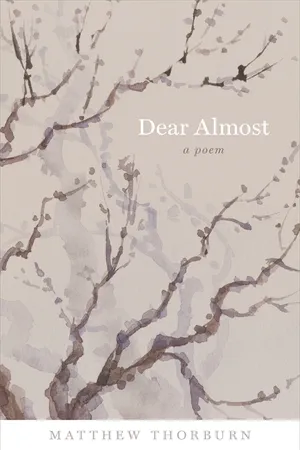
Dear Almost is a book-length poem addressed to an unborn child lost in miscarriage. Beginning with the hope and promise of springtime, poet Matthew Thorburn traces the course of a year with sections set in each of the four seasons. Part book of days, part meditative prayer, part travelogue, the poem details a would-be father's wanderings through the figurative landscapes of memory and imagination as well as the literal landscapes of the Bronx, Shanghai, suburban New Jersey, and the Japanese island of Miyajima.
As the speaker navigates his days, he attempts to show his unborn daughter "what life is like / here where you ought to be / with us, but aren't." His experiences recall other deaths and uncover the different ways we remember and forget. Grief forces him to consider a question he never imagined asking: how do you mourn for someone you loved but never truly knew, never met or saw? In candid, meditative verse Dear Almost seeks to resolve this painful question, honoring the memory of a child who both was and wasn't there.
Dusk in August— which means nearly nine o’clock here, an hour south of home, deep in the heart of central Jersey—and the deer step out to graze the backyards. They tear each yellowy red tulip cup, munch up rhododendrons and azaleas. Fifty years of new houses have eaten into their woodland, leaving only this narrow strip of trees along the trickly stream that zigzags between Route 9 and Lily’s mom’s backyard. The deer rise from the mist, hooves clicking on asphalt, a doe and a buck, his antlers like a chandelier. Sometimes a doe and two fawns. Or else we see just the white flags of their tails bobbing away into the dark. In theory the DNR should come catch them, let them go where it’s still forest, still possible to live as they were meant to. But these days there’s no money for that. And people keep leaving out old bread, rice, stale cookies, or else plant more delicious flowers. “Mei banfa,” my mother-in-law says: Nothing can be done. Seeing them in the distance—that distance we can’t close without them shying and turning and skittering down Dickinson Lane or bounding over a backyard fence— I try to imagine they’re messengers come back to tell us their stories, any news of the lost or what comes next, though if they could say anything, they would probably say, Go away.
This is the story of what’s missing, a space one can see only because we’ve filled in everything around it: keyhole I peer through to what I can’t hold, little hole in my heart where the air leaks out, little no more, no luck or way or how. I write one as if that distance softens the ache, makes it easier to know this hurt, as if one meant something other than a person who’s alone, who’s lonely. One means I’m by myself. This one is me. Autumn now
and I wish I could read you these old Chinese poems I love, which rarely use the word I (or Wo, to say it in Chinese: “Wo ai ni” means I love you, which I do). So it’s only because of an understanding built up over hundreds of years, the common warp in which the weft of each new poem was woven, that anyone who reads these poems— whether in the original Chinese like Lily’s mom or the English translations I get by on—and so hears
the last yellow leaves clinging to the black branch creak and moan as the wind sweeps through
or sees how
a swan circles the slate-gray lake, searching for her mate
knows these poems are really about Lao Wen and his own inner weather, his griefs and worries, heart- break, illness, someone dear but far from him he will never see again even though he hardly ever shows his face in them.
Dear almost—
Dear keyhole I squint through to see that other life—
Pinpoint of light that life revolves around—
Dear heart I can’t hear anymore, alone in the woods. I walk back into the past, last spring’s leaves crumbling underfoot. It’s September, deep in the season of decay and forgetting, but I want to hold on
to everything. Look how that gray squirrel socks away acorns to make it through winter. How does he remember where they’re all hidden? And above us, delicate brown nests woven into high-branching Vs, dark against the stark pale sky. Most birds make new ones each year, so these are left
to rot. They’ll be gone by spring when the birds return. They’re closing up shop. They’re packed and prepped for the long caravan south. How do they do it? “Get started,” my father would say. “Then keep
going.” This morning I don’t want to remember, it’s not in keeping with the season, which repeats what’s closest to hand like a mockingbird: let go, let go. In this cold field I keep turning over stones, looking for
what? And when I stop to answer it snags me, this hurt like a burr hooked in the haunch of a deer: I carry it with me all day. I think of you still,
so still, and not there anymore in that dark room, though I ought to know better, though I feel the tiny light I cup deep inside me gutter and go out. “It’s strange,” Lily says when I come home, “and un- satisfying, isn’t it? To hurt like this for someone
we never met?” She turns off the water, wipes her hands with the yellow towel. “But here we are, hurting for someone we never met.” I think what we’ve lost
is imagination—the soft glimmer of possibility, that hum in the belly (this part I don’t say out loud), the lightness I remember feeling each day during that little while when sarcasm and irony and even the last bit of bitterness had all fallen away so that it felt like gravity had been dialed down just for us.
Would music scare off deer? “Works on bad boys,” says Harry Chu. At the Wawa on Wickatunk Road, Harry cranks up the classics to keep teens from hanging out out front. “Loiterers.” They used to drop cigarette butts, soda cans, crinkly bits of shiny cellophane. “Bad for business.” But now it’s me
who lingers, windows down, foot on the brake, to hear the wavery sigh of the erhu over the rush of passing cars, snow sliding off pine boughs as “...
Table of contents
Cover
Title Page
Copyright Page
Dedication
Contents
Once in Early Spring
The Light that Lasts All Summer
Three Deer Beneath the Autumn Moon
The Day Winter Gives Way
Notes and Acknowledgements
Trusted by 375,005 students
Access to over 1.5 million titles for a fair monthly price.
Study more efficiently using our study tools.
Frequently asked questions
Yes, you can cancel anytime from the Subscription tab in your account settings on the Perlego website. Your subscription will stay active until the end of your current billing period. Learn how to cancel your subscription
No, books cannot be downloaded as external files, such as PDFs, for use outside of Perlego. However, you can download books within the Perlego app for offline reading on mobile or tablet. Learn how to download books offline
Perlego offers two plans: Essential and Complete
Essential is ideal for learners and professionals who enjoy exploring a wide range of subjects. Access the Essential Library with 800,000+ trusted titles and best-sellers across business, personal growth, and the humanities. Includes unlimited reading time and Standard Read Aloud voice.
Complete: Perfect for advanced learners and researchers needing full, unrestricted access. Unlock 1.5M+ books across hundreds of subjects, including academic and specialized titles. The Complete Plan also includes advanced features like Premium Read Aloud and Research Assistant.
Both plans are available with monthly, semester, or annual billing cycles.
We are an online textbook subscription service, where you can get access to an entire online library for less than the price of a single book per month. With over 1.5 million books across 990+ topics, we’ve got you covered! Learn about our mission
Look out for the read-aloud symbol on your next book to see if you can listen to it. The read-aloud tool reads text aloud for you, highlighting the text as it is being read. You can pause it, speed it up and slow it down. Learn more about Read Aloud
Yes! You can use the Perlego app on both iOS and Android devices to read anytime, anywhere — even offline. Perfect for commutes or when you’re on the go. Please note we cannot support devices running on iOS 13 and Android 7 or earlier. Learn more about using the app
Yes, you can access Dear Almost by Matthew Thorburn in PDF and/or ePUB format, as well as other popular books in Literature & Poetry. We have over 1.5 million books available in our catalogue for you to explore.