Two Civil Wars is both an edition of an unusual Civil War--era double journal and a narrative about the two writers who composed its contents. The initial journal entries were written by thirteen-year-old Celeste Repp while a student at St. Mary's Academy, a prominent but short-lived girls school in midcentury Baton Rouge. Celeste's French compositions, dating from 1859 to 1861, offer brief but poignant meditations, describe seasonal celebrations, and mention by name both her headmistress, Matilda Victor, and French instructor and priest, Father Darius Hubert.
Immediately following Celeste's prettily decorated pages a new title page intervenes, introducing "An Abstract Journal Kept by William L. Park, of the U.S. gunboat Essex during the American Rebellion." Park's diary is a fulsome three-year account of military engagements along the Mississippi and its tributaries, the bombardment of southern towns, the looting of plantations, skirmishes with Confederate guerillas, the uneasy experiment with "contrabands" (freed slaves) serving aboard ship, and the mundane circumstances of shipboard life. Very few diaries from the inland navy have survived, and this is the first journal from the ironclad Essex to be published. Jeffrey has read it alongside several unpublished accounts by Park's crewmates as well as a later memoir composed by Park in his declining years. It provides rare insight into the culture of the ironclad fleet and equally rare firsthand commentary by an ordinary sailor on events such as the sinking of CSS Arkansas and the prolonged siege of Port Hudson.
Jeffrey provides detailed annotation and context for the Repp and Park journals, filling out the biographies of both writers before and after the Civil War. In Celeste's case, Jeffrey uncovers surprising connections to such prominent Baton Rouge residents as the diarist Sarah Morgan, and explores the complexity of wartime allegiances in the South through the experiences of Matilda Victor and Darius Hubert. She also unravels the mystery of how a southern youngster's school scribbler found its way into the hands of a Union sailor. In so doing, she provides a richly detailed picture of occupied Baton Rouge and especially of events surrounding the Battle of Baton Rouge in August 1862.
These two unusual personal journals, linked by curious happenstance in a single notebook, open up intriguing, provocative, and surprisingly complementary new vistas on antebellum Baton Rouge and the Civil War on the Mississippi.
eBook - ePub
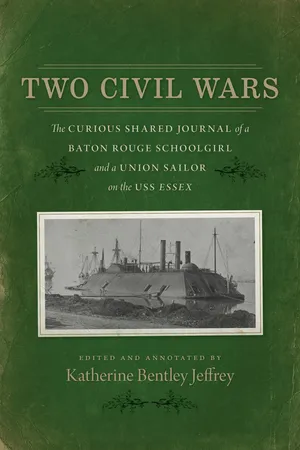
Two Civil Wars
The Curious Shared Journal of a Baton Rouge Schoolgirl and a Union Sailor on the USS Essex
- 296 pages
- English
- ePUB (mobile friendly)
- Available on iOS & Android
eBook - ePub
Two Civil Wars
The Curious Shared Journal of a Baton Rouge Schoolgirl and a Union Sailor on the USS Essex
About this book
Information
Subtopic
American Civil War HistoryIndex
HistoryAPPENDIX 1
William Porter’s Farewell Speech to the Crew of USS Essex
Commodore W. D. Porter, Address to the Crew of the Essex at New Orleans, September 9, 1862*
Men of the Essex:
We have now been associated together on board this vessel very near one year, and during that period you have been successfully engaged with the Enemy in six hard-fought battles. Your first achievement was with four of the craven Rebel gun-boats of vastly superior force, in Lucas Bend, all of which were disabled and driven below the batteries of Columbus. Your next achievement was at Fort Henry where you led the way and by your prowess and valor caused the surrender of that stronghold in the short space of one hour and ten minutes. At the time the Essex attacked Fort Henry she could scarcely be called an Iron clad boat. The ports were large and unprotected, and the Boilers exposed, and although fourteen were wounded to death and 24 wounded by steam and scalding waters, you were ready at your guns for action before the surrender of the fort. This Battle was one of the most important of the war, for up to that time our forces could scarcely say they had gained a victory. You by your valor, turned the tide of defeat and gave confidence to the country.
For a short period the ship was under external repairs and a large portion of this crew participated in the victories of Donaldson, Columbus, Island No. 10, Fort Pillow, and Memphis. When your old and tried ship became fully equipped you joined her at Cairo, and with your old and tried associates entered on a new field of operations. Vicksburg felt your prowess, and while your country lasts you will be gratefully remembered for your daring and courage at that time. The crowning effort of your courage is yet to be related.
For months the rebels had been building with great care a gun boat and ram up the Yazoo River. This vessel, when finished, successfully encountered and cut up three of the fleet, passed in safety two powerful fleets and took shelter under the batteries of Vicksburg. Here she stood the fire of a large fleet and escaped unhurt. The Essex ran past this heavy fort and attacked her. This, too, she stood without much injury. You were next battling away at the enemy before Baton Rouge. On the 6th of August you fought this noted Arkansas and after an action of half an hour destroyed this formidable vessel for which act you have received, through the Honorable Secretary of the Navy, the thanks of the Country and the Department. I have now to speak of one more of your feats of courage and chronicle again your valor; it is the attack on and successfully passing a battery of 35 guns at Port Hudson.1
Having now detailed your gallant conduct it becomes my painful task to bid you that painful word, Good-bye, and I sincerely hope you may prove the old Iron sided Essex as good a ship under your present commander as you did under the (old)
W. D. Porter
APPENDIX 2
Additional Naval Records and Correspondence Copied into the Park Journal
William Park’s inclusion of official documents—gathered retrospectively and copied into his journal—is, somewhat surprisingly, limited to 1862, when Essex was under the command of William D. Porter. These include documents pertaining to: the engagement at Lucas Bend; the first encounter of Essex with the Confederate ram Arkansas off Vicksburg; the destruction of Arkansas near Baton Rouge; the bombardment of Bayou Sara and Natchez by Essex; and the successful passage of Anglo-American, under Essex officer R. K. Riley, past the batteries of Port Hudson. There are also two records related to Pittsburg, the vessel to which Park was transferred during the spring of 1862. These include the successful attack on Fort Donelson and the running of the batteries at Island No. 10. Though his principle of selection is unclear, one assumes these are events of particular significance or pride in Park’s memory of that first year; his omission of the Battle of Fort Henry, given its horrors—especially the loss of his friend Andrew Waterman and other shipmates—is perhaps understandable.
These records follow immediately after the conclusion of Park’s journal, with one blank page intervening; the titles are all as they appear in his text.

Copy of Official Reports to Secretary of the Navy U.S. Gunboat Essex, Jan. 13th 1862
Sir: On the morning of the 11th General McClernand sent on board this vessel, and informed me that the enemy were moving up the river from Columbus with several vessels, towing up a battery. I immediately signaled Lieutenant Commanding Paulding of the St. Louis to get under weigh and prepare for action. A very thick fog coming on, we were compelled to steam slowly down the river, but about 10 o’clock or a little after, it rose, and showed us a large steamer at the head of Lucas Bend. We heard her whistle the moment we were seen by them. Shortly after whistling she was joined by another large and a small steamer. We pursued our course steadily down the river, and when within long range the large steamer fired a heavy shell gun, which struck the sand bar between us, and ricocheted within about two hundred yards of this vessel and burst. We at this time did not return the fire, but continued our course down in order to near the vessel. By this time the large steamer was joined by her consorts, and they opened a brisk fire upon us. I now hailed Lieutenant Commanding Paulding, and directed him to try one of his rifle cannons. He instantly fired, and sent his shots completely over the enemy. I then opened from my bow guns, and the action became brisk on both sides for about twenty minutes, the enemy firing by broadsides. This running fight continued until he reached the shelter of his batteries on the Iron bank above Columbus. We continued the action and drove him behind their batteries in a crippled condition, as we could distinctly see our shell explode on his decks. The action lasted over an hour, and terminated, as I think, in a complete defeat of the enemy’s boats, superior in size and number of guns to the Essex and St. Louis. The fire of the St. Louis was precise, and the shots told well. The officers and men of this vessel behaved with firmness—Mr. Riley, our First Master, carrying out all my orders strictly, while the officers of the gun divisions, Messrs. Lanning and Ferry paid particular attention to the pointing of their respective guns. Mr. Brittain, my aid, paid all attention to my orders and conveyed them correctly and with alacrity.1 In fact, all the officers and men on board behaved like veterans.
I have the honor to be, etc.
W. D. Porter, Commander
TO A. H. FOOTE
Extract from Commodore Foote’s report of attack on Fort Donelson Flag Ship St. Louis. February 15th 1862
Sir: I have the honor to report to the department that, at the urgent request of Major General Halleck and General Grant, who regarded the movement as a military necessity, although not, in my opinion, properly prepared, I made an attack on Fort Donelson yesterday, the 14th instant, at 3 o’clock P.M. with four ironclads and two wooden gunboats, the St. Louis, Carondelet, Louisville, and Pittsburgh, and the Taylor and Conestoga: after a severe fight of an hour and a half, being in the latter part of the action less than four hundred yards from the fort, the wheel of this vessel, by a shot through the pilot house, was carried away; the tiller ropes of the Louisville were also disabled by a shot, which rendered the two boats wholly unmanageable, and they drifted down the river, the relieving tackles not being able to steer or control them in the rapid current. The two remaining boats, the Pittsburgh and Carondelet, were also greatly damaged between wind and water, and soon followed us as the enemy rapidly renewed the fire as we drifted helplessly down the river. This vessel, the St. Louis, alone received fifty-nine shots, four of them between wind and water; one in the pilot house, mortally wounding the pilot; and others requiring some time to put her in repair. There were fifty-four killed and wounded in this attack, which, notwithstanding our disadvantages, we have every reason to suppose would, in fifteen minutes more, could the action have been continued, have resulted in the capture of the two forts bearing upon us. The enemy’s fire had materially slackened, and he was running from his batteries, when the two gunboats helplessly drifted down the river from disabled steering apparatus, as the relieving tackles could not control the helm in the strong current, when the fleeing enemy returned to their guns and again boldly reopened fire upon us from the river batteries which we had silenced.
The enemy must have brought over twenty heavy guns to bear upon our boats from the water batteries and the main fort on the side of the hill, while we could only return the fire with twelve bow guns from the four boats. One rifle gun aboard the Carondelet burst during the action. The officers and men in this hotly contested but unequal fight behaved with the greatest gallantry and determination, all deploring the accident which rendered two gunboats suddenly helpless in the narrow river and swift current.
Very respectfully, your
obedient servant,
A. H. Foote
obedient servant,
A. H. Foote
TO HON. GIDEON WELLES
(Copy) Navy department, April 12th 1862
Sir: The department desires you to convey to Commander Henry Walke and the officers and men of the Carondelet, also to Acting First Master Hoel of the Cincinnati, who volunteered for the occasion, its thanks for the gallant and successful service rendered in running the Carondelet past the rebel batteries on the night of the 4th instant. It was a daring and heroic act, well executed, and deserving of special recognition.
Commendation is also to be extended to the officers and crew of the Pittsburgh, who in like manner on the night of 6th instant performed a similar service. These fearless acts dismayed the enemy, enabled the army under General Pope to cross the Mississippi and eventuated the surrender to yourself of Island No. 10, and finally in the capture, by General Pope, of the forts on the Tennessee shore, and the retreating rebels under General Mackall.
I would also, in this connection, render the acknowledgements which are justly due the officers and crew of the several boats who, in conjunction with the detachment of the Forty-Second Illinois regiment, under Colonel Roberts, captured the first rebel battery and spiked the guns on Island No. 10 on the night of the 1st instant. Such services are duly appreciated by the department, which extends its thanks to all who participated in the achievements.
I am, respectfully, your obedient servant,
Gideon Welles
TO A. H. FOOTE
U.S. Gunboat Essex. Below Vicksburg, July 22nd 1862
Sir: I have the honor to inform you of the arrival of this ship below Vicksburg, Mississippi, and that we lost one man killed and two wounded.
I delivered several shots into the rebel ram Arkansas, as I believe, with effect. I endeavored to strike her, but, as we approached they let go her bow lines and the current drifted her stern on. The consequence was this vessel only grazed her side, and ran, with great force, high on the bank, where she lay at least ten minutes, subject to a terrible fire from the shore batteries.
I am very respectfully, your obedient servant,
W. D. Porter, Commander
TO: CAPTAIN C. H. DAVIS
U.S. Gunboat Essex Off Baton Rouge August 6th 1862
Sir: On the evening of the 4th instant I was informed by General Williams that the rebels, in considerable force, under General Breckinridge, were moving on this place. The rebel ram Arkansas, with two gunboats the Webb and Music, were also in the vicinity of the city to support the attack of the rebel army. I made such a disposition of the naval force under ...
Table of contents
- Cover
- Title Page
- Copyright Page
- Dedication
- Contents
- List of Maps and Illustrations
- Preface and Acknowledgments
- Introduction
- The Celeste Repp Journal (1859–1861)
- The William Park Journal (1861–1864)
- Abstract Journal Kept by William L. Park
- Afterword: The Wake of War
- APPENDIX 1: William Porter’s Farewell Speech to the Crew of USS Essex
- APPENDIX 2: Additional Naval Records and Correspondence Copied into the Park Journal
- APPENDIX 3: William Park’s “Abstract Journal” Compared with His Later, Amplified Memoir
- Bibliography
- Index
Trusted by 375,005 students
Access to over 1.5 million titles for a fair monthly price.
Study more efficiently using our study tools.
Frequently asked questions
Yes, you can cancel anytime from the Subscription tab in your account settings on the Perlego website. Your subscription will stay active until the end of your current billing period. Learn how to cancel your subscription
No, books cannot be downloaded as external files, such as PDFs, for use outside of Perlego. However, you can download books within the Perlego app for offline reading on mobile or tablet. Learn how to download books offline
Perlego offers two plans: Essential and Complete
- Essential is ideal for learners and professionals who enjoy exploring a wide range of subjects. Access the Essential Library with 800,000+ trusted titles and best-sellers across business, personal growth, and the humanities. Includes unlimited reading time and Standard Read Aloud voice.
- Complete: Perfect for advanced learners and researchers needing full, unrestricted access. Unlock 1.5M+ books across hundreds of subjects, including academic and specialized titles. The Complete Plan also includes advanced features like Premium Read Aloud and Research Assistant.
We are an online textbook subscription service, where you can get access to an entire online library for less than the price of a single book per month. With over 1.5 million books across 990+ topics, we’ve got you covered! Learn about our mission
Look out for the read-aloud symbol on your next book to see if you can listen to it. The read-aloud tool reads text aloud for you, highlighting the text as it is being read. You can pause it, speed it up and slow it down. Learn more about Read Aloud
Yes! You can use the Perlego app on both iOS and Android devices to read anytime, anywhere — even offline. Perfect for commutes or when you’re on the go.
Please note we cannot support devices running on iOS 13 and Android 7 or earlier. Learn more about using the app
Please note we cannot support devices running on iOS 13 and Android 7 or earlier. Learn more about using the app
Yes, you can access Two Civil Wars by Katherine Bentley Jeffrey in PDF and/or ePUB format, as well as other popular books in History & American Civil War History. We have over 1.5 million books available in our catalogue for you to explore.