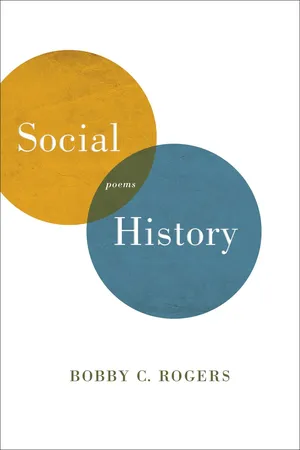
Bobby C. Rogers's second collection, Social History, listens hard to the voices of American characters and celebrates the gestures of ordinary life. The long lines of his narrative poems trace the undulations of southern speech, and his careful eye for detail reflects the influence of generations of storytellers, from authors like Robert Penn Warren and Eudora Welty to Rogers's own distant family members, living in "decrepit houses where the floors sagged and the front rooms reeked/of snuff, bitter as the smell off a pile of clods beside an open grave, the scent of time that hadn't succeeded in passing."
In his beguiling evocations of the past, Rogers looks back with affection to the rhythms and rituals of growing up in small-town Tennessee. While his poems speak of a living connection to community and to the earth, they also acknowledge the growing need to question what we have been taught and to break free and make our own way in this world. Graceful and plainspoken, the poems of Social History bear witness to ways of living that, though past, are never truly lost.
- 70 pages
- English
- ePUB (mobile friendly)
- Available on iOS & Android
eBook - ePub
About this book
Information
Subtopic
PoetryIndex
LiteratureCONTENTS
Lost Highway
Body Man
A Book by Its Cover
Abandoned Homesite in a Field
Smokers, Sunday Morning, 1975
Elizabeth Patton, Wife of Davy Crockett
The Principal’s Son
Meditation on Door Slams
The Common Sense Book of Baby and Child Care
Junk
Purple Martin Village
Farm Portrait
Featured Twirler
Regarding Symbols
A Hundred and One Affordable House Plans
September
I Will Not Talk in Class
Primitive Baptist
Social History
Americana
Elegy for George Garrett
All-American Cheerleader Sandi Sentell Stands in Line outside Alumni Gym before a Lecture by Gloria Steinem
Theology
Essay on Friendship
His Mark
Old Theater Ticket Found in the Pages of René Char’s Selected Poems
Interesting Case
Spit and Polish
Spring Recital, Beethoven Club, Memphis, Tenn.
Rooms with Radiators
National Association of Intercollegiate Athletics (NAIA) Hall of Fame Coach Jack Russell Makes a Visit to the Mound
Last Words
Salvage Yard in Mississippi
Girl Flagman on Highway 45
Fourth Grade Field Trip, Elmwood Cemetery
Rain Crow
Second Row at the Ballet
William Eggleston
Acknowledgments
Lost Highway
you’ll curse the day . . .
—Hank Williams
—Hank Williams
Years after the fact, he would say it was the right time to make a move when he
was invited to come into the bank, but he could see his ascent
was invited to come into the bank, but he could see his ascent
blocked by the bank president’s son, a man his very age and already groomed to
rise. So he clung to the safe job. Too late to take anything back
rise. So he clung to the safe job. Too late to take anything back
the day the news came that the banker’s son had died of a heart attack at the
mahogany desk in his father’s office. If our fates are fitted neatly
mahogany desk in his father’s office. If our fates are fitted neatly
into the pans of a scale, it might have been anything that tipped the balance, any
wrong turn or luckless cut of the cards, something as unlikely, even,
wrong turn or luckless cut of the cards, something as unlikely, even,
as losing the autograph—Elvis Presley coming down the driveway of Graceland in
1958, braking a showroom clean Duo-Glide Harley
1958, braking a showroom clean Duo-Glide Harley
next to the cranked down window of his just as shiny Chevy Bel-Air, twenty-four
payment slips left in the loan book. The singer called him sir,
payment slips left in the loan book. The singer called him sir,
wrote out an autograph and handed the scrap of paper to his wife, six-months
pregnant with their first child, the sweet ending of a spring day spent
pregnant with their first child, the sweet ending of a spring day spent
shopping and sightseeing before the hour-long drive back to their teaching jobs in
a crossroads town hardly big enough to have use for a school.
a crossroads town hardly big enough to have use for a school.
Or when he was a boy, keeping still under a sweat-soured quilt, trying to hide
from the polio virus settled in one leg’s large muscles, the afternoon
from the polio virus settled in one leg’s large muscles, the afternoon
of his highest fever, and through the unscreened window he could hear his parents
reaching a decision on where to bury him. Might as well say
reaching a decision on where to bury him. Might as well say
it all turned on the morning he was born, piercing the room with his first cried out
description of what had befallen him, and every time
description of what had befallen him, and every time
the wind nudged at the curtains, the room’s shadows gave shape to a ragged patch
of sunlight shifting its restless edges on the floorboards.
of sunlight shifting its restless edges on the floorboards.
Body Man
Billy Twiggs was an artist with a spray gun but could never paint sober. My father
had no sympathy for a drunk—if Billy wanted the work
had no sympathy for a drunk—if Billy wanted the work
he’d have to pull the dent from the driver’s side door before he took his first toddy
of the day. “I’ll give her a try,” Billy’d told him,
of the day. “I’ll give her a try,” Billy’d told him,
and I wondered if every artist looked this beleaguered of a morning. The dent was
my doing, the first of a million mistakes
my doing, the first of a million mistakes
it was up to me to make right, a sixteen-year-old wild at the wheel of the family
Ford. Billy did his prep work under a shade tree. The rotting roof
Ford. Billy did his prep work under a shade tree. The rotting roof
of the shed he used for a spray room sagged like a tent canvas. When the car rolled
out again, it was only up close that you could see
out again, it was only up close that you could see
each shaky pass of the paint gun, a grainy texture to the finish. Billy was all I could
afford. God knows what he aimed to fix
afford. God knows what he aimed to fix
self-medicating with Ten High bourbon and RC Cola, but that’s a repair that won’t
last long. A few years later I took my own car to him
last long. A few years later I took my own car to him
after a nearsighted neighbor put a crease down it with her Buick on a narrow
residential street in Memphis. Billy was still the best
residential street in Memphis. Billy was still the best
body man in that end of the state if you caught him at the right time of day, and the
cheapest. What’s on the surface is all
cheapest. What’s on the surface is all
we’ll ever lay hands on. Impossible to match the faded paint of a hard-driven
automobile but his eye could get it close. I wasn’t about to tell a man
automobile but his eye could get it close. I wasn’t about to tell a man
how to do his job. I’d held a few jobs by then and knew that to stay on the payroll
you had to find a way to keep getting the work done. The quarter panel
you had to find a way to keep getting the work done. The quarter panel
he mended looked like it’d been factory dipped, so new again and so beautiful how
could it ever blister or check? He was weaving a little
could it ever blister or check? He was weaving a little
in his walk but it was his hands that did the fixing, and they were still steady when
I paid him with teller machine twenties, counting out
I paid him with teller machine twenties, counting out
more than he’d asked for, a fair enough price to slow the rust for another year, until
the transmission went and I sold the car for scrap.
the transmission went and I sold the car for scrap.
A Book by Its Cover
Forty miles to a bad bookstore from my hometown. Calendars and coffee table
books, Rod McKuen and The Collected Poems
books, Rod McKuen and The Collected Poems
of Robert Frost. I was barely in high school and the teachers couldn’t tell just by
looking at me which book was going to change my life, years yet
looking at me which book was going to change my life, years yet
before I packed up and went away to pan the silt of a college professor’s opinions,
always a stack of titles and subtitles
always a stack of titles and subtitles
under “For Further Reading” on the back page of a purple-mimeographed
syllabus. Word got around about the box of rescued books
syllabus. Word got around about the box of rescued books
where my mother worked, rejects saved from the shredder by someone’s husband
who ran a press at Hall Printing Company, a pile of mis-cut
who ran a press at Hall Printing Company, a pile of mis-cut
romance novels with offset covers, mass market...
Table of contents
- Cover
- Title Page
- Copyright Page
- Dedication
- Contents
- Lost Highway
- Body Man
- A Book by Its Cover
- Abandoned Homesite in a Field
- Smokers, Sunday Morning, 1975
- Elizabeth Patton, Wife of Davy Crockett
- The Principal’s Son
- Meditation on Door Slams
- The Common Sense Book of Baby and Child Care
- Junk
- Purple Martin Village
- Farm Portrait
- Featured Twirler
- Regarding Symbols
- A Hundred and One Affordable House Plans
- September
- I Will Not Talk in Class
- Primitive Baptist
- Social History
- Americana
- Elegy for George Garrett
- All-American Cheerleader Sandi Sentell Stands in Line outside Alumni Gym before a Lecture by Gloria Steinem
- Theology
- Essay on Friendship
- His Mark
- Old Theater Ticket Found in the Pages of René Char’s Selected Poems
- Interesting Case
- Spit and Polish
- Spring Recital, Beethoven Club, Memphis, Tenn.
- National Association of Intercollegiate Athletics (NAIA) Hall of Fame Coach Jack Russell Makes a Visit to the Mound
- Last Words
- Salvage Yard in Mississippi
- Girl Flagman on Highway 45
- Fourth Grade Field Trip, Elmwood Cemetery
- Rain Crow
- Second Row at the Ballet
- William Eggleston
- Acknowledgments
Trusted by 375,005 students
Access to over 1.5 million titles for a fair monthly price.
Study more efficiently using our study tools.
Frequently asked questions
Yes, you can cancel anytime from the Subscription tab in your account settings on the Perlego website. Your subscription will stay active until the end of your current billing period. Learn how to cancel your subscription
No, books cannot be downloaded as external files, such as PDFs, for use outside of Perlego. However, you can download books within the Perlego app for offline reading on mobile or tablet. Learn how to download books offline
Perlego offers two plans: Essential and Complete
- Essential is ideal for learners and professionals who enjoy exploring a wide range of subjects. Access the Essential Library with 800,000+ trusted titles and best-sellers across business, personal growth, and the humanities. Includes unlimited reading time and Standard Read Aloud voice.
- Complete: Perfect for advanced learners and researchers needing full, unrestricted access. Unlock 1.5M+ books across hundreds of subjects, including academic and specialized titles. The Complete Plan also includes advanced features like Premium Read Aloud and Research Assistant.
We are an online textbook subscription service, where you can get access to an entire online library for less than the price of a single book per month. With over 1.5 million books across 990+ topics, we’ve got you covered! Learn about our mission
Look out for the read-aloud symbol on your next book to see if you can listen to it. The read-aloud tool reads text aloud for you, highlighting the text as it is being read. You can pause it, speed it up and slow it down. Learn more about Read Aloud
Yes! You can use the Perlego app on both iOS and Android devices to read anytime, anywhere — even offline. Perfect for commutes or when you’re on the go.
Please note we cannot support devices running on iOS 13 and Android 7 or earlier. Learn more about using the app
Please note we cannot support devices running on iOS 13 and Android 7 or earlier. Learn more about using the app
Yes, you can access Social History by Bobby C. Rogers in PDF and/or ePUB format, as well as other popular books in Literature & Poetry. We have over 1.5 million books available in our catalogue for you to explore.