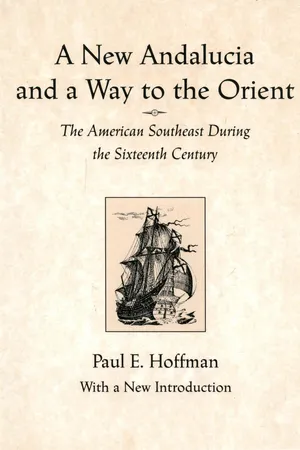
Paul E. Hoffman's groundbreaking book focuses on a neglected area of colonial history -- southeastern North America during the sixteenth-century. Hoffman describes expeditions to the region, efforts at colonization, and rivalries between the French, Spanish, and English. He reveals the ways in which the explorers' expectations -- fueled by legends -- crumbled in the face of difficulties encountered along the southeastern coast. The first book to link the earliest voyages with the explorations of the sixteenth century and the settlement of later colonies, Hoffman's work is an important reassessment of southern colonial history.
eBook - ePub
A New Andalucia and a Way to the Orient
The American Southeast During the Sixteenth Century
- 376 pages
- English
- ePUB (mobile friendly)
- Available on iOS & Android
eBook - ePub
A New Andalucia and a Way to the Orient
The American Southeast During the Sixteenth Century
About this book
Information
Topic
HistoriaSubtopic
Historia americana tempranaPART ONE
—————
The Spaniards and a New Andalucia
I
————
The Chicora Legend Created, 1521–1523
Pedro de Quejo was later to claim that he was the first to spot the thin dark line of land on the western horizon in the early hours of Monday morning, June 24, 1521, the day of the feast of Saint John the Baptist.1 Elated but mindful of his agreement with Francisco Gordillo, who commanded the caravel that was sailing some distance astern, Quejo ordered his sails luffed so that the other ship, an older, slower sailer badly in need of a careening, might catch up and learn the good news.2 By the time it had drawn abeam, however, Gordillo’s lookouts had also spotted the land. Exchanging the exciting news, both captains laid a course to the west.
Quejo’s caravel reached the coast first, just off the mouth of what he described as a river. Anchoring, he waited half an hour for his partner to come up and anchor. That done, the boats were let down into the sea, and landing parties were sent off to a beach. Twenty men from the crews went ashore before the commanders decided to move their ships into the comparative safety of the river. Sounding, they felt their way over the bar into what we know as the South Santee River (Map 1).
While the ships were being moved, the men on the beach encountered a group of Indians whose curiosity had drawn them from their village (or fishing camps?) along the river delta’s shores. The landing party made peace with them by giving presents from among the few items of clothing they carried.3
Such is the story Quejo told. Peter Martyr recounts the events of that morning a bit differently in the seventh decade of his De Orbe Novo.4 As he heard the story from the licenciado Lucas Vázquez de Ayllón, of whom more later, the Indians rushed to the edge of the sea, pushing and shoving one another in their excitement to see what the “monsters” were and to look at the men coming ashore in the boats. As soon as the Spaniards landed, the Indians fled, but the Spaniards ran after them. Some younger seamen sprinted ahead of their fellows and managed to catch a man and a woman, whom they took back to the boats. There the sailors dressed the captives in Spanish clothing, probably shirts and headcloths, attempted to convey by signs a desire to be friends, and then let them go. The Indians went to where the rest of their number had hidden and by showing off the new clothes induced them to return to the shore. There more Spanish clothing was given to the Indians, who soon went back to their village and showed the kerchiefs (paños de cabeza), linen shirts, and marvelous red caps (gorras) to their chief.5 He sent the Spaniards fifty of his servants (familiares), carrying native foods. These last scenes were what Quejo noticed and described.
All the Spaniards must have appreciated the importance of discovering what to them was a previously unknown land north of the Bahama Islands. But none could have known that their reports about this land would plant the seed for one of the more important, if neglected, legends connected with North American exploration. Relocated and worked upon by men’s imaginations until the discovery assumed the form of a new Andalucia flowing with milk and honey, not to mention laden with pearls, gold, silver, wine grapes, and olives, it was to spawn a legend that, together with another legend about the continent born three years later, would motivate Spaniards, Frenchmen, and Englishmen to explore and attempt to colonize the coast of North America between the latitudes of 32° and 39° north.
The Quejo-Gordillo voyage began as two separate ventures that merged in the Bahamas. Both had slaving as their objective. Each was commanded by a pilot and shipmaster with long experience in the Caribbean and in the Bahama Islands.
For some years Quejo had worked as a pilot and shipmaster for Sancho Ortiz de Urrutía, a merchant born in Gordejuela, Vizcaya. Ortiz de Urrutía had first come out to Española about 1512 accompanying his perhaps distant kinsman the licenciado Juan Ortiz de Matienzo, judge (oidor) of the royal audiencia, whose partner he had been in earlier ventures.6 Most of Quejo’s sailing experience seems to have been in the greater Antilles in connection with trading.
Gordillo was an experienced pilot and slave trader. He had visited Babacoa (or Habacoa) Island, the Bahamas—modern Andros Island—during 1514–1517 as the agent of Ayllón and his occasional business associates, among others the licenciado Juan de Bezerra, Ayllón’s father-in-law and a powerful land and mine owner on Española; Lope de Bardeci, a native of Palencia, in Spain, who represented many of the Italian firms doing business in the Antilles; and Juan de Manzorro, a member of the powerful Manzorro clan of Española. That expedition, and another fitted by some of the same men and directed by a Captain Toribio de Villafranca, had rounded up as many as nine hundred Indians, over half of whom died in pens in the Bahamas while awaiting supplies and ships so that they could be taken to Española for sale.7
In April or May, 1521, Urrutía again hired Quejo to pilot a ship, in which Urrutía planned to take merchandise to Cuba. Once that was accomplished, he intended to use a license granted by the son of Christopher Columbus, Diego Colón, admiral of the ocean sea and governor of Española from 1509 to 1527, to go to the Bahamas to hunt for slaves.8 Clearing Santo Domingo late in May, they sailed to Cuba and then back to La Yaguana, Española (near modern Léogane), where they unloaded part of the cargo and left Urrutía. At La Yaguana, Urrutía gave Quejo his power of attorney for all matters during the rest of the voyage, in a transfer of authority common between owners and shipmasters.
Departing from La Yaguana, Quejo sailed to Baracoa, Cuba, where he completely unloaded his ship and then put aboard a quantity of cazabi bread (bread made from flour prepared from cassava roots) and possibly other supplies as well. A large dugout canoe was also obtained for use as a tender. Quejo left Baracoa for the Bahamas about June 10. His plan seems to have been to take advantage of the waxing moon, which would be full on June 19, to aid navigation in the waters and reefs of the Bahamas.9
Gordillo’s voyage seems to have begun in late January or in February, 1521. Ayllón and Diego Cavallero, secretary of the audiencia, also had a license from Governor Colón, which they claimed later was not only for slaving but also, and more important, for exploration and discovery. According to Cavallero, Ayllón had heard of a discovery made by Captain Pedro de Salazar, a slave raider who had been in the employ of Ayllón’s fellow judge and occasional business partner, the licenciado Marcelo de Villalobos. Sometime between 1514 and 1516, Salazar had found land at a place to the northwest of the Bahama Islands.10 Ayllón intended that Gordillo should check Salazar’s report, but apparently only if he failed to find Indians in the Bahamas. Salazar had brought Indians of “giant” stature from his discovery and sold them as slaves, and that made his discovery doubly attractive to the ambitious and acquisitive judge.
Nothing is known of Gordillo’s voyage until Quejo met up with him at the Yucayuelos, a group of keys near Andros Island. Apparently Gordillo spent as many as three and a half months systematically but fruitlessly searching the Bahamas for Indians. There were none; previous expeditions had picked the islands clean.11
Quejo reached Andros Island on the thirteenth of June. A landing party found only one Indian and signs—probably trash and the remains of cooking fires—that other Europeans had been there ten to twelve days earlier. Because the crew discovered no other Indians, it determined to sail for Bahama Island (present-day Grand Bahama Island) or Yucayoneque (Great Abaco Island) and, if no Indians were found on them, next to sail fifty leagues in search of land and, if they did not sight any, to turn west to peninsular Florida. Sailing the next morning, Quejo had not gone more than five leagues, or sixteen nautical miles, when his lookouts spotted a caravel at anchor. As they approached, a bark came away from it and met them. In that boat was Alonso Fernández Sotil, the master and pilot of the caravel and a relative of Quejo’s. The kinsmen exchanged greetings, and Sotil persuaded Quejo to anchor and return to Andros Island the next day so that he and Gordillo, who was there, could work up an agreement to sail together.
On Andros Island, the two commanders compared notes and found that their crews were of equal size but that Quejo had three hundred cargas of cazabi biscuit whereas Gordillo had but one hundred. They agreed to redistribute the biscuit evenly between the ships and to divide evenly any slaves they found through Gordillo’s information about the Salazar voyage.
On June 15, Quejo’s and Gordillo’s ships cleared Great Abaco Island on a northerly course. Riding at times along the eastern edge of the Gulf Stream and using the light airs of mid-June, the ships moved north for eight days, covering a distance later estimated to be between 110 and 115 leagues, or about 352 to 368 nautical miles. Because Quejo and Gordillo did not encounter land in those eight days as they expected they would on the basis of their knowledge about Salazar’s voyage, they held a conference on June 22 and agreed to turn west, or more probably, southwest, for Florida. There they knew they would find Indians.12 During that afternoon they were becalmed, but Quejo says he noted straw (peje) in the water and sharks. A sounding showed sixty-five fathoms. With evening, the land breeze sprang up, and the ships got underway again on a generally southwesterly course. Two hours after sunset (about 10 P.M.; the sun set about 8 P.M. Eastern Standard Time),13 another sounding was taken at a point four to five leagues, or thirteen to sixteen nautical miles, beyond the first. Bottom was now at thirty fathoms. The ships continued to sail under a third-quarter moon.
On the morning of June 23, they sounded again and found eighteen to nineteen fathoms. No land was in sight, and the wind dropped, leaving them becalmed until 3 P.M., when the wind again rose. They sailed until sunset, sounded again, and found eight to nine fathoms. The ships were anchored for the night. The next morning was the day of the feast of Saint John the Baptist, the day on which they discovered land.
The ships remained at anchor in the river for several days while the Spaniards explored their surroundings. This river was later called the Jordan because of the river associated with Saint John the Baptist.14 Some exploration was apparently from the mastheads of the ships, but most was probably by ship’s boat rowed up the river and into various meandering side channels, down the coast to at least modern Cape Romain, and up the coast past the mouth of the North Santee River and over the shoals on the western side of the entrance to Winyah Bay.15 To the east, the shoals reached south and southeast for “two leagues,” or about six nautical miles, from the south end of what is now known as North Island.16
North Island, along with Waccamaw Neck, forms part of the long curved strand that arches away to the northwest from the entrance to Winyah Bay before turning back toward the northeast about where modern Myrtle Beach is located. Approached close in along the shore from the south, North Island—and the shoals on that side of the entrance to Winyah Bay—would appear to be an “island stretching east-west.”17 The area was later to be described as a cape, that is, a place where the coast line abruptly changes direction from one arc to another.18 The entrance to Winyah Bay is on the southwestern side of North Island, with the channel running northwest. On both sides of the entrance, the shoals were often covered by no more than nine feet of water even at nearly high tide. The coastal pilot of 1609 cautioned the mariner about them but added the significant detail that “within there is a very good port.”19 Up the bay lay various Indian villages, at least one of which came to be remembered as Chicora.
Having found the way into the estuary that they may have glimpsed as they approached the Santee from the northeast on June 23, the Spaniards moved their ships from the South Santee River to the better and safer anchorage of the bay. They went some distance up it to or near an Indian village. Indian sites of the period have been documented at Pawley’s Island and inland from Debidue Beach, but they are on the Atlantic side of Waccamaw Neck and could be reached, if at all, only from the Waccamaw River. More likely, the Indian camp or village that the Spaniards visited was on the bay side of Waccamaw Neck, because Martyr is quite clear that “on the other side of the bay” lay the land that stretched to the dominions of a chief he called Duhare, whose real name seems to have been Du-a-e (Due-ah-eh), and who can be identified as the Datha about whom Francisco Fernández de Ecija inquired in 1609.20
Wherever the village or villages were that the Spaniards visited, there is no doubt about what happened next. On the twenty-eighth or twenty-ninth of June, Gordillo and some of his men took possession of the land in the name of their employers. Upon learning of this, Quejo flew into a rage, visited Gordillo’s ship to angrily denounce his underhanded act, and then went ashore with a party of his own and formally took possession for Urrutía and his associates. In sign of possession, Quejo had crosses cut in the bark of some red cedar (savina) trees. He also took a solar latitude reading, calculating that he was at about 33°30’ north. It was Sunday, June 30, 1521, a week after they had first seen the new land.21
The land having been claimed by both parties, the Spaniards settled into two weeks of trade and, according to Martyr’s account, further exploration. Matienzo later asserted that besides the clothing initially given to the Indians, 4 axes, 300 “false pearls,” 150 “fine diamonds,” 3 very old hammers (mazos de abolorio), and a dozen combs were handed out, perhaps in exchange for the freshwater pearls and “other terrestrial gems” Martyr mentioned.22
Among the areas that Ayllón told Martyr his men had visited were “Arambe, Guacaya, Cuoathe, Tauzaca, and Pahor.” These were said to be of small area (corta extension) and under the dominion of the chief Du-a-e. The five places in question can be identified as the Arande, Guacaya, possibly Huaque, Tancaca, and Pahor of the Ayllón contract of 1523 (see Chapter II). The only one of them whose location can be positively identified is Guacaya, the name of which is actually a reversing of the major syllables of Cayagua, which is the Spanish spelling of Kiawa, the English version of the name of the Indians who lived around Charleston Harbor. Charleston lies about forty nautical miles to the south of the South Santee, about a day’s sail by small boat. It is of note that Martyr’s statement that Charleston Harbor was visited contradicts testimony given in 1526 that explicitly says that there was little or no exploration in 1521 beyond the immediate area of the landfall. The other names mentioned by Martyr probably refer to villages or chiefs located up the Santee, Black, Peedee, and Waccamaw rivers at no great distance from the landing points of the ...
Table of contents
- Cover
- Title Page
- Copyright Page
- Dedication
- Contents
- Maps
- Preface to the Paperback Edition
- Preface
- Abbreviations
- Part One: The Spaniards and a New Andalucia
- Part Two: The French and a to the Orient
- Part Three: The Contest for Empire in the Southeast
- Epilogue
- Appendix: Alonso de Chaves’ Rutter and the Locations of Ayllón’s Explorations and Colonies
- Bibliography
- Index
Trusted by 375,005 students
Access to over 1.5 million titles for a fair monthly price.
Study more efficiently using our study tools.
Frequently asked questions
Yes, you can cancel anytime from the Subscription tab in your account settings on the Perlego website. Your subscription will stay active until the end of your current billing period. Learn how to cancel your subscription
No, books cannot be downloaded as external files, such as PDFs, for use outside of Perlego. However, you can download books within the Perlego app for offline reading on mobile or tablet. Learn how to download books offline
Perlego offers two plans: Essential and Complete
- Essential is ideal for learners and professionals who enjoy exploring a wide range of subjects. Access the Essential Library with 800,000+ trusted titles and best-sellers across business, personal growth, and the humanities. Includes unlimited reading time and Standard Read Aloud voice.
- Complete: Perfect for advanced learners and researchers needing full, unrestricted access. Unlock 1.5M+ books across hundreds of subjects, including academic and specialized titles. The Complete Plan also includes advanced features like Premium Read Aloud and Research Assistant.
We are an online textbook subscription service, where you can get access to an entire online library for less than the price of a single book per month. With over 1.5 million books across 990+ topics, we’ve got you covered! Learn about our mission
Look out for the read-aloud symbol on your next book to see if you can listen to it. The read-aloud tool reads text aloud for you, highlighting the text as it is being read. You can pause it, speed it up and slow it down. Learn more about Read Aloud
Yes! You can use the Perlego app on both iOS and Android devices to read anytime, anywhere — even offline. Perfect for commutes or when you’re on the go.
Please note we cannot support devices running on iOS 13 and Android 7 or earlier. Learn more about using the app
Please note we cannot support devices running on iOS 13 and Android 7 or earlier. Learn more about using the app
Yes, you can access A New Andalucia and a Way to the Orient by Paul E. Hoffman in PDF and/or ePUB format, as well as other popular books in Historia & Historia americana temprana. We have over 1.5 million books available in our catalogue for you to explore.