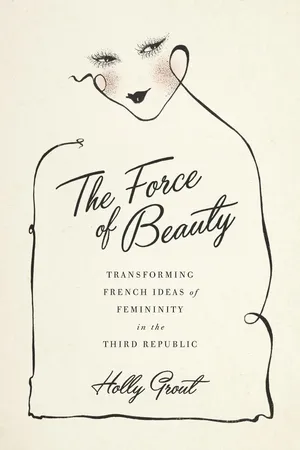
The market for commercial beauty products exploded in Third Republic France, with a proliferation of goods promising to erase female imperfections and perpetuate an aesthetic of femininity that conveyed health and respectability. While the industry's meteoric growth helped to codify conventional standards of womanhood, The Force of Beauty goes beyond the narrative of beauty culture as a tool for sociopolitical subjugation to show how it also targeted women as important consumers in major markets and created new avenues by which they could express their identities and challenge or reinforce gender norms. As cosmetics companies and cultural media, from magazines to novels to cinema, urged women to aspire to commercial standards of female perfection, beauty evolved as a goal to be pursued rather than a biological inheritance. The products and techniques that enabled women to embody society's feminine ideal also taught them how to fashion their bodies into objects of desire and thus offered a subversive tool of self-expression. Holly Grout explores attempts by commercial beauty culture to reconcile a standard of respectability with female sexuality, as well as its efforts to position French women within the global phenomenon of changing views on modern womanhood. Grout draws on a wide range of primary sources-hygiene manuals, professional and legal debates about the right to fabricate and distribute "medicines, " advertisements for beauty products, and contemporary fiction and works of art-to explore how French women navigated changing views on femininity. Her seamless integration of gender studies with business history, aesthetics, and the history of medicine results in a textured and complex study of the relationship between the politics of womanhood and the politics of beauty.
Woman is quite within in her rights, indeed she is even accomplishing a kind of duty, when she devotes herself to appearing magical and supernatural; she has to astonish and charm us; as an idol, she is obliged to adorn herself and to be adored. . . . Thus, if you will understand me aright, face-painting should not be used with the vulgar, unavowable object of imitating fair Nature and of entering into competition with youth. It has moreover been remarked that artifice cannot lend charm to ugliness and can only serve beauty. . . . Maquillage has no need to hide itself or to shrink from being suspected; on the contrary, let it display itself, at least if it does so with frankness and honesty. —Charles Baudelaire, “In Praise of Cosmetics”
In his collection of essays The Painter of Modern Life (1863), Charles Baudelaire joyfully celebrated woman’s right to employ artifice. Not only did he appreciate woman’s well-executed toilette, but he regarded it as a “kind of duty” that she was “obliged” to perform. Baudelaire condemned the “errors of the field of aesthetics [that] spr[u]ng from the eighteenth-century’s false premises.” He argued instead that artifice should not endeavor to replicate nature or recapture youth. It should be worn “with frankness and honesty” and need only serve the wearer herself.1 Baudelaire’s essay appeared at the height of the Second Empire, when artifice experienced a new period of vogue among the elites of Louis Napoleon Bonaparte’s imperial court. Nevertheless, the poet’s promotion of cosmetics, and the vibrant, feminized commodity culture that they signaled, was not yet enthusiastically accepted by a status quo that considered them false prophets, monikers of a duplicitous character, and tools of deception.
During the eighteenth century, cosmetics were important commodities in France’s growing luxury trades. Yet, because their use remained the prerogative of elites who possessed both the capital to purchase them and the time to use them, cosmetics operated as more than objects for purchase. They functioned as value-laden cultural signifiers that articulated the social and political hierarchies of the Ancien Régime. Within this culture of appearances, the use of artifice was carried out by social prescription and worked to reinforce rank-based proprietary norms. Elites equated whiteness with civilisation and politesse, and so to appear propre they painted their lips dark red and powdered their hair and wigs. The elite toilette established a social uniform that distinguished the aristocracy from the unbathed, unruly masses as well as from the uncultured middling sort. In this way, cosmetics became synonymous with aristocratic privilege, and they offered a visible template of social difference—a perceptible lexicon of power that could be easily read and decoded by even the most illiterate French men and women.
In the nineteenth century, however, a new commercial beauty culture emerged that rendered feminine beauty an essential precept of middle-class respectability. Promoting sanitary self-care as evidence of the middle-class woman’s restraint, propriety, and good taste, this culture established beauty as a legitimate and necessary form of woman’s work. Whereas her self-centered elite predecessors overindulged the female body, languishing in warm-water baths, covering every inch of skin with perfumes and paints, the practical middle-class woman conscientiously maintained her body by carrying out a sensible, hygienic toilette. Despite efforts to sanitize artifice, however, the specter of the decadent aristocrat continued to haunt beauty practices and discourses: advertisements featured cultural elites (actresses, socialites); lavish product packages connoted luxury; and advisors and counselors often claimed noble ancestry. But if the target consumer was bourgeois, why so blatantly connect beauty to its aristocratic origins? Whereas practical goods secured markets based solely on utility, luxury items, according to Stephen Gundle, “relied heavily on the ideas that were associated with them, in particular the promise of magical transformation or instant escape from the constraints of everyday life.”2 Boasting a seemingly infinite array of magical products and transformative practices, France’s commercial beauty culture certainly encouraged middle-class women to entertain “supernatural” fantasies.
Part I examines how the commercial beauty culture that emerged in nineteenth-century France constructed beauty as both a necessary female duty and an indulgent feminine pleasure. The first chapter investigates how beauty businesses (cosmetics firms, hair salons, institutes, product fabricators, and distributors) worked alongside health-care professionals (doctors, hygienists) to make beauty work socially acceptable. Growth in the beauty trade was fueled by developments within the chemical and pharmaceutical industries, the revolution in retailing, and advancements in the field of advertising. Significantly, these transformations transpired within a France increasingly anxious about national hygiene and public health. In the crusade against disease and depopulation, doctors and hygienists authored numerous self-care manuals. These manuals legitimized woman’s use of artifice by aligning it with good health and personal hygiene. This endorsement, along with the influx of safer, less toxic, more affordable products into the market, equipped women with the tools and the rationale for ministering to their bodies. Promoting beauty work as an enjoyable and necessary female labor, health-care professionals aligned corporeal care with middle-class respectability and fostered new attitudes about the female body.
Beauty did not only require work; it also performed important cultural work. Chapter 2 explores how the work of beauty exposed critical tensions between the discursive production of femininity and embodied practices of womanhood. Nineteenth-century gender ideology produced the feminine through exclusionary discourses that located woman’s social identity in her sexed body. Attributing appearance, character, and intellect exclusively to woman’s biology, these discourses used sex to naturalize gender differences and to establish woman’s place in the social order. By the late nineteenth century, the Nineteenth-Century Venus, the Grand Coquette, and the Beauty Countess revealed that femininity, like beauty, was not a biological inheritance but a carefully choreographed social performance. Importantly, these models posed alternatives to middle-class womanhood at the same time that they expanded the boundaries of respectability. The cosmetically enhanced, publicly nude Venus, whose sexual availability signaled a social threat, also illustrated how women could create themselves as both objects and subjects of desire. The glamorous Grand Coquette, embodied by the actress/celebrity and ridiculed for her sexual promiscuity, was also admired for her extravagant beauty. Finally, the humble Beauty Countess, who posed as the pampered aristocrat, cultivated desire and encouraged indulgence by couching beauty in the middle-class language of industry.
Ultimately, beauty work and the work of beauty reconfigured the relationship between womanhood and respectability. Beauty experts connected self-care to scientific progress, personal hygiene, and public health. They reiterated the belief that women were made to please, to be decorative objects and familial trophies. And they proposed to reinscribe the female body into the service of class and nation. Yet in its tools and function, commercial beauty culture undermined the notion that beauty was natural, somehow rooted in woman’s biology. Rather than portray beauty as an essential state of being, self-care manuals, breviaries, advice columns, and other cultural discourses exposed the diligent effort required to make women beautiful. Commercial beauty culture, like Baudelaire, tasked women with the “duty” of beautification; however, it also provided the tools necessary—hygiene and embellishment aids, instruction manuals, models to emulate, and commercial sites– to perform these labors. By 1900, French women were not only expected to “astonish and charm” but also to cleanse and to sanitize. In its own praise of cosmetics, France’s commercial beauty culture made the pursuit of beauty respectable at the fin de siècle.
1
Beauty Work
Is it a crime to want to always please and to be loved? And to achieve this using the most graceful tricks? —Vicomtesse de Réville, La Parisienne en 1900
In the fifteenth edition of his popular health and hygiene manual La beauté chez l’homme et chez la femme (1891), Dr. Paul Marrin explained to his predominantly middle-class readers that using artifice to embellish the body was a “question of aesthetics and public hygiene.”1 For much of the nineteenth century, middle-class men and women associated artifice (especially artificial agents used to enhance the body) with moral corruption and sexual promiscuity. After all, it was only the dandy, the prostitute, the actor, or the imperial ingénue who dared wear grease paints and heavy powders in public. At first glance, then, Marrin’s manual appeared to challenge prevailing attitudes toward cosmetics’ use. Yet, by the late nineteenth century, numerous health-care professionals endorsed the middle-class woman’s use of commercial beauty aids, and, like Marrin, they linked public hygiene with personal aesthetics.
By the fin de siècle, health-care professionals, primarily physicians and hygienists, made beauty work respectable by envisioning it as middle-class woman’s work. Amid national initiatives aimed at curtailing the spread of disease and replenishing an aging populace, health-care professionals proposed practices that connected individual, particularly feminine, cleanliness with the collective welfare. Attributing stagnant population growth not only to disease but also to the growing accessibility of contraceptives and even to the indifference of French mothers, health-care professionals published self-care manuals that sought to cleanse and regulate the reproductive female body.2 Article I of the law of February 19, 1902, for example, demonstrated state efforts to monitor public health through the regulation of private spaces. The law explicitly targeted “maladies transmissibles” (communicable diseases), addressed problems related to public sanitation, and sought to ensure the “cleanliness of houses and their residents.” Advocating salubrious practices, authorizing the use of commercial beauty aids, and targeting women as arbiters of familial hygiene, these manuals legitimized the middle-class woman’s beauty regimen by placing her body in the service of family and nation.
To no small degree, the fabrication and commercialization of new health and beauty products proved important by-products of and corollaries to national public health initiatives. The booming beauty industry that emerged in France at this time offered middle-class women a plethora of new products that promised to cleanse, sanitize, and beautify. On the advice of health-care professionals, women increasingly relied upon commercial cleansers, soaps, and deodorants to protect themselves and their families from germs. They employed professionally fabricated tonics, pastes, and elixirs to cleanse the skin, hair, and teeth. And, eager to enhance their physical appearance, women applied powders, creams, and serums to their clean bodies.
As concerns about public health escalated at the fin de siècle, health-care experts and beauty industry insiders increasingly equated beauty work with middle-class respectability. Doctors and hygienists authored countless self-care manuals. These manuals, which grew in number from twelve produced between 1800 and 1875 to seventy published between 1875 and 1900 (in the United States, England, and France collectively), echoed the call for clean, reproductive female bodies.3 Moreover, they discursively linked feminine beauty with personal, familial, and national health to promote corporeal care as a socially acceptable, even necessary, form of middle-class woman’s work. At the same time, by correlating beauty with hygiene, these manuals legitimized the respectable woman’s use of artifice and encouraged her to envision herself as a desirous and desiring individual. While health-care professionals sanctioned the middle-class woman’s pursuit of health and beauty, France’s commercial beauty culture provided her with the tools to achieve it. Fabricators manufactured safer, less toxic aids; department stores, beauty institutes, and hair salons provided new retail outlets that made products easily accessible; and image advertisements portrayed beautification as both a glamorous indulgence and a necessary chore. Thus, under the guidance of health-care professionals and in conjunction with France’s burgeoning commercial beauty culture, beauty became essential to the work of respectable middle-class womanhood.
BEAUTY IN THE SERVICE OF FAMILY AND NATION
French health-care professionals long promoted hygienic bodily care. Amid mounting concerns about population decline and growing anxieties about the health of French families, their efforts intensified. By the end of the nineteenth century, the healthy body became the focus of two major public health initiatives: the campaign to combat the spread of communicable diseases— specifically tuberculosis and syphilis; and the effort to repopulate the nation following crushing military defeat in the Franco-Prussian War (1870). While physician-legislators labored to improve public works, living conditions, and urban sanitation, other health-care professionals concentrated their efforts on the care of individual, particularly female, bodies. National debates about depopulation and disease frequently devolved into impassioned arguments about female fertility and maternal responsibility. As woman’s relationship to the state was becoming understood largely in terms of maternity, her value to the nation came to reside in her clean, moral, reproductive body. Echoing this sentiment, health-care professionals authored dozens of personal-care manuals that sought to discipline the middle-class woman’s body. By “extending diagnosis from the bodily to the social organism,” health-care professionals placed the middle-class woman’s body firmly in the service of the family and the nation.4
Indeed, health-care professionals were particularly well positioned to disseminate such messages. Medicine’s professional prestige rose after 1870 because of falling mortality rates in hospitals, the enhanced reputation of medical schools in Paris, and doctors’ better understanding of disease. At the same time, health-care professionals themselves came to exercise greater influence in French politics. Between 1870 and 1914, 358 physicians and 36 pharmacists won election as deputies or senators.5 Since the revolution of 1789, French physicians played a more influential role in politics than their European counterparts, but that role greatly expanded under the Third Republic, when many doctors welcomed political activism as a way to enhance the prestige and authority of their profession.6 Thus, health-care professionals derived professional legitimacy from their access to medical knowledge as well as from their relationship to the state. Even as physicians won the esteem of voters in the political realm, however, they still had to convince ordinary citizens of the value of their medical advice. One way that they did this was by authoring manuals that enabled them, by dispelling popular myths and demonstrating the personal and social benefits of self-care, to exercise disciplinary power over the docile bodies of individual men and women.7
In these manuals, health-care professionals associated feminine morality with sexual hygiene. Despite strides in identifying and treating syphilis, between 1890 and 1914, an estimated 13–15 percent of all Parisian males presented symptoms of the disease and 1 million individuals nationwide were believed to be infected.8 By 1900, scientists had definitively connected the transmission of syphilis to sexual practices, specifically to illicit and venal sex.9 Armed with this information, hygienists denounced nonprocreative sex as perverse, blamed the female prostitute for polluting the population, and linked disease to the larger problem of population decline. Syphilis and tuberculosis affected all European populations; however, these diseases were particularly troubling to the French because they fueled anxieties about national degeneration.10 Between 1850 and 1910, the French population increased by only 3.4 million, from 35.7 million to 39.1 million.11 Notwithstanding this incre...
Table of contents
Cover
Title Page
Copyright Page
Contents
Acknowledgments
Introduction: A Worthy Pursuit?
PART I: RESPECTABLE BEAUTY
PART II: EXCEPTIONAL BEAUTY
PART III: MODERN BEAUTY
Conclusion
Notes
Bibliography
Index
Trusted by 375,005 students
Access to over 1.5 million titles for a fair monthly price.
Study more efficiently using our study tools.
Frequently asked questions
Yes, you can cancel anytime from the Subscription tab in your account settings on the Perlego website. Your subscription will stay active until the end of your current billing period. Learn how to cancel your subscription
No, books cannot be downloaded as external files, such as PDFs, for use outside of Perlego. However, you can download books within the Perlego app for offline reading on mobile or tablet. Learn how to download books offline
Perlego offers two plans: Essential and Complete
Essential is ideal for learners and professionals who enjoy exploring a wide range of subjects. Access the Essential Library with 800,000+ trusted titles and best-sellers across business, personal growth, and the humanities. Includes unlimited reading time and Standard Read Aloud voice.
Complete: Perfect for advanced learners and researchers needing full, unrestricted access. Unlock 1.5M+ books across hundreds of subjects, including academic and specialized titles. The Complete Plan also includes advanced features like Premium Read Aloud and Research Assistant.
Both plans are available with monthly, semester, or annual billing cycles.
We are an online textbook subscription service, where you can get access to an entire online library for less than the price of a single book per month. With over 1.5 million books across 990+ topics, we’ve got you covered! Learn about our mission
Look out for the read-aloud symbol on your next book to see if you can listen to it. The read-aloud tool reads text aloud for you, highlighting the text as it is being read. You can pause it, speed it up and slow it down. Learn more about Read Aloud
Yes! You can use the Perlego app on both iOS and Android devices to read anytime, anywhere — even offline. Perfect for commutes or when you’re on the go. Please note we cannot support devices running on iOS 13 and Android 7 or earlier. Learn more about using the app
Yes, you can access The Force of Beauty by Holly Grout in PDF and/or ePUB format, as well as other popular books in History & European History. We have over 1.5 million books available in our catalogue for you to explore.