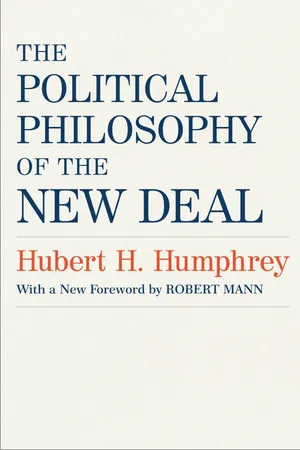
Brought up on Wilsonian democracy and populist ideals, a young Hubert Humphrey witnessed the near-failure of the American political system during the Great Depression and its revival under Franklin D. Roosevelt. In The Political Philosophy of the New Deal, Humphrey responds to the changing political landscape of his early adulthood and offers a broad-ranging analysis of the New Deal and its place in the American traditions of individualism and social responsibility. First published in 1970, Humphrey's book makes the case that the New Deal, by emphasizing stability for all citizens, situated itself firmly within the traditions of American democracy. His cogent assessment of Roosevelt's policies offers insights still applicable in current-day discourse about the financial and social sectors within the United States. This paperback edition includes a new foreword by Robert Mann, who explains the enduring importance of Humphrey's work and makes a strong case for the relevance of Humphrey's ideas in today's political climate.
- 168 pages
- English
- ePUB (mobile friendly)
- Available on iOS & Android
eBook - ePub
The Political Philosophy of the New Deal
About this book
Information
Subtopic
PoliticsCHAPTER 1
Toward an Understanding of the New Deal
AFTER EIGHT YEARS of New Deal administration there is no unanimity of opinion as to the meaning and objectives of the New Deal. Judged by the strength of the antipathies it has stirred, it is a social movement of revolutionary significance. Judged by the relatively lukewarm quality of the loyalties it has evoked, it would seem to be little more than a collection of palliatives. On June 26, 1936, the day after the Democratic platform was adopted, Mark Sullivan wrote in the New York Herald Tribune, “The New Deal is the American variation of the new order that has been set up in three great European countries and some smaller ones. The term ‘New Deal’ is the American equivalent of the term ‘Fascism’ in Italy, the term ‘Nazi’ in Germany, and the term ‘Soviet’ in Russia.” Republican Party leaders have labeled it as a new form of “statism,” a semi-dictatorship nourished and perpetuated by generous gifts from the public treasury. Its chief characteristics are an irresponsible bureaucracy, wasteful spending, and crackpot planning. In the view of the Hoover Republicans, the New Deal has not only destroyed free enterprise and regimented industry but has also destroyed the Constitution, defiled the Supreme Court, and demoralized the citizen body. The charges of the opposition are full of “viewing with alarm” and no “pointing with pride.” But the quest of the presidency is not conducive to impartial and objective analysis.
While the more conservative of our commentators and politicians have branded the New Deal as un-American and dangerously radical, the so-called leftist has found it to be reactionary and highly capitalistic. It has been described by the Marxist as an outgrowth of the same general economic and social factors which gave rise to Fascism in Germany and Italy. The disintegration of the capitalist economy everywhere menaced the power of monopoly capital. In order to beat back the rising revolt of the working masses and to strengthen their shaken domination, the American capitalist class yielded a few reforms and extended financial aid to the unemployed. This is the sum and substance of the New Deal in the view of the leftist. The evaluation is more Marxist than factual and reveals a failure to understand the circumstances confronting the American people in 1932. The records of the Depression years reveal no mass violence or uprising on the part of the workers; the only display of revolution was to be found among midwestern farmers, organized in the Farmers’ Holiday movement.
The New Deal is not without its friends and defenders. Democratic Party leaders have gushed forth a constant stream of oratory “pointing with pride” at the record. It has restored the government to the people, say the New Dealers. It has rescued industry, labor, and the farmer from economic disaster. It has protected the aged, the poor, and the sick; it has stabilized the banks, the insurance companies, and the stock market; it has broken the power of big business and returned the reins of government from Wall Street to Washington, D.C. It has provided for conservation of our national resources; it has doubled the national income. The accomplishments are bounteous; the good performed, inestimable. Yet, in all this amazing record of reform and recovery the politicians have not answered the question, What is the New Deal? What are its purposes, its methods, and its relationship to democratic government? Is it a coherent philosophy, or is it but a mere patchwork of political opportunism? Has it been a force of leadership or has it merely followed? It will be important to determine the effect of the New Deal on such traditions and institutions as individualism, freedom, and private property. Has it altered our constitutional system and if so, what may be the meaning of such changes? It is only with a consideration of these basic questions that we may arrive at some conclusion as to the political philosophy of the New Deal.
President Roosevelt has described the New Deal as a “changed concept of the duty and responsibility of government toward economic life.”1 A. A. Berle, Jr., believes it may be taken as a kind of index for an attitude whose major characteristic is a willingness to accept change and to take political action in terms of that change. The primary objective is to regain economic liberty for the average man. The method of redemption will be a reordering of the profit system in order to provide economic security without sacrificing political liberty.2 Ernest K. Lindley has described the New Deal as “democracy trying to create out of American materials an economic system which will work with reasonable satisfaction to the great majority of citizens.”3 It has sought to mend the evils of our condition by reasoned experiment within the framework of the existing social system. If it fails, says John Strachey, “rational change will be gravely prejudiced throughout the world, leaving orthodoxy and revolution to fight it out.”4 Mr. Strachey and a host of other liberal thinkers have sensed the complexity of the problems facing democratic government. The challenge is one of life or death. The issue resolves itself into a question as to the ability of democracy to adjust itself to the problems of industrial capitalism. Where it has failed, Fascism has stepped in to provide order and security. Freedom, as we know it, has been sacrificed for subsistence. The New Deal, faced with an unprecedented economic collapse of the domestic and world economy, chose the course of moderation and rebuilding. It acted boldly to stabilize and to rehabilitate the economic mechanism. It religiously preserved the profit system, even at the price of vast subsidies and direct financial aid to millions of consumers. It was with this thought in mind that Louis M. Hacker described the New Deal as a political program “in behalf of agricultural landlords and big commercial farmers, organized trade unionists, and oversea investors and speculators.”5 For it is these groups that reap the bounteous benefits of the profit system and demand its maintenance.
Partisan loyalty or opposition tends to cloud the objectivity of those who discuss the New Deal. However, one descriptive term seems to have been resorted to by its opponents from the right and even by some of its defenders. Back in 1933, Ernest K. Lindley, of New Deal sympathy, wrote a book which he called The Roosevelt Revolution. Former Senator Thomas P. Gore of Oklahoma has said the New Deal was more revolutionary than the Revolution of 1776. H. G. Wells in his book The New America stated, “America is undergoing a social if not a political revolution.”6 David Lawrence in a cryptic editorial has analyzed the New Deal, branding it a “revolution of political autocrats,”7 one that spells tyranny and oppression for the individual. This charge, that the New Deal is a revolution, demands that its real nature be subjected to analysis.
A revolution is seldom bloodless or peaceful. It is a device employed by society for the destruction of the constricting molds of class relations; it wipes them out once and for all and changes their solidified forms into a new fluidity. The history of the more modern revolutionary upheavals is ample proof of this conclusion. As long as an economic society is in its youth and the economy is an expanding one, revolution is unusual and improbable. But as an economic society grows into maturity and old age, the class lines harden and class relationships get out of balance. The leading problem shifts from expansion into new fields, to consolidation of those already won. Then oppression becomes the unconcealed weapon of the ruling group and class hostilities become open. The result of the continued oppression is revolution and the emergence of a new ruling group. Class lines again become flexible and the economy becomes readjusted to the pattern of the new leading group.8 Obviously, in terms of these considerations, the New Deal is not a revolution. Its rationale may be stated in the following propositions. The New Deal recognized that the American economy had changed from one of expansion to one of intensive consolidation. It had slowed down and the forces within the economy were out of balance.9 Opportunities for capitalist enterprise had contracted. The population had ceased expanding; there were few, if any, new great industrial fields to be opened up; and foreign trade had been seriously injured by cutthroat competition and high tariff barriers. Capitalism was actually confronted by a sharp decrease in the rate of profit and the security of investment. The New Dealer noticed that control had shifted from industrial capitalism to finance capitalism. The objective of business was no longer the seeking of legitimate economic expansion; instead, emphasis was laid on the exploitation of investors and the consuming public by stock market manipulation and monopoly price maintenance. It was evident that the spread between capacity to produce and ability to consume had constantly widened; imperialism revealed its inability to provide all the needed outlets for surplus capital. The world market for agricultural products had largely disappeared and a decline in farm values had set in. By 1932 it had become evident that opportunities for new jobs were few. The labor market had an oversupply of workers, and capital could find no willing investors. Agriculture had become burdened with an unbearable indebtedness, and the wholesale foreclosure on farm properties threatened the safety of orderly government. The domestic market was unable to consume farm produce, and the feeble attempts to control crop surpluses by the Federal Farm Board proved a failure. Class lines were being clearly drawn; the danger of class hostilities was no longer remote but already in evidence. Then, too, under the operation of the so-called capitalistic free market the owners or the controllers of the means of production, because of their greater strength, size, and organization, could continue to maintain themselves perhaps for a long time; but their security would depend upon the steady debasement of the standards of living of the other classes of society.10
The seeds of revolution or counterrevolution were present in such a situation. The hardening of class lines and the entrenchment of organized wealth at the expense of labor, farmer, and small business would eventually lead to the creation of conditions favorable to violent reaction. The philosophers of the New Deal had no desire to see the revolution. They refused to lose faith in the capitalistic system. Their creed called for positive action to save private enterprise and to set the system in balance. The New Dealers have had no intention of overhauling drastically the capitalist system. They felt the mechanism had run down temporarily and the solution was to wind it up again, after certain repairs have been made and new parts substituted.11 There has been no concerted attack on private enterprise. Private ownership of the means of production is to continue. The aim has been to prevent capitalism from exploiting both its labor supply and the producers of raw material. The wage earner has been given basic guarantees in the form of minimum wages and social security. While the hope has been that a higher standard of living may be achieved, subsistence has been assured. President Roosevelt has stated the position of the New Deal in its relationship to capitalism:
No one in the United States believes more firmly than I in the system of private business, private property, and private profit. . . . If the Administration had had the slightest inclination to change that system, all that it would have had to do was to fold its hands and wait—let the system continue to default to itself and to the public. Instead we did what the previous administration had declined to do through all the years of the depression. We acted quickly and drastically to save it. It was because of our belief in private enterprise that we acted quickly and drastically to save it. It was because of our belief in private enterprise that we acted, because of our faith in the essential and fundamental virtue of democracy and our conviction that individual initiative and private profit served it best.12
The New Deal has sought to establish a balance between American class relations. Far from desiring to enthrone the proletariat in any of its measures, it would seem to me the real objective is to abolish the proletariat, or rather make it wholly unnecessary by lifting it into a different state. Instead of endeavoring to create an equalitarianism, it has endeavored to liberate inequalities or to permit a more just recognition of inequalities. In that desire, instead of following the totalitarian doctrines proposed by the Communists, it has taken an individualistic attack, endeavoring to make something available to the individual so that thereafter he can take care of himself.13 The idea of establishing a balance between American class relations occurs again and again in the writings and speeches of President Roosevelt and his advisers. It has been assumed that it is possible to establish a permanent truce on class antagonisms. The devices the New Deal has mainly relied on are the restoration of the purchasing power and a more equitable distribution of national income. Roosevelt has expressed the principle clearly: “What we seek is balance in our economic system—balance between agriculture and industry and balance between the wage-earner, the employer and the consumer.”14 To the New Dealer good government should maintain the balance where every individual may find safety if he wishes it, where every individual may attain such power as his ability permits.15
The readjustments cannot be termed revolution in the historical meaning of the term, but implicit in all of this is a call for a changed conception of economy and life. For more than a hundred years the American economy has been essentially speculative and a dominant national ideal has been that of getting rich as quickly as possible. Even agriculture has been a huge venture in land speculation rather than a way of life. The stock market has been a kind of national shrine. The national objective has been to open up and develop this great country, regardless of waste or expense. The New Deal has sought to change this national ideal. It has insisted upon stabilization, steady price levels, and reasonable security for all. It has sought to equalize privilege by the helping hand of government. It has desired to bring about governmental action to mesh more with the rights and essential needs of the individual. It seeks to preserve the capitalistic system, but the operations of that system are to be hedged in the interests of the security of the workingman, the farmer, and the small investor. It has no desire to destroy individual liberty, but rather seeks to adjust personal freedom with the social good. If in these things clear-cut novelty is not discernible, there is in them a sharpness and weight of emphasis sufficient to make the New Deal signalize a break with much of our historic past. There can be no doubt but that the activities of the Roosevelt administration are so completely directed to the attainment of social rather than individual ends that to many, who had been brought up on the automatic operations of the laissez faire economy, a veritable revolution threatened.16
Much confusion as to the policies of the New Deal has arisen because of the method of approach to the problems it seeks to solve. Most of us are essentially doctrinaire and dogmatic in our economic and political beliefs. We have been schooled in the eternal verity of the law of supply and demand and the perfectibility of democratic institutions. We are more faithful than inquisitive, more conservative than courageous. Against the essential conservatism of a highly developed business economy, the New Deal attacked the problems of the social and economic maladjustment with a trial-and-error method. This philosophy has been termed pragmatism or experimentalism. The main characteristic of the pragmatist is action. Act, even if you act mistakenly. Pragmatism is a combination of thinking and doing. Professor John Dewey, the greatest exponent of pragmatic philosophy, has said that
. . . the best test of consequences is more exacting than that afforded by fixed general rules. When new acts are tried, new results are experienced, while the lauded immutability of eternal ideas and forms is in itself a denial of the possibility of development and improvement. . . . Ideals serve vaguely to arouse aspirations, but they do not evoke any direct strivings for embodiment in actual existence. . . . Progress is more sound when laws, principles, standards, and ideals are not regarded as something to swear by and stick to at all hazards, but when clews and tests found within concrete acts are employed instead. . . . In principle, experimental method does not signify random and aimless action—it implies direction by ideas and knowledge.17
What does all this mean, in simpler language? It means that the pragmatic experimental philosophy calls for being bold, and, if necessary, somewhat revolutionary in order to attain better results. It is not afraid of the new. Neither does it cling to the old. It is adventurous, willing to take risks. It is scientific in temper, everlastingly desirous of going forward and of doing something about an unsatisfactory situation, even if one experiment must be abandoned and a new one tried.18
It has only to be explained in this way to see that the Roosevelt and New Deal philosophy tends toward the pragmatic, experimental, and objective. It is, therefore, more directly scientific; and it explains why Roosevelt likes and uses his “Brain Trust,” whereas Woodrow Wilson, a much more subjective, idealistic person, could not have used such a plan or held such a philosophy. Also, it reveals how Herbert Hoover, full of “set” ideas of what “must not be done” and what “cannot be done,” was unable to meet the problems which beset his administration. He had many fixed ideas which he refused to alter when new conditions arose, and he shrank from bold experiment. Splendid man though he was, the fast pace of the times outraced him. “The day for pragmatic action had come; swiftness of economic change forced it.”19
Mr. Roosevelt has the type of mind t which little is impossible and nothing inevitable. Blind faith in the self-restorative powers of capitalism, the certainty of its doom— both are alien to his way of thinking. He has never been a doctrinaire. Reared in the self-confident tradition, his observations of the world have never driven him to refuge in a creed. With a sense of continual movement that comes from the study of history and practical experience in politics, Mr. Roosevelt is fully aware that the “iron laws” of successive schools of orthodox economists, no less than the patent remedies of successive scho...
Table of contents
- Cover
- Title Page
- Copyright Page
- Contents
- Foreword to the 2015 Edition
- Foreword
- Preface
- Acknowledgment
- Introduction
- Chapter 1 Toward an Understanding of the New Deal
- Chapter 2 One from Many
- Chapter 3 A Theory of Government
- Chapter 4 A More Perfect Union
- Chapter 5 Life—Liberty—Property
- Chapter 6 In the American Tradition
- Selected Bibliography
Trusted by 375,005 students
Access to over 1.5 million titles for a fair monthly price.
Study more efficiently using our study tools.
Frequently asked questions
Yes, you can cancel anytime from the Subscription tab in your account settings on the Perlego website. Your subscription will stay active until the end of your current billing period. Learn how to cancel your subscription
No, books cannot be downloaded as external files, such as PDFs, for use outside of Perlego. However, you can download books within the Perlego app for offline reading on mobile or tablet. Learn how to download books offline
Perlego offers two plans: Essential and Complete
- Essential is ideal for learners and professionals who enjoy exploring a wide range of subjects. Access the Essential Library with 800,000+ trusted titles and best-sellers across business, personal growth, and the humanities. Includes unlimited reading time and Standard Read Aloud voice.
- Complete: Perfect for advanced learners and researchers needing full, unrestricted access. Unlock 1.5M+ books across hundreds of subjects, including academic and specialized titles. The Complete Plan also includes advanced features like Premium Read Aloud and Research Assistant.
We are an online textbook subscription service, where you can get access to an entire online library for less than the price of a single book per month. With over 1.5 million books across 990+ topics, we’ve got you covered! Learn about our mission
Look out for the read-aloud symbol on your next book to see if you can listen to it. The read-aloud tool reads text aloud for you, highlighting the text as it is being read. You can pause it, speed it up and slow it down. Learn more about Read Aloud
Yes! You can use the Perlego app on both iOS and Android devices to read anytime, anywhere — even offline. Perfect for commutes or when you’re on the go.
Please note we cannot support devices running on iOS 13 and Android 7 or earlier. Learn more about using the app
Please note we cannot support devices running on iOS 13 and Android 7 or earlier. Learn more about using the app
Yes, you can access The Political Philosophy of the New Deal by Hubert H. Humphrey in PDF and/or ePUB format, as well as other popular books in Politics & International Relations & Politics. We have over 1.5 million books available in our catalogue for you to explore.