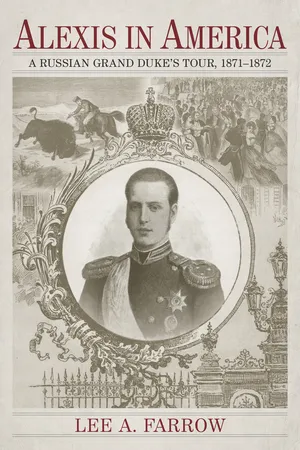
In the autumn of 1871, Alexis Romanov, the fourth son of Tsar Alexander II of Russia, set sail from his homeland for an extended journey through the United States and Canada. A major milestone in U.S.-Russia relations, the tour also served Duke Alexis's family by helping to extricate him from an unsuitable romantic entanglement with the daughter of a poet. Alexis in America recounts the duke's progress through the major American cities, detailing his meetings with celebrated figures such as Samuel Morse and Henry Wadsworth Longfellow and describing the national self-reflection that his presence spurred in the American people. The first Russian royal ever to visit the United States, Alexis received a tour through post-Civil War America that emphasized the nation's cultural unity. While the enthusiastic American media breathlessly reported every detail of his itinerary and entourage, Alexis visited Niagara Falls, participated in a bison hunt with Buffalo Bill Cody, and attended the Krewe of Rex's first Mardi Gras parade in New Orleans. As word of the royal visitor spread, the public flocked to train depots and events across the nation to catch a glimpse of the grand duke. Some speculated that Russia and America were considering a formal alliance, while others surmised that he had come to the United States to find a bride. The tour was not without incident: many city officials balked at spending public funds on Alexis's reception, and there were rumors of an assassination plot by Polish nationals in New York City. More broadly, the visit highlighted problems on the national level, such as political corruption and persistent racism, as well as the emerging cultural and political power of ethnic minorities and the continuing sectionalism between the North and the South. Lee Farrow joins her examination of these cultural underpinnings to a lively narrative of the grand duke's tour, creating an engaging record of a unique moment in international relations.
I wonder who he’s walking with and flirting on the deck; Oh give me just one chance at her, I’ll break her little neck; … Alas! the day the news arrived this gallant duke would come; ’Twere better far for us poor girls he had remained at home. … They say he’s handsome, graceful, too, and loves the ladies flair. I’d give my new piano for a handful of his hair.
—Detroit Free Press, November 17, 1871
ALEXIS ALEXANDROVICH ROMANOV was a member of the Romanov dynasty, which had ruled Russia since 1613 and had produced such leaders as Peter the Great (who reigned 1689–1725) and, through marriage, Catherine the Great (1762–96). Alexis’s grandfather was Nicholas I (1825–55), the grandson of Catherine the Great, who ruled Russia with a conservative program rooted in the principles of orthodoxy, autocracy, and nationality. His father was Alexander II (1855–81), the tsar who would reform Russia, liberate her serfs, and then die at the hands of terrorists. His brother would become Alexander III (1881–94), a reactionary monarch who, after the assassination of his father, made his primary goals the repression of revolutionary groups and the preservation of order. Alexis’s other siblings all married into the preeminent royal families of Europe, including those of Great Britain, the German states, and Greece. His nephew, Nicholas II (1894–1917), would be the last tsar of Russia, murdered with his family by the Bolsheviks in the summer of 1918.
Alexis was born in St. Petersburg on the morning of January 14, 1850, in the Winter Palace, the traditional family home of the imperial family since the 1700s, now known as the Hermitage. Alexis was the fifth child to be born to Maria Alexandrovna and the Tsarevich Alexander Nikolaevich, the future Alexander II. As the fourth son, Alexis was never expected to be in line for the throne, but his birth was nonetheless cause for celebration. Alexis’s imminent arrival was also a cause for concern, however. Only months earlier, on June 16, the royal couple had lost their first child, eight-year-old Alexandra, to scarlet fever. The parents took their daughter’s death hard, and Maria Alexandrovna, in particular, already pregnant with Alexis, had suffered terribly. Her doctor and family worried about how grief had undermined her health and weakened her at a time when she needed her strength. Soon after Alexandra’s death the family faced another loss, when Tsarevich Alexander’s favorite uncle, Grand Duke Mikhail Pavlovich, died in September 1850. When Maria Alexandrovna went into labor, then, the family was still deep in mourning and anxious about the well-being of the weakened and still grieving mother. These concerns only intensified when the baby arrived: Alexis was very weak, and it appeared that he might not survive. For more than an hour, family and friends worried about the fate of the baby until finally the danger passed and the tiny grand duke rallied. Everyone heaved a sigh of relief when the tsar appeared with his new son in his arms.1
The grand duke’s birth triggered a series of celebrations and proclamations. As was tradition, the imperial family held a mass in the large cathedral of the Winter Palace, and Tsar Nicholas I, the proud grandfather, issued a manifesto which was to be distributed throughout the empire announcing the royal arrival. In Moscow, cathedral bells throughout the city pealed in celebration, as did those of the centuries-old Ivan the Great Bell Tower in the Kremlin. The tsar also ordered an annual stipend of fifty thousand rubles to be released from the treasury for the maintenance of the new grand duke, and the baby’s father bestowed generous gifts on the members of the household staff and sent three thousand rubles each to the governor general of Moscow and St. Petersburg for the care of the poor. Three weeks later, the tsar and many other relatives and high officials gathered in the cathedral of the Winter Palace for the christening ceremony of the newest grand duke, initiated by the echoing booms of the cannons at the Peter and Paul Fortress. Later in the afternoon, the marble hall of the Winter Palace was the setting of an elaborate luncheon that included vocal and instrumental music, and toasts to the health of the newborn. That evening, the city of St. Petersburg glowed with illumination. The celebratory atmosphere was sustained by the birth of another grand duke one month later. When Grand Duke Constantin Nikolaevich and his wife had their first son and named him Nicholas, after his grandfather, the tsar ordered that two icons should be prepared in honor of his new grandsons, one of St. Alexis and one of St. Nicholas, both to be adorned in silver and gold in the traditional fashion.2
As a child, Alexis spent most of his time in the care of women, tended by nannies and governesses, usually from England and France. Alexis and his brothers also had Russian tutors to teach them their prayers and the fundamentals of reading and writing. During most of the year, the children occupied their own section of the Winter Palace, though they visited their parents daily, and in the summer, the family moved to the spectacular baroque Catherine Palace in Tsarskoe Selo. Literally “tsar’s village,” Tsarskoe Selo had been the royal family’s country residence and a popular summer retreat for the upper nobility since the previous century. Here the young boys played outdoors, hunted small birds, gathered mushrooms, and rode horses. One of their favorite outdoor games was skittles, a lawn game similar to bowling, but they also learned to play croquet, and when the weather kept them inside, they played chess and card games. In the evenings, the children usually spent time with their mother. The young grand dukes did have male influences as well. A male instructor taught the boys how to stand at attention, march, and hold a gun, accompanied the children on their outdoor excursions, and frequently participated in their games. When Tsar Nicholas and his wife were in Tsarskoe Selo, they occupied the nearby Alexander Palace, which allowed the tsar to visit his grandsons often, taking them on walks through the palace grounds.3
Alexis was a bit sickly as a toddler, but by the time he reached the age of four or five his health seemed to improve. Early photos of him show a boy with a sweet face, light hair, and large eyes. From the time he was very small, Alexis exhibited a guilelessness and a preference for honesty and transparency, characteristics that, while admirable, interfered with his familial duties in early adulthood. One contemporary recalled that, while visiting the new empress in July 1855, shortly after Nicholas I had died, she was pleased to see the four little grand dukes, Nicholas, Alexander, Vladimir, and five-year-old Alexis. When the empress asked the boys for an account of their lessons, Alexis honestly admitted that he had not done well. His mother looked upon him sternly, expressing her disappointment, and the small boy lowered his head and his eyes filled with tears.4
Between the ages of seven and nine, many things changed for Alexis. At the age of seven, he moved from the care of female nannies and governesses to male teachers and joined his older brothers in a more demanding curriculum. His daily lessons now included a wide range of subjects: French, German, English, and Russian; history and geography; mathematics; penmanship and drawing; horseback riding and gymnastics; religious studies; and military instruction. The boys’ daily schedule also incorporated visits to their parents. Alexis’s life changed in one other significant way; it was during this period that Constantin Nikolaevich Possiet became the grand duke’s guardian. Possiet was descended from a French noble family who had come to Russia during the time of Peter the Great. In 1858, Possiet assumed the position of governor to Alexis, though in reality, his duties went far beyond what we might interpret from his title. One of his primary responsibilities was to select teachers for the grand duke and to establish a program of instruction, meeting with the teachers on a monthly basis to give them plans and lessons. Possiet was also charged, however, with the much more difficult job of instilling his pupil with the discipline and conduct expected of a grand duke. This would prove to be the most challenging part of his job.5
Alexis was an average but rather lazy student, and throughout the early years of his tutelage Possiet repeatedly complained to the boy’s parents about his underperformance. In September 1861, when Alexis was eleven years old, his father wrote him that, while he was glad to hear that Possiet was generally happy with his conduct, he would like Alexis to show more diligence in his studies. Several months later, the tsar scolded Alexis for giving Possiet problems and noted how much this news saddened him and his wife. Alexis’s behavior and study habits were an ongoing topic of correspondence, however. In the fall of 1864, when Alexis was nearing the age of fifteen, his father stressed that they wanted to see continual, not occasional, diligence and reminded him of the promise he had made, presumably a promise to work harder and more seriously. It was a promise that would come up again and again. In June 1866, Alexander reminded Alexis of the promise and yet, later that summer, Possiet wrote in his diary that Alexis was lazy and that he had caught the sixteen-year-old smoking in the water closet. Despite his title and privileged upbringing, Alexis was like any other teenager; when scolded for bad behavior, Possiet reported that he asked forgiveness but never seemed resolute about changing his ways. We should not judge Alexis too harshly, however. Sources from his father’s childhood indicate that Tsar Alexander II was also frequently in trouble with his tutors and parents for laziness and poor performance in his studies.6
One significant portion of Alexis’s education and upbringing, of course, was his military training. It was traditional among the nobility and imperial family to register newborn males for positions in elite military units; consequently, on the day of his birth, Alexis became chief of the Imperial Guards Moscow Regiment and a member of the Preobrazhensky and Egersky guards regiments. Alexis was also assigned to the navy, the only one of Alexander II’s sons to be designated for a naval career at birth. Even in early childhood Alexis began to learn some of the fundamental skills of a military life such as marching, standing at attention, and holding a gun. By the age of seven, some type of military instruction became part of the boy’s daily curriculum and, in the summer of 1860, when Alexis was only ten, he began his naval training on one of the imperial yachts, the Shtandart. Two year later, Possiet arranged Alexis’s schedule so that he dedicated more time to naval training and less time to traditional lessons; art and music were relegated to free time only. In fact, the young grand duke began to spend more and more time on the sea. Initially, Possiet and his pupil stayed relatively close to home, venturing out to the Aland Islands in the Gulf of Finland and to the Gulf of Bothnia. But after a year or so, they began to travel greater distances, to the Gulf of Riga and the Baltic Sea, visiting Revel (Tallinn, Estonia) and Libau (Liepaja, Latvia) where Alexis saw a small home once occupied by Peter the Great (during his journey to Western Europe). During these travels, Alexis wrote many letters to his parents, describing his impressions. In the summer and early fall of 1867, for example, the grand duke sent telegrams to his mother from Malta, Marseilles, Salonique, Cadiz, Odessa, and Kiev. Alexis also spent several days in Constantinople and met the sultan and the patriarch of the Orthodox Church there. In 1868, Alexis traveled along the Volga to Uglich, Rybinsk, Astrakhan, and other cities, the Caspian Sea and Baku, and encountered many of the diverse nationalities in his father’s empire, including Chechens, Tatars, Jews, and the Ingush.7
These trips were not without peril. Once, while sailing on Lake Onega, a large lake to the east of St. Petersburg, Alexis saved a young noble and his sister after their boat had capsized. For this, Alexis received a medal for courage from his father which he proudly wore during ceremonial events. The American press made much of this story during the grand duke’s visit several years later as proof of his courage.8 This was not Alexis’s only brush with danger. In 1868, while serving as the head officer of the watch on the frigate Alexander Nevsky, the young grand duke had a harrowing experience at sea. The grand duke had been to Piraeus to participate in the festivities surrounding the marriage of his first cousin Grand Duchess Olga Konstantinovna and the Greek King George I. After sailing through the Mediterranean Sea, the Atlantic Ocean, and the North Sea, the frigate headed back toward Kronstadt; but on the night of September 25, it encountered fog and heavy rain. Bad weather and navigational errors resulted in disaster. The frigate ran aground on the isthmus between the Danish towns of Harboore and Thyboron, and in the ensuing attempts to get to shore two officers and four sailors drowned. By morning, the weather had cleared and the remaining men were able to safely reach the shore. Throughout this ordeal, Alexis refused to abandon the ship until Possiet expressly ordered him to do so. Years later, the grand duke’s uncle would recall that Alexis frequently retold the tale of that frightening night, slamming his fist on the table with dramatic affect at the denouement.9
Not everyone recalled the event with fondness, however. A naval court in St. Petersburg conducted an investigation in early 1869 and found Admiral Possiet guilty of mismanagement and neglect and recommended a public reprimand. Two other officers received short sentences in jail. According to the correspondent for the London Daily News, the whole trial was a farce and the two officers were simply scapegoats for the real culprit, Possiet. The admiral, however, had a strong advocate on his side in the person of Grand Duke Alexis who, along with Tsar Alexander, ensured that he got off lightly.10
As Alexis made his way from childhood to adulthood, his immediate family experienced a decade of challenges, hardships, and devastating losses. In 1860, Alexis’s eldest brother, Nicholas, the heir to the throne, fell from a horse while riding at Tsarskoe Selo and seriously injured his back. Over the next few years, his injury continued to give him pain, and in November 1863 one of the royal tutors noted that Nicholas could barely walk. Nonetheless, in April 1864, it was decided to send Nicholas on a trip to various cities in Europe, possibly for curative reasons since initially his illness was believed to be rheumatism. By the end of that year, however, his condition had worsened and he was in terrible pain, despite assorted treatments and consultations with various doctors. Throughout his illness, Nicholas continued to correspond with his brothers—for example, writing to Alexis from Florence, wishing him a happy birthday and complaining that he was under lock and key, one day better, one day worse. However, the tsarevich’s illness continued to intensify, the pain in his back accompanied by headaches, forgetfulness, and vomiting. He died in Nice on April 12; the autopsy determined he had suffered from meningitis.11 The royal family was devastated.
The death of the tsarevich raised another problem for the royal family. Nicholas had been engaged to marry Princess Dagmar of Denmark, and there is some indication that, on his death bed, he expressed a desire for his brother, Alexander, to marry his fiancée. This was problematic since at the time Alexander was in love with Maria Meshcherskaya, a maid at the court of his mother, the empress. The affair with Meshcherskaya was so intense that Alexander had apparently been prepared to renounce his right to the throne in order to marry her. It was a difficult pill to swallow, but in the face of his brother’s death and his new role as heir to the throne, Alexander accepted his responsibility and married Dagmar, who took the Russian name Maria Fedorovna. For Alexis, his brother’s marriage brought him not only a sister-in-law, but a dear friend. Alexis and “Minni,” as Maria Fedorovana was called by family, remained fast friends to the end, and Minni was one of his strongest defenders in subsequent years when his reputation was less than sterling.12
Even as the tsar and his family suffered through these personal tragedies, the wheels of government continued to turn. When Alexander II inherited the throne in 1855, Russia was embroiled in the Crimean War, a conflict that made it glaringly obvious that Russia’s military needed reform. The rank-and-file soldiers of the army were serfs, drafted into service despite often being in poor health, untrained, and usually illiterate. Thus, Russia’s loss in the Crimean War could be seen as a reflection of her failing social and economic system. In March 1856, Alexander called together representatives of the nobility in Moscow and declared that it was better to abolish serfdom from above than to wait until the serfs liberated themselves from below. Over the next five years, provincial noble committees and a central editing commission worked out the details of Russia’s most ambitious reform ever. Finally, in 1861, Alexander officially abolished the institution of serfdom, the system upon which the country’s agriculturally based economy had relied for centuries. In fact, the emancipation of the serfs was not the only major reform undertaken during Alexander’s reign. The tsar also enacted various educational reforms, introduced more generous policies toward Russia’s ethnic minorities, created institutions of self-government at both the district and provincial level in the countryside, and established the judiciary as an independent branch of the government. Finally, Alexander attempted to modernize the Russian Army, its training, maintenance, and equipment. While most of these reforms had their shortcomings, they were, nonetheless, rather remarkable given the conservatism that had predominated under Alexander’s father.
In many areas, however, traditional conservatism still reigned supreme. Such was the case with Russia’s relationship to the Polish part of her empire. Toward the end of the eighteenth century, Russia, Prussia, and Austria had partitioned Poland three times until she no longer existed as an independent nation. In doing so, Russia had absorbed several hundred thousand square miles of territory, gaining upwards of five million new subjects, most of whom retained their ethnic, religious, and cultural identity and continued to agitate for greater freedom and even independence. In 1830, Polish nationalists had rebelled against their foreign oppressors. Though the Russian military ultimately won out, it was not easy and the Poles were made to pay a high price for their insubordination. The Russian government replaced the Polish constitution with the Organic Statute of 1832 that made Poland an indivisible part of the Russian Empire, confiscated the estates of insurgents, closed Polish institutions of higher learning, and secularized the lands of the Catholic Church. Under Alexander II, the Poles had regaine...
Table of contents
Cover
Title Page
Copyright Page
Dedication
Contents
Acknowledgments
Introduction: The Eagle, Today, Nestles Close to the Bear
1. Born in the Shadow of an Imperial Crown
2. God Bless the Empire That Loves the Great Union
3. Where Every Man Is a Sovereign
4. Leaving His Russian Steppes Behind
5. “Roamin’ Off ” to the Midwest
6. So Happy to Be Hunting Again
7. This Young Duck of Muscovy
Conclusion: Buffalo Tales and Mardi Gras Myths
Notes
Index
Illustrations
Trusted by 375,005 students
Access to over 1.5 million titles for a fair monthly price.
Study more efficiently using our study tools.
Frequently asked questions
Yes, you can cancel anytime from the Subscription tab in your account settings on the Perlego website. Your subscription will stay active until the end of your current billing period. Learn how to cancel your subscription
No, books cannot be downloaded as external files, such as PDFs, for use outside of Perlego. However, you can download books within the Perlego app for offline reading on mobile or tablet. Learn how to download books offline
Perlego offers two plans: Essential and Complete
Essential is ideal for learners and professionals who enjoy exploring a wide range of subjects. Access the Essential Library with 800,000+ trusted titles and best-sellers across business, personal growth, and the humanities. Includes unlimited reading time and Standard Read Aloud voice.
Complete: Perfect for advanced learners and researchers needing full, unrestricted access. Unlock 1.5M+ books across hundreds of subjects, including academic and specialized titles. The Complete Plan also includes advanced features like Premium Read Aloud and Research Assistant.
Both plans are available with monthly, semester, or annual billing cycles.
We are an online textbook subscription service, where you can get access to an entire online library for less than the price of a single book per month. With over 1.5 million books across 990+ topics, we’ve got you covered! Learn about our mission
Look out for the read-aloud symbol on your next book to see if you can listen to it. The read-aloud tool reads text aloud for you, highlighting the text as it is being read. You can pause it, speed it up and slow it down. Learn more about Read Aloud
Yes! You can use the Perlego app on both iOS and Android devices to read anytime, anywhere — even offline. Perfect for commutes or when you’re on the go. Please note we cannot support devices running on iOS 13 and Android 7 or earlier. Learn more about using the app
Yes, you can access Alexis in America by Lee A. Farrow in PDF and/or ePUB format, as well as other popular books in History & North American History. We have over 1.5 million books available in our catalogue for you to explore.