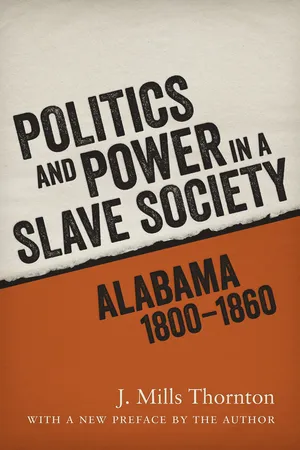
More than three decades after its initial publication, J. Mills Thornton's Politics and Power in a Slave Society remains the definitive study of political culture in antebellum Alabama. Controversial when it first appeared, the book argues against a view of prewar Alabama as an aristocratic society governed by a planter elite. Instead, Thornton claims that Alabama was an aggressively democratic state, and that this very egalitarianism set the stage for secession. White Alabamians had first-hand experiences with slavery, and these encounters warned them to guard against the imposition of economic or social reforms that might limit their equality. Playing upon their fears, the leaders of the southern rights movement warned that national consolidation presented the danger that fanatic northern reformers would force alien values upon Alabama and its residents. These threats gained traction when national reforms of the 1850s gave state government a more active role in the everyday life of Alabama citizens; and ambitious young politicians were able to carry the state into secession in 1861. Politics and Power in a Slave Society continues to inspire scholars by challenging one of the fundamental articles of the American creed: that democracy intrinsically produces good. Contrary to our conventional wisdom, slavery was not an un-American institution, but rather coexisted with and supported the democratic beliefs of white Alabama.
- 528 pages
- English
- ePUB (mobile friendly)
- Available on iOS & Android
eBook - ePub
About this book
Information
Chapter I Foundations
MARK TWAIN was still an adolescent in the years during which his cousin Jeremiah Clemens served in the United States Senate from Alabama. But the young man could hardly have been ignorant of the notoriety which his distinguished relative gained during the Crisis of 1850 for delivering speeches whose vitriolic denunciations of the North and passionate proclamations of southern righteousness startled all observers. Perhaps it was at this time that Twain began to grapple with the problem which was to dominate so much of his subsequent writing: what it meant to be born a southerner. Nine years after his cousin left the Senate, Twain gave a concrete demonstration of his dilemma by volunteering for the Confederate army and then, following the briefest of service, deserting the cause. Thereafter the problem seems to have tormented him. We have from his pen a number of loving portraits of boyhood in the South, punctuated by unexpected and sharp assaults upon the region. His most moving attempt to resolve the difficulty, however, is set not in the South but in medieval England.
A Connecticut Yankee in King Arthur’s Court, beneath its humor, is a tortured effort to explore the validity of the assumptions of laissez-faire America by placing them in conflict with the alien values of an earlier age. The hero is convinced of the virtues of machinery and democracy, and wishes to acquaint the sixth century with their benefits. He at first assumes that feudal civilization will crumble at his touch, but he quickly finds its foundations deeply laid. At one point he is particularly horrified to find members of the lower classes cooperating eagerly with the aristocracy to execute a group of rebels against the aristocracy’s rule. The hero tells us:
This was depressing to a man with the dream of a republic in his head. It reminded me of a time thirteen centuries away, when the “poor whites” of our South who were always despised and frequently insulted by the slave-lords around them and who owed their base condition simply to the presence of slavery in their midst, were yet pusillanimously ready to side with slave-lords in all political moves for the upholding and perpetuating of slavery, and did also finally shoulder their muskets and pour out their lives in an effort to prevent the destruction of that very institution which degraded them. And there was only one redeeming feature connected with that pitiful piece of history; and that was that secretly the “poor white” did detest the slave-lord and did feel his own shame. That feeling was not brought to the surface, but the fact that it was there and could have been brought out under favoring circumstances, was something—in fact it was enough; for it showed that a man is at bottom a man, after all, even if it doesn’t show on the outside…. Whole ages of abuse and oppression cannot crush the manhood clear out of him. Whoever thinks it a mistake, is himself mistaken.1
Twain was a southerner, however, and he knew that the Connecticut Yankee’s tenacious faith was ill placed. Because the Yankee refused to profit from the object lessons which the sixth century so regularly presented him, because he refused to abandon his naive notions of man, he impelled the novel toward a denouement in which his dreams were rejected and his world destroyed. There have been historians who have shared the Yankee’s view of the South, who have preferred his affirmations of cheering unreality to the discovery of a sadder truth. But as Twain knew—and as he was to teach his Yankee protagonist—the ideals of the antebellum South were the ideals of the southern citizenry. Students who insist upon attributing the evil of the region to a ruling class—who, in effect, absolve the populace from blame in the creation of its society—are often attempting to close their eyes to a fact which they do not wish to believe: that democracy contains no intrinsic tendency towards producing good. Democracy as a form of government is merely a mirror of men, and the insistence upon man’s nobility is what brought the Connecticut Yankee to his doom.
In the present work I shall undertake to explain how the political structure of antebellum Alabama permitted the adoption of secession, and why the social structure demanded the decision. The first chapter, an introduction to the larger study, will narrate briefly the events which, at the outset of the state’s history, created the assumptions and the style that were to dominate the coming decades. In the succeeding two chapters I shall describe the nature of government and politics in the state during the era. And in the final three chapters I shall turn to the last ten years of antebellum life, in an effort to show how the institutions and beliefs delineated in the earlier chapters worked together with awful logic to slay the community which had produced them.
The Birth of the Style
One shorthand but nonetheless useful way of delineating the periods of Alabama’s early political history is to glance at the educational background and length of service of her various congressmen. In the light of these criteria, the years during which antebellum Alabamians served in the national House of Representatives—1818 to 1861—fall readily into three periods of fourteen years each. Of the seven men elected before 1832, only two had not attended college.2 But of the twenty men first elected between 1832 and 1846, fifteen had never attended a college. Further, the two men in the earlier period who could not claim college attendance each served but a single term. The average tenure in this period is six years six months, and discounting the two non-college men it is eight years, or four terms. In the second period the average tenure is only four years four months, and by disregarding two men with long service we obtain the more accurately descriptive figure of three years two months, or a term and a half. Clearly, the electorate in the second period chose more poorly educated representatives and turned them out of office with much greater alacrity.
For those men elected after 1846, the picture changes a bit. Of the eighteen, six were graduated from a college, an additional three attended college but did not graduate, and two others attended formal professional schools. The difference is hardly marked, however, and to balance it we find such men as seven-term Representative Williamson R. W. Cobb, who had no formal education at all; his first employment was as an itinerant clock peddler. The average time served by these men is four years three months, and if Cobb and one other perennial congressman be disregarded, the average is three years three months. We may conclude that the candidates offering themselves for office were now somewhat better educated, but that the electorate was not appreciably more satisfied with its representation than earlier. As to party balance, we note a marked Democratic predominance. Only nine Whigs were elected to Congress during the entire antebellum period, and only one of these men-—Henry W. Hilliard—served more than two terms.3
There are factors which distinguish the third period more sharply from the second than it may appear, but we may leave them aside for the present in order to dwell upon the differences between the first period and both of its successors. One model frequently offered for antebellum political development does not seem to be confirmed by these findings. Far from encountering a rising aristocracy, we are struck by precisely the reverse—at least to the extent that the electorate’s acceptance of elitism may be measured by its willingness to retain its representatives in office for long stretches and to regard academic attainments as no disqualification for preferment. We may safely assert, at any rate, that after 1832 voters were far more disposed to appraise a representative’s efforts and find them wanting, and far more likely to demonstrate hostility to intellectual pretensions. A look at Alabama politics in the earliest period will help us to understand what caused this change.
Before the creation of the Alabama Territory in 1817, only two small sections of the state had been settled. The Tombigbee settlement, in present-day Washington and Clarke counties, was almost entirely isolated from contact with the outside world. Located in extreme southwest Alabama, it was surrounded on three sides by the vast wilderness of the Indian country and on the fourth by the hostile Spanish at Mobile. It was populated largely by cattle drovers. As late as 1820 it counted 643 herds of cattle over forty head each, to but 168 such herds in Madison County, the state’s other frontier settlement. At the same time it reported only 1,697 taxable slaves to Madison’s 5,511, and paid total taxes of $2,995.92 against Madison’s $9,254.95. The latter figure, incidentally, is one-fourth of the total taxes collected by the state in the year. The Tombigbee settlement’s most famous citizen was Harry Toulmin, a Scottish freethinker who fled to the region in search of a place so far from civilization that he could be safe from the Presbyterians. Toulmin, the territorial judge, represented the settlement in most of its relations with the outside world—primarily, it seems, because no one else was capable of undertaking the commissions.4
Madison County, in the Tennessee Valley in extreme northern Alabama, was a different case altogether. Squatters had been coming into the area since 1804, but it was not opened to purchase until the end of 1809. At the Nashville land sales of that year much of the best land was purchased by wealthy Georgians. Only about a third of the squatters were able to buy the lands which they had cleared. But many Tennessee settlers secured plots in the area. Of the original purchasers 85 percent bought small farms for homesteading.5 The net result of the land sales, therefore, was to create a population with an overwhelming majority of small Tennessee farmers, but to place most of the best land in the hands of a wealthy and clannish band of Georgia planters. The situation was ready-made for class conflict.
The Georgians in question are a most interesting congregation. Neighbors in the Piedmont of Virginia, they immigrated to the Broad River region of Georgia about 1784, under the leadership of General George Mathews, later twice governor of that state. The settlers, who from the outset possessed a strong sense of group identity, “formed the most intimate friendly social union ever known among the same number of persons.” The story of these remarkable people is related in the memoirs of Governor George R. Gilmer, himself one of them.6 Since the homes of many of the Broad River people had been in the same area of Virginia, some intermarriage had already taken place, but in Georgia the intermarriage reached such heights that every member of the group was closely related to every other. They were accustomed to wielding political power and, by the time of the settlement of Alabama, had already produced a governor, three senators, and numbers of congressmen and legislators. In Alabama’s early years, the cousinry dominated the state politically, economically, and socially. Though not completely homogeneous in their views, they generally shared a common social outlook which can only be described as confidently superior. In that particular sense, one might with some legitimacy characterize them as aristocrats.
The main migration into Alabama from the Broad River was not to come until 1818, and it was to be to the Black Belt, but in 1809 three of the Broad River group—Thomas Bibb, Alabama’s second governor; Bibb’s cousin, Leroy Pope; and Pope’s son-in-law, John W. Walker—bought extensive holdings in the newly opened Tennessee Valley, and a number of their kinsmen followed them there to become even wealthier off the fertile land. Leroy Pope, who created the town of Huntsville and by a liberal application of money and influence made it the county seat, became president of the Huntsville Bank—a fact of incalculable importance for the future history of the state.7
It is not hard to understand the hostility aroused in the Tennesseans by the opulent Broad River settlers. The inimitable Mrs. Anne Royall described Pope’s situation in 1823, somewhat more than three years after his bank’s suspension of specie payment had plunged the state into crisis: “Col. Pope is amongst the wealthiest men in the state of Alabama, and lives in princely style. If any man is to be envied on account of wealth, it is he. His house is separated from Huntsville … and from an eminence overlooks the town…. On the east lies his beautiful plantation, on a level with the house…. If I admired the exterior, I was amazed at the taste and elegance displayed in every part of the interior: massy plate, cut glass, chinaware, vases, sofas and mahogany furniture of the newest style decorated the inside.”8 Naturally the small farmers were suspicious of a bank which refused redemption in specie while its president lived in such a style.
But the roots of resentment go much further back in the history of Madison. It first appeared in the open in 1810, only a year after the opening of the county. A small settlement of squatters near the future site of Huntsville had existed before the land sales of 1809. The area was generally called Hunt’s Spring after the squatter who first built his cabin there. When, however, Pope laid off his town, he decided to give it a new name. Proud of his reputed relationship to Alexander Pope, he chose the name Twickenham, after the poet’s home. Having already expelled Hunt from his land, Pope had now expunged the squatter’s name from the landscape. The original residents were enraged. The next year Madison became entitled to three seats in the Mississippi territorial legislature, and the Georgians nominated County Attorney Louis Winston and Pope’s son-in-law John W. Walker, balancing their ticket with the selection of Tennessean Peter Perkins for the third seat. But the old settlers decided to make a fight, and put forward squatter Hugh McVay and newly arrived Tennessean Gabriel Moore. McVay and Moore swept to victory over Winston and Walker, and the future tone of Madison County politics was established. The Broad River group, destined to dominate the county economically and socially, were nevertheless not to win an election for seven years, and when they finally did so, as we shall see, their triumph was fleeting. It is worth noting that both Moore and McVay were to become governors of Alabama.
The first action of the new legislators was to have the name of Twickenham changed to Huntsville. In gratitude for this blow at the privileged, the Madison County electorate consistently returned Moore and McVay to the legislature every year for the rest of the territorial period. And Moore and McVay, especially the former, continued vigorously to fight the battles of the masses and to oppose the Broad River forces.9
The creation of the Alabama Territory in 1817, however, brought rapid change to the political order. Practically all of Alabama was opened to settlement at the same time. Except for two small plots in the west and the vast territory between the Coosa River and the Georgia line, the Indians ceded the entire area of the future state in 1816. By 1817 surveys had been completed and sales begun—at Huntsville for north Alabama and at Milledgeville, Georgia, for the central and southern areas. Thereafter, the population rose phenomenally. In 1813 the population of the two Alabama settlements was 13,000. As squatters began to enter the newly ceded lands during 1816, the population rose to 25,000. By the spring of 1817 it was 33,000 and by the summer 35,000. In 1819 the number had reached 70,000 and in 1820, 127,000.10 During this land boom period, the bulk of the Broad River community decided to follow its pioneer relatives from Georgia to the new territory. Forming a land company, the settlers selected a prominent Milledgeville friend, General John B. Scott, to handle the purchase of a tract from among the lands being offered for sale in his home town. Scott purchased a choice section on the upper Alabama River, including the future site of a part of the city of Montgomery, and in 1818 Scott’s associates began to remove to the area.
The rapidly increasing population brought dreams of statehood to the newly adopted Alabamians. And because the desire for admission was so strong, the Broad River immigrants were able to transfer their political prominence to their new home. One of the most powerful men in the national government, Secretary of the Treasury William H. Crawford, was a son of the Broad River, as were both of Georgia’s senators, William Wyatt Bibb and Charles Tait. The additional alliances of the Broad River were extensive. All of this influence could be mobilized in behalf of Alabama’s admission, if the Broad River group desired to do so. The astute politicians within the group quickly realized that they could use their power in order to strike an implicit bargain, promising the Alabamians statehood if the Alabamians in turn would bestow electoral favor upon them.
Senator Bibb, who had made himself unpopular in Georgia by voting to increase Senate salaries, resigned from Congress and accepted President Monroe’s appointment as governor of the Alabama Territory. From this eminence he began the effort to have Alabama admitted to the Union as a Broad River fief. The statehood argument had telling effect even in bitterly divided Madison County. In the elections of 1817 for the first territorial assembly, Gabriel Moore and Hugh McVay were returned of course, but the county’s other two seats went to the Broad River leader John W. Walker and an important ally of the group, Clement Comer Clay. Similar results appeared from throughout the state. When the legislature convened in 1818, the Broad River combination had great strength in the elective lower house, and was thus able to control the selection of the upper house as well. As soon as word of these events reached Washington, Charles Tait swung into action, had the Alabama admission bill passed by the following spring, and removed posthaste to the Alabama Territory in order to receive his reward—the new state’s federal judgeship. Meanwhile, the territorial assembly, under the recently elected Broad River leadership, undertook an unfortunate experiment intended to alleviate the growing pains of Alabama’s infant economy. In order to attract credit to the booming but currency-starved settlements, future Chief Justice Abner Lipscomb introduced and the legislators passed a bill repealing t...
Table of contents
- Cover
- Title Page
- Copyright
- Dedication
- Contents
- Preface to the New Paperback Edition
- Illustrations
- Tables
- Preface
- Acknowledgments
- Part One Quirites
- Part Two Commilitones
- Appendix 1 House Votes Indicating Party Divisions
- Appendix 2 House Votes Indicating Economic Divisions
- Bibliographical Note
- Index
Trusted by 375,005 students
Access to over 1.5 million titles for a fair monthly price.
Study more efficiently using our study tools.
Frequently asked questions
Yes, you can cancel anytime from the Subscription tab in your account settings on the Perlego website. Your subscription will stay active until the end of your current billing period. Learn how to cancel your subscription
No, books cannot be downloaded as external files, such as PDFs, for use outside of Perlego. However, you can download books within the Perlego app for offline reading on mobile or tablet. Learn how to download books offline
Perlego offers two plans: Essential and Complete
- Essential is ideal for learners and professionals who enjoy exploring a wide range of subjects. Access the Essential Library with 800,000+ trusted titles and best-sellers across business, personal growth, and the humanities. Includes unlimited reading time and Standard Read Aloud voice.
- Complete: Perfect for advanced learners and researchers needing full, unrestricted access. Unlock 1.5M+ books across hundreds of subjects, including academic and specialized titles. The Complete Plan also includes advanced features like Premium Read Aloud and Research Assistant.
We are an online textbook subscription service, where you can get access to an entire online library for less than the price of a single book per month. With over 1.5 million books across 990+ topics, we’ve got you covered! Learn about our mission
Look out for the read-aloud symbol on your next book to see if you can listen to it. The read-aloud tool reads text aloud for you, highlighting the text as it is being read. You can pause it, speed it up and slow it down. Learn more about Read Aloud
Yes! You can use the Perlego app on both iOS and Android devices to read anytime, anywhere — even offline. Perfect for commutes or when you’re on the go.
Please note we cannot support devices running on iOS 13 and Android 7 or earlier. Learn more about using the app
Please note we cannot support devices running on iOS 13 and Android 7 or earlier. Learn more about using the app
Yes, you can access Politics and Power in a Slave Society by J. Mills Thornton in PDF and/or ePUB format, as well as other popular books in History & North American History. We have over 1.5 million books available in our catalogue for you to explore.