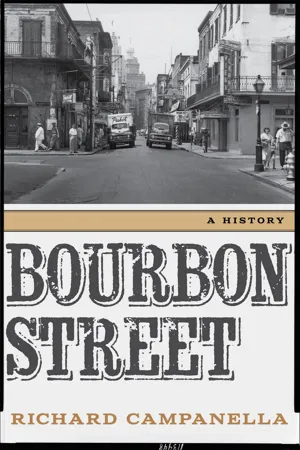
New Orleans is a city of many storied streets, but only one conjures up as much unbridled passion as it does fervent hatred, simultaneously polarizing the public while drawing millions of visitors a year. A fascinating investigation into the mile-long urban space that is Bourbon Street, Richard Campanella's comprehensive cultural history spans from the street's inception during the colonial period through three tumultuous centuries, arriving at the world-famous entertainment strip of today.Clearly written and carefully researched, Campanella's book interweaves world events—from the Louisiana Purchase to World War II to Hurricane Katrina—with local and national characters, ranging from presidents to showgirls, to explain how Bourbon Street became an intriguing and singular artifact, uniquely informative of both New Orleans's history and American society.While offering a captivating historical-geographical panorama of Bourbon Street, Campanella also presents a contemporary microview of the area, describing the population, architecture, and local economy, and shows how Bourbon Street operates on a typical night. The fate of these few blocks in the French Quarter is played out on a larger stage, however, as the internationally recognized brands that Bourbon Street merchants and the city of New Orleans strive to promote both clash with and complement each other.An epic narrative detailing the influence of politics, money, race, sex, organized crime, and tourism, Bourbon Street: A History ultimately demonstrates that one of the most well-known addresses in North America is more than the epicenter of Mardi Gras; it serves as a battleground for a fundamental dispute over cultural authenticity and commodification.
- 384 pages
- English
- ePUB (mobile friendly)
- Available on iOS & Android
eBook - ePub
About this book
Information
Subtopic
North American HistoryIndex
Social SciencesORIGINS
1
A Straight Line in a Sinuous Space
Creating Rue Bourbon, 1682–1722
There are no straight lines in nature. Nor are there any right angles. Rather, intricate arcs and fractures merge and bifurcate recurrently, like capillaries in a plant leaf or veins in an arm. Nowhere is this sinuous geometry more evident than in deltas, like that of the Mississippi River. Starting eighteen thousand years ago, warming global temperatures melted immense ice sheets across North America. The runoff aggregated to form the lower Mississippi River and flowed southward bearing vast quantities of sediment. The bluffs and terraces that confined the channel to a broad alluvial valley petered out roughly between present-day Lafayette and Baton Rouge in Louisiana, south of which lay the Gulf of Mexico.
Into that sea disembogued the Mississippi, its innumerable tons of alluvium smothering the soft marshes of the Gulf Coast and accumulating upon the hard clays of the sea floor. So voluminous was the Mississippi’s muddy water column that it overpowered the (relatively weak tides and currents of) the Gulf of Mexico, thus prograding the deposition farther into the sea. Occasional crevasses in the river’s banks diverted waters to the left or right, creating multiple river mouths and thus multiple depositions. High springtime flow also overtopped the river’s banks and released a thin sheet of sediment-laden water sideways, further raising the delta’s elevation.
In this manner, southeastern Louisiana rose from the sea. The process took about 7,200 years, making the Mississippi Delta, as Mark Twain put it, “the youthfulest batch of country that lies around there anywhere.”1 Young, dynamic, fluid, warm, humid: flora and fauna flourish in such conditions, as evidenced by the verdant vegetation and high productivity of the delta’s ecosystem. Humans, on the other hand, view these same conditions as inhospitable, dangerous, even evil, and endeavor to impose rigidity and rectitude upon them, so as to exploit better the delta’s resources.
When French colonials came to establish a city on this fluidity, they imposed river-restraining levees, runoff-draining canals, rational urban grids, delineated parcels, and defendable ramparts toward exerting control over this threatening and distant land. The premier spatial signature of these interventions was the one geometric shape utterly absent in nature: the straight line. From the European standpoint, Euclidean geometry—clean lines, orthogonal angles, neat triangles, perfect circles—introduced order to disorder, civilization to wilderness, godliness to the heathen, and the power of the Crown to the cowering native.
Straight lines arrived into the toolbox of colonialism via ancient architectural sources, starting with Hippodamus, who is credited with the first planned gridded street system in Piraeus in the fifth century BC, and with Marcus Vitruvius Pollio, whose De architectura did for buildings what Hippodamus had done earlier for cities. Vitruvius’s tome disappeared after Rome’s fall—a loss that can be viewed as symbolic, because progressive thought on urban design in the West subsequently waned.2 The Renaissance reinvigorated European thinking about cities, and in the late 1400s, Vitruvius’s De architectura fortuitously reappeared. The opus taught a new generation that buildings should be firmitas, utilitas, and venustas—strong, useful, and beautiful. So too should cities: a civil engineer and planner by today’s definitions, Vitruvius articulated the values of ordinatio (measured and incremented order), symmetria, and eurythmia (graceful adaptiveness) in urban design, manifested by central plazas and orthogonal street grids and paying homage, ultimately, to the human body.3
Vitruvian ideas particularly resonated with officials in Spain. Throughout their aggressive New World colonization, Spanish colonials produced hundreds of urban grids with central plazas fronted by institutions of church and state. Similar designs appeared in European cities during the 1600s and 1700s, taking “hold among the French at the very moment that the Bourbon monarchy was expanding its imperial domain on the Continent.”4 That domain spread across the Atlantic and took root in France’s two enduring but dissociated New World colonial regions. One was in Canada; the other was in the Caribbean.
French Canadian René-Robert Cavelier, sieur de La Salle sought to expand his king’s empire while figuring out how Canada and the Caribbean were geographically associated. In 1682, La Salle sailed across the Great Lakes and floated down the Illinois and Mississippi Rivers. That spring he and his crew became the first Europeans to describe what would become, decades later, the site for New Orleans. They proceeded to the mouth of the Mississippi, where, in the words of a crew member, “on the ninth of April, with all possible solemnity, we performed the ceremony of planting the cross and raising the arms of France, [taking] possession of that river, of all rivers that enter it and of all the country watered by them.”5 The Mississippi Basin, in La Salle’s mind, now belonged to France. He named it Louisiane to honor his king, Louis XIV, grandson of the first monarch in the Bourbon dynasty. Recognizing the strategic advantage afforded by the Mississippi River, La Salle sailed home to recommend to the Sun King the establishment of a fortification near the river’s mouth. “[A] port or two” there, he declared, “would make us masters of the whole of this continent.”6
Louisiana arrived into Bourbon France’s imperial docket at roughly the same time that Sébastien Le Prestre, Seigneur de Vauban emerged as the Crown’s premier military engineer. Vauban integrated new principles of military defense with Vitruvian and Hippodamian notions of symmetrical urban order. He designed plats with narrow streets (to funnel invading troops) which ran in straight lines (to allow local regimes to be readily summoned) and set them within fortifications angled to expose any attacker to maximum firepower. Vauban’s influential field manual instructed generations of engineers on how:
To make the Streets in a Fortress…
Of the principal Angles of a Fortress…
Of the Streets, Places of Arms, Corps de Garde, and Magazines…
Of the Advantages and Disadvantages of a Place situated on the side of great Rivers.7
The concept of neatly fortified cities appealed to the Crown’s absolutist aspirations. Eager to inscribe his power into the landscape, King Louis XIV deployed engineers trained by Vauban and his successor, the Marquis d’Asfeld, across the French countryside to build roads and bridges connecting villages with Paris. Villages that were once largely autonomous and vulnerable now became part of a national effort and dependent on the Crown for defense.
Likewise, French claims in the New World came to be viewed as tabulae rasae for similar Vauban-designed imperial envelopment. Urban planning worked hand in hand with national expansion; in the words of one historical anthropologist, it represented “a conscious conviction that spatial control yielded political control.”8 It was during this era, and under this paradigm, that Louisiana became a French possession.
Establishing a colony in Louisiana came at a slow pace and great cost. La Salle himself perished in a mutiny after getting lost on his 1684 return trip. Henri de Tonti sought to continue La Salle’s mission, cautioning French officials of English and Spanish interests, but the War of the League of Augsburg distracted their attention.
Not until 1697 did the Crown return to Louisiana matters. It directed French Canadian warrior Pierre Le Moyne, sieur d’Iberville to seek “the mouth [of the Mississippi River,] select a good site that can be defended with a few men, and block entry to the river by other nations.”9 Charged to establish Louisiana, Iberville set sail from France in late 1698 with two ships and two hundred men, among them his nineteen-year-old brother, Jean Baptiste Le Moyne, sieur de Bienville.
The 1699 voyage of Iberville and Bienville achieved only the first directive. A “good site” proved hard to find along the lower Mississippi, and the place where Iberville eventually established a fort (Maurepas, near present-day Biloxi) would not block other nations from the river. The French needed to be on the river and near its mouth—but where? And how? “All this land is a country of reeds and brambles,” bemoaned Iberville; “I climbed to the top of a nut tree… but saw nothing other than canes and bushes, [much of it] inundated.”10 With that water-logged terrain, however, came plentiful resources. “We regarded this beautiful river with admiration,” recalled crew members; “The water is… very good to drink.… The country [is] everywhere covered with splendid trees [and] wild game, such as ducks, geese, snipe, teal, bustards, and other birds.” Blooming vines entangled mature live oaks and blackberry patches, forming a junglelike scene. The crew spotted three alligators and killed a buffalo.
Iberville first viewed the future site of downtown New Orleans probably on March 7, 1699. There, he and his crew met a group of Annocchy Indians, with whom they traded tools and trinkets for buffalo meat, bear meat, and geographical intelligence. American bison grazed on the natural levees of future New Orleans; that morning, the crew “saw three buffaloes lying down on the bank,” which promptly disappeared into the “thick forest and cane-brakes.”11 These are among the first surviving descriptions of what the landscape around future Bourbon Street looked like three hundred years ago.
Iberville’s explorations spawned a colonial French society scattered thinly along the Gulf coast. Following the establishment of Fort Maurepas in 1699, Bienville built a small blockhouse on a flood-prone site along the lower Mississippi River in 1700. Two years later, he and Iberville established Fort Louis de Louisiana on the Mobile River, where draftsman Charles Levasseur designed a Vauban-style bastion and a small town plat. “La Mobile,” France’s first attempt at a street grid in Louisiana, grew over the next five years to host a solid fort, nearly a hundred structures, and eighty-one resident families, until scarce resources and flooding forced its relocation downriver in 1711. There, officer Jacques Barbizon de Pailloux laid out another Vauban fortification and urban grid. Streets were named to reify the Crown’s involvement: Rue Conti, Rue Dauphin, Rue Royale. All three toponyms remain in downtown Mobile, Alabama, today.12
Scarcity, hunger, pestilence, natural disaster, official inattention, and a desperate lack of settlers made life in early Louisiana a dreaded hardship. Frustrated and pessimistic, the Crown in 1712 ceded a monopoly to a prominent financier named Antoine Crozat for the commercial development of Louisiana. Privatizing Louisiana relieved the Crown of the hassle of management, while chancing that commercialization might actually prove lucrative. That hope was soon dashed: lack of mineral riches, scarcity of agriculturalists, and limited commercial interaction with Spain, coupled with mismanagement, feuding, and Indian tensions, doomed the speculative venture. “The colony of Louisiana is a monster that has no form of government,” grumbled authorities in 1716. Governor Cadillac was more blunt: “Bad country, bad people,” he called Louisiana.13
When Crozat retroceded his monopoly in 1717, Louisiana’s prospects seemed dim. Yet a number of important events occurred during the Crozat years. The colony gained four new forts on key positions on the Red, Mississippi, Coosa-Tallapoosa, and Tombigbee Rivers. It was also during the Crozat era that King Louis XIV died (1715) and left the throne to his five-year-old great-grandson Louis XV, for whom Philippe, Duc d’Orléans would act as regent of France. Among the Duc d’Orléans’s many business associates was a brilliant and flamboyant Scotsman peddling a bold proposition. His name was John Law.
Born in Edinburgh in 1671, Law grew rich through econometric wizardry parlayed into high-risk financial affiliations with European aristocracy. His dazzling intellect seeking a laboratory for his economic theories, Law settled with his millions in Paris and allied himself with the newly empowered Duc d’Orléans. The regent, impressed with Law’s fiscal acumen and something of a kindred spirit, authorized Law to establish the Banque Générale in 1716. It succeeded, reflecting favorably on Law’s thinking on fiat currency and emboldening him to seek a bigger experiment. He caught wind of Crozat’s surrender of an exotic and intriguing place that some people called Louisiana and others Mississippi. Law pounced, proposing to the regent a land-development plan than would enrich all investors while enlarging the empire. He envisioned the colony producing tobacco and raw materials in a mercantilist relationship with the mother country, while weaning France off the prized leaves grown by English colonists in the Chesapeake region. Equity in the company would pay off the national debt, and riches would follow. In this bold new experiment called Louisiana, France would also have an opportunity to learn from its mistakes in other New World ventures and finally get colonialism right. Part scheming gambler in search of a good hand, part brilliant economist striving to put theory into practice, Law found the right patron for a high-risk, high-reward adventure of breathtaking proportions. “The beguiling inclusiveness of Law’s plan,” wrote historian Lawrence N. Powell, “—its promise to retire the national debt, revive the French domestic and overseas economy, and establish an autarkic source of tobacco—is what drew the Regent to Law’s theories.”14
Less than a month after Crozat formally relinquished Louisiana, John Law’s new Company of the West received a twenty-five-year monopoly charter to develop commercially the Louisiana colony. Committed to populate it with six thousand settlers and three thousand slaves in the next ten years, the Company then launched an unprecedented marketing campaign across the continent to drum up investment in Louisiana stock and land, and to inveigle the lower classes to immigrate. Although based on scandalously exaggerated estimations of commercial viability, Law’s so-called Mississippi Company thrust Louisiana into the forefront of European attention. It also decided resolutely to found a city to be called La Nouvelle-Orléans.
“Resolved to establish, thirty leagues up the river, a burg which should be called New Orleans, where landing would be possible from either the river or Lake Pontchartrain.”15 Those words, scribed in the Company register for September 9, 1717, set in motion the foundation of the riverside settlement first envisioned by La Salle thirty-five years earlier.16 The name explicitly honored the royal sponsor, unlike the exotic monikers of earlier outposts such as Biloxi, Mobile, Natchitoches, and Natchez. It also made it clear to stockholders that this enterprise enjoyed the backing of the Crown and intended to extend the absolutist power of the king. The stipulated site came from intelligence gathered from Indians over the previous eighteen years regarding a strategic shortcut to the Mississippi River. Rather than sailing forty treacherous leagues up the lower Mississippi (the river route) amid fog and sand bars, against the current and sometimes against the wind, voyagers instead traversed the open waters of the Mississippi Sound into the protected waters of Lake Pontchartrain and up a little inlet called Bayou St. John. They would then disembark and trek a short Indian trail—today’s Bayou Road— along a slight upland now called the Esplanade Ridge, to reach the banks of the Mississippi. To Bienville, this lake route circumvented the dangers of the river route and mitigated concerns about the feasibility of a riverside settlement. Based on this geographical reckoning and amid a paltry array of viable alternatives, Bienville selected this site for New Orleans. In late March or early April 1718, six vessels bearing forty-three men anchored along the riverfront terminus of the portage to Bayou St. John. “M. de Bienville cut the first cane,” recalled colonist Jonathan Darby. Thirty workers, all convicts, proceeded to clear the “dense cane-brake” around the present-day intersection of Conti and Decatur Streets.17 Behind those bankside reeds lay the hardwood forests of the natural levee, which the axmen cleared next. ...
Table of contents
- Cover
- Title Page
- Copyright Page
- Dedication
- Contents
- Preface
- PART I: ORIGINS
- PART II: FAME AND INFAMY
- PART III: BOURBON STREET AS A SOCIAL ARTIFACT
- Notes
- Index
Trusted by 375,005 students
Access to over 1.5 million titles for a fair monthly price.
Study more efficiently using our study tools.
Frequently asked questions
Yes, you can cancel anytime from the Subscription tab in your account settings on the Perlego website. Your subscription will stay active until the end of your current billing period. Learn how to cancel your subscription
No, books cannot be downloaded as external files, such as PDFs, for use outside of Perlego. However, you can download books within the Perlego app for offline reading on mobile or tablet. Learn how to download books offline
Perlego offers two plans: Essential and Complete
- Essential is ideal for learners and professionals who enjoy exploring a wide range of subjects. Access the Essential Library with 800,000+ trusted titles and best-sellers across business, personal growth, and the humanities. Includes unlimited reading time and Standard Read Aloud voice.
- Complete: Perfect for advanced learners and researchers needing full, unrestricted access. Unlock 1.5M+ books across hundreds of subjects, including academic and specialized titles. The Complete Plan also includes advanced features like Premium Read Aloud and Research Assistant.
We are an online textbook subscription service, where you can get access to an entire online library for less than the price of a single book per month. With over 1.5 million books across 990+ topics, we’ve got you covered! Learn about our mission
Look out for the read-aloud symbol on your next book to see if you can listen to it. The read-aloud tool reads text aloud for you, highlighting the text as it is being read. You can pause it, speed it up and slow it down. Learn more about Read Aloud
Yes! You can use the Perlego app on both iOS and Android devices to read anytime, anywhere — even offline. Perfect for commutes or when you’re on the go.
Please note we cannot support devices running on iOS 13 and Android 7 or earlier. Learn more about using the app
Please note we cannot support devices running on iOS 13 and Android 7 or earlier. Learn more about using the app
Yes, you can access Bourbon Street by Richard Campanella in PDF and/or ePUB format, as well as other popular books in Social Sciences & North American History. We have over 1.5 million books available in our catalogue for you to explore.