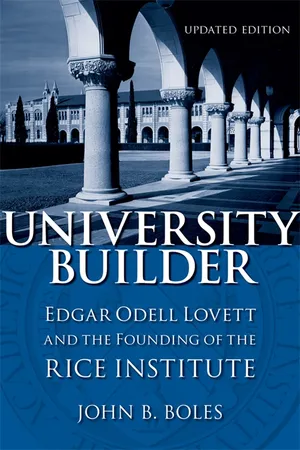
Rice University, one of America's preeminent institutions of higher education, grew out of the vision, direction, and leadership of one man: Edgar Odell Lovett (1871--1957). University Builder is the fascinating story of this extraordinary educator and the unique school he created. Widely acknowledged, almost from its founding in 1912, as one of America's best universities, Rice is distinguished as both the smallest and the youngest institution in the top tier of American universities. In telling the tale of Lovett and his innovative, enduring vision for Rice, John Boles provides both a compelling biographical narrative and a refreshing new view of American higher education in the first half of the twentieth century.
Lovett was not a Texan; he was not even a southerner. Rather, with two Ph.D.'s in hand, he was a rising star at Princeton University when the trustees of the newly founded Rice Institute--chartered in 1891 by wealthy Houston merchant William Marsh Rice--called him in 1907 to be the school's first president. Working with a significant endowment, a vague charter, a supportive board, and a visionary's gift for planning, Lovett set out on a fact-finding tour of educational institutions around the globe. He transformed the idea of the Institute into a complete university, one that emphasized research as much as teaching and aspired to world-class status. He sought the best architect available to design the campus, lured distinguished faculty from leading universities across the globe to Texas, and constructed a far-reaching vision of a small, carefully planned, elite university that incorporated the most advanced educational practices and shaped Rice's development for the next century.
Lovett served as president of Rice for nearly forty years, proving himself to be an exemplary and charismatic leader who inspired two generations of students. He was the creator of Rice University in practically every way. Indeed, perhaps no other American university has been so shaped by its founder's vision. Boles's exceptional account of Lovett's remarkable academic achievement is a vital contribution to the legacy of Rice University and an important addition to the historiography of education in the early twentieth-century South.
eBook - ePub
University Builder
Edgar Odell Lovett and the Founding of the Rice Institute
- 344 pages
- English
- ePUB (mobile friendly)
- Available on iOS & Android
eBook - ePub
About this book
Information
Topic
EducationSubtopic
Education GeneralCHAPTER ONE
DUAL BEGINNINGS
EDGAR ODELL LOVETT said or wrote very little about his parents or his childhood in the small northeastern Ohio town of Shreve, population 1,200, where he grew up. He once remarked that “I come of a race of teachers and preachers,” but he said no more of that inheritance, except that his paternal grandfather “was widely read in our beautiful science [mathematics].” His mother’s great-grandparents had immigrated from Alsace, France, in the early nineteenth century and settled in Wayne County, Ohio, where they became staunch “Northern Republicans.” His father’s parents, who had emigrated from Virginia to Ohio, remained determined “Southern Democrats.” That little, and nothing more, was the substance of his autobiographical reflections. Edgar was born the first son of Zephaniah Lovett and Maria Elizabeth Speng Lovett on April 14, 1871; three years later his brother Guy D. completed the family. Zephaniah was a surveyor and lumber dealer, and at one time he operated a grain warehouse, but he had no known proclivities for higher education. According to family tradition, Maria, a prize-winning quilter, was a severe taskmaster, but Edgar seemed quite close to her.
Young Edgar must have shown marked ability in mathematics at an early age, and, after a childhood infatuation with becoming a surveyor too, in his early teens he envisioned attending Ohio University to study engineering. But his devout parents had other thoughts. His Methodist father and his Lutheran mother each wanted him to attend a school of their denomination, so they compromised on a small church-affiliated college in nearby Bethany, West Virginia, in that tiny sliver of the state that protrudes northward between Pennsylvania and Ohio. Bethany College was a liberal arts college established by Alexander Campbell, the founder of the Christian Church (Disciples of Christ), and his “seminary of learning” had been duly chartered by the Commonwealth of Virginia in 1840 before there was a West Virginia. It had become co-educational in 1877, though women took a separate curriculum. Then as now it was beautifully sited amid the hills and forests of a small village, along Buffalo Creek, about a mile from Campbell’s home, and several of its original buildings still stand exactly as young Lovett first saw them in the fall of 1886 when as a fifteen-year-old student he began his academic career. He had actually graduated from high school “with first honors” on May 28, 1885, but, as Lovett’s father later wrote, his parents “on account of his delicate health kept him out of School one year.” They may have really thought that at the age of fourteen he was simply too young to go away to college.
As with most small colleges at the time, Bethany provided no dormitories, and so Lovett roomed at one of several privately run boarding houses down the hill from the main collegiate building near the intersection of the road past Campbell’s home and the road to Pittsburgh, some fifty miles to the northeast. Lovett worked his way through college with a job that involved picking up and delivering laundry to other students. During his sophomore year he became a “local” editor of the college’s literary magazine, the Bethany Collegian, writing news of alumni and happenings both on campus and in the surrounding village, interspersed with witty sayings. By his senior year Lovett was editor-in-chief as well as business manager, although contaminated water had made him ill at the beginning of the year and for a short while he was unable to perform his editorial duties. Later in the year he received a telegram that his father was ill, so once again he had to forgo his editing responsibilities for a short while—he and his brother Guy, by then a freshman at Bethany, both returned home to be with their father.
Probably in his freshman year Edgar had also joined the Neotrophian Literary Society, founded in 1841 and possessing its own hall for student meetings and staged debates on various subjects of the day—an institution characteristic of collegiate life in the nineteenth century. Here on October 15, 1888, Lovett practiced his speaking skills with his first society declamation, entitled “The Singleness of Purpose,” and although the text of the talk is lost, the title was eerily prescient of his later career. He would give his second oration on February 22, 1890, in celebration of George Washington’s birthday, and on this occasion his title, “Born of the Ages,” gives some hint of his message. Another student, describing the talk in an issue of the Bethany Collegian, reported that Lovett “clothed his thought in most beautiful figurative language,” a style beloved at the time though it seems almost baroque today. Bethany had a chapter of the Beta Theta Pi fraternity, and Lovett was a member. Lovett also found time to play the violin. A fellow student remembered that he had composed a song for the Neotrophian Literary Society and fondly recalled Lovett accompanying the members’ singing of it with “sweet strains” from his violin, while a brief notice in the Collegian for May 1889 mentioned Lovett’s performing in a concert at the local Presbyterian church. Both public speaking and the enjoyment of music would characterize Lovett’s future career.
Bethany College grew to slightly more than a hundred students while Lovett was enrolled, with a faculty of eleven, including the president emeritus. The academic program consisted of four separate tracks—a classical, scientific, ministerial, and ladies’ curriculum—with only the classical track concluding with a bachelor of arts degree. The classical track, which Lovett took, had set courses in six categories: sacred history and moral philosophy; Greek language; Latin language and literature; mathematics and astronomy; natural science; and mental, moral, and political philosophy, along with belles lettres. The various categories of classes were offered by what were termed Schools. For example, under the auspices of the School of Sacred History and Moral Philosophy, students in the classical curriculum studied the Bible in English translation for at least two years, and the moral philosophy was “drawn from the Bible itself.” Instruction in the School of the Greek Language began with a semester of basic grammar, followed over the next seven semesters by close reading of Xenophon, Homer, Pinder, Lucian, Plato, Sophocles, and Thucydides, concluding with lectures on Greek civilization. During his final two years Lovett served as a tutor in Greek. The Latin curriculum was similar, beginning with basic grammar and writing exercises, followed by readings in Caesar, Sallust, Cicero, Horace, Livy, Virgil, and Tacitus, finishing with lectures on Latin of the middle ages. Most of the language instruction utilized the recitation model, emphasizing basic translation. For the remainder of his life Lovett enjoyed reading the classics, and he would constantly mine these sources for quotations and illustrations to use in his public addresses.
The courses of the School of Mathematics and Astronomy swept from beginning algebra and plane geometry, through solid geometry, trigonometry, on to differential and integral calculus. Only in the senior year were there courses in mechanics and astronomy. Natural sciences were begun in the second year, and over the following six semesters students enrolled in physiology, zoology and botany, chemistry, geology, and, during the senior year, two semesters of physics. The School of Mental, Moral, and Political Philosophy offered courses only for a student’s final two years. The junior year consisted mainly of rhetoric, with some attention to English literature. During the senior year attention was paid, in quick succession, to metaphysics, philosophy, physiological psychology, logic, moral philosophy, the U.S. Constitution, political economy, philology, the history of civilization, and, at the very end, Christian evidences. The faculty were teachers, not researchers who discovered new knowledge, and the students were expected to learn by drill and recitation, with the emphasis on memorization, not creativity. A science teacher might demonstrate something in a lab, but students did not themselves do laboratory work. Still, able, determined students—such as Lovett—gained from such a curriculum an admirable breadth of knowledge, although it was a curriculum that evoked the past rather than anticipated the future needs of an industrializing and urbanizing nation. Certainly Lovett benefited from the scope of his Bethany education, but his later graduate work, along with his teaching and travel, would transform his ideas of education.
Edgar Odell Lovett assuredly made the most of his opportunities at Bethany College, making the “Honor List” as the only student earning summa cum laude status, and he graduated with his B.A. in 1890 as class valedictorian. (Years later a former teacher told Lovett that he had been “an inspiration” to have in class.) His valedictory address, reprinted in full in the June 1890 issue of the Bethany Collegian, reveals only the fashion of his oratory—flowery, overwrought by today’s standards, mainly a sentimental paean to dear old alma mater—and practically nothing of the quality of his mind or the direction of his career. Perhaps because his ambition had not been sufficiently kindled or found its direction, or more likely because he at the time did not have the funds for graduate work, Lovett that fall took what seems a curious choice and accepted a position as “professor” of mathematics and natural sciences at another small college, West Kentucky College,* founded in 1886 in Mayfield, Kentucky, and, like Bethany College, under the auspices of the Christian Church. There for two years he primarily taught mathematics, but given the small size of the faculty and the breadth of Lovett’s education, he also taught Greek. He took a room in a boardinghouse and settled down for his first academic appointment, a handsome young stranger in a small Kentucky town, no doubt expecting to be fully absorbed by class preparation, grading, and minor administrative duties. But romance intervened. It began after he had been in Mayfield only a month when, leaving church one Sunday, an attractive fifteen-year-old girl, Mary Ellen Hale, presented him, as a new visitor, with a flower. Looking into her eyes, he was smitten.
Mary was a first-year student at the college and the daughter of Major Henry Stevenson Hale, a prominent Mayfield banker, a former state senator, the present state treasurer, and one of the trustees of the college. On subsequent Sundays Lovett dallied at the close of services so that he always managed to leave the church when she did, and soon the two teenagers—Lovett was only nineteen in the fall of 1890—were in love. They both realized they had to keep their affection secret, for, after all, he was a professor and she a student, and the daughter of the town’s leading citizen as well. They began surreptitiously exchanging notes that fall, with him addressing her as “My darling Mary” and each professing love for the other. He cautioned her, in one note in late October, “Be unusually careful with this.” At the end of the term in June 1891 he returned to his parents’ home in Shreve, Ohio, but he and Mary continued to write each other. In their correspondence he expressed his regret that they had to be so secretive but deemed it necessary because she was a student.
In July, Lovett traveled to Charlottesville to take a six-week set of courses in mathematics and engineering, finishing just before the fall 1891 term began at West Kentucky College. He adored Mr. Jefferson’s academic village: “Am in love with this old place,” he wrote Mary on July 14. “Courses nearer my idea of English universities than any other school I know of,” with a good math library: “a veritable feast before me.” Then if not before he must have begun contemplating graduate work, but first he had to return to teaching—and Mary. They were careful, hoping to keep their romance hidden. He provided her with envelopes addressed to a friend, W. R. Warren, with Lovett’s return address, for her to leave at the post office, and he had a system of leaving notes for her there too. In one missive in the spring of 1892 he gave her the signal for when to expect a letter. “My sign for a note hereafter will be putting my pencil behind my ear after having taken down the absences in the morning…. I’ll give you the sign a day ahead and you can get it before or after chapel.” He expected her classmates might be on to something and would be watching every move the two of them made.
Because Mary’s parents had moved to Frankfurt for the duration of her father’s service as state treasurer, Mary was boarding at a Mrs. Wilson’s in Mayfield. The two young lovers, therefore, could not court in the parlor of her parents’ home. Evidently they met several times at Mrs. Wilson’s—with her chaperoning—but by the spring of 1892 a very understanding Mrs. Wilson began to let them visit one another at a little vine-covered cottage hidden down an alley. They would go there separately after it got dark, and while Mary apparently spent the night there, Lovett would silently slip back into his boardinghouse. They hoped no one suspected anything, but there were rumors, which they later acknowledged. One professor even remarked to Mary that he had noticed that she often missed Friday classes (did he have suspicions about where she had spent the night before?), and the college president mentioned to Lovett that it would be good for him to avoid meeting Mary, to which Lovett replied that the meetings were mostly accidental. Mayfield—and West Kentucky College—was too small to keep a romance between a well-known student and a popular professor hidden for long. One March evening at the hideaway cottage, they first kissed, and for years afterward they both would refer to that magical moment. While they cherished their time together and enjoyed hugs and sweet talk, their affair remained properly chaste. But all good things do come to an end. Lovett had already resigned his appointment at the college effective at the end of the year. The Mayfield Monitor printed the musical program for the graduation ceremony on June 2, 1892, his last official event at the college, and the festivities included a musical program in which “Prof. Lovett” played the violin accompanying a pianist, a flutist, and an organist. And student Mary Ellen Hale sang a solo entitled “Where Can Happiness Be Found?” (based on a poem by Elizabeth Barrett Browning), as if she did not know.
Lovett had decided fairly early during his second year at West Kentucky College that he would resign at the end of the academic year in order to attend the University of Virginia that fall on a fellowship to earn a doctorate in astronomy. He and Mary discussed his plans extensively, and though they regretted being apart, Lovett was quite firm about his duty to get the highest degree he could in order to do the most good possible, get a good position, be of larger service—he employed a variety of clichés to explain his ambition. Mary accepted his plans, though over the next few years the hundreds of letters exchanged between Virginia and Kentucky showed their heartsickness about being apart and revealed several understandable little squabbles such as Lovett’s fearing that back in Kentucky she had other beaus; in short, the kind of things sweethearts apart often fret about. Their letters are filled with longing for each other, they mention reading the books of the Bible in unison, they refer to their religious faith, and Lovett writes again and again about how duty drives him to continue his education even as his heart inclines him to marry now. But while he had told his mother about his and Mary’s love for each other, they had not yet officially notified her parents. They were secretly engaged, but had she, he asked in January 1893, told her parents?
He knew she had told her mother they were sweethearts, but that word “is used so loosely in the south” he wondered if Mother Hale really knew how deep and true was their commitment to each other. They began to make plans for him to write her mother, asking if he might visit the family (and of course Mary) in the spring. Back and forth the letters went, discussing exactly how he might express his desire. Mary felt sure her mother knew, because she could not be unaware of the torrent of letters from Charlottesville. Finally Lovett sent Mother Hale a letter on February 10. “You know it all,” he stated. “I’ve acted a hypocrite. I betrayed a trust. You gave me Mary as a pupil and I learned to love her.” After a few more lines he got around to the point of asking if he could have permission to visit: “You know from Mary that she loves me and you know from me that I love her, now may we meet as the lovers we are?” An unsurprised Mrs. Hale replied six days later that she felt Mary quite young for such a commitment,
but—if you are in earnest—and are “all the world” to each other, and as I believe you to be a worthy, honorable gentleman, I shall have to conform myself with the thought, so beautifully expressed by the poet Tupper [Martin Farquhar Tupper, a nineteenth-century British writer],
They that love early, become like-minded
And the Tempter touches them not.
They grow up leaning on each other
As the olive vine.
Youth longeth for a kindred spirit—
A heart that can commune with its own.
And the Tempter touches them not.
They grow up leaning on each other
As the olive vine.
Youth longeth for a kindred spirit—
A heart that can commune with its own.
And with that, she signed “yours sincerely.”
The visit, in late March, went so well that Edgar and Mary began planning several months later how he would write to her father, Major Hale, to ask his consent to their engagement. Mary was afraid her father would object, perhaps would be angry about rumors he might have heard from their college days together, but Edgar believed her father knew of their love and, after all, he had not put up obstacles to Edgar’s visit to their home in March. Still, Lovett wrote draft after draft of his letter, discussed with Mary exactly what to say, decided to backdate their informal engagement to June 4, 1891, so as to lessen the supposed offense of their seeing each other while he was a professor and she his student—if in fact her father knew of their relationship that early. The carefully crafted letter, sent July 19, was by turns humble, humorous, respectful, and autobiographical. Lovett explained that now he had an instructorship at Virginia, had paid off his college debts, and would soon be prepared for a university appointment. “I have but two objects—Mary’s happiness and my usefulness—and I place neither first—it seems one is necessary to the other.” He regretted that Major Hale might have heard “the linking of her name with mine so often by gossips,” and he explained that Mary had not been at fault and it was he who “loved the girl almost from the first.” Lovett said he was hesitant to send the letter, “but my very soul cries out for her and I hear the same longing from her in return, this gives me courage, so here goes.” Ten days later Major Hale gave his warm endorsement of their engagement. But the marriage was years away, for Lovett still had his dissertation to write at Virginia and he had already decided—as he had written Mary in September 1892—that “I must go to Germany when I get through here and finish up.” Not surprisingly he wrote a month later, “You did not seem to jump very vigorously at my scheme for Germany.”
Though he spent many evenings of observation at the McCormick Observatory while he was doing his graduate work in astronomy at Virginia, Lovett wrote of spending even more hours in his little “den of books.” He mainly wrote of how much he missed Mary and again and again rehearsed the arguments of why he was delaying their marriage and continuing his education, with references to the additional year or more in Germany. At times he seemed as much trying to reassure himself as convince Mary. He occasionally mentioned university dinners; he joined the Glee, Banjo, and Mandolin Club and participated in several concerts; he mentioned people he met in Charlottesville. He was mightily impressed by a blind law student whose wife helped him in his studies. As though he glimpsed the future, Lovett rather mushily commented to Mary, “If you should be an invalid it would be my highest joy to try to make life less a burden to you.” Occasionally both reminisced affectionately about their once secret meetings with each other in the picturesque little cottage in Mayfield. But letter after letter talked about duty, love, Lovett’s desire to maximize his “usefulness,” and promises to marry once he got a permanent position in the United States. Their parents and friends wondered out loud how they could stand to be separated. The correspondence continued after he left for Germany in July 1895, his doctorate from Virginia having been awarded on June 12 of that year.
Mary resigned herself to his ambition even if she did not fully understand it. As she wrote to college friends on July 20, just after Edgar had embarked for Germany, “My dear friends neither am I yet able to understand how Edgar and I made up our minds to such a ‘worldwide separation’—It certainly is sad to think of it, and oh! It was so hard to do!—but it was this way with us, he wanted to go to Germany, and I knew it, and I also knew that he’d never be satisfied if he didn’t, so feeling that ‘now is the time’ he went!” But more about his graduate training later. He did remain true to his word, and they remained true to each other. After finishing his degrees and getting a position at Princeton, he returned to Mayfield and on December 23, 1897, married Mary (in, according to the local newspaper, “one of the prettiest weddings ever seen in Mayfield”), who had in the years he was pursuing advanced degrees continued her musical training at the Cincinnati Conservatory of Music. She made a great match for Edgar: she loved music, art, and reading; was energetic; had a sweet disposition; and was considered a beauty of more than local fame, being featured in a photographic spread on “Representative Kentucky Belles” in the June 28, 1896, issue of the Louisville Courier-Journal, the state’s leading newspaper. They were ready for a life together of fifty years.
During the spring semester of Edgar Odell Lovett’s first year at West Kentucky College, another academic venture had an uncertain beginning a thousand miles to the southwest in the small Texas city of Houston. In 1839 a young, enterprising merchant from Massachusetts named William Marsh Rice had come to Houston after a short stay in the island port city of Galveston. Rice proved to have a genius for making money, and from his primary business as an import-export merchant to his investments in land, railroads, hotels, and cottonseed oil mills, everything he touched seemed to prosper. He was already a wealthy man by the outbreak of the Civil War—the 1859 credit rating of Rice by R. G. Dun and Company, the predecessor of Dun & Bradstreet, characterized him as “One of the best men in the state, has ample means to pay all his debts. Very rich and good for all purchases”—but Rice understood that the Union blockade would hamper his primary trade, so he resolved to move his operations to Matamoros, Mexico, just across the Rio Grande border and beyond the reach of the blockade. Hence William Marsh Rice continued to prosper even during the terrible carnage of the Civil War that left so much of the South devastated. Shortly after the war Rice moved back to Houston, married a widow, Elizabeth Baldwin Brown (his second wife), and, Houston being in the midst of a yellow fever epidemic, the two left almost instantly for residence first in New York City and later in nearby New Jersey.
The couple never resided again in Houston, though they occasionally returned for social and family reasons, with Rice himself making more frequent trips to oversee his various investments and businesses. Sometime in the late 1870s or early 1880s, Rice, who had...
Table of contents
- Cover
- Title Page
- Copyright Page
- Dedication
- Contents
- Foreword
- Preface
- CHAPTER ONE: Dual Beginnings
- CHAPTER TWO: Farewell to Princeton
- CHAPTER THREE: The Grand Tour
- CHAPTER FOUR: The Launching of the New University
- CHAPTER FIVE: Academic Administration in Peacetime and War
- CHAPTER SIX: Steadying the Course in the Roaring Twenties
- CHAPTER SEVEN: Confronting the Great Depression
- CHAPTER EIGHT: War, Stress, Change, and Promise
- CHAPTER NINE: Full Circle: Retirement, Transition, Renewed Momentum
- Acknowledgments
- Note on Sources
- Bibliography
- Index
Trusted by 375,005 students
Access to over 1.5 million titles for a fair monthly price.
Study more efficiently using our study tools.
Frequently asked questions
Yes, you can cancel anytime from the Subscription tab in your account settings on the Perlego website. Your subscription will stay active until the end of your current billing period. Learn how to cancel your subscription
No, books cannot be downloaded as external files, such as PDFs, for use outside of Perlego. However, you can download books within the Perlego app for offline reading on mobile or tablet. Learn how to download books offline
Perlego offers two plans: Essential and Complete
- Essential is ideal for learners and professionals who enjoy exploring a wide range of subjects. Access the Essential Library with 800,000+ trusted titles and best-sellers across business, personal growth, and the humanities. Includes unlimited reading time and Standard Read Aloud voice.
- Complete: Perfect for advanced learners and researchers needing full, unrestricted access. Unlock 1.5M+ books across hundreds of subjects, including academic and specialized titles. The Complete Plan also includes advanced features like Premium Read Aloud and Research Assistant.
We are an online textbook subscription service, where you can get access to an entire online library for less than the price of a single book per month. With over 1.5 million books across 990+ topics, we’ve got you covered! Learn about our mission
Look out for the read-aloud symbol on your next book to see if you can listen to it. The read-aloud tool reads text aloud for you, highlighting the text as it is being read. You can pause it, speed it up and slow it down. Learn more about Read Aloud
Yes! You can use the Perlego app on both iOS and Android devices to read anytime, anywhere — even offline. Perfect for commutes or when you’re on the go.
Please note we cannot support devices running on iOS 13 and Android 7 or earlier. Learn more about using the app
Please note we cannot support devices running on iOS 13 and Android 7 or earlier. Learn more about using the app
Yes, you can access University Builder by John B. Boles in PDF and/or ePUB format, as well as other popular books in Education & Education General. We have over 1.5 million books available in our catalogue for you to explore.