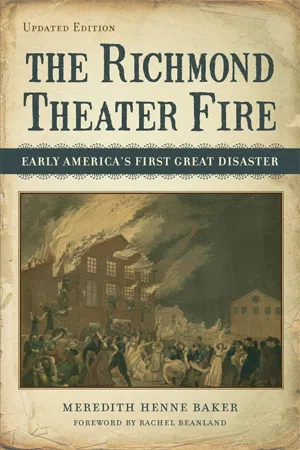
On the day after Christmas in 1811, the state of Virginia lost its governor and almost one hundred citizens in a devastating nighttime fire that consumed a Richmond playhouse. During the second act of a melodramatic tale of bandits, ghosts, and murder, a small fire kindled behind the backdrop. Within minutes, it raced to the ceiling timbers and enveloped the audience in flames. The tragic Richmond Theater fire would inspire a national commemoration and become its generation's defining disaster.A vibrant and bustling city, Richmond was synonymous with horse races, gambling, and frivolity. The gruesome fire amplified the capital's reputation for vice and led to an upsurge in antitheater criticism that spread throughout the country and across the Atlantic. Clerics in both America and abroad urged national repentance and denounced the stage, a sentiment that nearly destroyed theatrical entertainment in Richmond for decades. Local churches, by contrast, experienced a rise in attendance and became increasingly evangelical.In The Richmond Theater Fire, the first book about the event and its aftermath, Meredith Henne Baker explores a forgotten catastrophe and its wide societal impact. The story of transformation comes alive through survivor accounts of slaves, actresses, ministers, and statesmen. Investigating private letters, diaries, and sermons, among other rare or unpublished documents, Baker views the event and its outcomes through the fascinating lenses of early nineteenth-century theater, architecture, and faith, and reveals a rich and vital untold story from America's past.
- 352 pages
- English
- ePUB (mobile friendly)
- Available on iOS & Android
eBook - ePub
About this book
Information
Subtopic
North American HistoryIndex
History1
CATASTROPHE
Duty… induced me to dispatch you a hasty account of the most calamitous event our city has ever been afflicted with.
—ROBERT GAMBLE, JR., TO U.S. CONGRESSMAN
JAMES BRECKINRIDGE, RICHMOND, VIRGINIA,
DECEMBER 27, 1811, AT 2:30 IN THE MORNING
JAMES BRECKINRIDGE, RICHMOND, VIRGINIA,
DECEMBER 27, 1811, AT 2:30 IN THE MORNING
The fatal night of December 26, 1811, the Richmond Theater should have been empty and silent. Had actor George Frederick Cooke shown up on time for a carriage ride in New York City, the fire may never have happened at all.
Cooke, one of the most celebrated and chronically inebriated actors on the British stage, performed for years at the Royal Theater in Covent Garden. Near the end of 1810, at the urging of actor and manager Thomas Abthorpe Cooper, the fifty-four-year-old thespian sailed to the States for a lengthy American tour and a shot at personal and professional redemption. But even after Cooke agreed to cross the Atlantic, Cooper had some trouble getting him to leave Liverpool. From a perch at his tavern, Cooke repeatedly turned away the carriages Cooper sent, arguing that departure was “inconvenient.”1
When word reached the young nation that Cooke would perform on its boards, anticipation rose, and theater aficionados in the United States clamored for an opportunity to glimpse the legendary tragedian. Some fifty fans in Baltimore were trampled, none mortally, when ticket doors opened and the crowd “rushed in like a torrent.”2 In Boston, theatergoers, wrapped in blankets and thick wool coats and stamping their feet, huddled waiting outside the box office beginning in the wee hours of a frozen January morning to buy tickets.
Theatergoers in New York initially celebrated, then became disenchanted with Cooke during his lengthy stay there. The turning point in public favor came after a disastrously embarrassing benefit performance where Cooke, unrehearsed and stewed to the gills, repeated himself, recited soliloquies from the wrong play, and sputtered incoherent phrases.3 “If you have heard anything of me you have heard that I always have a frolic on my benefit day,” he protested lamely.4 His violent and verbally abusive alcoholic binges became a matter of public knowledge, regularly shaming his managers, who had hoped that a change in surroundings would lessen the pull of his most unfortunate drinking habit. “As a man in private life, he is the gentleman, the scholar, the friend…. Such is George Cooke, in his sober hours; but when stimulated by the juice of the grape, he acts in diametrical opposition to all this,” a fellow actor explained.5 After what had been, overall, a successful and influential American tour, by December 1811 Cooke’s behavior grew almost completely erratic. After a December 17 performance in New York City, he failed to catch his carriage to join the Placide & Green Company in Richmond, as was the mutual agreement.6 Instead, he inexplicably arranged a trip north to Massachusetts, went on a terrific bender when trapped in New London during a snowstorm, and missed his own opening night performance in Boston.
Meanwhile, Alexander Placide and John William Green, managers of the Placide & Green Company along with their associate William “Billy” Twaits, learned that Cooke had never engaged the carriage waiting for him in New York. Perhaps they assumed that he was ill, that he would simply be delayed, and were not aware that this was a stunt that Cooke was wont to pull—just as he had when Cooper attempted to dislodge him from Liverpool. Although patrons in the North may have grown weary of Cooke’s antics, the fact remained that he was an exceptionally famous artist, had never before toured in the South, and would be a sensation at the box office, drunk or not. His inclusion in the Placide & Green Company lineup effectively guaranteed them a triumphant and lucrative season.7 Cooke, undependable Cooke, if he would come through for them, stood to cement the company’s growing reputation and line their coffers well. And so the troupe waited, delaying their trip to Charleston, South Carolina, hoping Cooke would change his mind and meet them in Richmond. This meant extending their season several days until the evening after Christmas, when they put on what would be their final Richmond performance.
* * *
Placide & Green’s fortunes had seemed to be on an upswing. The descendant of a 1794 merger between Englishman Thomas Wade West and Frenchman Alexander Placide’s then-competing South Carolina companies, the supercompany broke into small groups of dancers, concert performers, or acting companies that toured through small venues when not needed to perform in a larger town during a peak season, like Richmond during the legislative session or Petersburg during the horse races.8 The units had a small touring group’s ability to travel easily, with the advantage of a large group’s top-quality instruments, scripts, sets, and costumes.9 The Charleston supercompany offered the best provincial theater in the United States and had no real competitor in the South. Margaretta Sully West took leadership of the company in 1799 when her husband Thomas Wade West, at age fifty-four, plunged from his Alexandria, Virginia, theater’s catwalk to the stage while examining fire damage.10 John William Green assumed her managerial mantle around 1804.11
During the Virginia tours lasting from August through December in 1811, the small company performed two or three evenings a week at the local theater near the capitol and kept Richmond audiences entertained with an impressive forty-five different plays. Fans flocked to Macbeth, Othello, She Stoops to Conquer, and lesser-known dramas like A Budget of Blunders.12 Placide & Green Company appealed to their patrons with visual effects and seemed to spare no expense in producing shows, advertising “new Scenery, Machinery, and Dresses” for the season and constant variety in their playbills. A new musical, Black Beard, the Pirate, amazed the audience in October with its “Grand Nautical Spectacle” and special effects: “The Revenge,” a pirate’s ship, “is seen on fire and sinks” in the final act.13
Though the company was enjoying a successful run in Virginia’s capital, the year was in other ways not winding to an auspicious close for Placide & Green. In early December 1811, the troupe lost one of their most popular members, a petite and graceful brunette actress named Elizabeth Arnold Poe. Her astonishing range of roles and her perky song-and-dance routines made Poe a favorite in the eight years she toured through Richmond with Placide & Green. In 1810, an unnamed critic in the Richmond Enquirer raved about Poe’s electrifying acting but confessed her personal charms were equally compelling to the male portion of the audience. “In regard to Mrs. Poe, for a reason which the glass will tell her, it is a difficult thing to separate the actress from the woman; no wonder then, if it should be also difficult to separate the critic from the man.”14 The twenty-four-year-old actress fell ill during the autumn of 1811, most likely with pneumonia. The company mustered profitable benefit performances to raise money for her medical care and support.15 Poe continued to worsen throughout the month of November, and her face grew sallow and thin as the disease progressed. She died in her rooms at the Washington Tavern on December 8, 1811, mere days before disaster struck her company, and was buried in an unmarked grave in Richmond’s public cemetery.
There was some question about what should happen to the children Poe left behind, a small, poorly disciplined boy of nearly three and an infant daughter. Her husband, a former member of Placide’s company and a shadowy historical figure, was probably dead. She had no family to speak of. The Mackenzies, a prominent Richmond family, took in Elizabeth’s daughter Rose.16 Wealthy, enterprising, and hard-driving Scotch tobacco merchant John “Jock” Allan and his kindhearted twenty-six-year-old wife Frances took in the boy. John had little interest in children, but Frances, who was adopted herself, had befriended an ailing Elizabeth Poe and fallen in love with her son. Frances’s appeals swayed John, but his relationship with the boy would become a thorny one. It would not be surprising if the sudden loss of his second parent and the sensory impressions of the dark days that soon descended upon Richmond had deeply affected the dark-haired, clever boy, deepening the melancholy artistic vision that would later permeate his poetry and render him one of America’s most groundbreaking and frightening authors.
As 1811 came to an end, there appeared unsettling signs, signs that made Virginians that December wonder aloud about the mysterious ways of nature—and the rumblings of divine wrath. On September 17, an annular eclipse had appeared in the sky, a bad portent. Then in November, America had been rocked by strange and sudden earthquakes, originating along the New Madrid fault line, which ran from southern Illinois down to Arkansas. The force of the quakes in Missouri caused the mighty Mississippi River to flow briefly backward and rang church bells in New England. Citizens as far away from the fault as Cuba, Quebec, and Washington, D.C.—where President and First Lady Madison feared the rattling White House was being burgled—felt the seismic activity, estimated to be as high as 8.0 on the modern Richter scale. The country would continue to rumble with aftershocks through February 1812.
Ominous feelings built when Virginians scanned the domestic and foreign news. The United States seemed to be in a very vulnerable position; war with Britain was imminent—it would be declared in June 1812—and the economic implications were sobering. In February 1811, President James Madison had levied another unpopular embargo against Britain, the third in four years, attempting to punish the British for their flagrant violations of international law against Americans. To Richmonder Benjamin Watkins Leigh, this was nothing less than an affair of honor between the two countries: “We have received a blow and we must strike one in return, or be forever disgraced,” he protested after the “insult offered to our Navy, in the affair of the Chesapeake.”17 Yet the country seemed in no condition to go to battle; Madison’s cabinet was unstable with its high turnover rates, the economy was worsening, and the nation’s troops lacked training and operated under generally poor leadership. If war should come, victory was by no means certain.
But Virginians were an irrepressible lot, and the Christmas season was just the time to put oppressive cares aside and lose oneself in the festivities. While descendants of the Puritans in the North had never made much of Christmastime, Virginians with their Anglican heritage heartily celebrated the holiday. Richmond’s population swelled in December due to the social season, which brought people into the capital from across the South. In an agrarian society, the overall pace of work, particularly for men, slowed during the winter, which became an ideal season for lengthy visits with friends and family, dances, and socializing.
It was also the time of year the state legislature held its annual session. In a 1904 retrospective, the Washington Post leafed back to the winter of 1811 in Richmond and stressed the significance of the social season in that locale. “Richmond and Philadelphia were in those days the two most important cities in America. While the meeting of Congress in Washington during the early winter of 1811 was a small affair in a small town, in the estimation of most Americans, the convening of the Virginia legislature and the opening of the social season in Richmond was in the Anglo-Saxon world second only to the opening of Parliament in London.”18 Many wealthy planters from distant counties in Virginia—or even other southern states—maintained a house in Richmond, relocating to town during the session.19 Other visitors and assemblymen boarded in the city or lodged with friends.20 Senators and delegates often brought their children of marriageable age to town in order to launch them into society, introducing them to suitable partners and business connections at dances, parties, and the theater, hoping to guarantee them a bright future. Parents had a narrow window: by February, the season would be over.21 The 1811–12 season was the “gayest winter Richmond had ever known and often we went from one entertainment to another and even a third on the same evening. There was dancing for the young people and cards for the old,” recalled one young woman.22
In 1811, a Philadelphia magazine praised Richmond for being a city celebrated beyond all others in the union for her cheerfulness and sophistication.23 First Lady Dolley Madison had been caught up in the swirl of Richmond hospitality during the winters when James served in the state legislature, and she recalled her days there fondly. In 1812, Dolley wrote to friend Sally Coles Stevenson in Richmond, “I rejoice to find your health restored & that you will past the Winter in Richmond. I some times wish myself with you for a while, for I love Richmond, because there is so much soul, so much real kindness in its enlighten’d society.”24
THE CITY
In 1780, Virginia had chosen a more central location for the seat of government than out-of-the-way Williamsburg and transferred the state capital to Richmond. Five years later, the state built the capitol building, designed by Thomas Jefferson, on Shockoe Hill, west of the original settlement on a nine-acre plot. This area, the “upper town,” had a magnificent view of the James River Falls and the sweeping countryside on either side. The sunset caught the banks along the river transforming them into red hills (“Rouge-Mont,” hence “Richmond”) that reminded her earliest settlers of the hills in Richmond, England. By 1811, Richmond was a place of influence and importance, a burgeoning manufacturing center centered midstate at the James River Falls. Many of the nation’s most prominent and powerful public servants in the colonial era and the early republic hailed from the state of Virginia—George Washington, Patrick Henry, Jefferson, James Madison—and most had spent time and established connections in Richmond.
Richmond was an isolated spot of u...
Table of contents
- COVER
- TITLE PAGE
- COPYRIGHT PAGE
- CONTENTS
- FOREWORD TO THE UPDATED EDITION
- PREFACE
- PROLOGUE
- 1: CATASTROPHE
- 2: PANDEMONIUM
- 3: LOSS
- 4: MOURNING
- 5: RECOVERY
- 6: JUDGMENT
- 7: REBUILDING
- 8: REVIVAL
- 9: RETURN
- EPILOGUE
- AFTERWORD, 2022
- APPENDIX
- NOTES
- BIBLIOGRAPHY
- ACKNOWLEDGMENTS
- INDEX
Trusted by 375,005 students
Access to over 1.5 million titles for a fair monthly price.
Study more efficiently using our study tools.
Frequently asked questions
Yes, you can cancel anytime from the Subscription tab in your account settings on the Perlego website. Your subscription will stay active until the end of your current billing period. Learn how to cancel your subscription
No, books cannot be downloaded as external files, such as PDFs, for use outside of Perlego. However, you can download books within the Perlego app for offline reading on mobile or tablet. Learn how to download books offline
Perlego offers two plans: Essential and Complete
- Essential is ideal for learners and professionals who enjoy exploring a wide range of subjects. Access the Essential Library with 800,000+ trusted titles and best-sellers across business, personal growth, and the humanities. Includes unlimited reading time and Standard Read Aloud voice.
- Complete: Perfect for advanced learners and researchers needing full, unrestricted access. Unlock 1.5M+ books across hundreds of subjects, including academic and specialized titles. The Complete Plan also includes advanced features like Premium Read Aloud and Research Assistant.
We are an online textbook subscription service, where you can get access to an entire online library for less than the price of a single book per month. With over 1.5 million books across 990+ topics, we’ve got you covered! Learn about our mission
Look out for the read-aloud symbol on your next book to see if you can listen to it. The read-aloud tool reads text aloud for you, highlighting the text as it is being read. You can pause it, speed it up and slow it down. Learn more about Read Aloud
Yes! You can use the Perlego app on both iOS and Android devices to read anytime, anywhere — even offline. Perfect for commutes or when you’re on the go.
Please note we cannot support devices running on iOS 13 and Android 7 or earlier. Learn more about using the app
Please note we cannot support devices running on iOS 13 and Android 7 or earlier. Learn more about using the app
Yes, you can access The Richmond Theater Fire by Meredith Henne Baker in PDF and/or ePUB format, as well as other popular books in History & North American History. We have over 1.5 million books available in our catalogue for you to explore.