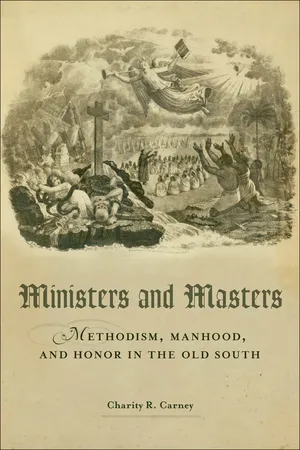
In Ministers and Masters Charity R. Carney presents a thorough account of the way in which Methodist preachers constructed their own concept of masculinity within -- and at times in defiance of -- the constraints of southern honor culture of the early nineteenth century. By focusing on this unique subgroup of southern men, the book explores often-debated concepts like southern honor and patriarchy in a new way.
Carney analyzes Methodist preachers both involved with and separate from mainstream southern society, and notes whether they served as itinerants -- venturing into rural towns -- or remained in city churches to witness to an urban population. Either way, they looked, spoke, and acted like outsiders, refusing to drink, swear, dance, duel, or even dress like other white southern men. Creating a separate space in which to minister to southern men, women, and children, oftentimes converting a dancehall floor into a pulpit, they raised the ire of non- Methodists around them. Carney shows how understanding these distinct and often defiant stances provides an invaluable window into antebellum society and also the variety of masculinity standards within that culture.
In Ministers and Masters, Carney uses ministers' stories to elucidate notions of secular sinfulness and heroic Methodist leadership, explores contradictory ideas of spiritual equality and racial hierarchy, and builds a complex narrative that shows how numerous ministers both rejected and adopted concepts of southern mastery. Torn between convention and conviction, Methodist preachers created one of the many "Souths" that existed in the nineteenth century and added another dimension to the well-documented culture of antebellum society.
- 200 pages
- English
- ePUB (mobile friendly)
- Available on iOS & Android
eBook - ePub
About this book
Information
1
Methodist Manhood
The perfection of ministerial purity of heart is to merge our honor in the honor of Christ.
—“Merging our Honor in Christ’s Honor,” Southern Christian Advocate, 1837
FELLOW CLERGYMEN and congregants might not have deemed John B. McFerrin an ideal minister. He had a short fuse and a firm belief in discipline that led him to rebuke others with unnecessary severity. Yet the same obstinate and aggressive personality that detracted from his ministry led his friends and followers to call him the ideal man. Born in Rutherford County, Tennessee, in 1807, McFerrin’s presumed predisposition for manliness was encouraged by a rugged frontier life and a family model that followed the customary gender roles of antebellum southern society. His mother’s gentle and nurturing personality contrasted with that of his father, whose dominant and willful temperament provided an example for young John. He truly became his father’s son. McFerrin’s domineering spirit would propel him into positions of authority in the Methodist Church as well as complicate his relationships with fellow ministers and laity alike. His attitudes and actions ultimately reflected a complex amalgam of regional expectations and Methodist restrictions on masculine behavior that consumed ministers in the antebellum South. This combination led to the creation of a distinct type of pastoral manhood, one that at once followed and deviated from southern norms.1
For McFerrin, the true test of manhood came when he joined the Tennessee Annual Conference in 1825 as a traveling minister and fell under the strict discipline of the Methodist Episcopacy. He, like many young ministers, felt responsible for the salvation of the men and women on his circuit (the region selected for his traveling ministry), and he went to great lengths to whip their souls into submission. “Cudgel in hand,” McFerrin would metaphorically “drive them back into the beaten path.” But the aggressive itinerant did not always consider the consequences of his passionate rebukes. He often went too far when chastising others and soon acquired a reputation for being harsh and uncompromising. While it may have cost the Church a few members, his direct and martial approach to discipline only contributed to the public perception of the minister’s manhood. According to his friend and biographer O. P. Fitzgerald, “the play of his genius and the intensity of his feeling bore him beyond the barriers where other men of weaker natures and cooler passions paused.”2 By crossing those barriers, McFerrin proved his commitment to the Church and demonstrated his manhood—a manhood that followed religious standards and reflected secular mores.
McFerrin’s confrontational attitude became evident when he entered into heated battles with other ministers and used what Fitzgerald described as “every lawful weapon within reach.” Some of his cohort admired his forcefulness, terming it a “gladiator” approach to all opposition. “What a man McFerrin is!” exclaimed the Rev. George W. Brush after witnessing McFerrin overpower opponents at a Louisville Conference, “His resources are inexhaustible!” Because of his rhetorical prowess, in 1840 he became editor of the South Western Christian Advocate in Nashville, giving him an outlet for continued verbal sparring over issues such as doctrine and ecclesiastical standards. His ego as well as his influence grew because of his appointment. McFerrin held that the defense of the Church and its success in the Southwest depended on his paper. In other words, he saw himself as the indispensable “Methodist warrior” in an “editorial watchtower” for the region. Upon his death in 1887, eulogists claimed that the “people of every State and every city and nearly every large town south of Mason and Dixon’s line have seen and heard and felt the power of this remarkable man.”3
Like McFerrin, other ministers viewed themselves as spiritual warriors and used the language of “honor” and masculine ideals to gird themselves for battle against sin and worldliness. And like other southern men, Methodist ministers defended their manhood as an incredibly valuable asset. Yet for these self-proclaimed holy men, manhood meant more than a place in the world; it was a sacred force that connected them to a higher power, the ultimate patriarch himself: their Father in Heaven. This connection between earthly competition and religious combat led to a marked contrast between regional and Methodist masculinity. Ministers served in the spiritual army of their Lord and saw disobedience to their heavenly Master as dishonorable. Living within a regional culture that prized masculine behavior that went against Methodist standards, ministers either stood apart from their secular peers or faced eternal dishonor. The Doctrines and Discipline of the Methodist Episcopal Church in America and the later edition created for the Methodist Episcopal Church, South (MEC, South) required ministers to act as examples for other believers and to abstain from all immoral activity. They were to avoid the worldly (and typically masculine) habits of “laying up treasure upon earth” through seeking fortune or fame, “fighting, quarreling, brawling,” “drinking spirituous liquors,” and “taking such diversions as cannot be used in the name of the Lord Jesus,” like politicking, frivolous socializing, dancing, and gambling.4
Individual ministers spoke at length about the dangers of southern honor and masculine culture, bolstering the language of the Discipline with personal stories and observations. The Rev. E. E. Wiley of the Holston Conference, for instance, pointedly remarked that the code of honor undermined rather than protected southern society. He argued that the way of honor “is marked with the tears and groans of stricken ones—the wail of widowed hearts—the blood of murdered men.” “The ‘code of honor,’ in its teachings, in its spirit, in its practical results, is so abhorrent to humanity, so bold a contradiction of Christianity, and so surely a remnant of a barbarous age,” that it could not survive in the progress of civilization.5 Although Wiley spoke explicitly of one of the most violent rituals connected to southern honor (the duel), his attitude reflects the feelings of the majority of Methodist ministers in the region when confronting the habits of their non-Methodist peers.
Despite the constraints placed on ministers’ social activities (either as personal choice or through adherence to church law), southern traditions and customs still influenced preachers’ lives and experiences. This was especially true as more southerners joined the Methodist “connection” (its network of circuits) and as the denomination became more entrenched in the region. The combination of cultural influences and Methodist disciplinary practices created a distinctive manhood for ministers who were eager to prove their masculinity as southern men and their spiritual purity and authority as southern ministers. Often Methodists relegated the aggressive and confrontational elements of worldly masculinity to their rhetoric. While they avoided physical violence, they appropriated elements of masculine conflict to meet their needs. The clergy dueled with pens, not pistols, on the pages of religious newspapers. Methodist preachers also defended their manhood and reputation openly before quarterly and annual denominational conferences, fending off assaults on their integrity and criticism from other ministers who questioned their orthodoxy or behavior. Although ministers could not join in the prototypical male conviviality in taverns nor attend dances and other social functions, they created their own fellowship through a clerical brotherhood, maintaining close relationships with each other and providing support for those itinerants undergoing special hardships. In the end, this clerical development of a particular brand of southern manhood led to distinct standards for men within the Church that imitated but hardly replicated the prescriptive standards of mainstream southern society.6
As ministers adapted to cultural demands in the early nineteenth century, they produced a brand of southern Methodist masculinity that borrowed from regional and religious concepts of manhood. Early in the southern Church’s history, an important component of ministerial honor depended on the minister’s outright rejection of mainstream southern social activities. Preachers prided themselves on a willingness to rebuke openly “sins” such as drinking, dancing, and other forms of carousing; some even went so far as to challenge some of the most fundamental of southern institutions, including slaveholding or the inner workings of plantation patriarchy. In challenging southern mores, Methodist ministers even became the targets of violence. The constant threat of persecution and their continued exposure to southern culture and customs altered the nature of southern Methodist masculinity. Like all cultural constructs, it remained flexible and even varied from circuit to circuit, changing from decade to decade in relation to the internal conditions in the Church and the external pressures of southern society. For instance, harassment combined with gradual entrenchment in southern culture led the southern Church to eventually accept sacred and secular proslavery arguments. On an even larger scale, continual pressures from within and without crafted Methodist masculinity, setting it apart from mainstream southern norms as well as northern Methodist standards.7
As did the mainstream masculine ideal, violence contributed to the molding of southern Methodist manhood, but it was violence perpetrated against and not by clergymen that helped define ministerial masculinity. In the early nineteenth century, many clergymen suffered from violent attacks, and a few died at the hands of angry mobs that viewed the Methodist Church as a threat to social order. During the winter of 1800 in Charleston, South Carolina, a mob overtook the preacher George Dougherty and tried to “pump him” (drown him by holding his head under a water pump) in front of the Methodist meetinghouse. “Here was a fine pretext for the young bloods of Charleston to display their chivalry,” a clergyman later noted, and for a young preacher to be publicly disgraced and emasculated. This statement alluded to the significance of violence in southern male culture, where physical altercations proved a young man’s masculinity. But by demonstrating their own “chivalry,” the persecutors endangered the perceived manhood of the poor preacher, who could not fight back because of his ministerial oath to follow Methodist prescripts. Contributing to the drama of the scene, a sympathetic Methodist woman, Martha Coogley, rushed to Dougherty’s aid. She tore off her apron and shoved it into the spout of the pump, rescuing the preacher from a likely sudden death. Her efforts ultimately failed to save him, however, for he died a few days later from a cold he caught that night. The attempted rescue of Dougherty by a sympathetic woman (who even used her apron, an emblem of her femininity, to save him) only further unmanned the beaten minister. Unfortunately, Dougherty’s persecution was hardly unique. Attacks on ministers were common in the early days of southern Methodism (before and directly after the Revolutionary War) and were often related to the widespread perception of their unmanliness.8
Dougherty’s tale speaks to another aspect of the Methodist ministerial reputation added in this early period. Many southern men believed that clergymen were effeminate and belonged in the woman’s sphere. Dougherty’s rescue by a female congregant, for instance, played into the imagery of the general weakness of Methodist ministers and their separation from male society. Ministers might be ridiculed as abstainers and moralizers for refusing to participate in typical masculine activities. Some southern patriarchs, such as John Randolph of Roanoke, openly questioned their manhood and maintained suspicions regarding their lack of manly recreation. At the 1829 Virginia Constitutional Convention, Randolph insisted that the clergy belonged in the “domestic circle” with women, arguing that society should limit the divines’ exposure to rough masculine pursuits to protect their sensitive moral scruples. Methodists attempted to create a separate sphere where itinerants “rejected the cares, and gains, and hindrances” of worldly interests. In fact, many clergymen believed that if traveling preachers “blend[ed] earthly and heavenly functions,” they would “suffer for their sacrilege.” But, even if they did not participate in traditional male practices, clergymen still understood the “language of honor” and when it was being used against them. Because of the accusations of men like Randolph, ministers sought to dispel doubts about their status as southern men. They created their own concepts of masculinity that borrowed from worldly standards of manhood but that also celebrated their spiritual elevation and isolation from southern society.9
Where the demands of society conflicted with the Methodist Discipline, ministers had to defend the latter regardless of their neighbors’ criticism. Faithfulness in the face of persecution often proved a minister’s worth. Divines “must expect to be hated and despised by all men,” the Discipline advised, “except the children of God, and those who are seeking so to be.” In explaining the doctrines and discipline of the church, Francis Asbury and Thomas Coke argued that isolation from irreligious society could serve as a necessary buffer from worldly vice. For a preacher experiencing such seclusion, “the wall of contempt which surrounds him, preserves him from a thousand temptations to which other ministers are exposed.” As Methodist influence grew in the South and hostility dwindled, however, ministers often adapted to cultural expectations of manhood. But this did not change the foundational principles of the Discipline or Methodist rhetoric regarding the need to adhere to its moral guidelines. In 1859, the Methodist Pulpit South published several articles eschewing the honor of man and promoting the higher cause of glorifying God. The Rev. G. F. Pierce of the Tennessee Conference argued that a man could follow “a constitutional impulse” to act morally in order to enhance his reputation or influence and show himself to be “honorable, moral, refined.” His soul, however, would undoubtedly suffer loneliness and destitution. A good name and wealth are worldly values, he maintained, but persecution and salvation are the lot and the reward of God’s true followers.10
Taking this advice to heart, many clergymen felt duty bound to confront other men over their social habits, dueling, and political aspirations. In rhetoric and testimonies most ministers emphasized their personal separation from secular pursuits that fostered violent or ungodly masculine behavior and chastised men who engaged in such activities. And if members of the Methodist connection participated in secular politics or frivolous socializing, they might receive harsh rebukes from their brethren, their position in the church exacerbating the sinfulness of their deeds. As they confronted and resisted the sins of temporal manhood, such as politicking, dueling, drinking, gambling, and idle socializing, the Methodist clergy simultaneously crafted their own standards of masculine behavior and a distinct conception of patriarchy. In a society obsessed with hierarchy and the maintenance of authority, ministers found new methods for expressing their masculinity and demanding respect. Like McFerrin, they delivered aggressive sermons and lived a martial faith to counter assumptions of clerical effeminacy; in doing so they created a ministerial society that borrowed from and distorted notions of southern manhood.
One of the most complex elements of Methodist manhood involved church politics. Politics (including campaigning and backbiting) swirled around the Methodist Church, but no good minister would ever confess to the sin of politicking. Most Methodist preachers shunned partisan politics and abstained from entering into political discussions. They also questioned the motives and morality of individuals who decided to enter into the political arena. For other men, public office provided an opportunity to demonstrate their status and independence and to fulfill family expectations. In a highly competitive environment, political disputes led to harsh words, lying, fighting, and other activities that contradicted Methodist discipline. Bullying and brutality—and a shared culture of alcohol and swearing—accompanied campaigns across the nation. Ministers did not participate in this feting, nor did they wish to sully their religious leadership with political ambition. They instead aspired to leadership positions within the Church, such as the Episcopacy, engaging in a form of politics supposedly removed from worldly ambition. McFerrin, for example, wielded enough power in his pulpit and through his newspaper to satisfy a thirst for authority and influence. According to his biographer, he would have made an excellent politician because of his aptitude for “the art of popularity.” What set McFerrin apart from his worldly counterparts was “a Christian heart, a Christian conscience, and a Christian purpose in life.” After taking ministerial vows, he “surrendered” any earthly reward or fame that politics would have brought him.11
Many preachers who shared this vision of separating spiritual from temporal authority warned against pursuing popularity and a life in politics. In an article entitled “Piety and Wealth—Contrasted,” one contributor to the Southern Christian Advocate praised the poverty of a dying woman who professed ultimate happiness because of her faith. The author compared her satisfaction at the end a long and impoverished life with the discontent of a wealthy war veteran and politician. He lived in a picturesque setting and had the respect and honor of the community but was painfully unhappy. “His ambition has always been worried with some fruitless effort to accomplish what he found impracticable,” and he never sought piety or salvation. The contrast between a devout but humble woman and a revered but unhappy man reflected the general Methodist disdain toward the relentless and vain acquisition of earthly riches and political esteem. This example pointed to masculine pursuits that distracted men from the important task of caring for their souls.12
Methodist Bishop James O. Andrew offered a similar account of an older gentleman who wasted his life in politics, foolishly hoping for fame and fulfillment in this world. In the 1840s, during a stay in Little Rock, Arkansas, Andrew witnessed the turmoil surrounding a session of the state legislature and commented on his disappointment with the representatives’ behavior. “Alas, for poor human nature,” he remarked, “here were men moving heaven and earth to obtain a little earthly distinction, who could, perhaps, scarcely afford to bestow a single day’s consideration on the imperishable interests of their immortality.” One graying senator caught his eye, a gentleman who held a position of responsibility and respect but who sought even more power at the end of his life. Despite the man’s professional success, Andrew cited him as an example of absolute failure. In the weeks following the election, the bishop claimed that the politician lost...
Table of contents
- Cover Page
- Title Page
- Copyright Page
- Dedication
- Contents
- Acknowledgments
- Introduction
- 1. Methodist Manhood
- 2. The Patriarchy of the Pulpit
- 3. Southern Honor and the Minister’s Family
- 4. Children, Obedience, and Authority
- 5. The Spiritual Slave
- Conclusion
- Notes
- Bibliography
- Index
Trusted by 375,005 students
Access to over 1.5 million titles for a fair monthly price.
Study more efficiently using our study tools.
Frequently asked questions
Yes, you can cancel anytime from the Subscription tab in your account settings on the Perlego website. Your subscription will stay active until the end of your current billing period. Learn how to cancel your subscription
No, books cannot be downloaded as external files, such as PDFs, for use outside of Perlego. However, you can download books within the Perlego app for offline reading on mobile or tablet. Learn how to download books offline
Perlego offers two plans: Essential and Complete
- Essential is ideal for learners and professionals who enjoy exploring a wide range of subjects. Access the Essential Library with 800,000+ trusted titles and best-sellers across business, personal growth, and the humanities. Includes unlimited reading time and Standard Read Aloud voice.
- Complete: Perfect for advanced learners and researchers needing full, unrestricted access. Unlock 1.5M+ books across hundreds of subjects, including academic and specialized titles. The Complete Plan also includes advanced features like Premium Read Aloud and Research Assistant.
We are an online textbook subscription service, where you can get access to an entire online library for less than the price of a single book per month. With over 1.5 million books across 990+ topics, we’ve got you covered! Learn about our mission
Look out for the read-aloud symbol on your next book to see if you can listen to it. The read-aloud tool reads text aloud for you, highlighting the text as it is being read. You can pause it, speed it up and slow it down. Learn more about Read Aloud
Yes! You can use the Perlego app on both iOS and Android devices to read anytime, anywhere — even offline. Perfect for commutes or when you’re on the go.
Please note we cannot support devices running on iOS 13 and Android 7 or earlier. Learn more about using the app
Please note we cannot support devices running on iOS 13 and Android 7 or earlier. Learn more about using the app
Yes, you can access Ministers and Masters by Charity R. Carney in PDF and/or ePUB format, as well as other popular books in History & North American History. We have over 1.5 million books available in our catalogue for you to explore.