Celebrated poet David Kirby says that when he was a boy he wanted to run away and join the circus but never found one he liked, so he invented his own. Many of the poems in his dazzling new collection, Talking about Movies with Jesus, suggest his personal carnival is still a work in progress.
Much like a traveling circus, Kirby's poems are defined equally by their transient nature and by their destination. The poem "The Phantom Empire" -- which features Gene Autry repeatedly having to escape from a fictional city 20, 000 feet underground in order to make it back home in time to voice his afternoon radio show -- suggests that Kirby has discovered the journey to what one is after is often more entertaining than getting it.
Yet, in frenetic musings on Bo Diddley, a certain First Lady ("Skinny-Dipping with Pat Nixon"), Kirk Douglas, and Gerald Stern, Kirby notes the importance of arrival. Earnest conversations with cultural icons from Little Richard to Jesus reveal to the poet, as a character in his own story, that art, whether a song or poem or scripture, is all we here on earth know of heaven and all we need to know.
Kirby's latest work is at once the caravan, the carnival, and the crowd merging together to form a wondrous collection.
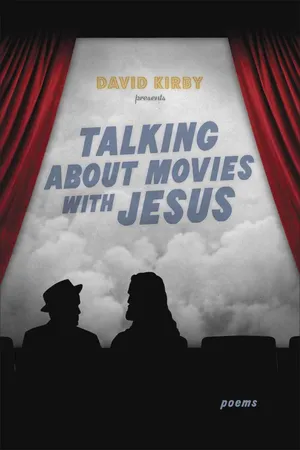
- 80 pages
- English
- ePUB (mobile friendly)
- Available on iOS & Android
eBook - ePub
About this book
Information
Subtopic
PoetryIndex
LiteratureTalking about Jesus with Little Richard
“I am the beautiful Little Richard,” says Little Richard
as he limps to his piano, “and you can see that I am telling
you the truth” before kicking off with “Good Golly, Miss
Molly” and going into “Blueberry Hill,” alternating between
his own hits and standards by Ray Charles, Hank Williams,
Bob Seger, and such lesser-knowns as fellow Specialty
Records artist Larry Williams (“Bony Moronie”) and, withal,
creating “a dream” that is “a memory of the future,” as Greil
Marcus says in The Shape of Things to Come: Prophecy
and the American Voice, quoting Steve Erickson’s novel
The Sea Came In at Midnight, though Marcus suggests
replacing “a dream” with “an art.” Good idea, Greil!
That’s the way art works for me, or at least good art.
So what’s bad art? I know, a memory of the past,
i.e, a memory and nothing more, and you’ve already had
plenty of those, right, reader? Little Richard only makes it
to the end of a couple of songs uninterrupted by his own
fizzy glee, biographical bits breaking through (“I was out
there when there wasn’t nobody!”) as well as musical
preferences (“Kanye West is so beautiful! And I like 50 Cent,
but I’d rather have a dollah!”), ads for merchandise (“I’ll sign
posters after the show, but only the big ones!”) and faith
testimonials (“Don’t put a question mark where God
has put a period!”). Also, who else but Little Richard
can say, “I want a big fat white lady to get up on the stage
and dance” and get away with it? “A big fat juicy white lady—
a juicy one, now! And a big fat juicy black lady, and a big fat
Mexican lady, too”? Before the show, I’d been talking
to Nancy, a registered nurse who has been to perhaps
a dozen Little Richard shows in the last couple of years
and is wearing a shiny red dress that causes her to “slither,”
she says, as, indeed, she slides out of her seat and nearly
onto the floor and gathers herself gamely and plops down
again before starting perhaps her dozenth floorward slide
of the evening, though when the Architect of Rock ’n’ Roll
issues his summons for beef on the hoof, Nancy, whom
any gentleman would describe as zaftig, takes off like a shot,
and within seconds she’s joined on stage by another twenty
women, most disappointingly slim, though, through
the magic of rock, somehow they all turned plump and juicy
as they bopped and shook. Speaking of magic, the group
that opens the show is called Falling Bones, a self-described
“party band” that wisely plays covers of everyone from
the day except Little Richard: Chuck Berry, Elvis, the Stones,
Johnny Cash. None of the musicians are spring chickens,
but the front man repeatedly and, after a while, convincingly
points out that the drummer has just celebrated his eighty-third
birthday, so I borrow Nancy’s binoculars, and he doesn’t look
a day over seventy-nine to me. The Falling Bones also say
if it hadn’t been for Little Richard, there would be
no rock ’n’ roll. Not true! It just wouldn’t be as good.
There’s always somebody before anybody: John the Baptist
before Jesus, for example, and God the Father before both
of them. I must be about my Father’s beeswax, says Jesus,
and behold, “Jesus had a huge impact on Christianity,”
as the student wrote in his freshman paper. Speaking
of magic again, what is in the black bag that a band member
sets down beside Little Richard’s piano stool? Nancy has
noticed it during previous shows and guesses that it might
be emergency medical supplies, which is reasonable, being
as how Little Richard has limped out on crutches, though
it turns out that the trouble is with his hip (“the pain never
leaves!”), so that, in his flowing tresses and spangled blue suit,
he looks like a sea god who has been clipped by a passing
motorboat. Nor does he lack for acolytes, not to mention
proselytes, apostles, and epigones, for even were there no star
performer, the ten-piece Little Richard band puts on a show
that would have the dead dancing, fat and juicy or not,
and its sound is big on guitars and saxes, so that it is loud
but sweet, like World War III fought with candy howitzers.
“Long Tall Sally,” “Slippin’ and “Slidin’,” “Jenny, Jenny,”
“Keep a Knockin’,” “The Girl Can’t Help It”—they keep
coming, the hits, so that one might say, as Diderot said
of Leibniz, who is best known for his work in philosophy
but who also contributed to the fields of chemistry,
chronometry, geology, historiography, jurisprudence,
linguistics, optics, physics, poetry, and political theory,
that “when one . . . compares one’s own small talents
with those of a Little Richard, one is tempted
to throw away one’s books and go die peacefully in the depths
of some dark corner.” And setting aside for the moment
that Diderot said this not of Little Richard at all, who,
to my knowledge, has contributed nothing to any of these
fields, but of the aforementioned Leibniz, still, it is true
that each of us owes God a death, as someone else says,
and though we may be beautiful, even “old and beautiful,”
as Little Richard describes himself when he engages yet again
with what is clearly a favorite topic, still, as great Achilles
says, “Fat sheep and oxen you can steal; cooking pots
and golden-maned horses you can buy; but once it has left
the circle of his teeth, the life of a man can be neither replaced,
nor stolen, nor bought.” All of us will die, some even “fall
dead,” as Little Richard says one of the sax players’ mothers
did just last week: “She fell dead!” he cries. “Imagine that,
your own mama fallin’ dead!” We all want to die in style,
with flowers on the bed table and a scribe to take down
our last words. But then we fall dead: we’re making
a blueberry pie for the people that love us so much
and that we love so much, and they’re in the other room
reading newspapers and watching the game on TV,
when, bam! There’s a crash in the kitchen, and they come
running in, and there you are in a welter of pie filling
and Pyrex, your glasses knocked sixteen ways from Tuesday
and your cotton house dress over your knees. They’re grabbing
their cell phones now: “It’s Big Mama,” they’re shouting,
“she fell dead!” I figure the band members are my best shot
at solving the black bag mystery, so as I wait backstage
for Little Richard to sign my poster and they leave
the dressing room for the bus, I ask first the bass player:
“Hey, what’s in the black bag?” “Oh, my!” he replies
and pats me on the shoulder. The trumpet player says,
“Hundred dollar bills—I hope!” A sax player may come
closest to the truth when he says, “ Aw, that’s just his
personal stuff.” The security guy warns us not to take
photos or touch the entertainer, but I do want to talk to him,
at least, and I think of Jesus’s words to his disciples
in Matthew 10:16, “Behold, I send you forth as sheep
in the midst of wolves: be ye therefore wise as serpents,
and harmless as doves,” and so, to be wise yet appear
harmless, I say “Willie Ruth” over and over again to myself,
Willie Ruth Howard being Little Richard’s cousin
and someone I’d interviewed earlier this year, so that when
I finally get up to the front of the line, instead of saying,
“I’m your biggest fan” or “you was out there when there
wasn’t nobody!” or some similarly off-putting claptrap,
I blurt out, “Willie Ruth loves you!” And Little Richar...
Table of contents
- Cover Page
- Title Page
- Copyright Page
- Dedication
- Contents
- Talking about Jesus with Little Richard
- Paganini’s Kickshaw, the Violin Known as “The Cannon”
- Wrestling
- The Phantom Empire
- Be Not Inhospitable to Fat Babies
- Old Dog Man
- Explaining Gods and Millionaires
- Ode to Gratitude
- Searching for the Wrong-Eyed Jesus
- The Have-a-Go Pensioner
- Big Man’s Got the Blues
- Bo Diddley in Japan
- Hey, Gerald
- Skinny-Dipping with Pat Nixon
- These Arms of Mine
- Bull Cow Moanin’ at Midnight
- Talking about Movies with Jesus
- Notes and Acknowledgments
Trusted by 375,005 students
Access to over 1.5 million titles for a fair monthly price.
Study more efficiently using our study tools.
Frequently asked questions
Yes, you can cancel anytime from the Subscription tab in your account settings on the Perlego website. Your subscription will stay active until the end of your current billing period. Learn how to cancel your subscription
No, books cannot be downloaded as external files, such as PDFs, for use outside of Perlego. However, you can download books within the Perlego app for offline reading on mobile or tablet. Learn how to download books offline
Perlego offers two plans: Essential and Complete
- Essential is ideal for learners and professionals who enjoy exploring a wide range of subjects. Access the Essential Library with 800,000+ trusted titles and best-sellers across business, personal growth, and the humanities. Includes unlimited reading time and Standard Read Aloud voice.
- Complete: Perfect for advanced learners and researchers needing full, unrestricted access. Unlock 1.5M+ books across hundreds of subjects, including academic and specialized titles. The Complete Plan also includes advanced features like Premium Read Aloud and Research Assistant.
We are an online textbook subscription service, where you can get access to an entire online library for less than the price of a single book per month. With over 1.5 million books across 990+ topics, we’ve got you covered! Learn about our mission
Look out for the read-aloud symbol on your next book to see if you can listen to it. The read-aloud tool reads text aloud for you, highlighting the text as it is being read. You can pause it, speed it up and slow it down. Learn more about Read Aloud
Yes! You can use the Perlego app on both iOS and Android devices to read anytime, anywhere — even offline. Perfect for commutes or when you’re on the go.
Please note we cannot support devices running on iOS 13 and Android 7 or earlier. Learn more about using the app
Please note we cannot support devices running on iOS 13 and Android 7 or earlier. Learn more about using the app
Yes, you can access Talking about Movies with Jesus by David Kirby in PDF and/or ePUB format, as well as other popular books in Literature & Poetry. We have over 1.5 million books available in our catalogue for you to explore.