In January 1847, a grain convoy passed through Buzançais, an obscure village in a remote region of central France that was suffering from hunger, high prices, and widespread unemployment. Villagers intercepted the shipment, invaded granaries and mills, and forced resale of the grain at a just price set by the people. What started as a classic subsistence movement, however, triggered two days of rioting and class hostility punctuated by uncommon property damage and death. Disorder soon spread throughout the region. The Buzançais riot quickly became an evocative symbol of the rights of the people, and stories about the riot have survived into the twenty-first century.
In Interpreting Social Violence in French Culture, Cynthia A. Bouton traces how the production and marketing of the Buzançais riot story served political commentators, publishers, authors, illustrators, and local enthusiasts, enabling them to draw upon key points from the 1847 uprising to negotiate issues relevant to their own times. Bouton argues that over time, especially from the 1970s, the persistent integration of stories of social protest into a widening variety of media has helped shape French political identity as one in which the politics of the street has become as customary as the politics of political assemblies.
Bouton examines representations of the riot in newspapers, novels, illustrations, popular and scholarly historical narratives, cartoons, television, local spectacles, and on the Internet. She analyzes power relations embedded in texts and in images; the ways in which texts and images complement, complicate, and contradict each other; and the ways in which history, memory, and fiction intersect. Both in 1847 and subsequently, she shows, efforts to reorder the disorder at Buzançais have exposed aspects of French social and cultural attitudes and practices. She demonstrates that the particular media employed to tell the Buzançais story both constrained and empowered the messages conveyed by textual and visual narratives of it, perhaps as much as the ideological positions of authors, illustrators, or producers.
By probing the relationship between medium and story in relation to the Buzançais riot, Interpreting Social Violence in French Culture offers a new interpretation of this defining moment in French history.
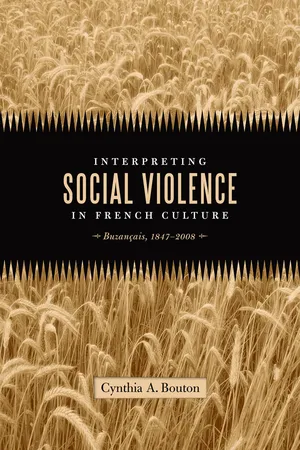
- 272 pages
- English
- ePUB (mobile friendly)
- Available on iOS & Android
eBook - ePub
About this book
Information
Table of contents
- Cover Page
- Title Page
- Copyright Page
- Contents
- Acknowledgments
- Introduction
- CHAPTER ONE The Riot and Its First Renditions
- CHAPTER TWO Repression and Reaction, Challenge and Response
- CHAPTER THREE Buzançais in Nineteenth-Century Politics and Literature
- CHAPTER FOUR Popular Publishing between the Wars
- CHAPTER FIVE Jacquerie as Cartoon and Television Drama
- CHAPTER SIX Buzançais Rendered in History, Patrimony, and Sound and Light
- Epilogue
- Notes
- Index
Trusted by 375,005 students
Access to over 1.5 million titles for a fair monthly price.
Study more efficiently using our study tools.
Frequently asked questions
Yes, you can cancel anytime from the Subscription tab in your account settings on the Perlego website. Your subscription will stay active until the end of your current billing period. Learn how to cancel your subscription
No, books cannot be downloaded as external files, such as PDFs, for use outside of Perlego. However, you can download books within the Perlego app for offline reading on mobile or tablet. Learn how to download books offline
Perlego offers two plans: Essential and Complete
- Essential is ideal for learners and professionals who enjoy exploring a wide range of subjects. Access the Essential Library with 800,000+ trusted titles and best-sellers across business, personal growth, and the humanities. Includes unlimited reading time and Standard Read Aloud voice.
- Complete: Perfect for advanced learners and researchers needing full, unrestricted access. Unlock 1.5M+ books across hundreds of subjects, including academic and specialized titles. The Complete Plan also includes advanced features like Premium Read Aloud and Research Assistant.
We are an online textbook subscription service, where you can get access to an entire online library for less than the price of a single book per month. With over 1.5 million books across 990+ topics, we’ve got you covered! Learn about our mission
Look out for the read-aloud symbol on your next book to see if you can listen to it. The read-aloud tool reads text aloud for you, highlighting the text as it is being read. You can pause it, speed it up and slow it down. Learn more about Read Aloud
Yes! You can use the Perlego app on both iOS and Android devices to read anytime, anywhere — even offline. Perfect for commutes or when you’re on the go.
Please note we cannot support devices running on iOS 13 and Android 7 or earlier. Learn more about using the app
Please note we cannot support devices running on iOS 13 and Android 7 or earlier. Learn more about using the app
Yes, you can access Interpreting Social Violence in French Culture by Cynthia A. Bouton in PDF and/or ePUB format, as well as other popular books in History & European History. We have over 1.5 million books available in our catalogue for you to explore.