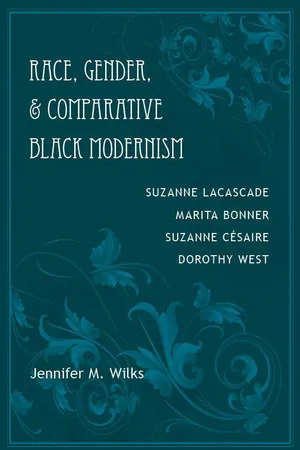
Race, Gender, and Comparative Black Modernism revives and critiques four African American and Francophone Caribbean women writers sometimes overlooked in discussions of early-twentieth-century literature: Guadeloupean Suzanne Lacascade (dates unknown), African American Marita Bonner (1899--1971), Martinican Suzanne Césaire (1913--1966), and African American Dorothy West (1907--1998). Reexamining their most significant work, Jennifer M. Wilks demonstrates how their writing challenges prevailing racial archetypes -- such as the New Negro and the Negritude hero -- of the period from the 1920s to the 1940s, and explores how these writers tapped into modernist currents from expressionism to surrealism to produce progressive treatments of race, gender, and nation that differed from those of currently canonized black writers of the era, the great majority of whom are men.
Wilks begins with Lacascade, whom she deems "best known for being unknown, " reading Lacascade's novel Claire-Solange, âme africaine (1924) as a protofeminist, proto-Negritude articulation of Caribbean identity. She then examines the fissures left unexplored in New Negro visions of African American community by showing the ways in which Bonner's essays, plays, and short stories highlight issues of economic class. Césaire applied the ideas and techniques of surrealism to the French language, and Wilks reveals how her writings in the journal Tropiques (1941-45) directly and insightfully engage the intellectual influences that informed the work of canonical Negritude. Wilks' close reading of West's The Living Is Easy (1948) provides a retrospective critique of the forces that continued to circumscribe women's lives in the midst of the social and cultural awakening presumably embodied in the New Negro.
To show how the black literary tradition has continued to confront the conflation of gender roles with social and literary conventions, Wilks examines these writers alongside the late twentieth-century writings of Maryse Condé and Toni Morrison. Unlike many literary analysts, Wilks does not bring together the four writers based on geography. Lacascade and Césaire came from different Caribbean islands, and though Bonner and West were from the United States, they never crossed paths. In considering this eclectic group of women writers together, Wilks reveals the analytical possibilities opened up by comparing works influenced by multiple intellectual traditions.
eBook - ePub
Race, Gender, and Comparative Black Modernism
Suzanne Lacascade, Marita Bonner, Suzanne Césaire, Dorothy West
- 272 pages
- English
- ePUB (mobile friendly)
- Available on iOS & Android
eBook - ePub
Race, Gender, and Comparative Black Modernism
Suzanne Lacascade, Marita Bonner, Suzanne Césaire, Dorothy West
About this book
Information
1 A Dying Exoticism
The Enigmatic Fiction of Suzanne Lacascade
Qu’est-ce après tout que l’engagement sinon la restitution de quelque aspect de la vérité que l’on a choisi d’illustrer?
What is engagement, after all, if not the restoration of some aspect of the truth that one has chosen to illustrate?
—MARYSE CONDÉ, “La littérature féminine de la Guadeloupe” (1976)
When Claire-Solange, âme africaine was published in 1924, the novel allegedly created such a stir that its author, Guadeloupean writer Suzanne Lacascade, was forced to leave her island home.1 Yet Lacascade is perhaps best known for being unknown; that is, it is her inscrutability that often precedes and intersects with critical examinations of Claire-Solange, her sole publication.2 What little biographical information is available verges on the nonexistent, as in writercritic Maryse Condé’s admission that “nous ne savons rien de Suzanne LACASCADE, de sa vie, de ses expériences” (“we know nothing about Suzanne LACASCADE, about her life, [or] about her experiences”).3 As a result, Claire-Solange is not only a literary text but also a historical document, the record of an otherwise unknowable black modernist woman writer. While such a claim rightly raises concerns about collapsing authorial and fictional identities, my aim here is to read the intersection between Lacascade’s life and her novel as evidence of the enigmatic nature of much early Francophone Caribbean fiction. Written between the death of exoticism and the birth of Negritude, Claire-Solange conjures and contradicts the work of predecessors, successors, and peers alike. It is fluent in the rhetoric of exoticism yet nevertheless advances a project of racial valorization that foreshadows Caribbean Negritude’s reclamation of the region’s African heritage. It coincides with the literature of regionalism yet embraces a diasporic perspective whose reach extends far beyond the Caribbean archipelago. And, finally, Claire-Solange recalls the models of exemplarity proffered by Negritude and regionalism yet does so through a protagonist who is too feminist for the former movement and too acerbic for the latter.
As a result, I am interested in how Lacascade’s novel, rather than conforming to fixed literary models, instead slips between them, revealing their permeability, points of contention, and, ultimately, interdependence. If the narrative of Claire-Solange, âme africaine is at times melodramatic, an assessment to which I will return later, it is a narrative whose flaws reveal the shortcomings of both exoticist escapism and Negritude “engagement.” When the protagonist’s unmitigated praises about her native (Caribbean) and ancestral (African) homes seem to reach a fever pitch, it is then, and perhaps only then, that one realizes the extent to which much of Claire-Solange’s persona is deliberate, strategic performance. The character not only boldly asserts a self-determined identity but, being conscious of others’ desire to define her, also positions herself as a living tableau to be read critically, indeed, to be regarded carefully, rather than through the rose-colored lenses of exoticist or Negritude stereotypes. It is in this unexpected and original narrative turn that I locate Lacascade’s modernism.
Set principally in World War I–era Paris, Claire-Solange opens with a cable announcing the imminent arrival of the title character, the twenty-year-old daughter of Aurore Duflôt Hucquart, a deceased Martinican mulâtresse (mulatta), and Étienne Hucquart, a white Frenchman.4 A devoted daughter, Claire-Solange reluctantly leaves Martinique to accompany an ailing Étienne to France. There father, daughter, and various members of the Duflôt family settle into the home of Étienne’s widowed sister-in-law. This generous but strained hospitality soon proves more mercenary than altruistic: convinced that she married the wrong brother, Jeanne Hucquart, the consummate Parisian bourgeoise, plans to woo Étienne by welcoming his Caribbean extended family into her home. To ensure success Jeanne enlists Jacques Danzel, her godson, to court Claire-Solange, thus persuading her to remain in Paris with Étienne. Yet neither Jeanne nor Jacques is prepared for the vehemence with which Claire-Solange rebuffs their advances. She dismisses the former as her “tante blanche” (“white aunt”; 63), the latter as her “pseudo-cousin” (62). Claire-Solange further distances herself from French society by proudly declaring her difference, alternately identifying herself as nègre, africaine, and mulâtresse française. This resistance extends to the physical environment: Claire-Solange prefers the French capital’s Caribbean enclave to the smart neighborhood where Jeanne lives. In brief Claire-Solange considers her visit to France more an occasion to assert her ties to Martinique than to appreciate or participate in life in Paris.
Ultimately, however, Claire-Solange finds herself more and more drawn to Jacques Danzel and, by extension, France. The woman who once responded to her cousins’ teasing prediction that she would marry Danzel with the denial “Jamais je n’épouserai un blanc, jamais pas, jamais pas” (“I’ll never marry a white man, never, never”; 28) begins to reconsider her formerly staunch opposition to all things, her father presumably excluded, white and French. After a series of monumental defining events—the departure of her maternal family (save her aunt and chaperone Émilienne), the experience of meeting her paternal family, and the outbreak of World War I—Claire-Solange acknowledges her change of heart. The novel casts her eventual union with Jacques Danzel as a triumph of love over pride, as Lacascade’s heroine at last recognizes the European heritage intermingled with her “African blood” and her suitor, wounded during the war, trusts that it is love, not pity, that has won Claire-Solange’s heart. While the fate of Jeanne’s pursuit remains unknown, the return of the prodigal Étienne is completed through his daughter: as he once exiled himself from France for his wife, so Claire-Solange exiles herself from Martinique to remain with Jacques Danzel.
It is perhaps because of the incongruity between Claire-Solange’s politicized narrative of race and identity and its apparent rehearsal of the more conventional marriage plot that reception of the novel has been uneven. At the time of its publication the novel was reviewed by the mainstream Le Petit Parisien, in which it was declared “de réelle promesses” (“of real promise”), and in the Francophone organ La Dépêche Coloniale et Maritime, in which Lacascade was praised as a writer “de réel talent” (“of real talent”).5 These positive statements aside, the manner in which the latter assessment was qualified speaks to the social discomfort and critical silence that the novel went on to produce:
Mais pourquoi l’auteur insiste-t-il autant sur l’intimité des races? C’est trop fort exagéré, Mademoiselle, je vous l’assure, et il y a beau temps que le préjugé de couleur n’existe plus en France, et que nous en avons laissé toute la cruelle sottise aux chrétiens anglo-saxons!
But why does the author insist so much on racial intimacy? It’s overexaggerated, Miss, I assure you, and it’s been a good while since color prejudice has existed in France and we’ve left its cruel foolishness to Anglo-Saxon Christians!6
Whatever the critic’s own political position, his words spoke to prevailing trends in both radical and conservative streams of Francophone Caribbean thought: interracial romance was not a progressive topic in the eyes of militant intellectuals advocating for sociocultural independence from France, nor was French racism a favorite subject among moderates or conservatives in the Guadeloupean and Martinican middle and upper classes. As part of its mission civilisatrice (civilizing mission), French colonialism initially strove to transform colonial others into French subjects through language, instruction, and—in the case of les vieilles colonies of Martinique, Guadeloupe, French Guyana, and Réunion—citizenship.7 The assumption of this new, French identity by the colonized was called “assimilation,” of which an important component was the belief that the France of the 1789 Revolution was incapable of fostering racism.
Paulette Nardal (1896–1985) and Étienne Léro (1910–39) are two key interwar Francophone intellectuals who were publicly vocal about questions of race and assimilation yet curiously silent about Claire-Solange. Although both Martinican, middle-class, and, during much of their writing careers, Paris-based, Nardal and Léro illustrate the aforementioned complexities of French colonial policies and politics. With her sisters Jane and Andrée, Nardal hosted a weekly salon where guests from throughout the African diaspora gathered to “[discuss] interracial and colonial problems, racist injustices, and current events.”8 These conversations continued in the pages of La Revue du Monde Noir/Review of the Black World, the bilingual journal the Nardals cofounded with cousin Louis-Thomas Achille in 1931. Paulette Nardal specifically addresses the intersection of gender and racial consciousness in the essay “Éveil de la conscience de race” (“Awakening of Race Consciousness”), her contribution to the Revue’s final issue:
Les femmes de couleur vivant seules dans la métropole moins favorisées jusqu’à l’Exposition coloniale que leurs congénères masculins aux faciles succès, ont ressenti bien avant eux le besoin d’une solidarité raciale qui ne serait pas seulement d’ordre matériel: c’est ainsi qu’elles se sont éveillées à la conscience de race.
The coloured women living alone in the metropolis, until the Colonial Exhibition, have certainly been less favored than coloured men who are content with a certain easy success. Long before the latter, they have felt the need of a racial solidarity which would not to [sic] be merely material. They were thus aroused to race consciousness.9
Nardal concludes “Eveil de la conscience de race” by cautioning that embracing blackness does not necessitate rejecting whiteness; in Nardal’s eyes the latter move could precipitate an unfortunate “retour à l’obscurantisme” (“return to ignorance”; 31). Yet there is no mention of Lacascade either in conjunction with these comments or in the chronological review of Caribbean literature that precedes them (27–29). Instead, the author who would seem to have been an ideal subject for Nardal’s analysis is nowhere to be found.
Lacascade is similarly absent from the writings of Nardal’s compatriot Léro, who was part of the Marxist-surrealist collective that published the single-issue journal Légitime Défense in 1932. While Nardal and her editorial team largely envisioned racial vindication through cultural awakening, Léro and his collaborators primarily advocated social revolution. Accordingly, in his signature essay, “Misère d’une poésie,” he uses a survey of Caribbean literary history to denounce early-twentieth-century Martinican and Guadeloupean writers for producing unimaginative work from within “une société mulâtre, intellectuellement et physiquement abâtardie” (“a mulatto society, intellectually and physically corrupt”).10 He continues by accusing this same society—his own, it should be noted—of being beholden to and manipulated by the French bourgeoisie (10).11 That Lacascade does not appear in the litany of authors critiqued by Léro is especially noteworthy because the novel was the literary form that Surrealists found the most restrictive of expressive freedom and the use of such an unimaginative, bourgeois form to depict a mulâtresse protagonist falling in love with a white Frenchman would seem all the more cause for Léro’s critical attention.12 If, as critic Valérie Orlando states, only thirty copies of Claire-Solange were printed, one might attribute these otherwise perplexing omissions to scarcity: perhaps Nardal and Léro were simply unable to access a copy of the novel.13 Yet, in light of the publicity Lacascade’s text received and the relative intimacy of Francophone intellectual circles in Paris (despite their markedly different social politics, for example, Léro contributed to La Revue du Monde Noir before going on to cofound Légitime Défense), it is surprising that neither Nardal nor Léro would not at least have heard of and been moved to mention Claire-Solange. These circumstances suggest another scenario, one in which Lacascade’s anomalous politics—too Afrocentric for the Revue, too bourgeois for Légitime Défense—may have posed too much of a critical conundrum for her peers to tackle. However much Nardal and Léro may have wished to challenge existing gender and class politics, respectively, they may not have been ready for a text as slippery as Claire-Solange.
One critic who would have been poised to tackle Lacascade’s novel is Frantz Fanon, whose landmark 1952 work Peau noire, masques blancs (Black Skin, White Masks) incorporates gender in its analysis of Caribbean racial consciousness. His work, however, like much of the pre-1950 Francophone Caribbean literature critiqued by scholar Nicole Aas Rouxparis, is largely male-dominated and devoid of representations of women as complex, nuanced subjects.14 In the collection’s now (in)famous chapter “La femme de couleur et le blanc” (“The Woman of Color and the White Man”), Fanon reads Martinican novelist Mayotte Capécia’s 1948 Je suis martiniquaise (I Am a Martinican Woman) as a narrative of lactification, or the desire to whiten the race.15 He contends that for Capécia, whom he uncritically conflates with her character and reads as representative of all Antillean women of color, the way to achieve this whitening is “choisir le moins noir” (“to select the least black of the men”) and, if possible, a white man, as a lover.16 Fanon complicates his reading in at least two ways: (1) he acknowledges the problematic nature of reading the woman of color— whomever this representative, all-encompassing figure might be—through a literary character; and (2) he follows the Capécia discussion with the chapter entitled “L’homme de couleur et la blanche” (“The Man of Color and the White Woman”), in which he discusses Martinican writer René Maran’s 1947 interracial romance Un homme pareil aux autres. Nonetheless, it is Fanon’s castigation of Capécia, not his admission of analytical irresponsibility, that has indelibly marked the critique of Francophone Caribbean women’s literature, and his critique of Maran is filtered through the following explanation:
Le Blanc étant le maître, et plus simplement le mâle, peut se payer le luxe de coucher avec beaucoup de femmes. Cela est vrai dans tous les pays et davantage aux colonies. Mais une Blanche qui accepte un Noir, cela prend automatiquement un aspect romantique. Il y a un don et non pas viol.
Since he is master and more simply the male, the white man can allow himself the luxury of sleeping with many women. This is true in every country and especially in colonies. But when a white woman accepts a black man there is automatically a romantic aspect. It is a giving, not a seizing.17
The statement astutely recognizes the social dynamic and power imbalance that formed the subtext of many colonial-era interracial relationships but does so in a one-sided fashion; Fanon denies not only the agency of the woman of color, who, in his reading, can only be victimized by the white man, but also that of the white woman, who, in turn, can only love the black man. The resulting framework reduces all women-authored novels about women of color in relationships with white men to narratives of lactification and elevates all male-authored texts about inverse relationships to narratives of true love. In any case both models render a novel like Claire-Solange, whose mulâtresse protagonist embraces her blackness even as she falls for a white suitor, a literary impossibility.
The late twentieth and early twenty-first centuries have brought a variety of studies reconsidering the place of Claire-Solange, âme africaine within Francophone Car...
Table of contents
- Cover
- Title Page
- Copyright Page
- Dedication
- Contents
- Acknowledgments
- Introduction: Model Modernity
- 1. A Dying Exoticism: The Enigmatic Fiction of Suzanne Lacascade
- 2. The Limits of Exemplarity: Marita Bonner’s Alternative Modernist Landscapes
- 3. Surrealist Dreams, Martinican Realities: The Negritude of Suzanne Césaire
- 4. Black Modernism in Retrospect: Dorothy West’s New (Negro) Women
- Conclusion: Atypical Women Revisited
- Notes
- Bibliography
- Index
Trusted by 375,005 students
Access to over 1.5 million titles for a fair monthly price.
Study more efficiently using our study tools.
Frequently asked questions
Yes, you can cancel anytime from the Subscription tab in your account settings on the Perlego website. Your subscription will stay active until the end of your current billing period. Learn how to cancel your subscription
No, books cannot be downloaded as external files, such as PDFs, for use outside of Perlego. However, you can download books within the Perlego app for offline reading on mobile or tablet. Learn how to download books offline
Perlego offers two plans: Essential and Complete
- Essential is ideal for learners and professionals who enjoy exploring a wide range of subjects. Access the Essential Library with 800,000+ trusted titles and best-sellers across business, personal growth, and the humanities. Includes unlimited reading time and Standard Read Aloud voice.
- Complete: Perfect for advanced learners and researchers needing full, unrestricted access. Unlock 1.5M+ books across hundreds of subjects, including academic and specialized titles. The Complete Plan also includes advanced features like Premium Read Aloud and Research Assistant.
We are an online textbook subscription service, where you can get access to an entire online library for less than the price of a single book per month. With over 1.5 million books across 990+ topics, we’ve got you covered! Learn about our mission
Look out for the read-aloud symbol on your next book to see if you can listen to it. The read-aloud tool reads text aloud for you, highlighting the text as it is being read. You can pause it, speed it up and slow it down. Learn more about Read Aloud
Yes! You can use the Perlego app on both iOS and Android devices to read anytime, anywhere — even offline. Perfect for commutes or when you’re on the go.
Please note we cannot support devices running on iOS 13 and Android 7 or earlier. Learn more about using the app
Please note we cannot support devices running on iOS 13 and Android 7 or earlier. Learn more about using the app
Yes, you can access Race, Gender, and Comparative Black Modernism by Jennifer M. Wilks in PDF and/or ePUB format, as well as other popular books in Literature & Literary Criticism. We have over 1.5 million books available in our catalogue for you to explore.