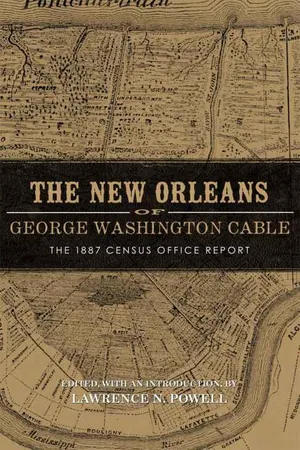
A pioneering local-color writer about Creole New Orleans and a public advocate for black equality in his native South during and after Reconstruction, George Washington Cable (1844--1925) depicted in his writing the clash between American newcomers and a quaint but proud French-speaking population in post--Louisiana Purchase New Orleans. His work, including the short-story collection Old Creole Days (1879) and his most famous novel, The Grandissimes (1880), received widespread critical acclaim and was serialized in the country's best highbrow magazines. In 1880, Cable was commissioned to write a "historical sketch" of pre--Civil War New Orleans for a special section of the Tenth U. S. Census. Although subsequently revised and published as Creoles of Louisiana, Cable's original piece never appeared in print again except as a facsimile reprint. With The New Orleans of George Washington Cable, Lawrence N. Powell presents this rare text in its entirety for the first time, including Cable's copious footnotes and other material deleted from the original census publication by its editors.
Likened by northern critics to Nathaniel Hawthorne and Bret Harte, Cable was already a literary sensation by the time he undertook the census project. He approached writing history as seriously as he did writing fiction, and he attacked his new challenge with vigor. Instead of the "sketch" he was asked to provide, Cable turned in 313 pages of meticulously documented history -- complete with 647 footnotes -- on everything from the origins of the city and its role in the Indian wars to the effect of West Indian immigration, the War of 1812, and commercial expansion through the mid-nineteenth century. He used sources in English, French, and Spanish, drawing on published histories, early maps, official surveys, travel accounts, medical journals, sanitation reports, city ordinances, American State Papers, city directories, and the New Orleans--based DeBow's Review -- a treasure trove of history, journalism, and useful statistics -- for his lively account of the Crescent City.
In an invaluable introduction to Cable's text, Powell illuminates the circumstances surrounding Cable's turn to historical writing and sheds new light on his controversial relations with white Creoles. Cable's forays into Creole culture aroused considerable hostility, as Powell ably demonstrates in his analysis of Cable's rivalry with Creole historian Charles Gayarré. Although Cable's vocal support for full civil rights for African Americans eventually forced him to leave New Orleans for Massachusetts, he continued to write novels, stories, and nonfiction about the Crescent City and the South. As Powell shows in his introduction, Cable's vast historical research fundamentally influenced both his development as a writer and his evolution as a political reformer.
eBook - ePub
The New Orleans of George Washington Cable
The 1887 Census Office Report
- 224 pages
- English
- ePUB (mobile friendly)
- Available on iOS & Android
eBook - ePub
About this book
Information

HISTORICAL SKETCH

[1.] SITE AND ORIGIN
The Mississippi river, between the states of Mississippi and Louisiana, flowing at first southward, touches, on its eastern side, at the city of Vicksburg, a line of high, abrupt hills or bluffs, the eastern boundary of its later alluvial basin. The direction of this bluff-line is southwesterly; and the river, turned from its southward course by it, flows in this new direction, occasionally impinging upon the abrupt barrier, as at Grand Gulf, Natchez, and Fort Adams, and presently turns again, with the bluffs, more directly toward the south, striking their base and swinging off from it, at Tunica, at Bayou Sara, and finally at Baton Rouge.
Just beyond this point the bluff-line swerves rapidly to a due eastward course, and declines gradually until in the parish of St. Tammany, in Louisiana, some 30 miles from the eastern boundary of the state, it sinks entirely down into a broad tract of wet prairie and sea-marsh, the mainland coast of various inlets from the Gulf of Mexico. It is the general belief that this line of elevated land, now some 80 or 90 miles due north of the Louisiana coast, was the pre-historic shore-line of the Gulf.
Cable’s “Historical Sketch” of New Orleans originally appeared in Department of the Interior, Census Office, Report on the Social Statistics of Cities, Part II, The Southern and Western States (vol. 19 of the report of the tenth census), compiled by George E. Waring Jr., Expert and Special Agent (Washington: Government Printing Office, 1887), 213–67. To the title “Historical Sketch” in that document the following footnote is appended: “In the preparation of the report on the city of New Orleans, the local assistant, George W. Cable, esq., not only secured and transmitted a very large proportion of the detailed information concerning the present and the past condition of the city, in response to schedules of interroga-tories, but to him alone is due the careful and elaborate historical sketch with which the report is introduced.”
Close under the Mississippi bluffs, where they make their short turn to the east, the bayou Manchac, once the Iberville river, and a chain of lakes—Maurepas, Pontchartrain, and Borgne—connected by navigable passes and rigolets, formerly (until the obstruction of bayou Manchac by the military forces of the United States in 1814) united the waters of Mississippi river with those of Mississippi sound. Meanwhile the river itself, turning less abruptly and taking a southeasterly course, cuts off between itself and these lakes a portion of its own delta formation.1 This fragment of half-made country, comprising something over 1,700 square miles of river shore, swamp and marsh lands, was once widely known as Orleans island.
In outline it is extremely irregular. Its most regular boundary, that of the river bank, is very tortuous, while its width varies, even in its older portions, from 57 miles across the parishes of Plaquemines and St. Bernard, to less than 5 miles from the river at English Turn to the margin of lake Borgne. Another narrow region is seen between the river and lake Pontchartrain, where these two waters approach to within 6 miles of each other.
This occurs at a point almost equally distant from the closed entrance of bayou Manchac, the upper end of Orleans island, and its lower end at the mouth of the Mississippi. In other words, it is 107 miles above the point where the waters of the river finally meet the sea at the outer end of Eads’ jetties; in latitude 29° 56’ 59” and longitude 90° 04’ 09” west from Greenwich;2 distant 1,242 miles by river3 or 700 by rail from St. Louis;4 1,760 by sea5 or 1,377 by rail from New York;6 4,800 from Liverpool and 4,800 from Havre.7 On this spot, in February of the year 1718, was founded the city of New Orleans.8
The colony of Louisiana, established nineteen years before at Biloxi, some 85 miles to the east, on the shore of Mississippi sound, had not exceeded at any time the number of a few hundred souls; yet, from the first it had been divided into two factions, one bent on the discovery of gold and silver, the development of pearl fisheries, the opening of a fur trade, and a commerce with South America, and therefore in favor of a sea-coast establishment; the other advocating the importation of French agriculturists and their settlement, in large numbers, on the alluvial banks of the Mississippi.
This wiser design, though faithfully urged by its friends, was for years overruled under the commercial policy and monopoly of the merchant, Anthony Crozat; but when his large but unremunerative privileges fell from his hands into those of John Law, director-general of the famed Mississippi Company, Bienville, governor of the colony, was permitted to found New Orleans, with a view to removing to the banks of the Mississippi the handful of French and Canadians who were struggling against starvation in the irrational search after sudden wealth on the sterile beaches of Mississippi sound and Massacre island.*
The site, which Bienville had chosen a year before,9 offered to a superficial glance but feeble attractions. The land, highest at the river’s edge, where it was but 10 feet above sea-level, sank back within the course of a mile to a minimum of a few inches. It was covered, for the most part, with a noisome and almost impenetrable cypress swamp, and was visibly subject to frequent if not annual overflow. One hundred miles and more lay between the spot and the mouth of a river whose current, in the time of its floods, it was maintained no vessel could overcome.
But the sagacity and Canadian pioneer craft of Bienville had seen its advantages. The bayous of St. John and Sauvage, navigable by small sea-going vessels to within a mile of the Mississippi’s bank, led by a short course to the open waters of the lakes, and thus to the streams emptying into those lakes on their farther side, to the countries pierced by these streams, and eastward through the same lakes to Mississippi sound and the Gulf of Mexico. On the opposite side of the Mississippi another easy avenue to and from the sea was presented by the bayou Barataria and the net-work of streams and bays of which it forms a part. By the same waters the wide countries of the Atchafalaya, the Attakapas, and the Opelousas were also made accessible; while northward the Mississippi and its great valley stretched beyond known limits.
Here, therefore, M. de Bienville decided to establish the post which later became his capital, and placed a detachment of twenty-five convicts and as many carpenters,10 who, with some voyageurs from the Illinois, made a clearing and erected a few scattered huts along the bank of the river.11
[2.] POPULATION AND SOCIAL ORDER
In the following year Bienville advocated the removal of the capital to New Orleans; but while the matter was under discussion, the settlement suffered a total inundation, and the project was for a time abandoned.1 However, it continued to be a trading post of the Mississippi Company;† in January, 1720, it was the final returning point of M. de la Harpe, after his arduous expedition up Red river;2 in April was put under the military command of M. de Noyan,3* and in December was again urgently recommended by Bienville, in colonial council, as the proper place for the seat of government.4 His wishes were still outvoted; but he sent his chief of engineers, Sieur Le Blond de la Tour, a Knight of St. Louis, to the settlement, with orders “to choose a suitable site for a city worthy to become the capital of Louisiana.”5 Stakes were driven, lines drawn, streets marked off, town lots granted, ditched, and palisaded, a rude levee thrown up along the river front, and the scattered settlers of the neighborhood gathered into the form of a town.6
In 1721, warehouses had already been erected,7 and Bienville, in certain governmental regulations, reserved the right to make his residence in the new city.8 Finally, in June of the following year (1722), the royal commissioners having at length given orders to transfer the seat of government,9 a gradual removal of the company’s effects and troops from Biloxi to New Orleans10 was begun. In August Bienville completed the transfer, by moving thither the gubernatorial headquarters.11 The place, in January preceding these accessions, already contained 100 houses and 300 inhabitants.12
The large proportion of a house to every three persons—if, indeed, the quartering of troops in barracks, did not make it still greater—points to the fact that most of these dwellings were not homes in that full significance which includes the family relation. Though a church of some humble sort was not wanting, and a public hospital had been established, and though the presence of a few ships in the river lent one characteristic of a sea-port, yet, in the poverty of its appliances for domestic and for public comfort, in the wildness of the half-cleared ground, in the frailness of its palisade huts, and the rude shelters which took the name of public buildings, and especially in the undue preponderance of adults and males in the population, the place presented more the features of a hunting or a mining camp than of a town.
Its instability had already been brought painfully to view. On the morning of September 11, 1722, a storm fell upon the land with such force that the church, the hospitals, and thirty dwellings were destroyed; crops were prostrated, and the rice, in particular, was rendered worthless.13
The next year, 1723, brought no better fortune. The “Mississippi bubble”* reached that point in its well-known history, where it was beginning to reveal its embarrassments, and the colonists of Louisiana found themselves participating in the widespread distress which those complications produced.14
Resort, even in miniature, to the insane example set them in France, of an absurd system of credits, gave its logical results; the year 1724 brought, for the moment, a satisfactory relation between the suffering planting interest and the company’s mercantile representatives in New Orleans; moreover, new industries—notably the raising of indigo and its manufacture—were introduced; debts were paid with paper, and the little city in embryo found herself the metropolis of an agricultural province, the total population of whose far-scattered plantations, missions, and military posts, was approaching 5,000 souls,15 and giving promise of abundant commercial tribute. When the secondary phase—financial collapse— followed, the colonists were extricated from their mutual obligations by the gross expedient of a scaling process, applied by royal edict and four times repeated; and under this treatment, as under a conflagration, the year 1726 brought in a sounder, though a shorn, prosperity.16
But though the population of New Orleans was now approaching the number of 1,600 inhabitants,17 the restraints of social life continued to be few and weak. A few civil and military officials of high rank had brought their wives from France, and a few Canadians had brought theirs from Canada; but these were rare exceptions, inappreciable in the total population. The male portion of the people, composed principally of soldiers, trappers, miners, galley-slaves, and redemptioners bound for three years’ service, was hardly of the disposition spontaneously to assume the responsibilities of citizenship, or to realize the necessity of public order, while the still disproportionately small number of females was almost entirely from the unreformed and forcibly transported inmates of houses of correction, with a few Choctaw squaws and African slave women.18 Gambling, dueling, and vicious idleness were indulged in to such a degree as to give the authorities grave concern.19
But now the company, as required by its charter, addressed its efforts to the improvement of both the architectural and the social features of its provincial capital, and the years 1726 and 1727 are conspicuous for these endeavors. The importation of male vagabonds and criminals had already ceased. Stringent penalties were laid upon gambling,20 and steps were taken for the promotion of education and religion.
Though the plan of the town comprised a parallelogram of some 4,000 feet river front, by a depth of 1,800, and was divided into regular squares of 300 feet front and depth,21 yet its appearance was disorderly and squalid. A few board cabins of split cypress, thatched...
Table of contents
- COVER
- TITLE PAGE
- COPY RIGHTPAGE
- DEDICATION
- CONTENTS
- MAPS
- INTRODUCTION: A Novelist Turns Historian
- [1.] SITE AND ORIGIN
- [2.] POPULATION AND SOCIAL ORDER
- [3.] INDIAN WARS
- [4.] THE FIRST CREOLES
- [5.] THE INSURRECTION OF 1768
- [6.] THE SUPERIOR COUNCIL AND THE CABILDO
- [7.] SPANISH CONCILIATION
- [8.] THE CREOLES STILL FRENCH*
- [ 9.] THE AMERICAN GRASP
- [10.] A FRANCO-SPANISH AMERICAN CITY
- [11.] FROM SUBJECTS TO CITIZENS
- [12.] BURR’S CONSPIRACY
- [13.] THE WEST INDIAN IMMIGRATION
- [14.] THE WAR OF 1812–15
- [15.] COMMERCIAL EXPANSION—1815 TO 1840
- [16.] POSITIVE GROWTH WITH COMPARATIVE DECLINE
- CABLE’S NOTES TO HISTORICAL SKETCH”
- WORKS CITED BY CABLE
- INDEX
Trusted by 375,005 students
Access to over 1.5 million titles for a fair monthly price.
Study more efficiently using our study tools.
Frequently asked questions
Yes, you can cancel anytime from the Subscription tab in your account settings on the Perlego website. Your subscription will stay active until the end of your current billing period. Learn how to cancel your subscription
No, books cannot be downloaded as external files, such as PDFs, for use outside of Perlego. However, you can download books within the Perlego app for offline reading on mobile or tablet. Learn how to download books offline
Perlego offers two plans: Essential and Complete
- Essential is ideal for learners and professionals who enjoy exploring a wide range of subjects. Access the Essential Library with 800,000+ trusted titles and best-sellers across business, personal growth, and the humanities. Includes unlimited reading time and Standard Read Aloud voice.
- Complete: Perfect for advanced learners and researchers needing full, unrestricted access. Unlock 1.5M+ books across hundreds of subjects, including academic and specialized titles. The Complete Plan also includes advanced features like Premium Read Aloud and Research Assistant.
We are an online textbook subscription service, where you can get access to an entire online library for less than the price of a single book per month. With over 1.5 million books across 990+ topics, we’ve got you covered! Learn about our mission
Look out for the read-aloud symbol on your next book to see if you can listen to it. The read-aloud tool reads text aloud for you, highlighting the text as it is being read. You can pause it, speed it up and slow it down. Learn more about Read Aloud
Yes! You can use the Perlego app on both iOS and Android devices to read anytime, anywhere — even offline. Perfect for commutes or when you’re on the go.
Please note we cannot support devices running on iOS 13 and Android 7 or earlier. Learn more about using the app
Please note we cannot support devices running on iOS 13 and Android 7 or earlier. Learn more about using the app
Yes, you can access The New Orleans of George Washington Cable by Lawrence N. Powell in PDF and/or ePUB format, as well as other popular books in History & North American History. We have over 1.5 million books available in our catalogue for you to explore.