Perhaps not southerners in the usual sense, Franklin D. Roosevelt, Harry S. Truman, and Lyndon B. Johnson each demonstrated a political style and philosophy that helped them influence the South and unite the country in ways that few other presidents have. Combining vivid biography and political insight, William E. Leuchtenburg offers an engaging account of relations between these three presidents and the South while also tracing how the region came to embrace a national perspective without losing its distinctive sense of place.
According to Leuchtenburg, each man "had one foot below the Mason-Dixon Line, one foot above." Roosevelt, a New Yorker, spent much of the last twenty-five years of his life in Warm Springs, Georgia, where he built a "Little White House." Truman, a Missourian, grew up in a pro-Confederate town but one that also looked West because of its history as the entrepôt for the Oregon Trail. Johnson, who hailed from the former Confederate state of Texas, was a westerner as much as a southerner.
Their intimate associations with the South gave these three presidents an empathy toward and acceptance in the region. In urging southerners to jettison outworn folkways, Roosevelt could speak as a neighbor and adopted son, Truman as a borderstater who had been taught to revere the Lost Cause, and Johnson as a native who had been scorned by Yankees. Leuchtenburg explores in fascinating detail how their unique attachment to "place" helped them to adopt shifting identities, which proved useful in healing rifts between North and South, in altering behavior in regard to race, and in fostering southern economic growth.
The White House Looks South is the monumental work of a master historian. At a time when race, class, and gender dominate historical writing, Leuchtenburg argues that place is no less significant. In a period when America is said to be homogenized, he shows that sectional distinctions persist. And in an era when political history is devalued, he demonstrates that government can profoundly affect people's lives and that presidents can be change-makers.
eBook - ePub
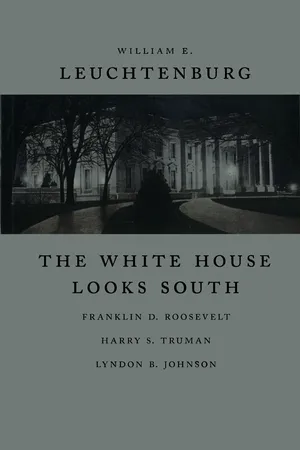
The White House Looks South
Franklin D. Roosevelt, Harry S. Truman, Lyndon B. Johnson
- 688 pages
- English
- ePUB (mobile friendly)
- Available on iOS & Android
eBook - ePub
The White House Looks South
Franklin D. Roosevelt, Harry S. Truman, Lyndon B. Johnson
About this book
Information
NOTES
ABBREVIATIONS
| COHC | Columbia Oral History Collection, Columbia University, New York |
| FDRL | Franklin D. Roosevelt Library, Hyde Park, N.Y. |
| HSTL | Harry S. Truman Library, Independence, Mo. |
| JFKL | John F. Kennedy Library, Boston, Mass. |
| LBJL | Lyndon B. Johnson Library, Austin, Tex. |
| LC | Library of Congress, Washington, D.C. |
| SHC | Southern Historical Collection, University of North Carolina at Chapel Hill, Chapel Hill, N.C. |
| SOHP | Southern Oral History Project, University of North Carolina at Chapel Hill, Chapel Hill, N.C. |
PROLOGUE
1. Thomas J. Knock, To End All Wars: Woodrow Wilson and the Quest for a New World Order (New York, 1992), 3; Woodrow Wilson, Robert E. Lee: An Interpretation (Chapel Hill, N.C., 1924), 11–12.
2. Leonard Lutwack, The Role of Place in Literature (Syracuse, N.Y., 1984), 183; Alvin Toffler, Future Shock (New York, 1970), 69, 82; Joseph J. Persky, The Burden of Dependency: Colonial Themes in Southern Economic Thought (Baltimore, 1992), 151. See, too, William M. Bevis, “Region, Power, Place,” in Reading the West: New Essays on the Literature of the American West, ed. Michael Kowalewski (New York, 1996), 21;Joseph A. Amato, Rethinking Home: A Case for Writing Local History (Berkeley, Calif, 2002), 2.
3. Jack Temple Kirby, Media-made Dixie: The South in the American Imagination (Athens, Ga., 1986), 159–60; Fritz Steele, The Sense of Place (Boston, 1981), 8; Walker Percy, Signposts in a Strange Land (New York, 1991), 5.
4. Michel Foucault, Power/Knowledge: Selected Interviews and Other Writings, ed. Colin Gordon (New York, 1980), 70; John A. Jakle, “Time, Space, and the Geographic Past: A Prospectus for Historical Geography,” American Historical Review 76 (1971): 1087; Wayne Franklin and Michael Steiner, “Taking Place: Toward the Regrounding of American Studies,” in Mapping American Culture, ed. Franklin and Steiner (Iowa City, Iowa, 1992), 8; Allen K. Philbrick, “Perceptions and Technologies as Determinants of Predictions about Earth, 2050,” in Human Geography in a Shrinking World, ed. Ronald Abler, Donald Janelle, Allen Philbrick, and John Sommer (Belmont, Calif., 1975), 33.
5. Michael Sorkin, “Introduction,” in Variations on a Theme Park, ed. Sorkin (New York, 1992), xi; Lutwack, Role of Place, 183.
6. Franklin and Steiner, “Taking Place,” 3–9; Michael A. Godkin, “Identity and Place: Clinical Applications Based on Notions of Rootedness and Uprootedness,” 73, and Anne Buttimer, “Home, Reach, and the Sense of Place,” 167, in The Human Experience of Space and Place, ed. Buttimer and David Seamon (New York, 1980); Carville Earle, The American Way: A Geographical History of Crisis and Recovery (Lanham, Md., 2003), 335; Robin W. Winks, “Regionalism in Comparative Perspective,” in Regionalism and the Pacific Northwest, ed. William G. Robbins, Robert J. Frank, and Richard E. Ross (Corvallis, Ore., 1983), 26; Peter N. Stearns, “Social History Present and Future,” Journal of Social History 37 (2003): 15. “Knowing who you are,” maintained one writer, “is impossible without knowing where you are.” Paul Shepard, “Place in American Culture,” North American Review 262 (fall 1977): 32.
7. Raymond Williams, “Decentralism and the Politics of Place,” in Resources of Hope: Culture, Democracy, Socialism, ed. Robin Gale (London, 1989), 282.
8. Alexander Pope, “Epistle to Burlington,” in The Poems of Alexander Pope, ed. John Butt (New Haven, Conn., 1963), 590, quoted in Franklin and Steiner, “Taking Place,” 6; D. H. Lawrence, Studies in Classic American Literature (New York, 1923), 8–9; Lutwack, Role of Place, 141, 2; Steele, Sense of Place, 99. One writer, though, alleging that “literary criticism has failed to acknowledge the full physical presence of the American landscape and its local geographies,” has called for “a new attention to place in literary studies.” Michael Kowalewski, “Writing in Place: The New American Regionalism,” American Literary History 6 (1994): 180, 182.
9. Annie Dillard, An American Childhood, in Three by Annie Dillard (New York, 1990), 273; Eudora Welty, The Eye of the Story: Selected Essays and Reviews (New York, 1978), 128–29.
10. Frank E. Vandiver, The Southwest: South or West? (College Station, Tex., 1975), 13; Scott Romine, “Where Is Southern Literature?: The Practice of Place in a Postsouthern Age,” in South to a New Place: Region, Literature, Culture, ed. Suzanne W. Jones and Sharon Monteith (Baton Rouge, La., 2002), 23, 39; James C. Cobb, “Community and Identity: Redefining Southern Culture,” Georgia Review 50 (1996): 11. A 1990 survey found that 68 percent of institutions with Ph.D. programs that responded to a questionnaire reported offering courses in U.S. regional history; in the South, 83 percent did so. Carl Abbott, “Tracing the Trends in U.S. Regional History,” Perspectives 22 (1990): 4. See, too, Louis D. Rubin Jr., “The American South: The Continuity of Self-Definition,” in The American South: Portrait of a Culture, ed. Rubin (Baton Rouge, La., 1980), 17.
11. Charlayne Hunter-Gault, In My Place (New York, 1992), 232; Jimmie Lewis Franklin, “Black Southerners, Shared Experience, and Place: A Reflection,” Journal of Southern History 60 (1994): 3. A 1993 study found that black southerners were more disposed than were whites in the region to taking pride in a southern identity. Benjamin Schwarz, “The Idea of the South,” Atlantic Monthly (December 1997): 122.
12. Michael Clark Steiner, “The Regional Impulse in the United States, 1923–1941” (Ph.D. dissertation, University of Minnesota, 1978), 28, 32; Walter Kollmorgen, “Crucial Deficiencies of Regionalism,” American Economic Review 35 (1945): 377, 381, 385–86; Jane Jacobs, The Death and Life of Great American Cities (New York, 1961), 22; Paul Goodman, Utopian Essays and Practical Proposals (New York, 1962), 7; Laurence R. Veysey, “Myth and Reality in Approaching American Regionalism,” American Quarterly 12 (1960): 31; Richard Maxwell Brown, “The New Regionalism in America, 1970–1981,” in Regionalism and Pacific Northwest, ed. Robbins, Frank, and Ross, 42, 45, 47; Bruce Clayton, “Southern Intellectuals,” in Debating Southern History: Ideas and Action in the Twentieth Century, ed. Clayton and John A. Salmond (New York, 1999), 40–41; John Shelton Reed, One South: An Ethnic Approach to Regional Culture (Baton Rouge, La., 1982), 33–34, citing Frank Westie.
13. James Gray, quoted in Earl Rovit, “The Region versus the Nation: Critical Battles in the Thirties,” Mississippi Quarterly 8 (1960): 91; George Core, ed., Southern Fiction Today: Renascence and Beyond (Athens, Ga., 1969), 66.
14. Ray Allen Billington, Frederick Jackson Turner: Historian, Scholar, Teacher (New York, 1973), 216, 374; Michael C. Steiner, “The Significance of Turner’s Sectional Thesis,” Western Historical Quarterly 10 (1979): 440; Merle E. Curti, “The Section and the Frontier in American History: The Methodological Concepts of Frederick Jackson Turner,” in Methods in Social Science: A Case Book, ed. Stuart A. Rice (Chicago, 1931), 364; Howard W. Odum, Southern Regions of the United States (Chapel Hill, N.C., 1936), 251.
15. Frederick Jackson Turner, “Is Sectionalism in America Dying Away?” in Turner, The Significance of Sections in American History (New York, 1932), 313–14; Donald G. Holtgrieve, “Frederick Jackson Turner as a Regionalist,” Professional Geographer 26 (1974): 159–65; Billington, Turner, 381.
16. Richard Hofstadter, The Progressive Historians: Turner, Beard, Parrington (New York, 1968), 91; Arthur M. Schlesinger Jr., A Life in the Twentieth Century: Innocent Beginnings, 1917–1950 (Boston, 2000), 159; Billington, Turner, 470–71; William Cronon, “Revisiting the Vanishing Frontier: The Legacy of Frederick Jackson Turner,” Western Historical Quarterly 28 (1987): 168.
17. Billington, Turner, 471; Hofstadter, Progressive Historians, 91, 100–101, 153.
18. David Potter, The South and the Sectional Conflict (Baton Rouge, La., 1968), 4; David R. Goldfield, “The New Regionalism,” Journal of Urban History 10 (1984): 176; Raymond D. Gastil, Cultural Regions of the United States (Seattle, 1975); Joel Garreau, The Nine Nations of North America (Boston, 1981), xiii–xiv; James C. Cobb, “An Epitaph for the North: Reflections on the Politics of Regional and National Identity at the Millennium,” Journal of Southern History 66 (2000): 16–17. See, too, Dewey W. Grantham Jr., The Regional Imagination: The South and Recent American History (Nashville, Tenn., 1979), 229; Allan G. Bogue, Frederick Jackson Turner: Strange Roads Going Down (Norman, Okla., 1998), 460.
19. Richard Franklin Bensel, Sectionalism and American Political Development, 1880–1980 (Madison, Wis., 1984), xix, 17, 411; M. Elizabeth Sanders, The Regulation of Natural Gas: Policy and Politics, 1938–1978 (Philadelphia, 1981), 14, 196–97; Frederick C. Harris, “Notes on a Native Son: A Foreword,” in Hanes Walton Jr., Reelection: William Jefferson Clinton as a Native-Son Presidential Candidate (New York, 2000), x; Thomas J. Sugrue, “All Politics Is Local: The Persistence of Localism in Twentieth-Century America,” in The Democratic Experiment: New Directions in American Political History, ed. Meg Jacobs, William J. Novak, and Julian E. Zelizer (Princeton, N.J., 2003), 302. See, too, Elizabeth Sanders, “Industrial Concentration, Sectional Competition, and Antitrust Politics in America, 1880–1980,” Studies in American Political Development 1 (1986): 142–214; Michael S. Lewis-Beck and Tom W. Rice, “Localism in Presidential Elections: The Home State Advantage,” American Journal of Political Science 27 (1983): 548. In 1970 Ira Sharkansky wrote, “The nationalization of American politics and public policies is more often alleged than demonstrated: it is evident that the nationalizing process has not proceeded so far as to obliterate the regions,” for “some of the sharpest differences in public affairs can be found in comparisons of politics from one section of the country to another.” Sharkansky found “a development toward both greater regionalism and greater nationalization—complementary movements which may seem odd in juxtaposition.” Ira Sharkansky, Regionalism in American Politics (Indianapolis, Ind., 1970), 78, 4, 98.
20. David J. Russo, Families and Communities: A New View of American History (Nashville, Tenn., 1974), 282; J. Bill Berry, ed., Located Lives: Place and Idea in Southern Autobiography (Athens, Ga., 1990), xii; Cleanth Brooks, “Regionalism in American Literature,” Journal of Southern History 26 (1960): 35, 37.
21. Michael Kammen, “Introduction,” in The Past before Us: Contemporary Historical Writing, ed. Kammen (Ithaca, N.Y., 1980), 35; Peter H. Smith, “Political History in the 1980s: A View from Latin America,” Journal of Interdisciplinary History 12 (1981): 3; Sean Wilentz, “On Class and Politics in Jacksonian America,” Reviews in American History 10 (1982): 51; Paul Goodman, “Putting Some Class Back into Political History: ‘The Transformation of Political Culture’ and the Crisis in American Political History,” Reviews in American History 12 (1984): 80. See, too, J. Morgan Kousser, “Restoring Politics to Political History,” Journal of Interdisciplinary History 12 (1982): 569. “Younger scholars,” James T. Patterson has noted, “distance themselves from a once dominant form of political history that had focused on the doings of federal government leaders and institutions…. The old adage ‘History is past politics, and politics present history’ long ago lost its appeal among younger historians interested in America in the twentieth century.” James T. Patterson, “Americans and the Writing of Twentieth-Century United States History,” in Imagined Histories: American Historians Interpret the Past, ed. Anthony Molho and Gordon S. Wood (Princeton, N.J., 1998), 193, 195...
Table of contents
- Cover
- Title Page
- Copyright Page
- Dedication
- Contents
- Acknowledgments
- Prologue
- Franklin D. Roosevelt
- Harry S. Truman
- Lyndon B. Johnson
- Conclusion: The White House Looks South
- Epilogue: The South on the Move
- Notes
- Bibliography
- Index
Trusted by 375,005 students
Access to over 1.5 million titles for a fair monthly price.
Study more efficiently using our study tools.
Frequently asked questions
Yes, you can cancel anytime from the Subscription tab in your account settings on the Perlego website. Your subscription will stay active until the end of your current billing period. Learn how to cancel your subscription
No, books cannot be downloaded as external files, such as PDFs, for use outside of Perlego. However, you can download books within the Perlego app for offline reading on mobile or tablet. Learn how to download books offline
Perlego offers two plans: Essential and Complete
- Essential is ideal for learners and professionals who enjoy exploring a wide range of subjects. Access the Essential Library with 800,000+ trusted titles and best-sellers across business, personal growth, and the humanities. Includes unlimited reading time and Standard Read Aloud voice.
- Complete: Perfect for advanced learners and researchers needing full, unrestricted access. Unlock 1.5M+ books across hundreds of subjects, including academic and specialized titles. The Complete Plan also includes advanced features like Premium Read Aloud and Research Assistant.
We are an online textbook subscription service, where you can get access to an entire online library for less than the price of a single book per month. With over 1.5 million books across 990+ topics, we’ve got you covered! Learn about our mission
Look out for the read-aloud symbol on your next book to see if you can listen to it. The read-aloud tool reads text aloud for you, highlighting the text as it is being read. You can pause it, speed it up and slow it down. Learn more about Read Aloud
Yes! You can use the Perlego app on both iOS and Android devices to read anytime, anywhere — even offline. Perfect for commutes or when you’re on the go.
Please note we cannot support devices running on iOS 13 and Android 7 or earlier. Learn more about using the app
Please note we cannot support devices running on iOS 13 and Android 7 or earlier. Learn more about using the app
Yes, you can access The White House Looks South by William E. Leuchtenburg in PDF and/or ePUB format, as well as other popular books in History & North American History. We have over 1.5 million books available in our catalogue for you to explore.