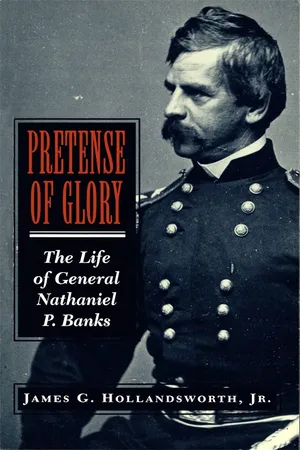
In this first modern biography of Nathaniel P. Banks, James G. Hollandsworth, Jr., reveals the complicated and contradictory nature of the man who called himself the "fighting politician." Despite a lack of formal education, family connections, and personal fortune, Banks (1816--1884) advanced from the Massachusetts legislature to the governorship to the U.S. Congress and Speaker of the House. He learned early in his political career that the pretext of conviction can be more important than the conviction itself, and he practiced a politics of expedience, espousing popular beliefs but never defining beliefs of his own. A leader in the new Republican party, he developed a reputation as a compelling orator and a politician with a bright future.
At the onset of the Civil War, Lincoln appointed Banks a major general, and, as Hollandsworth shows, the same pretext of conviction that served Banks so well in politics proved disastrous on the battlefield. He suffered resounding defeats in the 1862 Shenandoah Valley Campaign, the Battle of Cedar Mountain, and the Red River Campaign. Illuminating the personal characteristics that stalled the promise of Banks's early political career and contributed to his dismal record as a commanding officer, Hollandsworth demonstrates how Banks's obsessive pretense of glory prevented him from achieving its reality.
- 320 pages
- English
- ePUB (mobile friendly)
- Available on iOS & Android
eBook - ePub
About this book
Information
1
Born a Talker
Nathaniel P. Banks’s life began where it would end, in Waltham, Massachusetts, a factory town that grew up around a modern textile mill run by the Boston Manufacturing Company. Born in a company-owned house on River Street on January 30, 1816, Banks was the first child of Nathaniel P. Banks, Sr., and his wife of one year, Rebecca Greenwood Banks.1
People who knew Nat, as the young Banks was called, later remembered him as a healthy, active boy who enjoyed open, friendly relationships with the other children in his neighborhood. In time, he began his education in a crowded, one-room company school on Elm Street, where he mastered the fundamentals of reading and writing amid some seventy to eighty other pupils. His teachers considered Nat to be “bright and apt.”2
Nat’s father was a skilled worker at the mill who did better than most. Promoted to foreman, the senior Banks made as much as twelve dollars a week. Although this wage was three to four times what other workers in the mill got, it did not go far with a large family to feed. Consequently, Nat’s father expected him to drop out of school and go to work in the mill to help support the family.3
Nat did not want to quit school; he believed that he could make something of himself through education. Nevertheless, in 1830 he went to work in the Waltham Mill at the age of fourteen. His job was to remove bobbins when they were full of thread and replace them with empty spools. It was a monotonous assignment and paid only two dollars a week. Nat was also dissatisfied by the lack of respect being a mill worker brought him. “Rich men,” he maintained, “were thought more of by many people, whether they were deserving or not, and [that] seemed… wrong.” Thus at an early age, Nat acquired a determination to rise above his working-class origins.4
Education was the key to Nat’s ambitions. In an effort to enlarge on what he had learned in school, he set up a “study” in the attic on the third floor of the family’s house on the corner of Main and Common Streets. The study was a quiet place where he could go to read in the evening with Charlie, a friend who worked in the mill. Nat also began a modest library with the purchase his first book, John Locke’s Essay Concerning Human Understanding.5
On Saturdays, Nat and Charlie would walk the ten miles into Boston to spend the day at the Athenaeum Library, making the return trip on foot that night. Tradition has it that on one of these trips Nat stopped and peered through the gate at Harvard College, wishing that one day he would be able to study there. A college education, however, was out of reach for a mechanic’s son, so Nat sought knowledge wherever he could find it.6
He found one such opportunity by attending lectures at the Boston Manufacturing Company’s Rumford Institute, listening to some of the great speakers of the day such as Daniel Webster, Caleb Cushing, and Charles Sumner. Impressed by these displays of oratorical skill, Nat decided to form a debating society with several workers from the factory. The group met in the local schoolhouse on Tuesday evenings and provided the chance for the “Bobbin Boy” to indulge his newfound passion for rhetoric.7
Nat also tried his hand at acting. Inspired by seeing Edwin Booth perform in Boston, Nat decided to organize a dramatic society with some friends and took to acting with a zeal he had never demonstrated on the factory floor. By 1839 he was playing leading roles with such mastery that he was invited to perform in Boston, where he played the heroic lead in The Lady of Lyons.8
Nat liked being an actor, but in Waltham acting was not considered a “proper Christian profession.” Some members of the community questioned the advisability of even having a dramatic society and called a public meeting to discuss the issue. Nat attended the meeting with his mother to defend the group. He spoke for more than twenty minutes while his mother sat in astonished silence, expecting her son to embarrass both himself and the family. But Nat spoke on, finding the right words and using his voice to good effect. The address was Nat’s first public speech, and it forecast a career in public office rather than in the theater.9
Another diversion for Nat during this period was a dancing school he organized. He rented space, printed programs, and issued flyers that announced “dancing to commence at 7 o’clock” with “N. P. Banks, Jr.— Manager.” Tickets were $1.50.10
Unfortunately for Nat, dancing was another amusement that did not meet with the approval of local authorities. This time it was the Boston Manufacturing Company that objected, specifically to the late hours the young revelers kept. As one of the supervisors in the mill explained to a visitor: “We had some trouble last winter about the dancing-school. It must, of course, be held in the evening, as the young folks are in the mill all day. They are very young, many of them; and they forget the time, and everything but amusement, and dance away till two or three in the morning. Then they are unfit for their work the next day; or, if they get properly through their work, it is at the expense of their health.” As an alternative, the company promised to sponsor dances itself, once every two weeks, but it stipulated that these dances “shall meet and break up early.” Hoping to encourage attendance, the company posted a notice in the Waltham mill announcing that young ladies who attended Nat’s dancing school would be fired.11
If dancing and acting were not pursuits acceptable for a young man seeking a career, Nat soon found one that was when he joined a total abstinence society. The temperate use of alcohol had become a burning issue in Massachusetts, leading the state legislature in 1838 to ban the sale of distilled liquors in quantities of less than fifteen gallons. Ostensibly, the ordinance was designed to prohibit the sale of whiskey in taverns but not to limit its use by licensed apothecaries and physicians. In reality, the measure was directed primarily at the mill workers.12
Opponents of the measure argued that the law was an effort on the part of the company to increase the efficiency of its workers. The temperance people, however, argued that the new law would elevate the common man by saving him from the evils of strong drink. Both sides rushed speakers to the field, and Nat became a leading spokesman for the temperance movement in Waltham. He was an effective speaker, for he believed in what he was saying. Although he sometimes drank wine with his meals and would occasionally indulge in a glass of beer, Banks avoided hard liquor throughout his life. The voters forced the repeal of the law in 1840, but Nat attracted notice and was asked to do some stump speaking for the Democrats in the 1840 presidential race.13
The presidential campaign of 1840 was Nat’s formal introduction to politics, and he quickly attained local prominence. Encouraged by his success, Nat quit his job at the mill and tried his hand at party journalism as editor of the Lowell Democrat. The job came from the Reverend Eliphalet Case, who headed one of the local contingents of the Democratic party. Unfortunately, Benjamin F. Butler and other foes of the Case faction chose to launch a rival Democratic sheet, the Vox Populi, at the same time. Because the rival paper came out strongly for the shorter-hour movement, the more cautious Lowell Democrat was soon perceived to be antilabor; it folded in 1841, scarcely a year after it started.14
Smarting from the reversal, Nat returned to Waltham to start the Middlesex Reporter, which had no direct competition. But Waltham was too close to Boston to feel the need for a local press. Furthermore, Nat’s second editorial effort lacked either the capital or the corporate patronage it needed to succeed. Having failed twice as a newspaper editor in a little more than two years, Nat decided to put his skills to better use by running for political office. “I can see as far ahead as most persons of my years,” Nat wrote confidently in 1844, when he ran for a seat in the Massachusetts legislature. He lost.15
Banks’s decision to join the Democratic party made sense. The Democrats stood for the workingman against the National Republican party, or Whigs, which favored business interests. Furthermore, the Democratic leadership in Massachusetts was superior to that offered by the Whigs and included men such as Caleb Cushing, Benjamin F. Butler, and George S. Boutwell. The Democrat who caught Banks’s attention and respect, however, was the brilliant and enthusiastic Robert Rantoul, Jr.16
One of the ablest political leaders in the state, Rantoul was fervently interested in education. Supposedly he taught himself to read at the age of three and later attended Phillips Academy at Andover and Harvard College to assuage his “unquenchable thirst for knowledge and his intellectual independence.” Rantoul’s many interests included progressive causes such as pacifism, temperance, the humanitarian reform of prisons and insane asylums, efforts to end capital punishment, and, most important, the abolition of slavery.17
Rantoul served as an attractive role model for Banks, who saw him as a politician who espoused the causes a working-class youth could endorse. By 1840 Banks had begun to imitate Rantoul’s style. With practice and time, he learned to give speeches in the Rantoul manner and adopted his mentor’s method of appealing to the common man.18
Like many politicians, Rantoul was not always what he appeared to be. On one hand, he was an outspoken critic of wealth and privilege. One of his greatest successes along these lines came in 1842 before the Massachusetts Supreme Court when he argued and won the case of Commonwealth v. Hunt, which recognized the workers’ right to organize. On the other hand, Rantoul was willing to interpret his principles broadly so that on other occasions he worked energetically to promote the fortunes of the business interests he professed to hate. For example, he was instrumental in persuading the Illinois legislature to make very favorable concessions in granting the Illinois Central Railroad its charter. Rantoul defended this action by claiming that his promotion of commerce would benefit the workingman. Rantoul’s pragmatism, his willingness to bend on principle when it seemed expedient, was not lost on his young protege. Politics had become Banks’s bread and butter, and he wanted to be on the winning side.19
Winning was particularly important in 1843 after the collapse of the Middlesex Reporter, when Banks found himself “not in affluence.” Fortunately, he was able to get a job in the Boston customhouse, thanks to the kindness of Rantoul, who had been named collector of the port of Boston. Normally, the job fell under the federal patronage system and should have gone to a Whig because John Tyler was in the White House. But Tyler was quarreling with the Whigs in Massachusetts and favored the Democrats. Although the United States Senate rejected Rantoul’s appointment as port collector, Banks was able to hold on to his newly acquired position.20
Financially secure for the time being, Banks consummated an engagement that had lasted more than eight years when he married Mary Theodosia Palmer on April 11, 1847. They were very much in love. “Perhaps you have heard how well satisfied I am with my girl?” he wrote to Mary several months before they were married. “Such a sweet disposition! So much energy for improving herself and gratifying the family! Such ambition! Such a taste for dress! Such a kind joyous heart! Such eyes! Such legs!—Oh! She’s a dear!”21
Mary Palmer was an attractive young woman who worked in the mill. She was a strong person in her own right, quick to form opinions and reluctant to change them once they were set. She also had a temper. On one occasion, when referring to a family acquaintance known for her angry disposition, Banks remarked that “she is like my dear wife, who is occasionally very violent with those that do not treat her well.” Nevertheless, theirs was a long and happy union that lasted forty-seven years and resulted in four children.22
Banks made another unsuccessful run for the Massachusetts legislature as a Democrat in November 1847. There were several reasons why he could not get elected. Some of the voters thought he was too young for public office. Others objected to his temperance connections. The major obstacle to Banks’s success, however, was the Boston Manufacturing Company, which favored the Whigs. The company held such economic power that when it spoke, voters listened. In addition, the company used an open ballot system to force its employees to support the Whig ticket.23
Banks hated the Whigs because they had money. He expressed some of this resentment at the funeral of John Quincy Adams, sixth president of the United States and dean of Massachusetts politicians. Adams was buried on February 23, 1848, and his funeral was the sort of public event that someone seeking political office was expected to attend. Banks took part but found himself on foot in the funeral procession while the Whigs rode in fine carriages. The disparity irritated the aspiring politician, who at one point during the march turned to a companion and vowed, “By and by you and I will ride in these carriages, and those fellows will go on foot as we do now.”24
Unseating the Whigs would not be easy, and for a time Banks became so discouraged that he considered leaving Massachusetts for new opportunities in the West. Nevertheless, he stood his ground and continued to assail the “heartless” Whigs. Democratic party chiefs played their part by focusing on voters who were not as easily controlled by the Boston Manufacturing Company—storekeepers, farmers, and mechanics not on the company payroll. The strategy began to pay off. The Whigs had failed to gain the votes needed to elect a legislator from Waltham in 1844. One year later, the town had gone Democratic in the gubernatorial campaign. Finally, Banks gained a seat in Massachusetts General Court on November 7, 1848.25
Banks threw himself enthusiastically into his new job as a state legislator and quickly developed a talent for accommodation. Although he had made his political debut as a temperance advocate, Banks now courted the favor of “rum cocks” by backing a liquor dealer for state senator. He also avoided offending Caleb Cushing and other conservatives in the Democratic party by playing down his advocacy of rights for the working class.26
Banks also held the middle ground on the slavery issue. Although he doubted the merits of the Souths “peculiar institution,” Banks did not share the fiery sectionalism expressed by abolitionists such as William Lloyd Garrison. For example, Banks did not oppose the annexation of Texas in 1845, even though it meant the addition of another slave state. And although initially he supported the Wilmot Proviso, which was intended to bar slavery from newly acquired territories, Banks changed his position when the national Democratic party rejected the provision.27
Banks’s moderate stand on slavery was grounded in part in his strong sens...
Table of contents
- Cover
- Title Page
- Copyright Page
- Contents
- Illustrations
- Acknowledgments
- Abbreviations Used in Notes
- Introduction
- 1. Born a Talker
- 2. A Genius for Being Looked At
- 3. Success Is a Duty
- 4. Faultless-Looking Soldier
- 5. The Most Remarkable Movement of the War
- 6. We Have Backed Out Enough
- 7. Even Thieves Take Off Their Hats
- 8. To Stir a Man’s Blood
- 9. Pound Him at Your Will
- 10. The Sensation of Deliverance
- 11. Unsuited for This Duty
- 12. No Desire for Dishonest Gains
- 13. The Enemy Retreats before Us
- 14. I Am Alone
- 15. The Heart of the People
- 16. The Destiny of Nations
- 17. I Have Always Been a Republican
- 18. The General
- Bibliography
- Index
Trusted by 375,005 students
Access to over 1.5 million titles for a fair monthly price.
Study more efficiently using our study tools.
Frequently asked questions
Yes, you can cancel anytime from the Subscription tab in your account settings on the Perlego website. Your subscription will stay active until the end of your current billing period. Learn how to cancel your subscription
No, books cannot be downloaded as external files, such as PDFs, for use outside of Perlego. However, you can download books within the Perlego app for offline reading on mobile or tablet. Learn how to download books offline
Perlego offers two plans: Essential and Complete
- Essential is ideal for learners and professionals who enjoy exploring a wide range of subjects. Access the Essential Library with 800,000+ trusted titles and best-sellers across business, personal growth, and the humanities. Includes unlimited reading time and Standard Read Aloud voice.
- Complete: Perfect for advanced learners and researchers needing full, unrestricted access. Unlock 1.5M+ books across hundreds of subjects, including academic and specialized titles. The Complete Plan also includes advanced features like Premium Read Aloud and Research Assistant.
We are an online textbook subscription service, where you can get access to an entire online library for less than the price of a single book per month. With over 1.5 million books across 990+ topics, we’ve got you covered! Learn about our mission
Look out for the read-aloud symbol on your next book to see if you can listen to it. The read-aloud tool reads text aloud for you, highlighting the text as it is being read. You can pause it, speed it up and slow it down. Learn more about Read Aloud
Yes! You can use the Perlego app on both iOS and Android devices to read anytime, anywhere — even offline. Perfect for commutes or when you’re on the go.
Please note we cannot support devices running on iOS 13 and Android 7 or earlier. Learn more about using the app
Please note we cannot support devices running on iOS 13 and Android 7 or earlier. Learn more about using the app
Yes, you can access Pretense of Glory by James G. Hollandsworth, Jr. in PDF and/or ePUB format, as well as other popular books in History & American Civil War History. We have over 1.5 million books available in our catalogue for you to explore.