Throughout Louisiana's colonial and postcolonial periods, there evolved a highly specialized vocabulary for describing the region's buildings, people, and cultural landscapes. This creolized language -- a unique combination of localisms and words borrowed from French, Spanish, English, Indian, and Caribbean sources -- developed to suit the multiethnic needs of settlers, planters, explorers, builders, surveyors, and government officials. Today, this historic vernacular is often opaque to historians, architects, attorneys, geographers, scholars, and the general public who need to understand its meanings. With A Creole Lexicon, Jay Edwards and Nicolas Kariouk provide a highly organized resource for its recovery. Here are definitions for thousands of previously lost or misapplied terms, including watercraft and land vehicles, furniture, housetypes unique to Louisiana, people, and social categories.
Drawn directly from travelers' accounts, historic maps, and legal documents, the volume's copious entries document what would actually have been heard and seen by the peoples of the Louisiana territory. Newly produced diagrams and drawings as well as reproductions of original eighteenth- and nineteenth-century documents and Historic American Buildings Surveys enhance understanding. Sixteen subject indexes list equivalent English words for easy access to appropriate Creole translations. A Creole Lexicon is an invaluable resource for exploring and preserving Louisiana's cultural heritage.

eBook - ePub
A Creole Lexicon
Architecture, Landscape, People
- 304 pages
- English
- ePUB (mobile friendly)
- Available on iOS & Android
eBook - ePub
A Creole Lexicon
Architecture, Landscape, People
About this book
Information
Subtopic
LinguisticsAa
abandon (FC n, m). Upper Louisiana: the practice of opening the communal field to grazing by animals following the harvest each fall (Ekberg 1998:116). See commune, grand champ, open field agriculture, vaine pâture.
abat-vent; abattre vent (F; FC n, m). Lit: to knock down the wind, thus a windguard or bonnet. 1) Normandy: a jamb wall placed inside a farmhouse’s front door, which was traditionally kept open; the wall protected the hearth from wind. 2) A chimney cap or cover. See cheminée (23). 3) Québec: the upper floor or roof of an outbuilding. It projects forward one to two ft. from the wall of the facade and is ordinarily not supported with posts. See auvent, jetty, larmier. 4) Louisiana, an overhang or roof extension. New Orleans after ca. 1794: an extension of the roof over the sidewalk, usually at a pitch lower than the roof. Prior to ca. 1830 abat-vents of banquette cottages were supported on iron rods (Fig. 11), between ca. 1830 and 1861 many were supported on coyaux (rafter sprockets), and after the Civil War they were supported on wooden brackets (Fig. 15). See banquette cottage, Creole cottage. 5) Rural S-central Louisiana, both French and Anglo: by analogy, a fausse galerie, also called “hood” or “apron”—an extension added to the exterior of a gallery roof and often wrapped around the sides of the gallery and sometimes the building itself. Popular in central rural Louisiana between ca. 1870 and 1930, false galleries protected the woodwork of the gallery from exposure to sun and rain, thus prolonging its life (Fig. 59).
abatis; abattis (F; FC n, m, pl.). 1) Giblets. 2) Acadian Canada and Louisiana: cleared land but with the stumps of trees remaining. Louisiana FC bate diboi là (F abattre un arbre), to fell a tree (Valdman et al. 1998:63). See arrachis, terre défrichée.
abattoir (F, FC n, m). F abattre, to strike down. A slaughterhouse. Louisiana: 1) A country butchering. F boucher, a butcher; boucherie, a communal butchering shared among neighbors. 2) A meat market. See boucanier2, boucher, halle (2), matanza.
aboiteau (FC n, m). F porte d’écluse; vanne. 1) Acadian Canada: a sluice-gate with a clapper valve (clapet) mounted in a levée. This arrangement permitted excess fresh water (doucin) to drain from the land side into the Bay of Fundy at low tide, while prohibiting the landward flow of saltwater into recovered cultivated fields at high tide. Diked fields were constructed beginning ca. 1650 during Acadian settlement in Acadie. They were introduced by the colonist Charles de Menou d’Aulnay (LeBlanc & LeBlanc 1995:600). The Acadians preferred to dike the shallows of the Bay of Fundy, rather than clear the forests of the interior for their farm fields (Dulong 1989:2; Ancelet, Edwards & Pitre 1991:6–7). See Acadian, Cajun, écluse. 2) Cajun Louisiana: a kind of dam or breakwater made from large trees and clay (Ditchy 1932:34). See étanche.
about; rabout (F; FC n, m) F à, to + bout, the end. Abouter, rabouter (v, t), to abut or to join two members end to end (as with a scarf joint; Fig. 8f). 1) In reference to a beam or truss member, the butt end. 2) That part at the extremity beyond the supporting notch, lap joint, or mortise. In the case of a rafter in Louisiana, this is called the outlooker. Abou[t]ement, the joining of timbers end-to-end (Diderot 1751–65, 10:347). See alaise, assemblage (6), greffage, outlooker, queue, queue-de-vache.
abri; abris (F; FC n, m). 1) Shelter. An arbor or agricultural shelter, generally for the protection of plants. Upper Louisiana: Abrier (FC v, t), to shelter or protect (Dorrance 1935:52). 2) L’abri du soleil: a sunshade shelter often mounted on the wall of a house. 3) Cajun: a smokehouse for smoking meat or fish. See boucaner (3), boucanier2.
Acadian upper Teche house (E n). The name given by geographer Milton Newton to a Cajun-style house without an integral front gallery (Class I), located mostly along the upper Bayou Teche basin (Newton 1971:14). Otherwise, the floorplan is identical to the small Cajun house of the region. See Cajun house.
Acadiana (EC, n; FC n, f). Louisiana toponym. Neologism: that portion of southern Louisiana settled most heavily by the Acadians; the home of Cajun culture. The territory is bounded by a triangle extending from Lafourche Parish in the southeast to Avoyelles Parish in the north to Calcasieu and Cameron Parishes in the southwest (Fig. 1). According to the Encyclopedia of Cajun Culture, the term was coined in 1963 from a mistyped invoice sent to TV Channel 3 in Lafayette, La. The station’s manager liked the new word and began to use it on the air to describe south Louisiana. It quickly acquired popularity and by 1969 had won official recognition by the Louisiana State Legislature.
Acadie (F, FC n, f). Canadian toponym: Acadia, Nova Scotia. The name Arcadia was originally applied to the northern coasts of N America by the French privateer and merchant Jean d’Ango (1481–1555). The name of the mythic Greek bucolic paradise seems to have been adopted as a deliberate propaganda ploy to attract settlement to America (an honorable tradition, perhaps going as far back as the 12th cent. if one accepts the popular etymology of Vinland, “land of grapes,” named by Norse explorers). As governor of the port of Dieppe, d’Ango financed the French explorations of N America by Captain Verrazano, ca. 1540. The name may have been syncretized with a similar Micmac Indian toponym resulting in the final form. It was applied to Canadian Nova Scotia by French settlers in the 17th cent. (Fig. 2). L’Acadie or la Cadie became known as the Maritime Provinces of Canada (Massignon 1962:17). See Acadiana.
1. Map 1: Cajun Parishes of Louisiana
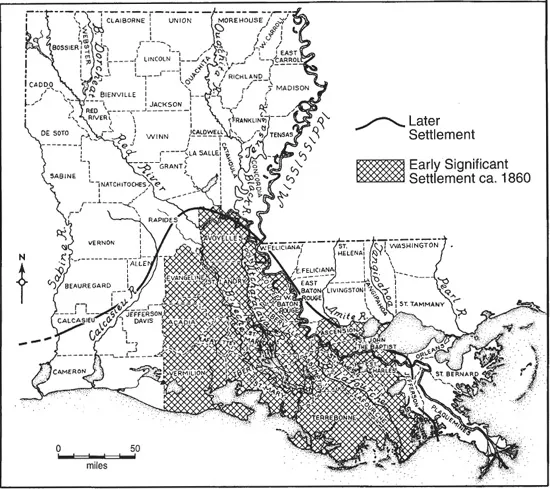
Acadien(ne) (F, FC n, m/f; adj). From Acadie, the French name for Nova Scotia. Thus, a resident of Acadie was an Acadien(ne). 1) A person immigrating to Louisiana from Nova Scotia mostly between 1764 and 1790. 2) The descendant of such a person. 3) One who has adopted the identity, language, and culture of Louisiana Acadians. See Cajun.
acajou; arcajou (F; FC n, m). Mahogany. This was one of the few luxury woods imported into Louisiana and used in Creole plantation houses of the wealthy planters (Mills 1977:180; Daigle 1934).
accesoria (FC n, f; SpC n, f). L accedere, to approach, be near. 1) An annex or addition to a house. 2) An outbuilding. 3) An extra room, without entrance to the interior of the building. Such rooms were often rented out as shops in urban Spanish colonial buildings (AIS 1771). See bodega (5).
accorer (F, FC v, t). 1) France: to prop up a boat that is under repair on land. 2) Upper Louisiana: generalized verb, to prop, support, or lean against (Dorrance 1935:52).
accrocher; acrocher (F; FC v, t). F un crochet, a hook (Fig. 53). To suspend or hang from a hook. Cajun: 1) To harness. 2) To fasten (Daigle 1934). See attelage, crochet, harnais.
2. Map 2: Original Acadian Settlement Areas
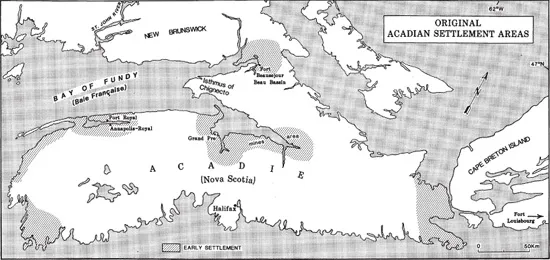
achenal (FC, n, m). See chenal.
acoyau, acouyau (FC n, f). See coyau.
acre; ak, zak (F n, f; FC n, f). Cadastral unit: 1) L’acre de Normandie: the Norman acre was a unit of land measure apparently brought back from England by Norman knights after 1066. Originally, it referred to the amount of open land that could be plowed by one yoke of oxen in one day. In NW France it was standardized as 160 square royal perches of 22 pieds (23.4448 Eng. ft.) on each side. This acre amounted to 77,440 pieds carrés. An intermediate measure of 1/4 acre or 40 sq. perches was called la vergée. Though in use at the time of Louisiana’s settlement, these units of measure were apparently not carried into Louisiana (Zupko 1978:1). See perche (4). 2) The American acre: a unit of land equivalent to 43,560 sq. ft., or 4,840 square yards, or about 1.183 superficial (areal) arpents. If square, its sides measure 208.7 ft. or 69.57 yards. There are 640 acres in a square mile, or American section. The Louisiana areal arpent was equal to 0.846 American acres, while the somewhat smaller arpent of Canada and Upper Louisiana equaled 0.84485 acres (Rolston & Stanton 1999:64, #515). See arpent, township and range.
(Los) Adáes; Adayes, Adais (SpC n, m; E n). Caddo hadai, brushwood (Read 1928:204). Toponym: San Miguel de Cuellar de los Adáes, a Spanish mission established among the Adáes Indians in 1717; and the nearby Presidio Nuestra Señora del Pilar de Los Adáes, a fort founded 1721–1724, in 2. Map 2: Original Acadian Settlement Areas western Louisiana, 14 mi. SW of Natchitoches. Its purpose was to limit further westward expansion by the French. This impoverished site functioned as the capital of Tejas (Texas) territory from 1729 through 1772, when the capital was moved to San Antonio. More important, Los Adáes was a center of trade between the colonial French and the Spanish, providing French Louisiana with much-needed horses, cattle, slaves (Comanche, Apache, Witchita), salt, bow wood (bois d’arc), and hard currency throughout the French colonial period. An architectural view of the fort appears on the undated Joseph Urrutia map of 1767 archived in the British Library (copy in library of Northwestern State University in Natchitoches; NRHP 1978:fig. 4; Avery 1997). The architecture is Cr...
Table of contents
- Cover Page
- Title Page
- Copyright Page
- Dedication
- Contents
- Illustrations
- Preface
- Acknowledgements
- Introduction
- How to Use This Lexicon
- Abbreviations
- Creole Lexicon
- Topical Indexes
- A Componential Analysis of New Orleans Vernacular Core Modules
- Bibliography
- About the Authors
- Footnotes
Trusted by 375,005 students
Access to over 1.5 million titles for a fair monthly price.
Study more efficiently using our study tools.
Frequently asked questions
Yes, you can cancel anytime from the Subscription tab in your account settings on the Perlego website. Your subscription will stay active until the end of your current billing period. Learn how to cancel your subscription
No, books cannot be downloaded as external files, such as PDFs, for use outside of Perlego. However, you can download books within the Perlego app for offline reading on mobile or tablet. Learn how to download books offline
Perlego offers two plans: Essential and Complete
- Essential is ideal for learners and professionals who enjoy exploring a wide range of subjects. Access the Essential Library with 800,000+ trusted titles and best-sellers across business, personal growth, and the humanities. Includes unlimited reading time and Standard Read Aloud voice.
- Complete: Perfect for advanced learners and researchers needing full, unrestricted access. Unlock 1.5M+ books across hundreds of subjects, including academic and specialized titles. The Complete Plan also includes advanced features like Premium Read Aloud and Research Assistant.
We are an online textbook subscription service, where you can get access to an entire online library for less than the price of a single book per month. With over 1.5 million books across 990+ topics, we’ve got you covered! Learn about our mission
Look out for the read-aloud symbol on your next book to see if you can listen to it. The read-aloud tool reads text aloud for you, highlighting the text as it is being read. You can pause it, speed it up and slow it down. Learn more about Read Aloud
Yes! You can use the Perlego app on both iOS and Android devices to read anytime, anywhere — even offline. Perfect for commutes or when you’re on the go.
Please note we cannot support devices running on iOS 13 and Android 7 or earlier. Learn more about using the app
Please note we cannot support devices running on iOS 13 and Android 7 or earlier. Learn more about using the app
Yes, you can access A Creole Lexicon by Jay Edwards,Nicolas Kariouk Pecquet du Bellay de Verton in PDF and/or ePUB format, as well as other popular books in Languages & Linguistics & Linguistics. We have over 1.5 million books available in our catalogue for you to explore.