Born into wealth in New Orleans in 1795 and married into misery fifteen years later, the Baroness Micaela Almonester de Pontalba led a life ripe for novelization. Intimate Enemies, however, is the spellbinding true account of this resilient woman's life -- and the three men who most affected its course.
Immediately upon marrying Célestin de Pontalba, Micaela was removed to his family's estate in France. For twenty years her father-in-law attempted to drive her to abandon Célestin; by law he could then seize control of her fortune. He tried dozens of strategies, including at one point instructing the entire Pontalba household to pretend she was invisible. Finally, in 1834, the despairing elder Pontalba trapped Micaela in a bedroom and shot her four times before turning his gun on himself.
Miraculously, she survived. Five years later, after securing both a separation from Célestin and legal power over her wealth, Micaela focused her attention on building, following in the footsteps of her late, illustrious father, Andrés Almonester. Her Parisian mansion, the Hôtel Pontalba, is today the official residence of the American embassy in France; and her Pontalba Buildings, which flank Jackson's Square in New Orleans, form together with her father's St. Louis Cathedral, Presbytere, and Cabildo one of the loveliest architectural complexes in America.
As for Célestin, he eventually suffered a total physical and mental breakdown and begged Micaela to return. She did so, caring for him for the next twenty-three years until her death in 1874.
In Intimate Enemies, Christina Vella embroiders the compelling story of the Almonester-Pontalba alliance against a richly woven background of the events and cultures of two centuries and two vivid societies. She provides a window into the yellow fever epidemics that raged in New Orleans; the rebuilding of Paris, the Paris Commune uprising, and the Second Empire of Napoleon III; European ideas of power, class, money, marriage, and love during the baroness' lifetime and their inflection in the New World setting of New Orleans; medical treatments, legal procedures, imperial court life, banking practices, and much more.
Combining the historian's meticulous research with the biographer's exacting knowledge of her subject and the novelist's gift for narrative, Vella has crafted a rare cross-genre work that will capture the imagination and admiration of every reader.
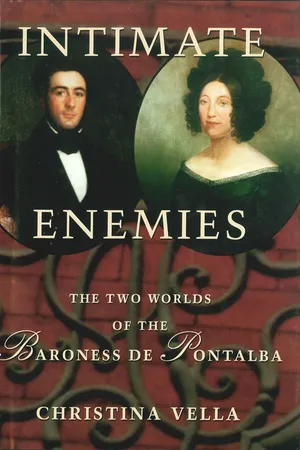
- 440 pages
- English
- ePUB (mobile friendly)
- Available on iOS & Android
eBook - ePub
About this book
Information
Subtopic
North American HistoryIndex
HistoryNotes
Sources frequently cited have been identified by the following abbreviations:
AGI | Archivo General de Indias |
AGI Catálogo | Catálogo de Documentos del Archivo General de Indias |
AGS | Archivo General de Simancas |
AN | Archives Nationales |
Ét. | Étude |
H-T | Howard-Tilton Memorial Library at Tulane University |
La. Hist. Ctr. | Louisiana Historical Center, New Orleans |
LHQ | Louisiana Historical Quarterly |
NONA | New Orleans Notarial Archives |
NOPL | New Orleans Public Library |
RE | Répertoires d’Études in Archives Nationales, Paris |
SD | Santo Domingo (the section of AGI dealing with New Orleans) |
Spec. Coll., | |
Manuscripts | Special Collections, Manuscripts Section, Howard-Tilton Library |
UNO | Earl K. Long Library at the University of New Orleans. Contains Louisiana Supreme Court Records. |
INTRODUCTION
1. Spain did not actually take possession of its new colony until May, 1765.
2. For an explanation of Spain’s position in Louisiana vis-à-vis France, Britain, the United States, and the Indians, see A. P. Nasatir, Borderland in Retreat (Albuquerque, N.M., 1976), 6–50.
I. NEW ORLEANS IN 1795
1. The colony stretched from the Gulf Coast in the south to a desolate and uncertain border along the Missouri River in the north; from the Appalachians in the east to the Rockies in the west. After 1783 the Spanish took over Florida (known as East Florida) and the entire Biloxi-Mobile-Pensacola Gulf Coast (West Florida.) A map clearly illustrating the complicated swapping of territories in the region among the European powers may be found in Charles Gibson’s Spain in America (New York, 1967), 184; see also p. 96.
2. Letters of Baron Joseph X. Pontalba to His Wife, manuscript letter diary in Pontalba Family Papers, WPA translation, Louisiana Historical Center. Construction of the Carondelet Canal was abandoned after Governor Carondelet left New Orleans.
3. Amos Stoddard, Sketches Historical and Descriptive of Louisiana (Philadelphia, 1812), 154. See also C. C. Robin, Voyage to Louisiana: 1803–1805, abridged and trans. Stuart O. Landry, Jr. (New Orleans, 1966); Minter Wood, “Life in New Orleans in the Spanish Period,” Louisiana Historical Quarterly, XXII (July, 1939), 642–737. The Cabildo and Presbytere had flat tops; mansard roofs and dormer windows were added in 1847. See especially Gilbert C. Din, “The Offices and Functions of the New Orleans Cabildo,” Louisiana History, XXXVII (Winter, 1996), 5–30. Din quite rightly observes that the building housing the council was the casa capitular and was never referred to as the Cabildo in the Illustrious Body’s records.
4. Letters to His Wife, May 13, 1796. For executions, see Records and Deliberations of the Cabildo, July 20, 1798, Sept. 30, 1803, WPA trans., microfilm, Louisiana Collection, New Orleans Public Library.
5. Records and Deliberations, Sept. 10, 1784; see also Oct. 1, 1779, Nov. 9, 1781. Although the stucco arcades of the French Market were not built until 1813, a roofed strip extended from St. Ann Street to rue de l’Arsenal (Ursuline), under which were stalls of randomly grouped produce.
6. Ibid. June 3, 1791, Oct. 21, 1796. Officials constantly inveighed against dumping in the street: “Orders of Miró,” ibid., June 1, 1786; Laura Porteous, trans., “A Regulation Concerning the General Police … 1795” LHQ, VIII (Jan., 1925), 598; “Auto de buen Gobierno de Don Manuel Gayoso de Lemos, 1798,” in Special Collections, Manuscripts Section, Howard-Tilton Library at Tulane University. For remarks by contemporaries on the city’s filth, see J. A. Robertson, ed., Louisiana Under the Rule of France, Spain, and the United States (1785–1807) (Cleveland, 1911), I, 63; [?] Berquin-Duvallon, Vue de la Colonie Es-pagnole de Mississipi (Paris, 1803), 26 ff., 90; Dunbar Rowland, ed., Official Letter Books of W. C C Claiborne, 1801–1816 (Jackson, Miss., 1917), II, 273; Laura Porteous, trans., “Sanitary Conditions in New Orleans Under the Spanish Regime, 1799–1800,” LHQ, XV (Oct., 1932), 612. Contemporary documents contain many references to deliveries or visits that were prevented because of impassable streets.
7. Laura Porteous, trans., “Index to Spanish Judicial Records of Louisiana, XXXVIII,” LHQ, XV (Oct., 1932), 686–87.
8. Samuel Wilson, Jr., ed., Impressions Respecting New Orleans by Benjamin Henry Boneval Latrobe (1905; rpr. New York, 1951), 41–42.
9. Records and Deliberations, Nov. 11, 1793. See also Oct. 30, 1789; Feb. 14, 19, Apr. 9, 30, 1790; and “Droit de Levée du Baron de Carondelet, 28 juin 1792,” French and Spanish Document #209 in La. Hist. Ctr. An arpent was equal to about five-sixths of an acre.
10. Records and Deliberations, June 8, July 13, Oct. 5, 1787; Francisco Gil, Disertacíon físico-médica … para preservar a los pueblos de veruelas (1784) (Windsor, Ontario, 1979), 49, Vol. B-2 of Documenta Novae Hispaniae; John Duffy, ed., The Rudolph Matas History of Medicine in Louisiana (Baton Rouge, 1958), I, 264–65.
11. Berquin-Duvallon, Vue de la Colonie, 97.
12. Letters to His Wife, Apr. 20, June 25, July 10, July 17, Sept. 23, Oct. 16, Oct. 22, 1796.
13. Joseph Xavier de Pontalba à Estevan Miró, 6 oct. 1792, manuscript letter diary (in French) in La. Hist. Ctr.
14. Ibid., Sept. 14, 1796. Miró a Pontalba, 26 dic. 1792, Correspondance du Gouverneur Don Estevan Miró à son neveu Joseph Delfau de Pontalba, ms. letter diary (in Spanish, though the title is in French), La. Hist. Ctr.
15. Letters to His Wife, July 24, Sept. 15, Oct. 2, 10, 1796. Pontalba à Miro, 5 sept. 1792, letter diary in La. Hist. Ctr.
16. Duffy, ed., History of Medicine, I, 275.
17. Porteous, trans., “Sanitary Conditions in New Orleans,” 613.
18. Records and Deliberations, Oct. 27, 1797.
19. Carondelet to las Casas, New Orleans, Feb. 17, July 12, Oct. 26, 1793, Mar. 28, 1794, Despatches of the Spanish Governors of Louisiana, WPA trans. in Spec. Coll., Manuscripts, H-T. See also the long, rambling depositions by informers reporting on people alleged to be French sympathizers in messages of Sept., 1793, and May, 1795. A. P. Nasatir expressed the view that the French in Louisiana were never reconciled to Spanish control, and that during the French Revolution New Orleans was, in Nasatir’s words, “filled with jacobins” who were “begging to return to French rule.” Spanish War Vessels on the Mississippi, 1792–1796 (New Haven, 1968), 4–5.
20. Goeau Duffief to Julien Poydras, 1795, “Private and Commercial Correspondence of an Indigo and Cotton Planter, 1794–1800,” typescript in La. Hist. Ctr.
21. Poydras to Claude Poydras, Aug. 25, 1796, ibid.
22. For the official version of colonial trade, see “Regulations and Royal Tariffs for the Free Commerce of Spain to Louisiana, the Indies, and her other Possessions, 1788,” WPA trans., La. Hist. Ctr.
23. Carondelet to las Casas, New Orleans, July 12, 1793, Despatches.
24. Miró to las Casas, Nov. 25, 1790, ibid. See also Miró to Don Joseph Espeleta, Aug. 16, 1788; Miró to las Casas, Aug. 12, Oct. 6, Nov. 13, 25, 1790. Even after he left New Orleans, Miró remained preoccupied with the importance of dealing justly with the Indians in Louisiana and securing their loyalty to Spain. See his Obra, as he called it, addressed to the Duke de Alcudia in 1793, reprinted in Publications of Louisiana Historical Society, IX (1916), 80–85.
25. Miró to las Casas, Aug. 12, 1790, Despatches. See also Vincente Manuel de Zespedes to Domingo Cabello, Dec. 10, 1789; Miró to Espeleta, Nov. 2, 1788; to las Casas, Dec. 12, 1790; to Cabello, May 19, 1790.
26. Miró to las Casas, July 15, Aug. 12, 1791; Sept. 10, 1790.
27. Rowland, ed., Letter Books of Claiborne, I, 314.
28. Records and Deliberations, Apr. 30, 1784; “Auto de … Gayoso de Lemos, 1798,” H-T. Ira Berlin, in Slaves Without Masters (New York, 1974), devotes an entire chapter to the argument that free blacks in Spanish Louisiana and on the Gulf Coast were better off than those in the English colonies.
29. Porteous, trans., “A Regulation Concerning the General Police,” 598.
30. “Orders of Miró,” Records and Deliberations, June 1, 1786. Some scholars have attempted to dispel what they consider is a myth concerning the pampered life of the quadroon concubine. See Eugene D. Genovese, “Free Negroes,” in Neither Slave nor Free, ed. David W. Cohen and Jack P. Greene (Baltimore, 1972), 258–77.
31. Records and Deliberations, Aug. 27, Oct. 8, 15, 1773; Apr. 30, May 28, June 4, 14, 1784. Although the whites made legal distinctions ...
Table of contents
- Cover
- Title Page
- Copyright Page
- Dedication
- Contents
- Illustrations
- Acknowledgments
- Introduction
- I: New Orleans in 1795
- II: Almonester
- III: Pontalba
- IV: The Widow
- V: Mont-l’Évêque
- VI: We All Live Here
- Photograph
- VII: A Separation of Body and Belongings
- VIII: Home Alone
- IX: New Orleans in 1850
- X: Building
- XI: The War Is Over
- New Orleans Street Names
- Notes
- Bibliography
- Index
Trusted by 375,005 students
Access to over 1.5 million titles for a fair monthly price.
Study more efficiently using our study tools.
Frequently asked questions
Yes, you can cancel anytime from the Subscription tab in your account settings on the Perlego website. Your subscription will stay active until the end of your current billing period. Learn how to cancel your subscription
No, books cannot be downloaded as external files, such as PDFs, for use outside of Perlego. However, you can download books within the Perlego app for offline reading on mobile or tablet. Learn how to download books offline
We are an online textbook subscription service, where you can get access to an entire online library for less than the price of a single book per month. With over 1.5 million books across 990+ topics, we’ve got you covered! Learn about our mission
Look out for the read-aloud symbol on your next book to see if you can listen to it. The read-aloud tool reads text aloud for you, highlighting the text as it is being read. You can pause it, speed it up and slow it down. Learn more about Read Aloud
Yes! You can use the Perlego app on both iOS and Android devices to read anytime, anywhere — even offline. Perfect for commutes or when you’re on the go.
Please note we cannot support devices running on iOS 13 and Android 7 or earlier. Learn more about using the app
Please note we cannot support devices running on iOS 13 and Android 7 or earlier. Learn more about using the app
Yes, you can access Intimate Enemies by Christina Vella in PDF and/or ePUB format, as well as other popular books in History & North American History. We have over 1.5 million books available in our catalogue for you to explore.