"In most standard texts on the Civil War, Mobile appears only in reference to the famous Battle of Mobile Bay. It is thus refreshing to find a work that illuminates the complete war years of this major southern city.... Confederate Mobile is an indispensable and thoroughly researched volume on Mobile's role in the Confederacy.... It will prove an invaluable guide to anyone wishing to understand wartime Mobile and the military maneuvers involved in defending the important southern port." -- Florida Historical Quarterly
"Bergeron's depiction of this colorful port city and how it reacted to the throes of war is a landmark in Civil War history." -- History Book Club Review
- 296 pages
- English
- ePUB (mobile friendly)
- Available on iOS & Android
eBook - ePub
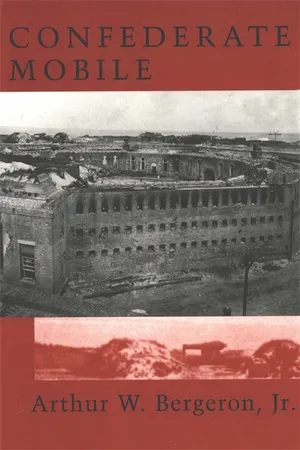
Confederate Mobile
About this book
Information
Subtopic
American Civil War HistoryIndex
HistoryCHAPTER 1
Mobile 1861, Strategic Port and Rail Center
Mobile on the eve of the Civil War was the leading city of Alabama and one of the most important cities in the South. The French, under Pierre LeMoyne, Sieur d’Iberville, had established a settlement there in 1711. From then until 1814, when it fell to General Andrew Jackson, Mobile belonged successively to the French, British, and Spanish governments. When the Americans took possession, the population numbered a mere handful, but it grew steadily and stood at 29,258 persons in 1860.1 One observer described the city in 1861: “With a population of thirty thousand the city contains many pleasant residences, embowered in shade trees, and surrounded by generous grounds. It is rendered attractive by its tall pines, live oak, and Pride-of-China trees.”2 Located on a sandy plain near the northwest corner of Mobile Bay, the city enjoyed excellent drainage and had no problems with mud. The inhabitants found this sand difficult to cross, however, so they established over the years a system of oyster-shell roads. These roads became a favorite carriage route and were well-known throughout the Gulf South.3
Both because of the various countries that had owned the area and of its status as a major port, Mobile’s population contained a significant number of foreign-born persons. The 1860 census recorded 7,733 foreigners in the city, one-fourth of the total population and 37 percent of the white population.4 A visitor to Mobile considered its society “more cosmopolitan than that of any city in the South, save perhaps, New Orleans.”5 When British correspondent William Howard Russell made a brief visit to the city in May 1861, he wrote in his diary that on his arrival he saw “a fringe of tall warehouses, and shops alongside [the wharf], over which were names indicating Scotch, English, many Spanish, German, Italian, and French owners.” Later Russell found the market “crowded with Negroes, mulattoes, quadroons, and mestizos of all sorts, Spanish, Italian, and French, speaking their own tongues, or a quaint lingua franca, and dressed in very striking and pretty costumes.”6
In 1860 the Medical College of Alabama and Spring Hill College were located in or near Mobile. The former was a branch of the University of Alabama, the latter a private school run by the Jesuit order. Mobile had seven public schools and several private academies, all of which had reputations for their fine academic standing. The city’s five hospitals provided excellent care for the sick. The Protestant Orphan Asylum, the Catholic Orphan Asylum, the Female Benevolent Society, the Samaritan Society, and the Can’t-Get-Away-Club constituted the city’s charitable institutions. Twenty-four Christian places of worship and two Jewish synagogues ministered to the spiritual needs of the populace. Mobile also had one of the finest fire departments in the South, consisting of eight engine companies and one hook-and-ladder company.7
Mobile prospered primarily because of its status as a center for trade and commerce. As a port, Mobile stood second only to New Orleans in the South. More than 330 vessels cleared and over 200 vessels entered the port in 1860. The value of articles exported totaled $3,670,183. Foreign imports amounted to $1,050,310. Thus “Mobile had the worst export-import imbalance of all antebellum ports.”8 Much of Mobile’s trade moved up and down the rivers that converged on the city, primarily the Tombigbee and Alabama systems. Alabama is said to have had “more navigable river miles than any state in the nation,” and most flowed into Mobile Bay. Alabama produced more cotton than any other Southern state except Mississippi by 1860, and the majority of these bales were sold in Moblie. In exchange for this cotton coming down the rivers, Mobile’s merchants sent to the planters and farmers of the interior such goods as pork, corn, flour, and whiskey.9
Mobile never served as a center of Southern radicalism during the antebellum period. Its commercial ties with the North and fairly large population of foreigners seemed to argue for continued ties with the North. In the presidential election of November 1860, Mobile County voters cast 1,823 votes for Stephen A. Douglas, 1,629 for John Bell, and 1,541 for John C. Breckinridge—a better than two-to-one majority against the secessionist candidate.10 The election of Abraham Lincoln, however, pushed Mobilians toward the secessionist camp. On December 7, 1860, the city’s leading newspaper stated: “The rapid progress of events within the last few weeks leaves little ground for hope that the Union can be preserved upon any basis, just, equitable, and satisfactory to the Southern people.” The paper expressed the hope that the separation of the states would be peaceful.11
Mayor Jones M. Withers of Mobile issued a proclamation on December 8 in which he stated, “We are in the midst of a revolution, and are invoking the sovereignty of our State against wrong and oppression.”12 Two days earlier Governor Andrew B. Moore had issued a call, in accordance with a resolution of the General Assembly, for an election of delegates on the twenty-fourth to a state convention to consider the course Alabama should follow. In meetings at Temperance Hall, the secessionists nominated their delegates, and the cooperationists (who wanted the Southern states to work together and leave the Union as a unit) met at Odd Fellows Hall to select their slate.13 The news of the secession of South Carolina reached Mobile late on December 20 and, “though not unexpected, caused considerable excitement, and a salute of 100 guns was fired . . . in honor of the event.”14 The arrival of this news just before the election of delegates in Alabama undoubtedly affected the vote in Mobile.
Clarence P. Denman wrote of the secession of Alabama, “The returns [of the state convention delegates election] from Mobile County came as quite a surprise to those who regarded the cooperationist party as the successor of the Bell and Douglas parties.” Those returns showed 2,297 votes cast for the secessionists and 1,229 for the cooperationists: a majority of 1,068 for the former. In analyzing these results, Denman concludes: “The cooperationists of the county had advocated a method of withdrawing so closely akin to straight-out secession that they should have received the votes of all those not strongly in favor of separate state action; therefore, the large majority for the straight-outs indicates that the people of Mobile County were in harmony with the interior of the state.”15
The most recent study of antebellum Mobile explains that the people supported secession because of the extreme trade imbalance and “the extent of the commitment to the cotton trade,” which put Mobile in “the most extreme position of colonial dependency within the national economy.” Northern businessmen handled most of the marketing of the cotton flowing through the city because it was destined for either Northern or European textile mills. Additionally, the majority of Mobile’s imports came from New York. Mobilians, therefore, hoped that a new southern nation “would, among other things, end their colonial relationship to the North and spur urban growth in their city.”16
The Alabama convention began its meetings in Montgomery on January 7, 1861. Four days later the delegates voted sixty-three to thirty-nine to take the state out of the Union. Business establishments in Mobile had closed down awaiting the decision of the convention. During the afternoon of the eleventh, the news of secession became public, and celebrations broke out. The militia fired one hundred guns in salute, and bands struck up joyful tunes. All of Mobile’s military companies turned out to parade through the streets. That night the citizens lit lamps and candles in homes and businesses and tar barrels along Government Street so that the revelry might continue. A huge fireworks display in Bienville Square highlighted the night celebration.17
The city’s leading daily newspaper, anticipating the formation of a Southern nation, recommended that Mobile be made the capital of the Confederacy. The article suggested that the Confederacy would eventually expand to include Mexico and the West Indies, which would make Mobile the best place for the center of government: “Mobile is, to a degree, the convenient center of the present and the geographical center of the future, is a seaport susceptible of impregnable defence, is healthful, and in every respect eligible for the honor of being elected the capital city of the South.”18 The paper’s second choice was Montgomery.
Before the secession convention met in Montgomery, Governor Moore had begun seizing federal installations and property near Mobile. On January 3, he called out six Mobile companies of the First Alabama State Troops to accomplish that task. Two companies moved by steamer on January 4 to seize Fort Morgan and Fort Gaines at the mouth of Mobile Bay, while four companies moved at the same time against the Mount Vernon Arsenal, thirty miles north of Mobile. Ordnance Sergeant S. Patterson turned over the property under his supervision at Fort Morgan to Colonel John B. Todd. Not until January 18, however, did Colonel Todd take formal possession of Fort Gaines from Lieutenant C. B. Reese of the United States Corps of Engineers. Both forts were still unfinished, and United States engineer troops had been working to strengthen them. The property seized included some five thousand shot and shell.19
After the seizure of the forts, Mobile’s citizens continued to form military companies, and the newspapers urged them to consider the possibility of war. At least one paper suggested that the city’s fire companies follow Charleston’s example and organize themselves for military duty. The fire companies were already enlisted, were accustomed to obeying orders, and could adapt quickly to drill. They would act primarily as a home guard, keeping their present uniforms. The paper expected that no more than one-third of the men would be called for duty outside the city at one time. The firemen did organize for home defense, forming a Fire Brigade and using the various engine houses as armories.20
Governor Moore acted quickly after Alabama seceded to provide for the defense of Mobile, the point most likely to come under enemy attack in a war because of its coastal location. On his own authority, he gave permission to his assistant quartermaster, Colonel Duff C. Green, to make a draft of $10,000 against the Executive Department to strengthen the forts below the city. Neither the General Assembly nor the secession convention had appropriated funds for that purpose. Green wrote to Moore that the people of Mobile intended to raise an additional $100,000, which could later be reimbursed by the state. Moore wrote that “Mobile must be defended at whatever cost,” but he urged his military subordinates to use public monies economically and efficiently.21
Planters in the interior of the state offered the services of some of their slaves to help construct defenses. At one time in early 1861, the engineers employed as many as 150 laborers at Fort Morgan. On another occasion, the authorities expected some 400 slaves to arrive in the city. The volunteers and laborers cleaned the cisterns in the fort so they could hold fresh rainwater. The men mounted all the artillery pieces they could on the available carriages and used sandbags to sod the ramparts facing the ship channel. Eventually, the entire fort would receive the same treatment, but for the time being, the men cut grass sod for the outer faces. After trenches were dug at the base of the scarp, water from the soil filled them, adding a little to the defensive posture of the fort.22 But Fort Morgan was far from ready to withstand an attack.
The new Confederate government became involved in the defense of Mobile almost immediately. The city seemed particularly vulnerable because Pensacola, Florida, some sixty miles to the east, remained in Federal hands. The Confederate government did not yet have troops of its own to send but did begin acting in other areas of defense. Secretary of War Leroy Pope Walker telegraphed Colonel John H. Forney at Barrancas Barracks near Pensacola on February 26 and asked if he could spare any columbiads (large siege artillery pieces) from Fort McRae for use in Fort Morgan. When Forney replied that he could spare two such guns, Walker told him to make the transfer “without delay, so as not to excite suspicion and report.”23 Forney reported on March 4 that he had sent to Fort Morgan that day two eight-inch columbiads, with complete carriages, chassis, equipment, and implements.24 On March 7, the military authorities at Mobile received by rail two ten-inch columbiads from the Tredegar Iron Works in Richmond, Virginia. With their mile-and-a-half range these guns were the most powerful ones at the fort.25
On March 18, 1861, the Confederate War Department assumed supervision of Fort Morgan, assigning Colonel William J. Hardee to command the post. Hardee, author of the standard text on infantry tactics, would have the services of two artillery officers to help train the local troops.26 Nine and a half companies, about eight hundred men, constituted the garrison. Hardee found that the officers and enlisted men alike had had little instruction and lacked discipline. He began a program to correct these deficiencies but could do little by himself. On March 28 he wrote to Secretary Walker to request officers capable of conducting both infantry and artillery instruction, warning that if such services were not provided, in battle the Alabama volunteers would “disgrace themselves and the Confederacy.” A visitor to the fort reported shortly afterward that Hardee seemed to have put the place “in thorough repair and readiness.”27
As Hardee’s force at Fort Morgan grew, he moved most of the men outside the fort into tents for fear that in such crowded conditions yellow fever or some other epidemic sickness might strike. The only tents available were small, however, and the men had to remain out in the hot sun much of the time. To provide clear fields of fire in case of attack, Hardee had ordered the men to level the sand hills and to cut down the few trees near the fort. An observer called the result “a huge, unbroken waste of sand, nearly as white as snow and intensely hot.” By this time units from the northern part of the state had relieved most of the south Alabama companies. These new troops were not accustomed to such exposure. The same observer recommended that the government provide larger tents equipped with flies so the sea breeze could blow through.28
Mobile’s defenses suffered other problems as well. Some people thought Fort Morgan could repel a naval attack but not a land assault. More serious, however, the approaches to Mobile from Mississippi Sound through Grant’s Pass were completely unprotected. The closest work to the pass, Fort Gaines, had no garrison and could not have prevented light-draft vessels from using the approach. Robert H. Smith, Mobile’s representative in the Confederate Congress, suggested that Hardee’s command be extended to include Fort Gaines, Grant’s Pass, and all other approaches to Mobile.29
About this same time, Major General Jeremiah Clemens of the Alabama militia suggested that guns from Fort Morgan be placed in defensive works on Dauphin Island and Sand Island at the mouth of the bay and at Spanish River and Choctaw Point near the city.30 The Confederate authorities responded quickly. Major Danville Leadbetter, a noted engineer officer, received orders to inspect the defenses and make a full report. General Samuel Cooper, adjutant general of the Confederacy, authorized Hardee to transfer guns to the points suggested by Clemens, saying that they would be replaced by others from the arsenal at Baton Rouge, L...
Table of contents
- Cover
- Title Page
- Copyright Page
- Dedication
- Contents
- Introduction
- 1. Mobile 1861, Strategic Port and Rail Center
- 2. An Array of Military Commanders
- 3. Failed Federal Hopes of Attacking Mobile
- 4. Strengthening Mobile’s Defenses, 1862
- 5. Defense Work Continues, 1863
- 6. Defenses Deemed Inadequate
- 7. Civilian Life in Wartime Mobile
- 8. Role of Blacks in Mobile’s Defense
- 9. Blockade Running into Mobile
- 10. Naval and Military Engagements at Mobile
- 11. The Battle of Mobile Bay
- 12. Preparing for the End
- 13. The Last Days
- Epilogue
- Notes
- Bibliography
- Index
Trusted by 375,005 students
Access to over 1.5 million titles for a fair monthly price.
Study more efficiently using our study tools.
Frequently asked questions
Yes, you can cancel anytime from the Subscription tab in your account settings on the Perlego website. Your subscription will stay active until the end of your current billing period. Learn how to cancel your subscription
No, books cannot be downloaded as external files, such as PDFs, for use outside of Perlego. However, you can download books within the Perlego app for offline reading on mobile or tablet. Learn how to download books offline
Perlego offers two plans: Essential and Complete
- Essential is ideal for learners and professionals who enjoy exploring a wide range of subjects. Access the Essential Library with 800,000+ trusted titles and best-sellers across business, personal growth, and the humanities. Includes unlimited reading time and Standard Read Aloud voice.
- Complete: Perfect for advanced learners and researchers needing full, unrestricted access. Unlock 1.5M+ books across hundreds of subjects, including academic and specialized titles. The Complete Plan also includes advanced features like Premium Read Aloud and Research Assistant.
We are an online textbook subscription service, where you can get access to an entire online library for less than the price of a single book per month. With over 1.5 million books across 990+ topics, we’ve got you covered! Learn about our mission
Look out for the read-aloud symbol on your next book to see if you can listen to it. The read-aloud tool reads text aloud for you, highlighting the text as it is being read. You can pause it, speed it up and slow it down. Learn more about Read Aloud
Yes! You can use the Perlego app on both iOS and Android devices to read anytime, anywhere — even offline. Perfect for commutes or when you’re on the go.
Please note we cannot support devices running on iOS 13 and Android 7 or earlier. Learn more about using the app
Please note we cannot support devices running on iOS 13 and Android 7 or earlier. Learn more about using the app
Yes, you can access Confederate Mobile by Arthur W. Bergeron in PDF and/or ePUB format, as well as other popular books in History & American Civil War History. We have over 1.5 million books available in our catalogue for you to explore.