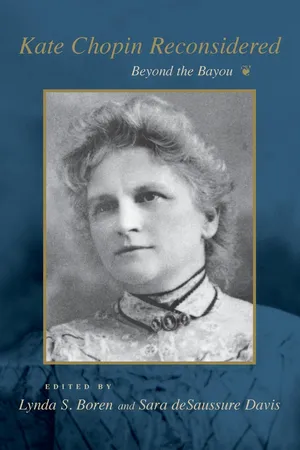
In this indispensable volume, fourteen intellectually compelling essays consider Kate Chopin's life and art from a variety of critical perspectives—biographical, New Historicist, materialist, poststructuralist, feminist—with several of the pieces focusing on Chopin's classic novel, The Awakening.
Charles Baudelaire, in his essay “The Painter of Modern Life” (1863), praises the role of the artist as a “man of the world,” the “flaneur,” the “passionate spectator,” who can move through all aspects of the city observing the women he encounters. According to Baudelaire, the woman functions as
that being towards or for whom all their [men’s] efforts tend; that awe-inspiring being, incommunicable like God (with this difference that the infinite does not reveal itself because it would blind and crush the finite, whereas the being we are speaking about is incommunicable only, perhaps, because having nothing to communicate); that being . . . for whom, but especially by whom, artists and poets compose their most delicate jewels; . . . woman, in a word, is not for the artist . . . only the female of the human species. She is rather a divinity, a star, that presides over all the conceptions of the male brain . . . the object of the most intense admiration and interest that the spectacle of life can offer to man’s contemplation.1
Baudelaire describes the male artist’s appropriation of the female as a silent cipher into which men pour their desires and visions of beauty, thus exemplifying the argument put forth by recent feminist art and film critics that the visual representation of women by men reflects the power of the male gaze to appropriate the image of woman and objectify and “commodify” her. An example of this empowering is found in the following comments from a late-nineteenth-century essay in which the writer concedes that “modern literature as well as ancient courts women of genius, and modern education and freedom have opened the learned branches of letters to the sex with satisfactory results,” but in the areas of painting and sculpture, where “execution is inextricably welded with invention,” women “have been little more than parasites.” The author, who goes by the initials D.S.M. only, deplores the existence of women artists’ exhibitions and maintains that “this pastime of painting” should be “driven back to the Charity Bazaar.” He also laments the waste of time, money, and energy spent in attempting to train women as artists because it “depends on the illusion that education can supply the place of a king of inventive gift, so rare among women that there are millions to one of odds against its occurrence.” As Griselda Pollock has observed, “The sexual politics of looking functions around a regime which divides into binary positions, activity/passivity, looking/being seen, voyeur/exhibitionist, subject/object.”2
With its traditional emphasis on the female form (particularly the female nude as an essential feature of art training), painting serves as a metaphor for the psychological and economic subjugation of women. The use of nude models (generally female), considered an essential feature of art training, was often prohibited to women artists until the late nineteenth century. Linda Nochlin cites an 1885 photograph of the women’s modeling class at the Pennsylvania Academy that reveals the women art students using cows rather than nude models. And Germaine Greer argues that even among such women as Henrietta Rae, who ignored criticism and painted female nudes, “when one looks at her boneless, pink and hairless creations, lyrically swarthed with tulle and surrounded by roses, it is immediately obvious how the female artist has had to blinker herself.”3
This phenomenon exemplifies the Freudian emphasis on a scopic sexual economy that, as Luce Irigaray has stated, is particularly inappropriate for representing female desire. And because painting has historically been produced by men for men, the exchange of the image of women is a corollary to Levi-Strauss’ concept of the exchange of women as the basis of social organization, a concept expanded upon by Irigaray in her discussion of the traffic of women. As Pollock explains, “the flaneur-artist is articulated across the twin ideological formations of modern bourgeois society—the splitting of private and public with its double freedom for men in the public space and preeminence of a detached observing gaze whose possession and power is never questioned, as its basis in the hierarchy of the sexes is never acknowledged.”4 The male artists’ appropriation of the female, as described by Baudelaire, also points to a tradition of depicting the female body as an object of male desire, which characteristically ignores the possibility of women desiring their own, or other women’s bodies.
In The Awakening (1899) Kate Chopin explores the different facets of the appropriation of women, including its artistic, sexual, social, and religious manifestations. Chopin confronts these issues through her creation of a woman painter, Edna Pontellier, and her friend and model Adele Ratignolle. Edna’s attempt to paint Adele brings to the foreground the problems she faces as a woman artist in attempting to paint her own desire without objectifying Adele. But it also brings to the forefront Edna’s growing sensuality and her dissatisfaction with the social and religious restrictions placed on women as wives and mothers.
The painting scene is directly followed by Edna’s moment of awakening in which she begins to “realize her position in the universe as a human being” (KCA, 17). Part of what makes the scene of Edna’s painting radical is that her desire is directed toward Adele, not Robert.5 Robert attempts to control the scene by placing himself in a position of authority and intimacy between the two women. Thus, he surveys Edna’s work with “close attention” while “giving forth little expressions of appreciation in French, which he addressed to Madame Ratignolle” (KCA, 13). He even places his head on Edna’s arm as she works, but his “oblivious” attentions are repulsed. Instead, Edna’s attention is focused on Adele. Her sensuous assessment of Adele breaks through a male libidinal economy based on heterosexual genital sex. The sensuality of Edna’s desire for Adele is palpable. She does not wish just “to try her hand” at “painting” but to “try herself on Madame Ratignolle. Never had that lady seemed a more tempting subject than at that moment, seated there like some sensuous Madonna, with the gleam of the fading day enriching her splendid color” (KCA, 13; emphasis added).
In addition to the complications faced by a female artist regarding her position and that of her model, Edna intensifies her situation by her conception of Adele as a Madonna. Significantly, this puts Edna in a tradition of religious iconography that has exalted the Madonna as the embodiment of an unobtainable model of womanly virtue: simultaneous chastity and motherhood based on submission and obedience. Edna’s depiction of Adele as a Madonna refers to an earlier description of her as a mother-woman and the quasi-religious language that describes her. Mother-women “idolized their children, worshipped their husbands, and esteemed it a holy privilege to efface themselves as individuals and grow wings as ministering angels” (KCA, 10). The mother-women, like the Madonna, are in a position of adoring and of being adored as both worshiper and angelic figure, but in both positions they are effaced as individuals. The Madonna’s power and worth come from her position as the silent bearer of the Word incarnate. Her value is strictly positional. It is not what she does but what is done to her for which she bears her fame and status in a patriarchal religion. She is almost literally a “vessel” of God.
The sensuous, romantic aspects of Adele and the religiously dutiful and sacrificial elements come together in the double function the Madonna serves in Christian iconography. The Madonna is fecund yet chaste, and she serves as an object of desire at the same time that she is safely out of reach of human contact. These conflicting images are exemplified by Edna’s rapt admiration (she “liked to sit and gaze at her fair companion as she might look upon a faultless Madonna”) and her desire to “try herself” on the tempting image of Adele, the “sensuous Madonna.”
Julia Kristeva examines the cultural and psychological significance of the pictorial representations of the Madonna, focusing on the Madonnas of Leonardo da Vinci and Giovanni Bellini. Her insights into the artist’s relation to the maternal body prove relevant to Edna’s relationship to Adele, who is not only referred to as a Madonna but is also pregnant when Edna chooses to draw her. According to Kristeva, the Madonna serves as the supreme fiction of the unity of mother and child, “hypostatized by Christianity” in an attempt to establish “a subject at the point where the subject and its speech split apart, fragment, and vanish. Lay humanism took over the configuration of that subject through the cult of the mother; tenderness, love, and seat of social conservation.” The maternal body therefore maintains the fiction that our coming into being is somehow tied to a subject, the mother, rather than realizing the more disquieting reality, as Kristeva stresses, that we come into existence from a void, a “subjectless biological program” that is instilled into a “symbolizing subject, this event called motherhood.”6
Da Vinci with his emphasis on the fetishized figure of the Madonna and on representation, reinforces the concept of the unity of the subject. The Madonna’s rapt attention to the child emphasizes the mother-child bond and the image of the maternal body as the subject through which our “being” originates. Bellini, on the other hand, goes through a series of phases. He begins with the rigid orthodox version, which allows for no space between mother and child. He proceeds to a Madonna who seems to find her pleasure beyond the child in the averted gaze, then to the sexual, hostile figure of the Madonna and child as antagonists, and finally to a depiction in which the Madonna’s jouissance dissolves into the expanse of luminous color and space that knows no bounds. For Kristeva, Bellini’s “predominance of luminous, chromatic differences” is “beyond and despite corporeal representation” and attempts to transcend the domain of the symbolic to the place where biology and society, symbolic and semiotic, the conscious and preconscious meet. The search for jouissance “appears wherever color, constructed volume, and light break away from the theme . . . implying that they are the real, objectless goal of the painting.”7
The emphasis on an “impressionistic” use of color and light to create a subjective rendering of nature, as outlined by Kristeva, is similar to the qualities of Edna’s vision of Adele and the “gleam of the fading day” that enriched “her splendid color.” And Edna’s “sensuous susceptibility to Beauty,” which first attracted her to “the excessive physical charm of the Creole,” reflects the “homosexual-maternal aspect” of motherhood that Kristeva describes, the realm of the semiotic, which consists of “a whirl of words, a complete absence of meaning and seeing; it is feelings, displacement, rhythm, sound, flashes and fantasied clinging to the maternal body.” According to Kristeva, it is through an identification with the maternal body in its marginal position that the artist is able to reach “his own specific jouissance, thus traversing both sign and object.”8
Understanding the maternal body and the work of art as a site of the unrepresentable clash of nature and culture, of an inexpressible “maternal jouissance,” suggests at least a partial explanation for Edna’s inability to render a realistic depiction of Adele, the pregnant “sensuous Madonna.” As the narrator explains, “The picture completed bore no resemblance to Madame Ratignolle. She was greatly disappointed to find that it did not look like her. But it was a fair enough piece of work, and in many respects satisfying” (KCA, 13). On the one hand, given the emphasis on realistic art in the mid-nineteenth century, Adele is justified in assuming that the painting should resemble her.9 In this light, Edna’s ability as an artist is seriously in question, especially since the painting “bore no resemblance.” Yet we cannot assume at this juncture that Edna lacks the ability to render Adele’s likeness, for upon Edna’s return to New Orleans after her summer at Grand Isle, we learn that she has a collection of “old sketches” that are a testimony to her realistic drawing skills. And Adele herself praises the sketches as realistic: “ ‘Surely, this Bavarian peasant is worthy of framing: and this basket of apples! never have I seen anything more lifelike. One might almost be tempted to reach out a hand and take one’ ” (KCA, 56). Nor can we assume that Adele’s beauty is particularly difficult to capture, for we are told, “There was nothing subtle or hidden about her [Adele’s] charms: her beauty was all there, flaming and apparent” (KCA, 10). The painting is also described as “satisfying in many respects,” which further suggests that Edna has talent.
If Edna has the ability to render a realistic depiction of Adele, the question remains, why is it that she does not? The problem of depicting Adele as a sensuous Madonna lies in the contradictory position of the mother-woman, for precisely in her role as a type of Madonna, as a mother-woman, Adele becomes “efface[d] . . . as [an] individual.” And to identify with the maternal body as represented by Adele would mean that Edna too would be effaced as an individual. In order to capture the sensuous essence of Adele, or what Kristeva would refer to as maternal jouissance, Edna must go beyond realistic representation. Mary Kelley suggests this as a strategy for dealing with the dilemma of woman as spectator.10
In assessing Edna’s attempt to paint Adele, it is also important to examine the tension between representational realism and an increased emphasis on color and light evident in the art world of the nineteenth century, especially as it developed in what Barbara Novak calls the “painterly mode,” a combination of elements of bo...
Table of contents
Cover
Half title
Title
Copyright
Contents
Foreword
Acknowledgments
Abbreviations
Introduction
I Biographical Approaches
II Daring and Defying
III Earning the Right
IV Reawakenings and Romantic Self-Deceptions
V The Lesser-Known Fiction
Bibliography
Contributors
Index
Trusted by 375,005 students
Access to over 1.5 million titles for a fair monthly price.
Study more efficiently using our study tools.
Frequently asked questions
Yes, you can cancel anytime from the Subscription tab in your account settings on the Perlego website. Your subscription will stay active until the end of your current billing period. Learn how to cancel your subscription
No, books cannot be downloaded as external files, such as PDFs, for use outside of Perlego. However, you can download books within the Perlego app for offline reading on mobile or tablet. Learn how to download books offline
Perlego offers two plans: Essential and Complete
Essential is ideal for learners and professionals who enjoy exploring a wide range of subjects. Access the Essential Library with 800,000+ trusted titles and best-sellers across business, personal growth, and the humanities. Includes unlimited reading time and Standard Read Aloud voice.
Complete: Perfect for advanced learners and researchers needing full, unrestricted access. Unlock 1.5M+ books across hundreds of subjects, including academic and specialized titles. The Complete Plan also includes advanced features like Premium Read Aloud and Research Assistant.
Both plans are available with monthly, semester, or annual billing cycles.
We are an online textbook subscription service, where you can get access to an entire online library for less than the price of a single book per month. With over 1.5 million books across 990+ topics, we’ve got you covered! Learn about our mission
Look out for the read-aloud symbol on your next book to see if you can listen to it. The read-aloud tool reads text aloud for you, highlighting the text as it is being read. You can pause it, speed it up and slow it down. Learn more about Read Aloud
Yes! You can use the Perlego app on both iOS and Android devices to read anytime, anywhere — even offline. Perfect for commutes or when you’re on the go. Please note we cannot support devices running on iOS 13 and Android 7 or earlier. Learn more about using the app
Yes, you can access Kate Chopin Reconsidered by Lynda S. Boren, Sarah deSaussure Davis, Lynda S. Boren,Sarah deSaussure Davis in PDF and/or ePUB format, as well as other popular books in Literature & Feminist Literary Criticism. We have over 1.5 million books available in our catalogue for you to explore.