Winner of the Pulitzer Prize for Poetry In a collection that represents over thirty-five years of her writing life, this distinguished poet explores a wide range of subjects, which include her cultural and family history and reflect her fascination with music and the discoveries offered by language. In fact, her book is a testament to the miraculous power of language to interpret and transform our world. It is a testament that invites readers to share her vision of experiences we all have in common: sorrow, tenderness, desire, the revelations of art, and morality—"the hard, dry smack of death against the glass."
In the title piece Mueller brings a sense of enduring and unclouded wonder to a recognition of all those whose lives might have been our own. "Speaking of marvels, " says the poem's speaker, "I am alive." Thus we, too—alive together—are marvels, and so are our children:
who—but for endless ifs—
might have missed out on being alive
together with marvels and follies
and longings and lies and wishes
and error and humor and mercy
and journeys and voices and faces
and colors and summers and mornings
and knowledge and tears and chance.
Imaginative, poignant, and wise—Alive Together is a marvelous book, an act of faith and courage in the face of life's enduring mystery.
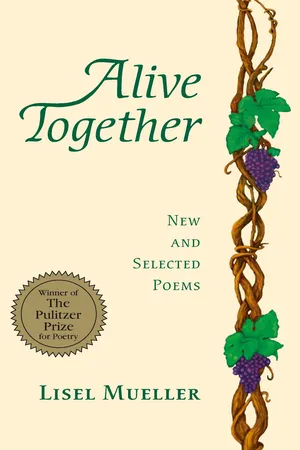
- 240 pages
- English
- ePUB (mobile friendly)
- Available on iOS & Android
eBook - ePub
About this book
Information
Topic
LiteraturaSubtopic
PoesíaCURRICULUM VITAAE
1992
1) I was born in a Free City, near the North Sea.
2) In the year of my birth, money was shredded into
confetti. A loaf of bread cost a million marks. Of
course I do not remember this.
confetti. A loaf of bread cost a million marks. Of
course I do not remember this.
3) Parents and grandparents hovered around me. The
world I lived in had a soft voice and no claws.
world I lived in had a soft voice and no claws.
4) A cornucopia filled with treats took me into a building
with bells. A wide-bosomed teacher took me in.
with bells. A wide-bosomed teacher took me in.
5) At home the bookshelves connected heaven and earth.
6) On Sundays the city child waded through pinecones
and primrose marshes, a short train ride away.
and primrose marshes, a short train ride away.
7) My country was struck by history more deadly than
earthquakes or hurricanes.
earthquakes or hurricanes.
8) My father was busy eluding the monsters. My mother
told me the walls had ears. I learned the burden of secrets.
told me the walls had ears. I learned the burden of secrets.
9) I moved into the too bright days, the too dark nights
of adolescence.
of adolescence.
10) Two parents, two daughters, we followed the sun
and the moon across the ocean. My grandparents stayed
behind in darkness.
and the moon across the ocean. My grandparents stayed
behind in darkness.
11) In the new language everyone spoke too fast. Eventually
I caught up with them.
I caught up with them.
12) When I met you, the new language became the language
of love.
of love.
13) The death of the mother hurt the daughter into poetry.
The daughter became a mother of daughters.
The daughter became a mother of daughters.
14) Ordinary life: the plenty and thick of it. Knots tying
threads to everywhere. The past pushed away, the future left
unimagined for the sake of the glorious, difficult, passionate
present.
threads to everywhere. The past pushed away, the future left
unimagined for the sake of the glorious, difficult, passionate
present.
15) Years and years of this.
16) The children no longer children. An old man’s pain, an
old man’s loneliness.
old man’s loneliness.
17) And then my father too disappeared.
18) I tried to go home again. I stood at the door to my
childhood, but it was closed to the public.
childhood, but it was closed to the public.
19) One day, on a crowded elevator, everyone’s face was younger
than mine.
than mine.
20) So far, so good. The brilliant days and nights are
breathless in their hurry. We follow, you and I.
breathless in their hurry. We follow, you and I.
PLACE AND TIME
History is your own heartbeat.
—Michael Harper
—Michael Harper
Last night a man on the radio,
a still young man, said the business district
of his hometown had been plowed under.
The town was in North Dakota.
Grass, where the red-and-gold
Woolworth sign used to be,
where the revolving doors
took him inside Sears;
gone the sweaty seats
of the Roxy—or was it the Princess—
of countless Friday nights
that whipped his heart to a gallop
when a girl touched him, as the gun
on the screen flashed in the moonlight.
Grass, that egalitarian green,
pulling its sheet over rubble,
over his barely cold childhood,
on which he walks as others walk
over a buried Mayan temple
or a Roman aqueduct beneath
a remote sheep pasture
in the British Isles. Yet his voice,
the modest voice on the radio,
was almost apologetic,
as if to say, what’s one small town,
even if it is one’s own,
in an age of mass destruction,
and never mind the streets and stones
of a grown man’s childhood—
as if to say, the lives we live
before the present moment
are graves we walk away from.
a still young man, said the business district
of his hometown had been plowed under.
The town was in North Dakota.
Grass, where the red-and-gold
Woolworth sign used to be,
where the revolving doors
took him inside Sears;
gone the sweaty seats
of the Roxy—or was it the Princess—
of countless Friday nights
that whipped his heart to a gallop
when a girl touched him, as the gun
on the screen flashed in the moonlight.
Grass, that egalitarian green,
pulling its sheet over rubble,
over his barely cold childhood,
on which he walks as others walk
over a buried Mayan temple
or a Roman aqueduct beneath
a remote sheep pasture
in the British Isles. Yet his voice,
the modest voice on the radio,
was almost apologetic,
as if to say, what’s one small town,
even if it is one’s own,
in an age of mass destruction,
and never mind the streets and stones
of a grown man’s childhood—
as if to say, the lives we live
before the present moment
are graves we walk away from.
Except we don’t. We’re all
pillars of salt. My life began
with Beethoven and Schubert
on my mother’s grand piano,
the shiny Bechstein on which she played
the famous symphonies
in piano reductions. But they were no
reductions for me, the child
who now remembers nothing
earlier than that music,
a weather I was born into,
a jubilant light or dusky sadness
struck up by my mother’s hands.
Where does music come from
and where does it go when it’s over—
the child’s unanswered question
about more than music.
pillars of salt. My life began
with Beethoven and Schubert
on my mother’s grand piano,
the shiny Bechstein on which she played
the famous symphonies
in piano reductions. But they were no
reductions for me, the child
who now remembers nothing
earlier than that music,
a weather I was born into,
a jubilant light or dusky sadness
struck up by my mother’s hands.
Where does music come from
and where does it go when it’s over—
the child’s unanswered question
about more than music.
My mother is dead, and the piano
she could not take with her into exile
burned with our city in World War II.
That is the half-truth. The other half
is that it’s still her black Bechstein
each concert pianist plays for me
and that her self-taught fingers
are behind each virtuoso performance
on the stereo, giving me back
my prewar childhood city
intact and real. I don’t know
if the man from North Dakota has
some music that brings back
his town to him, but something does,
and whatever he remembers
is durable and instantly
retrievable and lit
by a sky or streetlight
which does not change. That must be why
he sounded casual about
the mindless wreckage, clumsy
as an empty threat.
she could not take with her into exile
burned with our city in World War II.
That is the half-truth. The other half
is that it’s still her black Bechstein
each concert pianist plays for me
and that her self-taught fingers
are behind each virtuoso performance
on the stereo, giving me back
my prewar childhood city
intact and real. I don’t know
if the man from North Dakota has
some music that brings back
his town to him, but something does,
and whatever he remembers
is durable and instantly
retrievable and lit
by a sky or streetlight
which does not change. That must be why
he sounded casual about
the mindless wreckage, clumsy
as an empty threat.
IMMORTALITY
In Sleeping Beauty’s castle
the clock strikes one hundred years
and the girl in the tower returns to the world.
So do the servants in the kitchen,
who don’t even rub their eyes.
The cook’s right hand, lifted
an exact century ago,
completes its downward arc
to the kitchen boy’s left ear;
the boy’s tensed vocal cords
finally let go
the trapped, enduring whimper,
and the fly, arrested mid-plunge
above the strawberry pie
fulfills its abiding mission
and dives into the sweet, red glaze.
the clock strikes one hundred years
and the girl in the tower returns to the world.
So do the servants in the kitchen,
who don’t even rub their eyes.
The cook’s right hand, lifted
an exact century ago,
completes its downward arc
to the kitchen boy’s left ear;
the boy’s tensed vocal cords
finally let go
the trapped, enduring whimper,
and the fly, arrested mid-plunge
above the strawberry pie
fulfills its abiding mission
and dives into the sweet, red glaze.
As a child I had a book
with a picture of that scene.
I was too young to notice
how fear persists, and how
the anger that causes fear persists,
that its trajectory can’t be changed
or broken, only interrupted.
My attention was on the fly:
that this slight body
with its transparent wings
and life-span of one human day
still craved its particular share
of sweetness, a century later.
with a picture of that scene.
I was too young to notice
how fear persists, and how
the anger that causes fear persists,
that its trajectory can’t be changed
or broken, only interrupted.
My attention was on the fly:
that this slight body
with its transparent wings
and life-span of one human day
still craved its particular share
of sweetness, a century later.
LOSING MY SIGHT
I never knew that by August
the birds are practically silent,
only a twitter here and there.
Now I notice. Last spring
their noisiness taught me the difference
between screamers and whistlers and cooers
and 0, the coloraturas.
I have already mastered
the subtlest pitches in our cat’s
elegant Chinese. As the river
turns muddier before my eyes,
its sighs and little smacks
grow louder. Like a spy,
I pick up things indiscriminately:
the long approach of a truck,
car doors slammed in the dark,
the night life of animals—shrieks and hisses,
sex and pi under in the garage.
Tonight the crickets spread static
across the air, a continuous rope
of sound extended to me,
the perfect listener.
the birds are practically silent,
only a twitter here and there.
Now I notice. Last spring
their noisiness taught me the difference
between screamers and whistlers and cooers
and 0, the coloraturas.
I have already mastered
the subtlest pitches in our cat’s
elegant Chinese. As the river
turns muddier before my eyes,
its sighs and little smacks
grow louder. Like a spy,
I pick up things indiscriminately:
the long approach of a truck,
car doors slammed in the dark,
the night life of animals—shrieks and hisses,
sex and pi under in the garage.
Tonight the crickets spread static
across the air, a continuous rope
of sound extended to me,
the perfect listener.
AN UNANSWERED QUESTION
If I had been the lone survivor
of my Tasmanian tribe,
the only person in the world
to speak my language
(as she was),
of my Tasmanian tribe,
the only person in the world
to speak my language
(as she was),
if I had known and believed that
(for who can believe
in an exhaustible language),
and if I had been shipped
to London, to he exhibited
in a cage (as she was)
to entertain the curious
who go to museums and zoos,
(for who can believe
in an exhaustible language),
and if I had been shipped
to London, to he exhibited
in a cage (as she was)
to entertain the curious
who go to museums and zoos,
and if among all those people
staring and pointing and laughing
and making their meaningless sounds
there had been one thoughtful face,
a woman’s, say, sympathetic,
staring and pointing and laughing
and making their meaningless sounds
there had been one thoughtful face,
a woman’s, say, sympathetic,
who might have instinctively understood
the one word I could not let die,
the indispensable word
I must pass through the bars
of mutual incomprehension,
the one word I could not let die,
the indispensable word
I must pass through the bars
of mutual incomprehension,
what word would it have been?
EYES AND EARS
Perhaps it’s my friendship with Dick,
who watches and listens from his wheelchair
but cannot speak, has never spoken,
that makes me aware of the daily
unintrusive presences
of other mute watchers and listeners.
Not the household animals
with their quick bodies—they have cry
and gesture as a kind of language—
but rooted lives, like trees,
our speechless ancestors,
which line the streets and see me,
see all of us. By August
they’re ...
who watches and listens from his wheelchair
but cannot speak, has never spoken,
that makes me aware of the daily
unintrusive presences
of other mute watchers and listeners.
Not the household animals
with their quick bodies—they have cry
and gesture as a kind of language—
but rooted lives, like trees,
our speechless ancestors,
which line the streets and see me,
see all of us. By August
they’re ...
Table of contents
- Cover
- Title Page
- Copyright Page
- Dedication
- Contents
- New Poems
- Notes
Trusted by 375,005 students
Access to over 1.5 million titles for a fair monthly price.
Study more efficiently using our study tools.
Frequently asked questions
Yes, you can cancel anytime from the Subscription tab in your account settings on the Perlego website. Your subscription will stay active until the end of your current billing period. Learn how to cancel your subscription
No, books cannot be downloaded as external files, such as PDFs, for use outside of Perlego. However, you can download books within the Perlego app for offline reading on mobile or tablet. Learn how to download books offline
We are an online textbook subscription service, where you can get access to an entire online library for less than the price of a single book per month. With over 1.5 million books across 990+ topics, we’ve got you covered! Learn about our mission
Look out for the read-aloud symbol on your next book to see if you can listen to it. The read-aloud tool reads text aloud for you, highlighting the text as it is being read. You can pause it, speed it up and slow it down. Learn more about Read Aloud
Yes! You can use the Perlego app on both iOS and Android devices to read anytime, anywhere — even offline. Perfect for commutes or when you’re on the go.
Please note we cannot support devices running on iOS 13 and Android 7 or earlier. Learn more about using the app
Please note we cannot support devices running on iOS 13 and Android 7 or earlier. Learn more about using the app
Yes, you can access Alive Together by Lisel Mueller in PDF and/or ePUB format, as well as other popular books in Literatura & Poesía. We have over 1.5 million books available in our catalogue for you to explore.