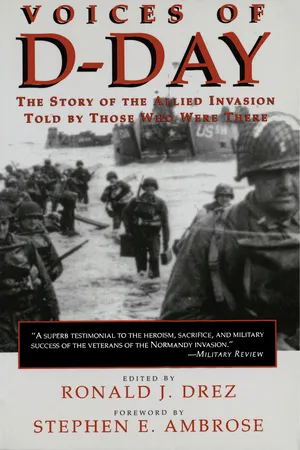
In 1983 the Eisenhower Center at the University of New Orleans began a project to record the recollections of as many people as possible -- civilians as well as soldiers -- who were involved in one of the most pivotal events of the century. Skillfully edited by Ronald J. Drez and first published on the fifty-year anniversary of D-Day, the award-winning Voices of D-Day tells the story of that momentous operation almost entirely through the words of the people who were there.
eBook - ePub
Voices of D-Day
The Story of the Allied Invasion Told by Those Who Were There
- 312 pages
- English
- ePUB (mobile friendly)
- Available on iOS & Android
eBook - ePub
About this book
Trusted by 375,005 students
Access to over 1.5 million titles for a fair monthly price.
Study more efficiently using our study tools.
Information
Subtopic
World War IIIndex
HistoryChapter 1

SIGNING UP
HARRY BARE: “I was born and raised in Philadelphia, Pennsylvania, in 1914. In 1942, Pearl Harbor had been bombed, and we were in it. I was young, in good shape, and they were not going to have a war without me. We did not have ROTC at my college, but I did learn about VOC, Volunteer’s Officer Candidate School, and thought, that’s for me. I signed up, and at Fort Niagara took all the tests and qualified in all except the physical. After three days, I was washed out for high blood pressure.
“Disappointed and angry, I went right down and enlisted. Strange, but I passed my physical with flying colors. Not a word was said about high blood pressure. I was assigned to the 269th Ordnance Service Battalion as a T-5 but realized that this was not for me, so I joined the 116th Infantry Regiment, 29th Division, 2nd Battalion, F Company, as a buck sergeant. I received another stripe, and as a staff sergeant was in charge of 1st Squad, F Company.”
JAMES LYNAPP GILLIGAN (Company B, 149th Combat Engineers): “Selectees for military service were assigned a number by a sort of national lottery, and 1 had been given a number so high that it was unlikely that I would be called into service for a long time, if at all. With the demanding work hours, and to reduce the commuting gas usage, since gas was rationed, I decided to relocate to Stamford, Connecticut, which was the town I worked in, and ten miles closer than where I lived. So I wrote the Draft Board in 1943 to get their best estimate of my call-up date, so I could arrange a lease. Their cordial response was to call me into service immediately.”
F. L. MUTTER (16th Infantry, 1st Division): “It was in November, 1942. The Americans had landed in North Africa, and I had seen a couple of real good war movies, and my patriotism was really inflated. I decided to enlist in the Army.
“At the induction center, they kept me there two days, urinating in a bottle, before they gave me a rejection slip and told me I had a kidney problem. I was pretty disappointed.
“There were three of us guys who palled around together, Dinky, Artie, and myself. Dinky got drafted, so Artie and I went to the Draft Board and asked if we could all go together, since Artie and I were due to be drafted in a few months anyway, and they approved.
“In the induction center, we were taking our physicals; I told Dinky to save a little for my bottle or I wouldn’t pass. He did and I passed easily. I became a member of the Big Red One.”
DAVID M. JONES: “I was born August 30, 1920, in Oakland, California. Following the bombing of Pearl Harbor on December 7, 1941, like all eligible males of that time, I was caught up in the patriotic fervor and enlisted in the United States Army Air Corps, December 30, 1941, with the thought of flying high. It didn’t take long to find out that there were some rather menial tasks to be done in that branch of the service. I couldn’t stand it any longer and after a year found the only avenue of escape was to transfer to the airborne, eventually being assigned to Headquarters Company, 1st Battalion, 508th Parachute Infantry Regiment, 82nd Airborne Division.”
ROBERT HEALEY: “I was born in Somerville, Massachusetts, on May 7, 1919. I was first called up in February of 1942. I was turned down for poor eyesight and was very disappointed, because like everyone else of that day, people of my age wanted to be in the service because all of our friends were there. I was hoping for another chance, and that chance came in November of 1942 when I was again called up and sent for a physical. Luckily for me, the army used an eye chart with a large E and with progressively smaller letters as you went down. Standing in line with my glasses on, I memorized the whole chart, so when it came time to take the test, I passed. A clerk who was there remarked to the doctor that on my previous test my eyes had been much worse, and the doctor told the clerk, ‘Mind your own business. Go ahead, kid.’ I was in, and I was tickled.
“The command I was sent to was the 149th Combat Engineers; I was assigned to A Company, 1st Platoon.”
SAM GRUNDFAST: “I was born on February 5, 1921, in New York City. On December 8, 1941, the day after Pearl Harbor, I went down to the naval recruiting office at 33 Pine Street in New York City and proceeded to enlist in the United States Navy. At that time I was a junior at NYU, at the Washington Square College in New York City. They said that after I joined and I was sworn in, I would be allowed to finish my education. So in March of 1942, I was sworn in to the V-7 Naval Training Program and allowed to stay in college and finish my education. I was a pre-med student and graduated in June of 1943.
“At that time, I received orders to proceed to the Notre Dame midshipmen’s school of the United States Navy in South Bend, Indiana. I arrived there and for ninety days I was educated and was told that I was now a sailor. I successfully completed my training and was graduated from the midshipmen’s school in Notre Dame in September of 1943. I commanded LCT 607.”
MARTIN FRED GUTEKUNST (Signalman 3rd Class, U.S. Navy): “I had a high draft number, so I thought the conflict would be over before I was drafted. By 1943, after a series of defense industry deferments, and with a constant reminder from mothers who had sons in the army saying to me, ‘How come you’re still around here?—my son has been in for so many years,’ I was anxious to join them.
“At the induction center, I was asked which branch of service I preferred. My choice was the Air Corps. However, the authorities in charge directed me to a table with a lot of uniformed men. They said, ‘You are now in the navy.’
“We did some dry landings and were taught how to dig foxholes. We soon began to realize that we were not in the navy as we had known the navy to be. This was the amphibious, which was new, and somewhat disorganized. Somewhere our unit was named JASCAL, or Joint Assault Signal Company.”
BRIAND BEAUDIN, M.D.: “I was born in West Warwick, Rhode Island, on July 21, 1917. I spent four years in ROTC at Georgetown Medical School and was graduated as a physician and first lieutenant on May 25, 1942. On August 13, 1943, I was inducted in the U.S. Army as a first lieutenant and given orders to report to Carlisle Barracks in Pennsylvania for six weeks of military medical training, to be followed by reporting to the 97th Infantry Division at Camp Swift in Bastrop, Texas.
“After four weeks at Carlisle Barracks, a paratroop medical officer with rank of captain appeared at all our classes. He informed us that the parachute troops were looking for volunteers and invited us all to a meeting that night, where the concept of parachute troops would be explained and jump paraphernalia would be shown, as well as an up-to-date training film. About four hundred medics showed up that evening. After the talk and viewing of the equipment, about three hundred were left. After the film, only twelve were present. Of these twelve, after physical exams, I was one of four who were chosen.
“I had volunteered for three reasons. First, I had always had a serious fear of heights, even to the point of walking to the center of the road if there was a precipice or waterfalls along the sidewalk—especially on a bridge! Second, the extra hundred dollars a month sounded very good. Third, there was a matter of pride, and the knowledge that this training would cure me of my fears—or kill me.
“On the Friday night of my third training week, a plane’s propeller dropped off and the C-47 crashed, killing all passengers. I was determined after that that when my turn came for a night jump a week later, I would sit in my normal position across from the door, and if the motors began to fail, I would immediately jump out the door.
“When I received my parachute wings I wrote to my parents, who learned for the first time that I had been at Fort Benning to get parachute training. I was made assistant battalion surgeon and assigned to the 3rd Battalion, 508th Regiment.”
ROBERT BUTLER: “I was born in Battle Creek, Michigan, April 21, 1915, and was inducted at Fort Custer in Battle Creek in 1941 and ended up in the Coast Guard Artillery, in a barrage balloon battalion in Seattle, Washington, where they expected the Japanese to invade at any moment. We lived out in the country on this barrage balloon site, and all our meals were brought to us by truck, and we were not allowed to leave the area, twenty-four hours, seven days a week.
“I did not enjoy this type of service, and when I found out that they were looking for volunteer glider pilots, I immediately applied. The qualification for becoming a glider pilot at that time was that you had to have a pilot’s license in civilian life, which I did have, at a rather tender age.
“Our training started in Victorville, and we promptly became staff sergeants, in order to get larger flight pay, and graduated as flight officers, which was a new designation and rank alongside a warrant officer. We were accorded the privilege of going into officers’ clubs and eating in the officers’ mess and that sort of thing, but really, were never totally accepted as a full-fledged officer.
“Our training after graduation from Victorville was in various areas of the United States, from Arizona to Texas to Louisville, Kentucky, and one of the first was at Tucumcari, New Mexico, where the Air Force had taken over a dude ranch which had a landing strip, and there were about twenty of us that lived very exclusively in the dude ranch facilities, with their French chef and that sort of thing.
“We had as our instructor a German defector who was a world-famous glider pilot and had trained many German troops and pilots prior to their entering World War II. Eventually, we got into the CG-4 military gliders, which carried fifteen full-laden airborne troops, and practiced for many, many months throughout the country under every condition imaginable. I became an instructor in North Carolina for nighttime training, and this experience was equally as exciting as combat duty, in that we had to land by smudge pots at night, in very small areas, and we instructors had to wait until the very last second to take over in case of emergencies, and there were many. It was a nerve-racking job, and I was almost elated when I received word that I was being transferred to England.
“I joined the 434th Troop Carrier Group at Aldermaston, England, and was in the 74th Squadron. Our training there was various over several months, and initially, we got into the Horsa—English—glider, which is an enormous glider that carried thirty-five troops. The glider itself was made mostly of plywood and had hydraulic flaps and a tricycle landing gear. It was so large that it could not be flown very successfully at night and was meant to land in France in the daytime.
“After becoming quite proficient in the Horsa glider, they decided that my group would go in at night, and we went back to the CG-4 glider and trained for many weeks to land in exceptionally short spaces, between all sorts of obstacles.”
KENNETH MERRITT: “I was born the tenth of August, 1923, in a little town named Warner, Oklahoma, in the county of Muskogee. In October, 1942, I decided to join the marines, but while I was waiting to see the marine recruiting sergeant, I noticed an army recruiting poster of a soldier floating to the ground in a parachute and a Thompson .45 submachine gun across his reserve chute. Right there and then I forgot about the marines,’ and I knew that I wanted to go into the parachute troops. The recruiting poster asked, ‘Are you man enough to fill these shoes?’ I was assigned to a light machine-gun platoon, Headquarters Company, 1st Battalion, 508th Parachute Infantry Regiment, 82nd Airborne.”
FRED PATHEIGER: “I was born on December 22, 1919, in Rastatt, Germany. When I was a year old, my mother and father were divorced. I lived with my mother, grandmother, and aunt. When Hitler got into power, my mother, grandmother, and aunt had to join the [Nazi] party. I had to join the Hitler Youth or I couldn’t have gone to school, and I discovered one day while a youngster crawling into the living room and listening to these ladies speak that much to my amazement, my grandfather on my mother’s side was Jewish.
“My aunt went with a fellow. They were going to get married and she told him about her background, and when he found out that her father had been Jewish, well, that was it. He reported it and we were all in trouble. We had to get out of the party; I had to get out of the Hitler Youth. This was in the mid-thirties, and of course, I continued to go to school, and my mother made overtures to distant relatives in Chicago to get me out of the country. I would have been nothing but cannon fodder.
“A distant cousin put up an affidavit, and I came over here in April, 1938. The others remained over there. We tried to get them over here, but the Nazis kept bringing up one obstacle after another. We finally had everything set and had made arrangements to bring them over via Japan, but then Pearl Harbor happened, and that did not work out. Eventually, they succumbed in the concentration camps.
“I got into the service in December, 1942. I volunteered for the Air Corps—glider. I was the typical ninety-pound weakling pictured in Charles Atlas ads until paratrooper training. That completely changed me. I was now one of the elite; I was a Screaming Eagle of the 101st Airborne Division.”
DONALD NUTTALL: “I was born January 10, 1927, in Norfolk, Massachusetts, and am better known as Mickey Nuttall. In 1943, I was sixteen and the U.S. was talking about drafting seventeen-year-olds. I told my mother I didn’t want to be drafted. I went and signed up when I was sixteen, and the Navy told me, ‘When you’re seventeen, we will call you.’
“On January 10, 1944, I made seventeen and was sworn in, and in April, we sailed for Scotland on the ‘Queen Mary and joined the LST 309 at Portland, England.”
WALTER SHAWD: “I was born in Kenton, Ohio, December 19, 1921. I met my wife in September of 1941, and we were engaged in November, and we decided to be married in January, 1942. Pearl Harbor came on December 7, 1941, but when January came we decided to go ahead and get married anyway.
“In the fall she was pregnant, and we went to Columbus, Ohio, to buy her a maternity dress. I had a cousin living in Columbus at the time, and he suggested we go down and sign up with the Coast Guard. So we went down to the Coast Guard and he got in and I didn’t because of flat feet. So I decided I would let them draft me.
“I was working in a machine shop making machine tools, and I had several deferments because of my job, but on March 6, 1943, I was drafted into the army and put in L Company, 116th Regiment of the 29th Division. I was in the mortar section as an assistant mortar man.”
BRIAN ALAN DAVIE: “I was born in Glasgow, Scotland, in 1915. My father was a professional teacher of singing and a choir conductor. I became an indentured apprentice with the departmental firm of Gruses, Cooper and Company in Glasgow.
“When Chamberlain made his declaration that we were at war with Germany, I became a conscientious objector to the war. I simply took the personal and individual view that war was absurd and I wasn’t going to be any part of it.
“At that time, I had a business of my own in Walton-on-the-Naze, blending and selling tea, and because of the evacuation from East Anglia, my business simply fell away. There were no customers and I simply closed down. I went to London and lived in a small community of conscientious objectors. We lived together, and we did various social works, including running a school for small children. That area of Paddington was severely bombed in the first big bombing of London in September, 1940, and I then, fortunately, was given a job in Bicester in Oxford as a housemaster at a hospital for maladjusted boys who were too difficult to be billeted in private houses; and it was while I was there acting as a housemaster that I received call-up papers, which I ignored. After three months, an escort was sent to Bicester and I was taken to Wakefield Jail in Yorkshire.
“After being taken from the hostel in Bicester to Wakefield, I refused to put on the uniform, so I was placed in the guardroom at the training regiment in Wakefield, and it was while in the guardroom that I was charged and taken to court in Leicester, where I was sentenced to three months’ imprisonment.
“Most of those who were recognized as conscientious objectors were people either with long and strong religious connections, pacifist connections, or members of...
Table of contents
- Cover
- Title Page
- Copyright Page
- Contents
- Illustrations
- Foreword
- Preface
- Editor’s Note
- Introduction
- 1 Signing Up
- 2 The Gathering Forces
- 3 Training and Quarantine
- 4 Plans and Execution
- 5 The Screaming Eagles
- 6 The Bridge Prangers
- 7 Troarn and Robehomme
- 8 The All-Americans
- 9 The Air War
- 10 Utah Beach
- 11 The Guns of Brecourt
- 12 The 116th at Omaha Beach
- 13 Easy Red and the 1st Division
- 14 Guns and Rangers
- 15 Satterlee, Harding, and Mccook
- 16 Gold and Juno Beaches
- 17 Sword Beach
Frequently asked questions
Yes, you can cancel anytime from the Subscription tab in your account settings on the Perlego website. Your subscription will stay active until the end of your current billing period. Learn how to cancel your subscription
No, books cannot be downloaded as external files, such as PDFs, for use outside of Perlego. However, you can download books within the Perlego app for offline reading on mobile or tablet. Learn how to download books offline
Perlego offers two plans: Essential and Complete
- Essential is ideal for learners and professionals who enjoy exploring a wide range of subjects. Access the Essential Library with 800,000+ trusted titles and best-sellers across business, personal growth, and the humanities. Includes unlimited reading time and Standard Read Aloud voice.
- Complete: Perfect for advanced learners and researchers needing full, unrestricted access. Unlock 1.5M+ books across hundreds of subjects, including academic and specialized titles. The Complete Plan also includes advanced features like Premium Read Aloud and Research Assistant.
We are an online textbook subscription service, where you can get access to an entire online library for less than the price of a single book per month. With over 1.5 million books across 990+ topics, we’ve got you covered! Learn about our mission
Look out for the read-aloud symbol on your next book to see if you can listen to it. The read-aloud tool reads text aloud for you, highlighting the text as it is being read. You can pause it, speed it up and slow it down. Learn more about Read Aloud
Yes! You can use the Perlego app on both iOS and Android devices to read anytime, anywhere — even offline. Perfect for commutes or when you’re on the go.
Please note we cannot support devices running on iOS 13 and Android 7 or earlier. Learn more about using the app
Please note we cannot support devices running on iOS 13 and Android 7 or earlier. Learn more about using the app
Yes, you can access Voices of D-Day by Ronald J. Drez in PDF and/or ePUB format, as well as other popular books in History & World War II. We have over 1.5 million books available in our catalogue for you to explore.