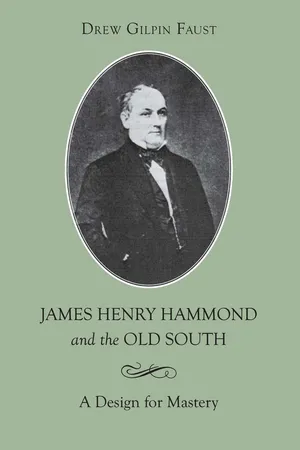
From his birth in 1807 to his death in 1864 as Sherman's troops marched in triumph toward South Carolina, James Henry Hammond witnessed the rise and fall of the cotton kingdom of the Old South. Planter, politician, and an ardent defender of slavery and white supremacy, Hammond built a career for himself that in its breadth and ambition provides a composite portrait of the civilization in which he flourished.
A long-awaited biography, Drew Gilpin Faust's James Henry Hammond and the Old South reveals the South Carolina planter who was at once characteristic of his age and unique among men of his time. Of humble origins, Hammond set out to conquer his society, to make himself a leader and a spokesman for the Old South. Through marriage he acquired a large plantation and many slaves, and then through their coerced labor, shrewd management practices, and progressive farming techniques, he soon became one of the wealthiest men in South Carolina. He was elected to the United States House of Representatives and served as governor of his state. Evidence that he sexually abused four of his teenage nieces forced him to retreat for many years to his plantation, but eventually he returned to public view, winning a seat in the United States Senate that he resigned when South Carolina seceded from the Union.
James Henry Hammond's ambition was unquenchable. It consumed his life, directed almost his every move and ultimately, in its titanic calculation and rigidity, destroyed the man confined within it. Like Faulkner's Thomas Sutpen, Faust suggests, Hammond had a "design, " a compulsion to direct every moment of his life toward self-aggrandizement and legitimation. Despite his sexual abuse of enslaved females and their children, like other plantation owners, Hammond envisioned himself as benevolent and paternal. He saw himself as the absolute master of his family and slaves, but neither his family, his slaves, nor even his own behavior was completely under his command. Hammond fervently wished to perfect and preserve what he envisioned as the southern way of life. But these goals were also beyond his control. At the time of his death it had become clear to him that his world, the world of the Old South, had ended.
- 432 pages
- English
- ePUB (mobile friendly)
- Available on iOS & Android
eBook - ePub
About this book
Information
Subtopic
North American HistoryIndex
HistoryPart I
To Be Great Among Men
Oh God, … Make me great among men.
JAMES HENRY HAMMOND
JAMES HENRY HAMMOND
CHAPTER 1
A Father’s Pride and Ornament
JAMES HENRY HAMMOND’S father never doubted that his firstborn son was a genius. From the time of James’s birth in 1807, Elisha Hammond lived, as his son later recounted, “for me & in me.” The father’s hopes burdened the boy with expectations he would spend his life trying to meet. His “heart dwelt on me,” James remembered, “with the fondest & alas most confident assurances, that I would one day be what he might have been, but for the blast of early hardship.”1
Elisha’s own existence represented a bitter chronicle of debt, failure, and disappointment, brightened only by dreams of a better lot for his promising son. Born in New Bedford, Massachusetts, in 1774, the elder Hammond was at the age of twenty-one earning his living building stone walls. But he aspired beyond the drudgery of manual labor. Having never so much as seen a Latin grammar, Elisha began to educate himself, working one-half of each year to support a subsequent six months of study, first at academies, then at college. In 1802 Elisha graduated from Dartmouth and embarked southward to seek his fortune. When he arrived in Charleston in November of that year, he was “Sick and a Stranger to every body I had few cloathes, and had one single ¼ of a dollar in my pocket.” Out of desperation he considered becoming a Methodist minister, but more worldly ambitions prevailed. He left Charleston to seek opportunities in the growing interior of the state and established himself as a schoolmaster at Mount Bethel, a respected Methodist academy in the Newberry District of the Carolina up-country. By the spring of 1805, he had advanced remarkably, for he was appointed professor of languages in the inaugural term of the new South Carolina College in Columbia. Family legend maintains that the regularly elected professor did not appear, and so the trustees turned to nearby Mount Bethel, the source of a number of the college’s students, for an emergency replacement. Hammond was well liked at the College, where students and colleagues found “his personal appearance and manners … very captivating.” His charm soon won him a bride, Catherine Spann, of Edgefield, South Carolina, to whom he was wed in July of 1806. The Spanns were a family of middling means who owned some land and several slaves, but Catherine’s meager property did not markedly improve her struggling husband’s position.2
Soon after their marriage, Elisha resigned his professorship in Columbia and returned to rural Newberry, where he became principal of Mount Bethel. On November 15, 1807, a child was born to the schoolmaster and his young wife, and they named the boy James Henry Hammond. The early years of James’s life passed amidst the secondary-school routine. The main building at Mount Bethel, built of rough-hewn stone, housed students on its second floor and the main classrooms below. The Hammonds lived in one of several surrounding cabins that served as residences for teachers and additional students who could not be accommodated in the main hall. “Among the hundred or more boys & young men there,” Hammond later remembered, “I could not fail to learn something of human nature & customs even before I was eight years old.” Elisha took advantage of the school environment to begin his son’s academic education at an early age. “If hereafter,” James mused in 1826, “ought of fame & honor shall be mine to boast of, all praise is due him who early instilled into me a ‘holy thirst’ for knowledge—a noble desire to excel.” Elisha was soon convinced of his son’s unusual endowments, for the boy quickly began to exhibit signs of great intelligence and to demonstrate as well that he had inherited his father’s physical attractiveness and charm.3
But Elisha was not entirely satisfied by these evidences of talent. The father’s hopes for his “pride and ornament” were so great that he could not entirely allay fears of ultimate disappointment. Elisha’s apprehensions, his son later recalled, “were that I would prove a prodigal & lack steadiness of purpose & many a sound flogging did he give me on these premises.” His father’s thrashings succeeded in alerting James both painfully and permanently to the dangers of these potential character flaws. Hammond would never forget what he came to regard as a congenital predisposition to laziness and improvidence.4
The secret of success, Elisha taught his son, the way for him to realize the ambition his father had awakened, was through constant and unremitting self-control. The “greatest contests that the greatest men have ever had,” Elisha warned, “were with their passions to subdue and over come them.” James possessed, his father assured him, “by nature and acquirement a superior Genius, health, youth, handsome address…. Learn, my dear Son, the government of your passions.” The alternative to effective self-discipline was ignominious failure, a prospect with which Elisha terrified the boy. “More than half of the young men raised in the Southern States are sooner or later ruined by disapation [sic] but this,” Elisha solemnly intoned, “I trust, will not apply to you.” Even when the elder Hammond’s voice was stilled by death, his warnings and evocations of disaster continued to echo within James’s mind. The son internalized his father’s fear of displaying impulse and emotion and throughout his life endeavored to maintain that tight self-control Elisha had prescribed. His remarkable drive, James believed, was only a façade. “I still fear myself,” he confessed in 1848, “that my acting may give out some day.” More than a decade later Hammond admitted how difficult he continued to find the task of self-control. “I often think I should be better if I had one of those thrashings my Father used to bestow on me—rather liberally, I thought then.” Elisha was a good teacher, for his most important pupil never forgot this crucial lesson.5
However gifted an instructor he may have been, Elisha was not making the fortune he desired at Mount Bethel. Even efforts to supplement his school revenues with farming, a general store, and an entrepreneurial scheme to raise beans for castor oil did not provide him with sufficient income to meet the needs of his family, which increased by another child almost every year. Caroline Augusta arrived in 1810, Adeline Eliza in 1811, Juliana in 1813, and Marcus Claudius Marcellus in 1814. The year after the birth of his second son, Elisha returned to Columbia with his wife and four children. (Juliana had died at just over a year of age.) At the head of the state’s largest river system, Columbia had become the center of Carolina’s up-country market, and Elisha was determined to make his fortune in the rapidly growing town. He invested in a sawmill, opened a sidewalk market that sold vegetables and meat, and secured the post of steward at South Carolina College, thus assuming responsibility for feeding the more than one hundred hungry youths enrolled in the institution. The students complained that Elisha’s provisions were unpalatable, his hominy “disagreeable,” and his meat infested with worms, but Hammond made more money at this endeavor than at any of the other schemes he undertook during his life.6
His family, meanwhile, continued to grow. Two babies died in infancy in 1816 and 1817, and a third son, John Fox, was born in 1820. But the arrival of Marcellus and John little diminished James’s importance in his father’s eyes. From the first, the younger boys seemed less gifted, less interesting to their father than his favored firstborn. Never as bright or as handsome as James, they would all their lives exhibit the heedless, impetuous “prodigality” Elisha worked so hard to thrash out of their older brother.
For James, the move to Columbia opened a new world. Rustic as it was, with a population of scarcely a thousand, the town was laid out on a monumental scale. Boulevards more than a hundred feet wide marked off four-acre blocks dotted with wooden houses regularly trimmed in yellow and grey. Because of its more central location within the state, Columbia had replaced Charleston as South Carolina’s capital, and the statehouse, atop a three-hundred-foot hill covered with oaks, dominated the town. Just across the street lay the brick buildings of the college and the residential quarters of the steward and his family. James was awed by his new home, by the ambitious and sophisticated college students, and by the dramas of state politics taking place all around him.7
Even the meager ceremony associated with government in this provincial town must have dazzled an impressionable youth so recently arrived from an area of far greater rudeness and isolation. Hammond would no doubt have witnessed the annual fall opening of the legislative session, the parade of delegates and colorfully clad militia officers accompanying the biennial election of the new governor, and the annual commencement procession of the college, which included not only the scholars arrayed in academic robes but the officers of the state as well. On his way to school each morning, Hammond later remembered, he encountered the same governor’s aide, en route to the capitol astride a spirited stallion. “I thought him Bucephalus & you Alexander so grand & imperial you both seemed to me.” The power of office seemed represented by the force of the sleek animal that the rider so easily directed and controlled. The sight aroused a desire in the boy to be himself mounted on a similar steed, receiving the admiration of passing pedestrians. It was a concrete stimulant to his already active ambition. While the goals his father had held out to him had previously seemed abstract and unreal, in Columbia Hammond came face to face with the embodiments of success and power.8
But Hammond’s earliest efforts to distinguish himself were not to lie in the political realm. Instead, he began to fill notebooks with essays and verse, some copied from romantic poets and others conveying his own musings in appropriately literary forms. His subjects ranged widely, but patriotic themes were a favorite. At the age of fourteen he composed a musical comedy in verse to commemorate the Battle of Eutaw, South Carolina’s triumph of the Revolutionary War. In the final chorus, the cast gathered to hail the defeat of British despotism:
Columbia’s free. Oppression’s oer
The din of war will sound no more.
South now the happy eagles soar
And light on Carolina’s shore
This it [is] the day that freedom brings
The Battle’s past oer Eutaw Springs
Happy nation we are free
thus forever may we be
Time only and eternity
Can destroy our liberty.9
The din of war will sound no more.
South now the happy eagles soar
And light on Carolina’s shore
This it [is] the day that freedom brings
The Battle’s past oer Eutaw Springs
Happy nation we are free
thus forever may we be
Time only and eternity
Can destroy our liberty.9
In the period of intense nationalism that followed the War of 1812, this young Carolinian was deeply affected by the currents of patriotic fervor. But it would not be long before Hammond, like other South Carolinians, would find that threats far more immediate and tangible than “time” and “eternity” were undermining “our liberty.”
Hammond’s boyhood writings displayed not only the influences of the era’s pervasive nationalism but the age’s closely related romanticism as well. These strains are evident in the poems of Byron, Burns, and Shelley that James carefully copied into his notebook; in the boy’s worshipful attention to heroes, from Nathanael Greene to Bonaparte; and in his essays and plays. But the romantic temper appears most clearly in the painful introspection that characterized so much of Hammond’s writing. James felt he knew a great deal about suffering, for his father’s expectations had made life a constant trial. “From my earliest recollections I now remember that I had nightmares & before I was 17 years old I had confirmed indigestion … that paralyzed intellect & shattered nerves.” On paper he explored some of the dilemmas that had begun to consume him. “Every thought and every action of man,” he scribbled at age twelve, “is founded on the broad basis of self-love … the hope of tranmittig to posterity his name covered with laurels.” “In whatsoever situation man is placed from the highest to the lowest his generate desire is to excel. To distinguish himself is the chief end of all his wishes.” Three years later his penmanship and spelling had improved, but his subject matter had not changed. “No passion rules the soul with half the force Ambition does, this the first, the primogenial ingredient of our nature.” The most inspiring embodiment of the noble force of ambition, Hammond proclaimed, was Napoleon. “No man ever rose from so low a degree to such preeminence. … he had no friend but his genius, no companion but his ambition, no wealth but his mind, no power but his dignity.” For the talented and aspiring, Hammond concluded, all things are possible.10
For Elisha Hammond, however, almost all things seemed impossible. Exasperated by the constant complaints of the college students about their fare, Hammond resigned as steward in 1821. Instead he determined to supplement his growing lumbering ventures on the rivers about Columbia with a similar enterprise on the Savannah, a larger and more commercially active waterway. Leaving a partner in charge in the capital city, Elisha moved his family once again. For most of the remaining six years of his life, Elisha struggled to make his fortune in a series of marginal enterprises in the area around Augusta, Georgia, and the developing South Carolina town of Hamburg just across the river. When barges of wood destined for the coast failed to provide adequate returns, Elisha supplemented his income with the profits his wife made feeding boarders for fifty cents a day.
But this time James was spared the direct experience of his parents’ struggles and disappointments. When they left Columbia in 1823, he remained behind to enter the junior class at South Carolina College. The institution had been transformed since the days of its infancy when Elisha Hammond had served as its first professor of languages. By the mid-twenties, the college boasted a president and five professors, and James’s graduating class would include thirty-one members. Only one building had been completed during Elisha’s term on the faculty, but since that time six additional structures had been erected to form a horseshoe around a row of trees and an expansive lawn.
In the years since its founding, the college had come to play an ever-expanding role in the political and social as well as the intellectual life of the state. The college was unquestionably an institution for the training of Carolina’s leaders. Scholarship funds were scarce, and because Carolina had no system of common schools, ordinarily only the privileged advanced even to the secondary-school level. As a result, those who qualified for college were a select minority that usually included only a few youths from outside the state’s aristocratic class. Some poorer pupils, such as the influential politician George McDuffie or the Presbyterian theologian James Henley Thornwell, were sponsored by wealthy benefactors. Others, like Hammond, succeeded in reaching the college through a combination of their parents’ sheer determination and sacrifice with one or another fortuitous circumstance—in Hammond’s case, Elisha’s long connection with the institution. But such students were exceptions. The legislature funded the college with the express aims of educating and unifying the state’s leadership class. The alumni’s domination of state politics provoked continual complaints from less-privileged Carolinians. A pseudonymous critic protested in the Columbia Southern Chronicle in 1842 that many citizens looked upon “those educated at the South Carolina College as alone fit to fill the offices and control the destinies of the state.” Twelve of the twenty-one governors between 1824 and 1865 had attended the college; three of the four state chancellors, five of the six state judges, and a majority of United States senators were former college students.11
In part the institution achieved this record through recruitment: sons of the state’s most prominent families came to the college, and they succeeded naturally to leadership positions when they completed their academic course. But the college years were of crucial importance as well. South Carolina College socialized the upper-class youth of the state for the public service implied in their positions within the United States’ most aristocratic subculture. The impact of this training is nowhere more evident than in the career of James Henry Hammond.
James’s acceptance at the college with advanced standing indicated that he had already mastered the basics of Latin and Greek and was prepared to read Tacitus, Cicero, Homer, and Xenophon for semiweekly recitations. In addition he would pursue a host of other subjects, including trigonometry, quadratic equations, metaphysics, rhetoric, chemistry, mineralogy, geology, political economy, and moral philosophy. Hammond’s notebooks testify to the tediousness of most of the curriculum. Lectures were, for the most part, delivered as series of propositions, which students copied almost verbatim. In language and mathematics, classes were devoted to “drill,” with emphasis on exact memorization of the knowledge imparted. The most intellectually stimulating of Hammond’s studies may have been the moral philosophy course that he, like almost all other students of his era, took during his senior year. This course went beyond rote learning to address questions of immediate import; moral philosophy was the science of “what ought to be.” In this class Hammond imbibed lessons that made a lasting impact on his view of the world. Not only were many of Elisha’s maxims reinforced but James encountered a broader political and philosophical context within which to locate his ever-growing ambition. As Professor Robert Henry led his charges through an exploration of “the true nature of man,” he reiterated Elisha’s exhortations to “defer not for a day, not an hour your resolution to be virtuous” and confirmed as well what James had long since suspected: that human beings were formed “to delight in the possession and exercise of power.” But Henry opened James’s eyes to a new understanding of the larger world through his detailed description of the social order in which these young men might expect to make their mark. Henry’s organic conception of man’s place in society offered a solid f...
Table of contents
- Cover
- Title Page
- Copyright Page
- Contents
- Illustrations
- Acknowledgments
- Abbreviations
- Introduction
- Part I To Be Great Among Men
- Part II My Little Kingdom: The World of the Plantation
- Part III The Hazards of Power
- Part IV In a Different Sphere
- Part V The Irony of Success
- Epilogue
- Appendix: Charts and Tables
- Bibliographical Essay
- Index
Trusted by 375,005 students
Access to over 1.5 million titles for a fair monthly price.
Study more efficiently using our study tools.
Frequently asked questions
Yes, you can cancel anytime from the Subscription tab in your account settings on the Perlego website. Your subscription will stay active until the end of your current billing period. Learn how to cancel your subscription
No, books cannot be downloaded as external files, such as PDFs, for use outside of Perlego. However, you can download books within the Perlego app for offline reading on mobile or tablet. Learn how to download books offline
Perlego offers two plans: Essential and Complete
- Essential is ideal for learners and professionals who enjoy exploring a wide range of subjects. Access the Essential Library with 800,000+ trusted titles and best-sellers across business, personal growth, and the humanities. Includes unlimited reading time and Standard Read Aloud voice.
- Complete: Perfect for advanced learners and researchers needing full, unrestricted access. Unlock 1.5M+ books across hundreds of subjects, including academic and specialized titles. The Complete Plan also includes advanced features like Premium Read Aloud and Research Assistant.
We are an online textbook subscription service, where you can get access to an entire online library for less than the price of a single book per month. With over 1.5 million books across 990+ topics, we’ve got you covered! Learn about our mission
Look out for the read-aloud symbol on your next book to see if you can listen to it. The read-aloud tool reads text aloud for you, highlighting the text as it is being read. You can pause it, speed it up and slow it down. Learn more about Read Aloud
Yes! You can use the Perlego app on both iOS and Android devices to read anytime, anywhere — even offline. Perfect for commutes or when you’re on the go.
Please note we cannot support devices running on iOS 13 and Android 7 or earlier. Learn more about using the app
Please note we cannot support devices running on iOS 13 and Android 7 or earlier. Learn more about using the app
Yes, you can access James Henry Hammond and the Old South by Drew Gilpin Faust in PDF and/or ePUB format, as well as other popular books in History & North American History. We have over 1.5 million books available in our catalogue for you to explore.