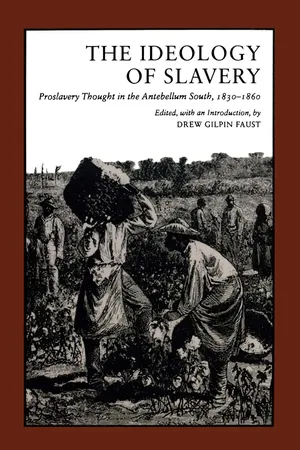
In one volume, these essentially unabridged selections from the works of the proslavery apologists are now conveniently accessible to scholars and students of the antebellum South. The Ideology of Slavery includes excerpts by Thomas R. Dew, founder of a new phase of proslavery militancy; William Harper and James Henry Hammond, representatives of the proslavery mainstream; Thornton Stringfellow, the most prominent biblical defender of the peculiar institution; Henry Hughes and Josiah Nott, who brought would-be scientism to the argument; and George Fitzhugh, the most extreme of proslavery writers.
The works in this collection portray the development, mature essence, and ultimate fragmentation of the proslavery argument during the era of its greatest importance in the American South. Drew Faust provides a short introduction to each selection, giving information about the author and an account of the origin and publication of the document itself.
Faust's introduction to the anthology traces the early historical treatment of proslavery thought and examines the recent resurgence of interest in the ideology of the Old South as a crucial component of powerful relations within that society. She notes the intensification of the proslavery argument between 1830 and 1860, when southern proslavery thought became more systematic and self-conscious, taking on the characteristics of a formal ideology with its resulting social movement. From this intensification came the pragmatic tone and inductive mode that the editor sees as a characteristic of southern proslavery writings from the 1830s onward. The selections, introductory comments, and bibliography of secondary works on the proslavery argument will be of value to readers interested in the history of slavery and of nineteenth-centruy American thought.
eBook - ePub
The Ideology of Slavery
Proslavery Thought in the Antebellum South, 1830–1860
- 320 pages
- English
- ePUB (mobile friendly)
- Available on iOS & Android
eBook - ePub
About this book
Information
I. THOMAS RODERICK DEW
Abolition of Negro Slavery
“The seal has now been broken.…”
Thomas Roderick Dew was born in 1802 in Tidewater Virginia to a plantation-owning family that had been in America since the mid-seventeenth century. In 1818, he enrolled at the College of William and Mary, where he quickly rose to the top of his class. Dew continued through the M.A. degree, then departed for Europe in 1824 in an effort to improve his failing health. Upon his return to Virginia in 1826, he was made a professor of political law at his alma mater, where he taught history, political economy, law, and the philosophy of the human mind. Dew was deeply concerned with political and social questions and published essays on internal improvements, usury law, the tariff, and the proper relation of the sexes. In 1831 he served as a delegate to a Philadelphia Free Trade Convention, where he met such champions of southern rights as William Harper, who, like Dew, became a prominent defender of slavery.1
When Nat Turner’s rebellion frightened the Virginia legislature into a heated debate over emancipation in 1831–32, Dew, as a slaveholder, intellectual, and social commentator, took up his pen to respond. His Review of the Debate in the Virginia Legislature of 1831–2 was widely acclaimed and thenceforth recognized as an overture to the outpouring of proslavery writings that followed in the three decades after its publication. Dew was rewarded by his fellow Virginians with the presidency of William and Mary in 1836. For the remaining decade of his life, he continued his work as a scholar and public essayist. In 1846, Dew died on his honeymoon trip to Paris.
The essay below, which appeared in the American Quarterly Review of September, 1832, under the title “Abolition of Negro Slavery,” was the first published version of what was to become Dew’s classic work.2 A few months later, the essay was reprinted in an expanded pamphlet form.3 Because the Virginia legislative debate had itself attracted so much public attention, excerpts from Dew’s work were widely reprinted throughout the South. As a result, his pamphlet had an impact never achieved by earlier defenders of slavery. Even two decades later, the essay still seemed of sufficient importance to merit inclusion in a collection of classic defenses of slavery, The Pro-Slavery Argument as Maintained by the Most Distinguished Writers of the Southern States.4
Notable as the inaugural effort in the post-1830 proslavery movement, the version below demonstrated a new depth of commitment to slavery. In its insistence that emancipation and colonization were impossible, it brought widespread attention throughout the region to a position previously enunciated by only a few southerners.5 Yet at the same time, it was a traditional work, for it concentrated on the immediate situation of the South, and of Virginia particularly, to a far greater extent than would later writings. Moreover, Dew seemed uncertain whether to accept or to challenge the notion of slavery as an evil that ought ultimately to be eradicated, and he therefore alternated between the two positions in the course of his essay. His own preference seems to have been that the Virginia economy develop naturally in such a way as to attract free labor and thus render slavery no longer necessary. But the essay never directly addressed the possibility of an ultimate withering away of the peculiar institution. Dew’s attitude toward the doctrines of natural rights was equally confused. While basically affirming the Revolutionary heritage, he nevertheless sought to curtail the legitimate right of rebellion, thus manifesting the South’s growing disenchantment with the legacy of the Founding Fathers. Political economist at heart, the Virginian dwelt more on the rights of property as justification for human bondage than would his followers, who turned increasingly to what they saw as the disinterested and therefore nobler rationalizations of moral stewardship. Subsequent versions of this essay themselves reflected the rapid development and change within proslavery thought toward a more broad-gauged and confident stand. Like his successors in the proslavery movement, Dew would devote more attention to transcendent justifications for human bondage by appealing beyond the exigencies confronting the South to more general—and, he hoped, more compelling—systems of legitimation, such as religion, moral philosophy, and the sciences of both the natural and social world.6
Abolition of Negro Slavery.
In looking to the texture of the population of our country, there is nothing so well calculated to arrest the attention of the observer as the existence of negro slavery throughout a large portion of the confederacy; a race of people differing from us in colour and in habits, and vastly inferior in the scale of civilization, have been increasing and spreading—“growing with our growth and strengthening with our strength”—until they have become intertwined with every fibre of society. Go through our southern states, and every where you see the negro slave by the side of the white man, you find him alike in the mansion of the rich, the cabin of the poor, the workshop of the mechanic, and the field of the planter. Upon the contemplation of a population framed like this, a curious and interesting question readily suggests itself to the inquiring mind. Can these two distinct races of people, now living together as master and servant, be ever separated? Can the black be sent back to his African home? or will the day ever arrive when he can be liberated from this thraldom, and mount in the scale of civilization and rights to an equality with the white? This is a question of truly momentous character: it involves the whole framework of society, contemplates a separation of its elements, or a radical change in their relation, and requires for its adequate investigation the most complete and profound knowledge of the nature and sources of national wealth and political aggrandizement, an acquaintance with the elastic and powerful spring of population, and the causes which invigorate or paralyze its energies. It requires a clear perception of the varying rights of man amid all the changing circumstances by which he may be surrounded, and a profound knowledge of all the principles, passions, and susceptibilities, which make up the moral nature of our species, and according as they are acted upon by adventitious circumstances, alter our condition, and produce all that wonderful variety of character which so strongly marks and characterizes the human family. Well, then, does it behoove even the wisest statesman to approach this august subject with the utmost circumspection and diffidence; its wanton agitation even is pregnant with mischief, but rash and hasty action threatens, in our opinion, the whole southern country with irremediable ruin. The evil of yesterday’s growth may be extirpated to-day, and the vigour of society may heal the wound; but that which is the growth of ages may require ages to remove. The Parliament of Great Britain, with all its philanthropic zeal, guided by the wisdom and eloquence of such statesmen as Chatham, Fox, Burke, Pitt, Canning, and Brougham, has never yet seriously agitated this question, in regard to the West India possessions. Revolutionary France, actuated by the most intemperate and phrenetic zeal for liberty and equality, attempted to legislate the free people of colour in the Island of St. Domingo into all the rights and privileges of the whites; and but a season afterwards, convinced of her madness, she attempted to retrace her steps, when it was too late; the deed had been done, the bloodiest and most shocking insurrection ever recorded in the annals of history had broken out, and the whole island was involved in frightful carnage and anarchy, and France in the end has been stript of “the brightest jewel in her crown,”—the fairest and most valuable of all her colonial possessions. Since the revolution, France, Spain, and Portugal, large owners of colonial possessions, have not only not abolished slavery in their colonies, but have not even abolished the slave trade in practice.
In our southern slave-holding country, the question of emancipation had never been seriously discussed in any of our legislatures, until the whole subject, under the most exciting circumstances, was, during the last winter, brought up for discussion in the Virginia legislature, and plans of partial or total abolition were earnestly pressed upon the attention of that body. It is well known, that during the last summer, in the county of Southampton in Virginia, a few slaves, led on by Nat Turner, rose in the night, and murdered in the most inhuman and shocking manner between sixty and seventy of the unsuspecting whites of that county. The news of course was rapidly diffused, and with it consternation and dismay were spread throughout the state, destroying for a time all feeling of security and confidence, and even when subsequent development had proven, that the conspiracy had originated with a fanatic negro preacher, (whose confessions prove beyond a doubt mental aberration,) and that this conspiracy embraced but few slaves, all of whom had paid the penalty of their crimes, still the excitement remained, still the repose of the commonwealth was disturbed, for the ghastly horrors of the Southampton tragedy could not immediately be banished from the mind. Rumour, with her thousand tongues, was busily engaged in spreading tales of disaffection, plots, insurrections, and even massacres, which frightened the timid, and harassed and mortified the whole of the slave-holding population. During this period of excitement, when reason was almost banished from the mind, and the imagination was suffered to conjure up the most appalling phantoms, and picture to itself a crisis in the vista of futurity, when the overwhelming numbers of the blacks would rise superior to all restraint, and involve the finest portion of our land in universal ruin and desolation, we are not to wonder that even in the lower part of Virginia many should have seriously inquired, if this supposed monstrous evil could not be removed from her bosom. Some looked to the removal of the free people of colour, by the efforts of the Colonization Society, as an antidote to all our ills; some were disposed to strike at the root of the evil, to call on the general government for aid, and by the labours of Hercules to extirpate the curse of slavery from the land; and others again, who could not bear that Virginia should stand towards the general government (whose unconstitutional action she had ever been foremost to resist) in the attitude of a suppliant, looked forward to the legislative action of the state as capable of achieving the desired result. In this degree of excitement and apprehension, the legislature met, and plans for abolition were proposed and earnestly advocated in debate.
Upon the impropriety of this debate we beg leave to make a few observations. Any scheme of abolition proposed so soon after the Southampton tragedy, would necessarily appear to be the result of that most inhuman massacre. Suppose the negroes, then, to be really anxious for their emancipation, no matter on what terms, would not the extraordinary effect produced on the legislature by the Southampton insurrection, in all probability have a tendency to excite another? And we must recollect, from the nature of things, no plan of abolition could act suddenly on the whole mass of slave population in the state.… Waiting, then, one year or more until the excitement could be allayed, and the empire of reason could once more have been established, would surely have been productive of no injurious consequences, and in the mean time a legislature could have been selected which would much better have represented the views and wishes of their constituents on this vital question. Virginia could have ascertained the sentiments and wishes of other slave-holding states, whose concurrence, if not absolutely necessary, might be highly desirable, and should have been sought after and attended to, at least as a matter of state courtesy. Added to this, the texture of the legislature was not of that character calculated to ensure the confidence of the people in a movement of this kind. If ever there was a question debated in a deliberative body, which called for the most exalted talent, the longest and most tried experience, the utmost circumspection and caution, a complete exemption from prejudice and undue excitement where both are apt to prevail, an ardent and patriotic desire to advance the vital interests of the state, uncombined with all mere desire for vain and ostentatious display, and with no view to party or geographical divisions, that question was the question of the abolition of slavery in the Virginia legislature. “Grave and reverend seniors,” “the very fathers of the republic,” were indeed required for the settlement of one of such magnitude. It appears, however, that the legislature was composed of an unusual number of young and inexperienced members, elected in the month of April previous to the Southampton massacre, and at a time of profound tranquillity and repose, when of course the people were not disposed to call from their retirement their most distinguished and experienced citizens.
We are very ready to admit, that in point of ability and eloquence, the debate transcended our expectations. One of the leading political papers in the state remarked—“We have never heard any debate so eloquent, so sustained, and in which so great a number of speakers had appeared, and commanded the attention of so numerous and intelligent an audience. Day after day multitudes throng to the capital, and have been compensated by eloquence which would have illustrated Rome or Athens.” But however fine might have been the rhetorical display, however ably some isolated points might have been discussed, still we affirm, with confidence, that no enlarged, wise, and practical plan of operations, was proposed by the abolitionists. We will go further, and assert that their arguments, in most cases, were of a wild and intemperate character, based upon false principles, and assumptions of the most vicious and alarming kind, subversive of the rights of property and the order and tranquillity of society, and portending to the whole slave-holding country—if they ever shall be followed out in practice—inevitable and ruinous consequences. Far be it, however, from us, to accuse the abolitionists in the Virginia legislature of any settled malevolent design to overturn or convulse the fabric of society. We have no doubt that they were acting conscientiously for the best; but it often happens that frail imperfect man, in the too ardent and confident pursuit of imaginary good, runs upon his utter destruction.
We have not formed our opinion lightly upon this subject; we have given to the vital question of abolition the most mature and intense consideration which we are capable of bestowing, and we have come to the conclusion—a conclusion which seems to be sustained by facts and reasoning as irresistible as the demonstration of the mathematician—that every plan of emancipation and deportation which we can possibly conceive, is totally impracticable. We shall endeavour to prove, that the attempt to execute these plans can only have a tendency to increase all the evils of which we complain, as resulting from slavery. If this be true, then the great question of abolition will necessarily be reduced to the question of emancipation, with a permission to remain, which we think can easily be shown to be subversive of the interests, security, and happiness, of both the blacks and whites, and consequently hostile to every principle of expediency, morality, and religion. We have heretofore doubted the propriety even of too frequently agitating, especially in a public manner, the questions of abolition, in consequence of the injurious effects which might be produced on the slave population. But the Virginia legislature, in its zeal for discussion, boldly set aside all prudential considerations of this kind, and openly and publicly debated the subject before the whole world. The seal has now been broken, the example has been set from a high quarter; we shall, therefore, waive all considerations of a prudential character which have heretofore restrained us, and boldly grapple with the abolitionists on this great question. We fear not the result, so far as truth, justice, and expediency alone are concerned. But we must be permitted to say, that we do most deeply dread the effects of misguided philanthropy, and the intrusion, in this matter, of those who have no interest at stake, and who have not that intimate and minute knowledge of the whole subject so absolutely necessary to wise action.
In our study, we began the examination of this subject with a general inquiry into the origin of slavery in ancient and modern times, and proceeded to a consideration of the slave trade, by which slavery has been introduced into the United States. We indicated the true sources of slavery, and the principles upon which it rests, in order that the value of those arguments founded on the maxims that “all men are born equal,” that “slavery in the abstract is wrong,” that “the slave has a natural right to regain his liberty,” and so forth, might be fully appreciated. We endeavoured to show that those maxims may be and generally are inapplicable and mischievous, and that something else is requisite to convert slavery into freedom, than the mere enunciation of abstract truths divested of all adventitious circumstances and relations. But this first principal division of our subject proved so voluminous that we have been obliged to set it aside for the present, in order to obtain room for the more pressing and important topics of the great question which we undertook to treat. Upon these we enter, therefore, at once, and inquire seriously and fairly whether there be means by which our country may get rid of negro slavery.
Plans for the Abolition of Slavery.
Under this head we will consider, first, those schemes which propose abolition and deportation, and secondly, those which contemplate emancipation without deportation. 1st. In the late Virginia legislature, where the subject of slavery underwent the most thorough discussion, all seemed to be perfectly agreed in the necessity of removal in case of emancipation. Several members from the lower counties, which are deeply interested in this question, seemed to be sanguine in their anticipations of the final success of some project of emancipation and deportation to Africa, the original home of the negro. “Let us translate them,” said one of the most respected and able members of the Legislature, (Gen. Broadnax,) “to those realms from which, in evil times, under inauspicious influences, their fathers were unfortunately abducted.—Mr. Speaker, the idea of restoring these people to the region in which nature had planted them, and to whose climate she had fitted their constitutions—the idea of benefiting not only our condition and their condition by the removal, but making them the means of carrying back to a great continent, lost in the profoundest depths of savage barbarity, unconscious of the existence even of the God who created them, not only the arts and comforts and multiplied advantages of civilized life, but what is of more value than all, a knowledge of true religion—intelligence of a Redeemer—is one of the grandest and noblest, one of the most expansive and glorious ideas which ever entered into the imagination of man. The conception, whether to the philosopher, the statesman, the philanthropist, or the Christian, of rearing up a colony which is to be the nucleus around which future emigration will concenter, and open all Africa to civilization and commerce, and science and arts and religion—when Ethiopia shall stretch out her hands, indeed, is one which warms the heart with delight.” (Speech of Gen. Broadnax of Dinwiddie, pp. 36 and 37.) We fear that this splendid vision, the creation of a brilliant imagination, influenced by the pure feelings of a philanthropic and generous heart, is destined to vanish at the severe touch of analysis. Fortunately for reason and common sense, all these projects of deportation may be subjected to the most rigid and accurate calculations, which are amply sufficient to dispel all doubt, even in the minds of the most sanguine, as to their practicability.
We take it for granted that the right of the owner to his slave is to be respected, and consequently that he is not required to emancipate him, unless his full value is paid by the state. Let us then, keeping this in view, proceed to the very simple calculation of the expense of emancipation and deportation in Virginia. The slaves, by the last census (1830) amounted within a small fraction to 470,000; the average value of each one of these is $200; consequently the whole aggregate value of the slave population of Virginia in 1830, was $94,000,000, and allowing for the increase since, we cannot err far in putting the present value at $100,000,000. The assessed value of all the houses and lands in the state amounts to $206,000,000, and these constitute the material items in the wealth of the state, the whole personal property besides bearing but a very small proportion to the value of slaves, lands, and houses. Now, do not these very simple statistics speak volumes upon this subject? It is gravely recommended to the state of Virginia to give up a species of property which constitutes nearly one-third of the wealth of the whole state, and almost one-half of that of Lower Virginia, and with the remaining two-thirds to encounter the additional enormous expense of transportation and colonization on the coast of Africa. But the loss of $100,000,000 of property is scarcely the half of what Virginia would lose, if the immutable laws of nature could suffer (as fortunately they cannot) this tremendous scheme of colonization to be carried into full effect. Is it not population which makes our lands and houses valuable? Why are lots in Paris and London worth more than the silver dollars which it might take to cover them? Why are lands of equal fertility in England and France worth more than those of our Northern States, and those again worth more than Southern soils, and those in turn worth more than the soils of the distant West? It is the presence or absence of population which alone can explain the fact. It is in truth the slave labour in Virginia which gives value to her soil and her habitations—take away this and you pull down the atlas that upholds the whole system—eject from the state the whole slave population, and we risk nothing in the prediction, that on the day in which it shall be accomplished, the worn soils of Virginia will not bear the paltry price of the government lands in the West, and the Old Dominion will be a “waste howling wilderness,”—“the grass shall be seen growing in the streets, and the foxes peeping from their holes.”
But the favourers of this scheme say they do not contend for the sudden emancipation and deportation of the whole black population;—they would send off only the increase, and thereby keep down the population to its present amount, while the whites increasing at their usual rate would finally become relatively so numerous as to render the presence of the blacks among us for ever afterwards entirely harmless. This scheme, which at first to the unreflecting seems plausible, and much less wild than the project of sending off the whole, is nevertheless impracticable and visionary, as we think a few remarks will prove. It is computed that the annual increase of the slaves and free coloured population of Virginia is about six ...
Table of contents
- COVER
- TITLE PAGE
- COPYRIGHT PAGE
- CONTENTS
- PREFACE
- INTRODUCTION: The Proslavery Argument in History
- I. THOMAS RODERICK DEW: Abolition of Negro Slavery
- II. WILLIAM HARPER: Memoir on Slavery
- III. THORNTON STRINGFELLOW: A Brief Examination of Scripture Testimony on the Institution of Slavery
- IV. JAMES HENRY HAMMOND: Letter to an English Abolitionist
- V. JOSIAH C. NOTT: Two Lectures on the Natural History of the Caucasian and Negro Races
- VI. HENRY HUGHES: Treatise on Sociology
- VII. GEORGE FITZHUGH: Southern Thought
- Selected Bibliography of Secondary Works on the Proslavery Argument
Trusted by 375,005 students
Access to over 1.5 million titles for a fair monthly price.
Study more efficiently using our study tools.
Frequently asked questions
Yes, you can cancel anytime from the Subscription tab in your account settings on the Perlego website. Your subscription will stay active until the end of your current billing period. Learn how to cancel your subscription
No, books cannot be downloaded as external files, such as PDFs, for use outside of Perlego. However, you can download books within the Perlego app for offline reading on mobile or tablet. Learn how to download books offline
Perlego offers two plans: Essential and Complete
- Essential is ideal for learners and professionals who enjoy exploring a wide range of subjects. Access the Essential Library with 800,000+ trusted titles and best-sellers across business, personal growth, and the humanities. Includes unlimited reading time and Standard Read Aloud voice.
- Complete: Perfect for advanced learners and researchers needing full, unrestricted access. Unlock 1.5M+ books across hundreds of subjects, including academic and specialized titles. The Complete Plan also includes advanced features like Premium Read Aloud and Research Assistant.
We are an online textbook subscription service, where you can get access to an entire online library for less than the price of a single book per month. With over 1.5 million books across 990+ topics, we’ve got you covered! Learn about our mission
Look out for the read-aloud symbol on your next book to see if you can listen to it. The read-aloud tool reads text aloud for you, highlighting the text as it is being read. You can pause it, speed it up and slow it down. Learn more about Read Aloud
Yes! You can use the Perlego app on both iOS and Android devices to read anytime, anywhere — even offline. Perfect for commutes or when you’re on the go.
Please note we cannot support devices running on iOS 13 and Android 7 or earlier. Learn more about using the app
Please note we cannot support devices running on iOS 13 and Android 7 or earlier. Learn more about using the app
Yes, you can access The Ideology of Slavery by Drew Gilpin Faust in PDF and/or ePUB format, as well as other popular books in History & North American History. We have over 1.5 million books available in our catalogue for you to explore.