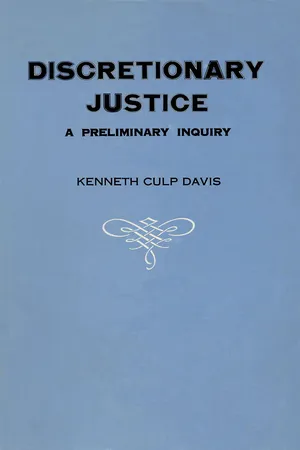
Research about justice for individual parties has been primarily concerned with the content of rules and principles and has insufficiently tried to penetrate discretionary justice as meted out by police, prosecutors, and other administrators. In this groundbreaking study Kenneth Culp Davis dispels the prevailing notion that discretionary justice is too elusive for scholarly investigation.Davis advances proposals for badly needed reforms in our system of discretionary justice and lays the groundwork for further empirical and philosophical studies. "Our jurisprudence of statutes and of judge-made law, " says Davis, "is overdeveloped; our jurisprudence of administrative justice, of police justice, of prosecutor justice- of discretionary justice is under-developed. We need a new jurisprudence that will encompass all of justice, not just the easy half of it.
- 256 pages
- English
- ePUB (mobile friendly)
- Available on iOS & Android
eBook - ePub
About this book
Information
Subtopic
North American HistoryIndex
HistoryVIII
Summary and
Perspective
1. The basic jurisprudential question. In its largest dimension, the central question of this essay is a basic one that legal philosophers have pondered for thousands of years: In our entire legal and governmental system, how can we improve the quality of justice for individual parties; how can we reduce injustice? Over the centuries, the main answer has been to build a system of rules and principles to guide decisions in individual cases. That is a good answer, as good for the future as for the past. The continued development of rules and principles is both desirable and inevitable.
Yet something more is needed, something the philosophers over the centuries have not supplied. If we stay within the comfortable areas where jurisprudence scholars work and concern ourselves mostly with statutory and judge-made law, we can at best accomplish no more than to refine what is already tolerably good. To do more than that, we have to open our eyes to the reality that justice to individual parties is administered more outside courts than in them, and we have to penetrate the unpleasant areas of discretionary determinations by police and prosecutors and other administrators, where huge concentrations of injustice invite drastic reforms.
And even after we enter administrative territory, significant progress is unlikely if, along with the organized bar’s administrative law committees, we focus only on the superior agencies that deal with large economic interests, such as the federal regulatory agencies and the Internal Revenue Service, where the quality of justice is usually reasonably high, and neglect the generally inferior agencies which deal with mixtures that seem more human than economic, such as police, prosecutors, welfare agencies, selective service boards, parole boards, prison administrators, and the Immigration Service, where the usual quality of justice is relatively low. Unlike the bar groups, we must dig into the kinds of injustice that can be neither cured nor alleviated by either formal hearings or judicial review.
The strongest need and the greatest promise for improving the quality of justice to individual parties in the entire legal and governmental system are in the areas where decisions necessarily depend more upon discretion than upon rules and principles and where formal hearings and judicial review are mostly irrelevant. We must try something that neither the legal philosophers down through the centuries nor our current study groups of the organized bar have tried—we must try to find ways to minimize discretionary injustice.
2. The more specific question. Probably nine-tenths of the basic question of how to reduce injustice to individual parties in our whole system of law and government is contained in the much narrower question: How can we reduce injustice to individual parties from the exercise of discretionary power? That is the central question of this essay.
3. The framework of a suggested approach. The broad framework of the approach I recommend is expressed in this one sentence: The vast quantities of unnecessary discretionary power that have grown up in our system should be cut back, and the discretionary power that is found to be necessary should be properly confined, structured, and checked.
4. A government of laws and of men. The starting point has to be a recognition that what we have and what we ought to have is a government of laws and of men. No legal system in world history has been without significant discretionary power. None can be.1 Discretion is indispensable for individualized justice, for creative justice, for new programs in which no one yet knows how to formulate rules, and for old programs in which some aspects cannot be reduced to rules. Eliminating discretionary power would paralyze governmental processes and would stifle individualized justice. Those who would forbid governmental coercion except on the basis of rules previously announced seem to me to have misunderstood the elements of law and of government.2
5. Cutting back unnecessary discretionary power. The proper goal is to eliminate unnecessary discretionary power, not to eliminate all discretionary power. My observation is that all levels of American government—federal, state, and local—are shot through with unnecessary discretionary power. Such power far exceeds what is necessary for an industrialized society, as is conclusively shown by the relative success of the countries of Western Europe in limiting such power.3 We can and we should cut back huge quantities of unnecessary discretionary power.
6. Improved statutory standards largely a false hope. The traditional proposal for limiting unnecessary discretionary power is to require more meaningful standards when power is delegated. That approach seems to me unpromising for three reasons: (1) Legislative bodies have neither the capacity nor the inclination to do substantially more through statutory drafting than they now do in providing policy guidance to administrators, and legislative bodies ought to be allowed to govern the extent of their own participation.4 (2) The idea of requiring standards fails to reach the great bulk of discretionary power which has grown without legislative delegation. (3) The hope not only for development of meaningful standards but also for going beyond standards to rules lies in the use of administrative rule-making power. The second and third reasons are elaborated in the next two sections.
7. The incongruity of the non-delegation doctrine alongside the huge ungranted power of selective enforcement. The three sources of discretionary power of officers are purposeful legislative delegations, vague statutory terms to which administrators must give meaning, and public acquiescence in administrative assumption of ungranted power. The third probably involves more power than the first two in combination, and the second probably involves more than the first. Yet the non-delegation doctrine, requiring meaningful standards to guide the exercise of delegated power, is designed only for the first.
The non-delegation doctrine seems crazily incongruous when placed alongside realities of the commonplace power of selective enforcement, as exercised by police, prosecutors, regulatory agencies, and other administrators. Not only is the power of selective enforcement typically ungranted through legislative delegation, and not only is it completely unguided by statutory or other standards, but it is also unstructured and unchecked, and it includes the power to set aside legislation in whole or in part, no matter how clearly the legislative will has been expressed.5 What is still worse, the power of selective enforcement is exercised by single officers in individual cases,6 with no requirement of consistency, so that a statute is set aside in one case, enforced in the next case, and partially enforced in a third case. And no equal protection clause, no principle of equal justice, and no judicial review are ordinarily available to a victim of arbitrary exercise of the power of selective enforcement.7
Here is a simple example. A statute, an ordinance, and a police manual all provide that a policeman “shall” arrest all known violators of law. A policeman lectures a boy from a middle-class neighborhood, but he arrests a boy from the slums, although he knows that both are equally guilty of violating the same statute. Because the evidence against both boys is clear, the policeman’s decision is the only one that counts, for the release of the first boy is permanent and the conviction of the second follows almost automatically. No standard, meaningful or otherwise, guides the policeman’s decision. The policeman’s release of the first boy is in contravention of the statute, the ordinance, and the police manual, but, if prevailing customs are followed, superiors in the department could know all the facts without disapproving. And the plain practicality is that in our whole legal system the second boy has no legal remedy, even though he has obviously been denied equal justice and equal protection of the laws.
The unplanned, ungranted power of selective enforcement has been assumed by the police, by prosecutors at all levels, and by many other administrators.8 A regulatory agency may institute a rate reduction proceeding against one company but not against another. A licensing agency may look the other way when one licensee violates but quickly move to suspend or revoke the license of another.
The power of selective enforcement is so dominant that it may account for about two-thirds of all unnecessary discretionary power over individual parties in our entire governmental system.9
The courts go along with the huge ungranted and unguided system of selective enforcement, never murmuring a word about the lack of standards. At the same time many courts go on singing silly tunes about a requirement of standards when legislative bodies intentionally delegate!
8. Administrative rule-making is a key. The hope lies, I think, not in better statutory standards, but in earlier and more elaborate administrative rule-making and in better structuring and checking of discretionary power.
Administrative rule-making is the key to a large portion of all that needs to be done. To whatever extent is practical and consistent with the need for individualized justice, the discretion of officers in handling individual cases should be guided by administrative rules adopted through procedure like that prescribed by the federal Administrative Procedure Act.10 Agencies through rule-making can often move from vague or absent statutory standards to reasonably definite standards, and then, as experience and understanding develop, to guiding principles, and finally, when the subject matter permits, to precise and detailed rules. The constant objective, when discretionary power is excessive, s...
Table of contents
- Cover
- Title Page
- Copyright Page
- Preface
- Contents
- I. The What and the Why of Discretion
- II. The Rule of Law and the Non-delegation Doctrine
- III. Confining Discretion
- IV. Structuring Discretion
- V. Checking Discretion
- VI. The Practice of Selective Enforcement Interlocked with the Theory of Privilege
- VII. Confining, Structuring, and Checking the Prosecuting Power
- VIII. Summary and Perspective
Trusted by 375,005 students
Access to over 1.5 million titles for a fair monthly price.
Study more efficiently using our study tools.
Frequently asked questions
Yes, you can cancel anytime from the Subscription tab in your account settings on the Perlego website. Your subscription will stay active until the end of your current billing period. Learn how to cancel your subscription
No, books cannot be downloaded as external files, such as PDFs, for use outside of Perlego. However, you can download books within the Perlego app for offline reading on mobile or tablet. Learn how to download books offline
We are an online textbook subscription service, where you can get access to an entire online library for less than the price of a single book per month. With over 1.5 million books across 990+ topics, we’ve got you covered! Learn about our mission
Look out for the read-aloud symbol on your next book to see if you can listen to it. The read-aloud tool reads text aloud for you, highlighting the text as it is being read. You can pause it, speed it up and slow it down. Learn more about Read Aloud
Yes! You can use the Perlego app on both iOS and Android devices to read anytime, anywhere — even offline. Perfect for commutes or when you’re on the go.
Please note we cannot support devices running on iOS 13 and Android 7 or earlier. Learn more about using the app
Please note we cannot support devices running on iOS 13 and Android 7 or earlier. Learn more about using the app
Yes, you can access Discretionary Justice by Kenneth Culp Davis in PDF and/or ePUB format, as well as other popular books in History & North American History. We have over 1.5 million books available in our catalogue for you to explore.