Before the Civil War, Oberlin, Ohio, stood in the vanguard of the abolition and black freedom movements. The community, including co-founded Oberlin College, strove to end slavery and establish full equality for all. Yet, in the half-century after the Union victory, Oberlin's resolute stand for racial justice eroded as race-based discrimination pressed down on its African American citizens. In Elusive Utopia, noted historians Gary J. Kornblith and Carol Lasser tell the story of how, in the nineteenth and early twentieth centuries, Oberlin residents, black and white, understood and acted upon their changing perceptions of race, ultimately resulting in the imposition of a color line.Founded as a utopian experiment in 1833, Oberlin embraced radical racial egalitarianism in its formative years. By the eve of the Civil War, when 20 percent of its local population was black, the community modeled progressive racial relations that, while imperfect, shone as strikingly more advanced than in either the American South or North. Emancipation and the passage of the Civil War amendments seemed to confirm Oberlin's egalitarian values. Yet, contrary to the expectations of its idealistic founders, Oberlin's residents of color fell increasingly behind their white peers economically in the years after the war. Moreover, leaders of the white-dominated temperance movement conflated class, color, and respectability, resulting in stigmatization of black residents. Over time, many white Oberlinians came to view black poverty as the result of personal failings, practiced residential segregation, endorsed racially differentiated education in public schools, and excluded people of color from local government. By 1920, Oberlin's racial utopian vision had dissipated, leaving the community to join the racist mainstream of American society.Drawing from newspapers, pamphlets, organizational records, memoirs, census materials and tax lists, Elusive Utopia traces the rise and fall of Oberlin's idealistic vision and commitment to racial equality in a pivotal era in American history.
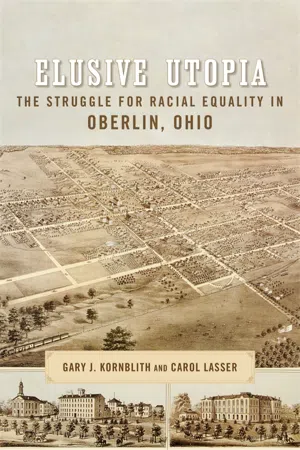
eBook - ePub
Elusive Utopia
The Struggle for Racial Equality in Oberlin, Ohio
- 344 pages
- English
- ePUB (mobile friendly)
- Available on iOS & Android
eBook - ePub
Elusive Utopia
The Struggle for Racial Equality in Oberlin, Ohio
About this book
Information
Topic
Ciencias socialesSubtopic
Educación superior1
ENVISIONING UTOPIA

“Map of the Western Reserve including the Fire Lands in Ohio, ” published by William Sumner, 1826. Cleveland Public Library.
The location was inauspicious. Three decades after Ohio had achieved statehood in 1803, Russia Township in Lorain County was covered with little more than swamps, woods, and wildlife. Although Native Americans had resided in the area for millennia before Europeans “discovered” North America in the sixteenth century, by the middle of the eighteenth century the territory along the southern rim of Lake Erie between the Cuyahoga and Sandusky Rivers was nearly devoid of human habitation—the disastrous consequence of epidemic disease and military conflict.1 In the decades following the War of Independence, Euro-Americans flooded across the Appalachian Mountains into the Northwest Territory, but few chose to settle in Russia Township, where dense clay made plowing difficult.2 In 1830 the twenty-five square miles comprising the township boasted a total population of only 216 individuals residing in forty-one households.3
Beginning in 1833, however, hundreds of new migrants made their way to this desolate place to create the Oberlin colony. Motivated primarily by a deep sense of Christian purpose, these early colonists—initially all white—aspired to construct a utopian community that would serve as a model for the United States and the world. In 1835 they took another radical leap. In open defiance of the antiblack racism that pervaded the so-called free North as well as the slave South, they made a public commitment to racial egalitarianism and determined to include people of color as full participants in their social experiment. They would stand not only against slavery, but also for the eradication of color prejudice in their community and throughout American society.
Oberlin’s story begins with John Jay Shipherd, a religious visionary and Oberlin’s founding father. Born in 1802 into a well-to-do, politically prominent, white, slaveholding family in upstate New York, Shipherd from his youth desired to preach the gospel. In 1827 he took his first ministerial position in Shelburne, Vermont, and the next year he became general agent of the state’s Sabbath School Union. In 1830 he decided on a bolder course.4 “[I]t now seems to me the finger of Providence points westward even to Mississippi’s vast val[l]ey, which is fast filling up with bones which are dry, very dry,” he explained to his parents. “The Lord of the harvest says ‘Whom shall I send, & who will go for us?’ The heart of your unworthy son responds: ‘Here am I send me.’”5
Accompanied by his wife, Esther, and their young children, Shipherd departed for Ohio’s Western Reserve in late September 1830. On their journey they stopped in Rochester, New York, where Charles Grandison Finney, the foremost evangelist of the Second Great Awakening, was leading a gigantic religious revival.6 On October 7 the family arrived by steamboat in Cleveland, Ohio. Before the week was out Shipherd found employment as minister of the First Presbyterian Church in nearby Elyria, a village of roughly seven hundred people.7
By his own admission, John Jay Shipherd was not a gifted preacher. Although during the summer of 1831 he engineered a religious revival in Elyria, his success proved short-lived. When he called his congregation to forsake the corrupting pleasures of intoxication in favor of the holy cause of temperance, several church members objected. They regarded imbibing alcohol as a right of frontier living, not a sin, and they undertook to drive Shipherd from his pulpit. By early fall he was out of a job.8
From these difficulties emerged Shipherd’s plan to found a small, intentional community dedicated to the glorification of God and the Christian conversion of humankind. His main collaborator in this audacious enterprise was Philo P. Stewart, a friend from Shipherd’s youth who, with his wife, had taken up residence in the Shipherds’ house in 1832. Stewart, like Shipherd, felt called to help save the American West, and he had served as a missionary to the Choctaw Indians in Mississippi before moving to Elyria to prepare for ordination under Shipherd’s supervision.9 Taking inspiration from the late Pastor John Frederic Oberlin’s celebrated ministry among the rural inhabitants of Ban de la Roche—a remote region of Alsace, France—Shipherd and Stewart imagined a religious colony of their own design in the wilds of Ohio.10 “O! tho[ugh]t we, how would God be honored in the influence of his religion upon the world, if it were divorced from Mammon, & wedded to simplicity & true wisdom!” Shipherd wrote his brother in August 1832. “Now, said we, let us gather some of the right spirits, & plant them in the dark Valley, to give such an example as Pastor Oberlin’s flock, & they will make our churches ashamed of their unholy alliances with earth.”11
The colony would be named after Pastor Oberlin and its focus would be education. “To promote useful education at home & abroad,” Shipherd explained, “schools shall be established . . . from the infant school up and as high as may be, at least, as high as the highest High School. The hope is that we may have, eventually, an institution which will afford the best education for the Ministry.”12
Lacking financial resources but brimming with confidence in God’s beneficence, Shipherd and Stewart researched possible sites for their projected community. They soon decided on a heavily forested section of Russia Township, roughly nine miles southwest of Elyria. The location that they selected was conveniently uninhabited, which meant that they would not encounter resistance from established residents who failed to share their utopian vision.13 Shipherd and Stewart could, in effect, approach the territory as a “tabula rasa.”
The land on which Shipherd and Stewart wanted to establish the Oberlin colony was not free for the taking, however. It was owned by Titus Street and Samuel Hughes, two merchants from New Haven, Connecticut, whose local sales agent was Eliphalet Redington, the postmaster of Amherst, Ohio, which bordered Russia Township. Although Redington was eager to sell the seven thousand acres in question, Shipherd and Stewart lacked sufficient funds to make the purchase. So they devised a two-pronged strategy for moving forward. Shipherd would go east to raise money, recruit colonists, and negotiate a deal with Street and Hughes. Stewart, with Redington’s help, would prepare the site in Russia Township for human settlement in anticipation of Shipherd’s success.14
Shipherd departed Elyria in late November 1832. He traveled by horseback through upstate New York and then on to New Haven, stopping regularly along the way to make appeals for financial support. The initial response was discouraging. After two months on the road, he had raised less than $200. Once he reached New Haven the situation brightened. Impressed by Shipherd’s dedication—and lacking other prospective buyers—Street and Hughes offered him generous terms. On the condition that construction would begin promptly, they agreed to donate five hundred acres for an educational institution, and they further agreed to sell land to incoming settlers at the bargain rate of $1.50 per acre. The contract was signed on February 16, 1833.15 From that date forward, Shipherd found it much easier to raise funds for the fledgling enterprise. By the time he returned to Ohio in September, contributions and financial pledges to the Oberlin colony totaled over $3,600.16
Equally important as raising money was recruiting colonists. Shipherd carried with him on his eastward journey a statement of intent and obligation that he asked prospective colonists to endorse. Remarkably similar to the documents that served as founding charters of Puritan communities in seventeenth-century New England, the Covenant of Oberlin Colony consisted of twelve propositions that together defined the mission of the colony and specified the obligations of its members. In sharp contrast to the individualistic and acquisitive values that dominated much of American society in the 1830s, the Oberlin covenant prescribed a profoundly communitarian and ascetic way of life.17
The covenant opened with dire observations about “the degeneracy of the church and the deplorable condition of our perishing world.” To reverse this trend required concerted human effort, beginning in the Mississippi Valley (broadly conceived to include Ohio) and spreading across the globe. The covenant’s first proposition identified the colony’s main purposes: to glorify God and to do good in the world. Thereafter followed six propositions emphasizing the importance of self-denial and self-discipline. Although colonists would own property in their own names, they were expected to behave as if they possessed that property in common. They were to purchase and consume only what they needed for subsistence and basic comfort; any excess goods or income should be applied to the higher purpose of serving God and evangelizing others. All forms of extravagance were to be avoided. The “smoking[,] chewing and snuffing of tobacco” was expressly prohibited “unless it be necessary as a medicine,” and colonists were expected to forego culinary indulgences such as tea, coffee, and anything else “simply calculated to gratify the palate.” Likewise, colonists were to “renounce all the world’s expensive and unwholesome fashions of dress” and to reside in plainly furnished houses. By living simply and frugally, the colonists would “add to our time, health, and means for service of the Lord.”18
Alongside personal restraint, the covenant emphasized communal obligation. The eighth proposition declared that “we all as the body of Christ are members of one another” and specified as a collective responsibility the care of the ill, the poor, and those without family guardians. The ninth and tenth points highlighted the importance of education and tied the colony’s fate to the success of the Oberlin Institute, the projected school for training ministers. Finally, the last two propositions reiterated the importance of piety, mutuality, and service to the Lord and pledged the signatories “to provoke each other to love and good works.”19
Although to a twenty-first century reader the covenant’s precepts may seem a prescription for rigid social conformity and the repression of both individual freedom and cultural diversity, it is important to recognize as well the optimistic and inspirational dimensions of the Oberlin colony’s original mission. Like John Winthrop and other founders of the Massachusetts Bay colony two centuries earlier, Shipherd and Stewart sought to establish a “city upon a hill” that would serve as a model of virtue and generosity for humankind to emulate.
At the start of his eastward journey, Shipherd had hoped to convince “about 50 families of the Lord’s peculiar people” to make the trek to northeastern Ohio to join the Oberlin experiment.20 Although he fell short of this goal, the folks who signed on to the project did so with enthusiasm. One of the first persons to make a commitment was Theodore S. Ingersoll, a farmer living in rural Ogden, New York.21 After learning of the successful negotiations with Street and Hughes, Ingersoll wrote Shipherd, “I have not sold my farm yet; but am making every calculation as if I had: trusting that the Lord will send somebody to buy in his own time which I shall be satisfied with.” Ingersoll also sought to interest others in the enterprise. “I am now trying to obtain 2 or 3 females to go to Oberlin as school teachers & other useful employments,” he reported. “I see the hand of the Lord in the work, & in the efforts I am making & believe it will go forward.”22
Back in Ohio, Stewart and Redington prepared to welcome the anticipated colonists. They arranged to have land cleared, and they enlisted a “Board of Trust” to oversee the launch of the Oberlin Institute. The board consisted of leading citizens of Lorain County, and at a meeting on Ma...
Table of contents
- Cover
- Title Page
- Copyright Page
- Dedication
- Contents
- List of Maps
- List of Charts and Tables
- Acknowledgments
- Introduction
- 1 Envisioning Utopia
- 2 The Arrival of African Americans
- 3 An Experiment in Racial Integration
- 4 Means and Ends in Oberlin Abolitionism
- 5 Fighting for Equal Rights in the Civil War Era
- 6 The Postwar Pursuit of Black Political Power
- 7 Race and Opportunity in the Late Nineteenth Century
- 8 Temperance, Gender, and the Racialization of Respectability
- 9 Utopia Forsaken
- Epilogue
- Notes
- Index
- Illustrations
Trusted by 375,005 students
Access to over 1.5 million titles for a fair monthly price.
Study more efficiently using our study tools.
Frequently asked questions
Yes, you can cancel anytime from the Subscription tab in your account settings on the Perlego website. Your subscription will stay active until the end of your current billing period. Learn how to cancel your subscription
No, books cannot be downloaded as external files, such as PDFs, for use outside of Perlego. However, you can download books within the Perlego app for offline reading on mobile or tablet. Learn how to download books offline
Perlego offers two plans: Essential and Complete
- Essential is ideal for learners and professionals who enjoy exploring a wide range of subjects. Access the Essential Library with 800,000+ trusted titles and best-sellers across business, personal growth, and the humanities. Includes unlimited reading time and Standard Read Aloud voice.
- Complete: Perfect for advanced learners and researchers needing full, unrestricted access. Unlock 1.5M+ books across hundreds of subjects, including academic and specialized titles. The Complete Plan also includes advanced features like Premium Read Aloud and Research Assistant.
We are an online textbook subscription service, where you can get access to an entire online library for less than the price of a single book per month. With over 1.5 million books across 990+ topics, we’ve got you covered! Learn about our mission
Look out for the read-aloud symbol on your next book to see if you can listen to it. The read-aloud tool reads text aloud for you, highlighting the text as it is being read. You can pause it, speed it up and slow it down. Learn more about Read Aloud
Yes! You can use the Perlego app on both iOS and Android devices to read anytime, anywhere — even offline. Perfect for commutes or when you’re on the go.
Please note we cannot support devices running on iOS 13 and Android 7 or earlier. Learn more about using the app
Please note we cannot support devices running on iOS 13 and Android 7 or earlier. Learn more about using the app
Yes, you can access Elusive Utopia by Gary Kornblith,Carol Lasser, Richard J. M. Blackett, Edward Bartlett Rugemer, Richard J. M. Blackett,Edward Bartlett Rugemer in PDF and/or ePUB format, as well as other popular books in Ciencias sociales & Educación superior. We have over 1.5 million books available in our catalogue for you to explore.