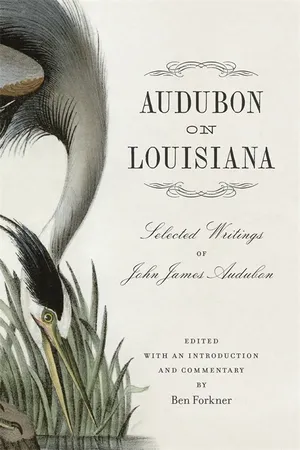
Although we remember John James Audubon's years in Louisiana primarily for the art he produced there, his writings reflect the profound impact the region made on him and his artistic vision, especially in his magnificent collection of paintings published as The Birds of America. In Audubon on Louisiana, Ben Forkner compiles and explains in depth Audubon's essential writings on the region. Beginning in 1810 as Audubon arrives in the upper Louisiana Territory, and continuing as he moves into southern Louisiana ten years later (and eventually brings his wife, Lucy, to join him), Audubon's journals, essays, and letters reveal his struggles to fill his portfolio with new watercolors, his discoveries throughout the region, and the transformative effect the area had on both his art and his life.Forkner provides a detailed introduction to Audubon's private journal of 1820–21, the Louisiana Journal, to guide readers through this compelling document. Until now, the difficulty of comprehending Audubon's rough English has often kept readers from fully appreciating the Journal 's significance. The volume also contains a dozen essays that Audubon penned about his experiences in Louisiana; most of these "episodes" he published in his Ornithological Biography, a massive five-volume written work that complements the visual art of Birds of America. Letters describing Audubon's last voyage to Louisiana in 1837 followed by nine of his Louisiana bird biographies round out the collection. These original texts, augmented with Forkner's commentary, form a magisterial work that illuminates the importance of Louisiana to Audubon's life and art. Audubon on Louisiana deepens appreciation of one of the most significant artists—and nature writers—of the nineteenth century.
- 424 pages
- English
- ePUB (mobile friendly)
- Available on iOS & Android
eBook - ePub
About this book
Information
Topic
ArtSubtopic
Artist Monographs
LOUISIANA
JOURNAL


Without any money my talents are to be my support, and my enthusiasm my guide in my difficulties, the whole of which I am ready . . . to keep, and to surmount.
—Louisiana Journal, October 12, 1820
The Louisiana Journal is the most rending self-portrait Audubon committed to ink. Beginning from the time he left Pennsylvania for Kentucky with Lucy in 1808, he wrote dozens of diaries over the years. When he was forty-one years old he sat down and counted twenty-six, and he was far from finished. Most of them were eventually lost or destroyed. The few early diaries Lucy saved were published in some form or another by Lucy herself, in the texts she sent Robert Buchanan for his authorized biography (and anthology) in 1868, and by Audubon’s granddaughter, Maria Rebecca Audubon, in what she intended to be the definitive collection of her grandfather’s writings thirty years later. Under their watchful eyes, these diaries were heavily edited and to some extent rewritten, but at least they were published.
Aside from a few carefully handpicked selections in the Buchanan biography, the Louisiana Journal was too close to the bone to be exposed to the public, but too cherished a memory to be abandoned. After Audubon’s death the carefully stored manuscript had surely become hallowed as a family testament, a raw record of Audubon’s solitary struggle to reverse the downward spiral of his life by a combination of sheer will and artistic faith, driving him day after day for over a year through a backbreaking ordeal that would have brought most strong men to their knees.
When he decided, with Lucy’s approval, to head down the Mississippi and devote himself to turning his portfolio of birds into the great book he had dreamed about for years, he had reached a standstill on a dead end in Cincinnati. After ten thriving years on the Kentucky frontier, a series of bad investments forced him to leave Henderson in 1819 for Louisville, where he was briefly jailed for debts and forced to declare bankruptcy. For years he would continue to be haunted by the threat of creditors seeking him out. In Louisville he was able to barely scrape by, painting portraits and giving drawing lessons. Lucy did have her brother Tom and her sister Eliza (who had married a wealthy businessman, Nicholas Berthoud), both of whom had settled nearby, but neither Lucy nor her husband was capable of living on charity.
Audubon soon moved to Cincinnati, where he found a job as a taxidermist in the Western Museum of Cincinnati College. Lucy and the two boys joined him, but hard times followed the family like a dark cloud. Audubon had to beg for his salary, and found himself once more trapped in a hopeless routine of teaching and painting portraits. With two young sons to support, Lucy and Audubon made the decision to risk everything on the grand design. Audubon would take his portfolio down the Mississippi, and spend what he first intended to be seven months adding new birds and expanding his range of ornithological knowledge. Lucy would stay behind with the boys, taking on private students to provide the minimum for food and household expenses.
The seven months stretched out to fourteen, and at the end of the journal Lucy and the boys had joined Audubon in Louisiana, where Lucy would live (and teach) for almost a decade. Thus when she held the pages of the Louisiana Journal in her hands, years later, without having to reread what she knew by heart, she could respond to every misspelled word, every botched and blotted line, every defiant flourish of Audubon’s fine cursive handwriting; she knew the story to a syllable, and she could never forget what had been at stake, and all the battles and humiliations that she and her husband had endured and overcome.
For Audubon, thirty-five years old and endowed with remarkable natural vigor and resistance, hard physical work was the least of his troubles. To pay for his trip down the Ohio and the Mississippi into southern Louisiana, he had willingly hired himself out to a flatboat captain as a hunter to supply food for the crew. He knew what he had to do and did it well. Rowing a skiff from flatboat to riverbank, he tramped through the canebrakes, stalked and killed deer and other game, gutted them, skinned them, hauled them back for the cook. When game was scarce, he threw out trotlines for fish. There were always catfish, though it took time and effort to pull their skin off with a pair of pincers.
The hunting and the fishing every day did not faze him; neither did the shooting of birds and the hours drawing them on the deck despite the pitch and roll of the boat. None of these activities was of a nature to worry Lucy and restrain her from printing more than a few censored pages of the diary after Audubon’s death. She was used to life on the frontier. What did hold her back were surely the waves of self-doubt that Audubon could not suppress, even when he did his best to reassure both himself and his family. These were too private, and too painful, for her (or her granddaughter) to publish or to rewrite.
Audubon seldom admitted defeat, and could usually overcome his frustrations by stepping aside from his cares and forgetting everything but the immediate wonders of the woods. The Louisiana Journal is often brightened with the old youthful Audubon exuberance and self-delighted discovery. A cloud formation, a sunrise, or a hawk in flight could stop him in his tracks, even when he was too tired to think. After a wet night wrapped in a bearskin he was still able to wake up in awe at finding himself alive in three dimensions, on his way to the promised land on a boat. But he could not hide from Lucy, and did not want to hide, in a diary that is a serial letter disguised as a chronicle, that he was often on the brink of despair. He had waged everything on this voyage, and he knew when he waved farewell to Lucy and the boys that Louisiana was his last chance.
Before the birds and magnolia woods of Oakley worked their spell, the Journal veers uneasily from one mood to another, with Audubon never fully able to shake the fear of having drifted down the Mississippi towards a doom even darker than the poverty and disgrace he had left behind in Kentucky. The glowing vision of Louisiana as a bright new world of hope and glory might turn out to be a mere mirage, a crazy Frenchman’s feu follet in a lonely swamp.
Audubon was not a man to give in to fate, but on this trip thoughts of suicide crossed his mind several times. Only after he had fought through the trials of New Orleans, a city he hated for testing his spirit to the breaking point, was his battered faith in Louisiana rewarded by ...
Table of contents
- COVER
- TITLE PAGE
- COPYRIGHT PAGE
- DEDICATION
- CONTENTS
- ACKNOWLEDGMENTS
- READING Audubon on Louisiana
- INTRODUCTION
- JOURNEY UP THE MISSISSIPPI
- LOUISIANA JOURNAL
- LOUISIANA EPISODES
- LAST VOYAGE TO LOUISIANA
- LOUISIANA BIRDS (Ornithological Biography)
- SOURCES AND OTHER MATTERS
- INDEX
Trusted by 375,005 students
Access to over 1.5 million titles for a fair monthly price.
Study more efficiently using our study tools.
Frequently asked questions
Yes, you can cancel anytime from the Subscription tab in your account settings on the Perlego website. Your subscription will stay active until the end of your current billing period. Learn how to cancel your subscription
No, books cannot be downloaded as external files, such as PDFs, for use outside of Perlego. However, you can download books within the Perlego app for offline reading on mobile or tablet. Learn how to download books offline
Perlego offers two plans: Essential and Complete
- Essential is ideal for learners and professionals who enjoy exploring a wide range of subjects. Access the Essential Library with 800,000+ trusted titles and best-sellers across business, personal growth, and the humanities. Includes unlimited reading time and Standard Read Aloud voice.
- Complete: Perfect for advanced learners and researchers needing full, unrestricted access. Unlock 1.5M+ books across hundreds of subjects, including academic and specialized titles. The Complete Plan also includes advanced features like Premium Read Aloud and Research Assistant.
We are an online textbook subscription service, where you can get access to an entire online library for less than the price of a single book per month. With over 1.5 million books across 990+ topics, we’ve got you covered! Learn about our mission
Look out for the read-aloud symbol on your next book to see if you can listen to it. The read-aloud tool reads text aloud for you, highlighting the text as it is being read. You can pause it, speed it up and slow it down. Learn more about Read Aloud
Yes! You can use the Perlego app on both iOS and Android devices to read anytime, anywhere — even offline. Perfect for commutes or when you’re on the go.
Please note we cannot support devices running on iOS 13 and Android 7 or earlier. Learn more about using the app
Please note we cannot support devices running on iOS 13 and Android 7 or earlier. Learn more about using the app
Yes, you can access Audubon on Louisiana by Ben Forkner in PDF and/or ePUB format, as well as other popular books in Art & Artist Monographs. We have over 1.5 million books available in our catalogue for you to explore.