Regarded as one of the most vocal, well-traveled, and controversial statesmen of the nineteenth century, antebellum politician Henry Stuart Foote played a central role in a vast array of pivotal events. Despite Foote's unique mark on history, until now no comprehensive biography existed. Ben Wynne fills this gap in his examination of the life of this gifted and volatile public figure in The Man Who Punched Jefferson Davis: The Political Life of Henry S. Foote, Southern Unionist.
An eyewitness to many of the historical events of his lifetime, Foote, an opinionated native Virginian, helped to raise money for the Texas Revolution, provided political counsel for the Lone Star Republic's leadership before annexation, and published a 400-page history of the region. In 1847, Mississippi elected him to the Senate, where he promoted cooperation with the North during the Compromise of 1850. One of the South's most outspoken Unionists, he infuriated many of his southern colleagues with his explosive temperament and unorthodox ideas that quickly established him as a political outsider. His temper sometimes led to physical altercations, including at least five duels, pulling a gun on fellow senator Thomas Hart Benton during a legislative session, and engaging in run-ins with other politicians—notably a fistfight with his worst political enemy, Jefferson Davis. He left the Senate in 1851 to run for governor of Mississippi on a pro-Union platform and defeated Davis by a small margin. Several years later, Foote moved to Nashville, was elected to the Confederate Congress after Tennessee seceded, and continued his political sparring with the Confederate president.
From Foote's failed attempt to broker an unauthorized peace agreement with the Lincoln government and his exile to Europe to the publication of his personal memoir and his appointment as director of the United States mint in New Orleans, Wynne constructs an entertaining and nuanced portrait of a singular man who constantly challenged the conventions of southern and national politics.
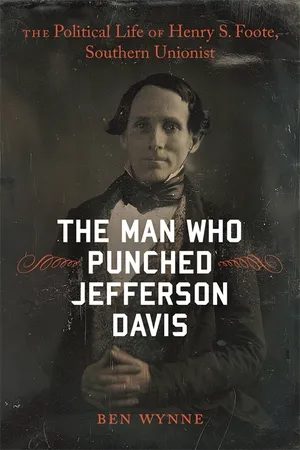
eBook - ePub
The Man Who Punched Jefferson Davis
The Political Life of Henry S. Foote, Southern Unionist
- 300 pages
- English
- ePUB (mobile friendly)
- Available on iOS & Android
eBook - ePub
The Man Who Punched Jefferson Davis
The Political Life of Henry S. Foote, Southern Unionist
About this book
Information
1
The Rise of Lawyer Foote
The Rise of Lawyer Foote
My life, upon the whole, has been more or less tempestuous.
—Henry Stuart Foote
—Henry Stuart Foote
HENRY STUART FOOTE’S LONG AND STORMY LIFE began in Fauquier County, Virginia, on February 28, 1804. According to a nineteenth-century genealogical treatment and Foote’s own memory of his family lineage, he was a fifth-generation American on his father’s side. At the time of his birth, the Foote family had been in northern Virginia since the 1680s and was among a small group of significant landowning families who had dominated the region for decades.1 The first Foote to arrive in Virginia was apparently an immigrant from Cardinham, County Cornwall, in southwest England. The progeny of the original immigrant flourished in America and the family was well established by the time the British officially organized Fauquier County, in 1759.
Foote’s father, Richard Helm Foote, was born shortly before the American Revolution, and around the turn of the nineteenth century he married Jane Stuart, the daughter and granddaughter of prominent local ministers. Henry Foote’s mother had Scottish roots. Her clergyman grandfather, David Stuart, immigrated to Virginia in 1715 and settled on the banks of the Potomac River in what at the time was Stafford County. Her father, William Stuart, was sent to England to study for the ministry and, according to one account, “studied theology in London and was ordained for the priesthood in 1745.” Called Parson Stuart by his flock, William married into money and raised his children on the family estate, Cedar Grove, in northern Virginia.2
The product of a family of landed gentry and a family of ministers, Henry Foote was educated in local schools and by private tutors, including Eliab Kingman, a man who left a lasting impression on the youth. Kingman came to Fauquier County around 1816 looking for work as a schoolteacher. A native of Rhode Island and a recent graduate of Brown University, he approached Foote’s father for assistance and eventually moved into the Foote home. With the help of the Footes, Kingman organized a small school with about fifteen pupils and also tutored Henry in the evenings. The youngster’s experience with his new teacher represented a turning point in his life. He was an eager student and later credited Kingman with instilling in him all of the qualities of “a refined and well-bred gentleman, as well as a patriotic and useful citizen.” Throughout his life Foote placed a high value on education, and until his death he held an enthusiasm for Latin, Greek, and other classical studies that could be traced back to his early training with his tutor. Kingman also fired the imagination of his pupils with regard to the nature of public discourse and current events, and Foote’s time with the teacher was likely the genesis of the young boy’s interest in public affairs.
Kingman eventually left Fauquier County and moved to Washington, DC, where he became a prominent newspaper reporter and columnist. During his career, he wrote for a number of major publications, including the Baltimore Sun, the Charleston Courier, the New York Journal of Commerce and the vaunted National Intelligencer in the nation’s capital. By the start of the Civil War, some called Kingman “the dean of the Washington press corps,” and when he died, in 1883, at age eighty-six, one obituary stated that “he may fairly be classed among the most noted and popular newsmen of the last half-century.” Unable to break the habit of his youth even after his election to the United States Senate, Foote always referred to the reporter as “Mr. Kingman” and later wrote that his old tutor was “as pure a model as I have ever known of domestic and social excellence.”3
Whether it was through the direct influence of Eliab Kingman or the product of natural curiosity, Henry Stuart Foote had a keen interest in national affairs by the time he passed through his teenage years. In late 1824, at the age of twenty, he traveled from his home in the Virginia countryside to Washington, DC, a distance of around fifty miles, “attracted thither,” he later said, “by the interesting scenes of one kind or another known to be there.” Upon his arrival, Foote found the city buzzing over the recent presidential election involving John Quincy Adams, Andrew Jackson, Henry Clay, and William Crawford. Adams’s victory over Jackson was perhaps the most controversial in the history of American presidential politics. Because four candidates were involved in the race, no candidate was able to collect a majority of the presidential electoral votes and therefore the contest was decided in the House of Representatives, with the two leading candidates, Adams and Jackson, competing for the seat. Although Jackson had received more popular and electoral votes than Adams, the House declared Adams the winner. Furious at the results, Jackson’s supporters claimed that Henry Clay, the Speaker of the House at the time, had manipulated the election’s outcome in exchange for Adams agreeing to appoint Clay as secretary of state. The accusation stuck and would haunt Adams’s one-term presidency, hurting his bid for reelection four years later.
Foote arrived in Washington as this saga unfolded, and he secured a seat in the House chamber gallery to watch Adams take the oath of office with Chief Justice John Marshall presiding. “I had the honor to witness this ceremony, which to me at the time was full of novelty and interest,” Foote remembered. “[Adams] enunciated the oath in a clear and distinct tone, and ascended the Speaker’s chair for the purpose of delivering therefrom his inaugural address.” When the president concluded his remarks, Foote left the House chamber and assembled with a large crowd on the grounds of the White House to watch outgoing president James Monroe depart for retirement. According to Foote, who was able to elbow his way through the throngs of people to get a good look at the former president, Monroe “wore a kindly and genial smile, and he was evidently rejoicing inwardly at being relieved at last from the toils and cares of office.” The young Virginian soon afterward returned home with his patriotic spirit fired and his resolve to enter public life firmly established.4
Henry Foote attended both Georgetown University and Washington College (now Washington and Lee University) but never graduated. “I never took a degree of any kind at any college or university,” he later wrote, claiming that any knowledge and skills that he might possess were merely “the result of self-culture.” He later studied law in the office of John Scott and Francis P. Brooks in Warrenton, Virginia, and it was there that he made his first friend of substance, a fellow student named Noah Haynes Swayne. The two aspiring attorneys began a lifelong friendship as they pored over law texts, and Foote later dedicated two of his own books to Swayne.
On the surface the two men seemed very different. Foote was from a family of slave-owning Virginians, while Swayne came from a family of antislavery Pennsylvania Quakers who had only recently moved to the Old Dominion. Despite these differences, they were drawn to one another from the first day they met, and they would remain, in Swayne’s words, “as close as brothers” for the rest of their lives. They were admitted to the Virginia bar together but parted ways soon afterwards. Swayne moved to Ohio, where he established a flourishing law practice and political career. As a Quaker, he strongly opposed slavery, and though originally a Jacksonian Democrat, he joined the fledgling Republican Party in 1854. Several years later he became Abraham Lincoln’s first appointee to the United States Supreme Court, the first Republican to occupy a seat there. He served on the court for almost two decades, until he was well into his seventies, and over the years Foote occasionally called on his old friend for help with various problems, both political and personal.5
As Swayne left Virginia to seek his fortune in Ohio, Henry Foote contemplated his next career move, which eventually took him farther south. In 1798, the United States organized the Mississippi Territory, which included much of what would later become the states of Mississippi and Alabama. At the time, the area was the heart of the American Southwest, and with the end of the War of 1812, it began attracting settlers. In 1817, Congress split the territory into two parts. The western half entered the Union that same year as Mississippi, with Alabama achieving statehood two years later.
Alabama was only six years old when Henry Foote decided to relocate there, in the spring of 1825, and the southwestern frontier proved to be the perfect environment for the young, extroverted lawyer whose loud and abrasive personality was already beginning to develop. Alabama during the period was wide open in terms of business, politics, and general opportunity. It was a typically American frontier state filled with simple, hardworking recent immigrants as well as scores of opportunists looking to capitalize financially on the state’s initial lack of a tight fiscal infrastructure. In his study of the Jacksonian period in the region, Joshua D. Rothman wrote that, in the new states of Alabama and Mississippi, “the institutions or customs that might have instilled civility and order were weak or nonexistent, and appearances were often deceptive, allowing the brash, the crafty, the venal, and the predatory to thrive.” While there was money to be made in Alabama, doing business in the state could be chaotic. Many land titles were drawn up in haste, the fledgling frontier credit system was unstable, and legislators had not yet had the opportunity to create the statutes needed to define the financial parameters of almost any type of significant business pursuit. As a result, there was no shortage of tangled legal cases to be adjudicated, and lawyers were in great demand. Joseph G. Baldwin, a lawyer and author who witnessed Alabama’s early development, later wrote, “There was no end to the amount and variety of lawsuits and interests involved in every complication. . . . Many members of the bar, of standing and character, from the other states flocked in to put their sickle to this abundant harvest.”6
Leaving his home in Virginia behind, Henry Foote settled in Tuscumbia, Franklin County, in the northern part of the state. Nestled securely along the Tennessee River, the region around Tuscumbia was first settled around 1810, but the future of the town was secured after the War of 1812, when the United States government promoted a project to construct a military road connecting Nashville, Tennessee, with New Orleans, Louisiana. The road passed through Tuscumbia and instantly breathed life into the area. In April of 1816, Congress authorized $10,000 for the project and placed General Andrew Jackson in charge. Surveyors plotted the route and, after an additional $5,000 congressional appropriation, the massive construction project began in April of 1819. According to a Tuscumbia newspaper account, the undertaking included “an average of 300 men employed on the work, including sawyers, carpenters, blacksmiths, etc. who were amply furnished with oxen, traveling forges, and all tools and implements necessary.” By May of the following year, much of the road was complete and was becoming more heavily traveled. At the time, Franklin County had a free population of 3,308 and a slave population of 1,667. Over the course of the next ten years, the county’s total population doubled, and during the 1820s, signs of civilization began to show themselves in Tuscumbia with the construction of a school, a masonic lodge building, several churches, and a variety of mercantile establishments.7
Foote’s arrival in Tuscumbia, which he later remembered as “a quiet and pleasant village,” in 1825, marked the beginning of his professional career. Alabama was a new state, filled with opportunity for someone blessed with intelligence and a general determination to persevere. “This country was just settling up,” one observer later remembered. “Emigrants came flocking in from all quarters of the Union, especially from the slaveholding States. The new country seemed to be a reservoir, and every road leading to it a vagrant stream of enterprise and adventure.”8
Foote quickly set about the task of establishing himself as an up-andcoming man of the region. In the spring of 1826, paid announcements began appearing on the front page of the Tuscumbian, a local newspaper, stating that “Henry S. Foote, attorney at law, having fixed residence in the town of Tuscumbia, will in future attend the Courts of Lauderdale, Franklin and Lawrence counties and the Supreme Court of this state.” As he established his law practice, he began cultivating personal and political alliances with other recent immigrants to the region, including brothers Platt and Stark Washington, local planters who could claim distant kinship to the nation’s first president, and William W. Parham, who represented Franklin County in the Alabama legislature. Foote eventually established a partnership with another young attorney, John Caldwell. Caldwell was the son of Irish immigrants who had recently come to Alabama from Nashville. Like Foote, he would only stay in Tuscumbia for a few years before moving on. Foote’s personal life also took a leap forward, in 1826, when he married another northern Alabama transplant, Elizabeth Winter, a woman six years his junior who had come to Tuscumbia with her family from Charles County, Maryland. In 1828, the couple welcomed their first child, a daughter they named Jane, after Henry’s mother. The couple would raise six more children during a union that lasted until Elizabeth’s death in 1855.9
Desperate for his voice to be heard above everyone else’s, Foote began a newspaper, the Tuscumbia Patriot, and like many other prudent politicians of the time, supported the career of Andrew Jackson. A bona fide war hero and legend, following his crushing defeat of the British at New Orleans in 1815, Jackson was wildly popular in Alabama and the rest of the South. In addition to his military pedigree, Jackson had fashioned an irresistible political image of himself as “the hero of the common man,” and many simple farmers of the region revered him as a role model. In the 1824, 1828, and 1832 presidential elections, Jackson garnered all of Alabama’s electoral votes and won the popular vote by large margins.
In addition to praising the tenets of Jacksonian democracy in his newspaper, Foote also touted local politicians and issues that he supported, and he was involved in projects that helped shape the northern Alabama region. He was one of twenty-one founding trustees of LaGrange College, a Methodist school that later became Florence Wesleyan University and still later the University of North Alabama, and was also an early proponent of railroad building in the northern part of the state. Foote commented at length in his newspaper on Washington politics, reserving column after column for the comings and goings of Congress and for his own staid pronouncements on the nature of government in a republic. He was particularly keen on dissecting one of the most politically vexing questions in the new nation during antebellum period: At what point in a republic does the authority of the federal government begin and end and, conversely, at what point does state authority begin and end? In drawing up the United States Constitution, the founders had left plenty of room for debate on the subject, and the discussions in political circles on the nature and limits of state and federal power never waned. The issue of state authority versus federal authority became particularly explosive and even more complicated during the antebellum period, when southerners began using traditional states’ rights rhetoric to defend the institution of slavery. As if he was already paving the way for his future discourse as a United States senator and as a governor, Foote disseminated his views on the subject from the moment he started his newspaper.10
The young editor was particularly agitated in 1827, when the state of Georgia came into conflict with the federal government and President John Quincy Adams over removal of the Cherokee Indians from the northern part of the state. The general arguments centered around whether the federal government or the state of Georgia had the ultimate authority to administer the Cherokee lands. At one point during the conflict, Georgia governor George Troup threatened to call out the state militia to combat any federal interference with the state’s administration of the Cherokee holdings. Although negotiations quickly eased the crisis, Foote felt compelled to comment on the situation in his newspaper. In doing so, he for the first time publicly articulated his personal political philosophy with regard to the union of states and definitions of state and national authority, a philosophy that remained constant through more than three turbulent decades.
In general, he counseled “a spirit of moderation, on both sides,” but he also felt strongly that the federal government should not be held hostage by the acts of one of its members and that every American’s future was tied to a strong federal union of states. He called the refusal of the state of Georgia to adhere to federal authority, and the governor’s threat to use military force to resist federal mandates, acts that seemed “to thrust this nation upon the brink of destruction, and to place in an awful endangerment the most exalted interest which appertain to human existence, the blessing of a free government.” Using the type of rhetoric that he would use years later as a United States senator and as governor of one of the cotton states before the Civil War, he claimed that while states’ rights should be upheld, the concept could only go so far in a republic and that, in the end, federal authority was the foundation of the national existence. While his comments in 1827 related to a potential military clash between the state of Georgia and the federal government that never happened, these events foreshadowed future sectional conflicts that would be all too real. “This recklessness about involving the country in civil war cannot be too strongly condemned,” he editorialized, more than thirty years before the Confederacy was formed, “and we trust that this disgraceful example will never be repeated in our long history.”11
While a fondness for national discourse gripped Henry Foote during the late 1820s, it did not soften political rivalries that he developed at the local level, where clashes of personality and ego could quickly generate lifetime feuds and grudges. Foote proved this was the case when he became involved in a potentially deadly dispute with Edmund Winston, a member of a large northern Alabama clan that would have a prominent place in Alabama politics for generations. The Winstons came to northern Alabama not long before Foote, with a formidable political pedigree. They were all descendants of Anthony Winston, a Revolutionary officer and Virginia politician who was a cousin of the famous patriot Patrick Henry. Immediately after their arrival in Tuscumbia, the Winstons immersed themselves in local and state politics and were already establishing themselves when Foote arrived on the scene.12
Apparently viewing the family as a threat or hindrance to his own political aspirations, Foote had a falling out with the Winston clan that came to a head in Tuscumbia during the summer of 1827. At one point, through his newspaper, Foote “assailed with great severity” the character of Edmund Winston, a local judge, leading one of Winston’s sons to demand a retraction. Foote refused and, later, members of the Winston family attacked Foote and several of his friends on the street and a brawl ensued. One published account stated that the fight “grew out of a personal encounter between Mr. Foote and Stark a...
Table of contents
- Cover
- Title Page
- Copyright Page
- Dedication
- Acknowledgments
- Introduction
- 1. The Rise of Lawyer Foote
- 2. The Emerging Politician
- 3. Temporary Texan
- 4. Senator Foote
- 5. Compromise
- 6. Governor Foote
- 7. California
- 8. The Confederate
- 9. The Final Years
- APPENDIX: Henry Foote Chronology
- Notes
- Bibliography
- Index
- Illustrations
Trusted by 375,005 students
Access to over 1.5 million titles for a fair monthly price.
Study more efficiently using our study tools.
Frequently asked questions
Yes, you can cancel anytime from the Subscription tab in your account settings on the Perlego website. Your subscription will stay active until the end of your current billing period. Learn how to cancel your subscription
No, books cannot be downloaded as external files, such as PDFs, for use outside of Perlego. However, you can download books within the Perlego app for offline reading on mobile or tablet. Learn how to download books offline
Perlego offers two plans: Essential and Complete
- Essential is ideal for learners and professionals who enjoy exploring a wide range of subjects. Access the Essential Library with 800,000+ trusted titles and best-sellers across business, personal growth, and the humanities. Includes unlimited reading time and Standard Read Aloud voice.
- Complete: Perfect for advanced learners and researchers needing full, unrestricted access. Unlock 1.5M+ books across hundreds of subjects, including academic and specialized titles. The Complete Plan also includes advanced features like Premium Read Aloud and Research Assistant.
We are an online textbook subscription service, where you can get access to an entire online library for less than the price of a single book per month. With over 1.5 million books across 990+ topics, we’ve got you covered! Learn about our mission
Look out for the read-aloud symbol on your next book to see if you can listen to it. The read-aloud tool reads text aloud for you, highlighting the text as it is being read. You can pause it, speed it up and slow it down. Learn more about Read Aloud
Yes! You can use the Perlego app on both iOS and Android devices to read anytime, anywhere — even offline. Perfect for commutes or when you’re on the go.
Please note we cannot support devices running on iOS 13 and Android 7 or earlier. Learn more about using the app
Please note we cannot support devices running on iOS 13 and Android 7 or earlier. Learn more about using the app
Yes, you can access The Man Who Punched Jefferson Davis by Ben Wynne in PDF and/or ePUB format, as well as other popular books in Política y relaciones internacionales & Biografías militares. We have over 1.5 million books available in our catalogue for you to explore.