An exploration of how a state transitions from the collectivized production and distribution of socialism to the consumer-focused culture of capitalism.
In
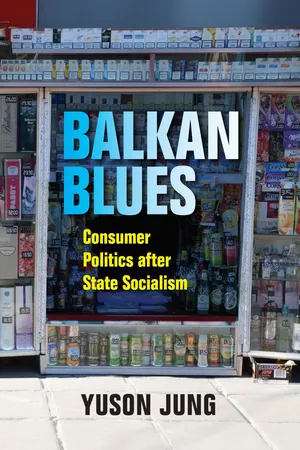
Balkan Blues, Yuson Jung considers the state as an economic agent in upholding rights and responsibilities in the shift to a global market. Taking Bulgaria as her focus, Jung shows how impoverished Bulgarians developed a consumer-oriented society and how the concept of "need' adapted in surprising ways to accommodate this new culture.
Different legal frameworks arose to ensure the rights of vulnerable or deceived consumers. Consumer advocacy NGOs and government officers scrambled to navigate unfamiliar EU-imposed models for consumer affairs departments. All of these changes involved issues of responsibility, accountability, and civic engagement, which brought Bulgarians new ways of viewing both their identities and their sense of agency. Yet these opportunities also raised questions of inequality, injustice, and social stratification. Jung's study provides a compelling argument for reconsidering of the role of the state in the construction of twenty-first-century consumer cultures.
"A good contribution to post-socialist and Balkan studies, showing well that the concept of post-socialism can still be useful not only in the context of Central and Eastern Europe, but also in the Balkans. The book is based on long-term, deep ethnography and is well written . . . I recommend it to anyone who wants to try to understand social, political, and economic differences in Europe and everyday practices related to the (imaginaries of the) state." —Karolina Bielenin-Lenczowska,
Ethnologia Polona
- 203 pages
- English
- ePUB (mobile friendly)
- Available on iOS & Android
eBook - ePub
About this book
Information
1
MENTE
Consumer Grievances
Deception and Risk
Many of my friends in Sofia were getting ready for their annual seaside vacation at the Black Sea in the summer of 2002. Irena, an energetic journalist in her mid-20s, suggested I accompany her to some shoe shops to buy sandals. She wanted a particular Western brand, Salomon, known to be sturdy and of reliable quality. We started our quest in the former Central Department Store building, Tsum, which had been turned into a Western-style shopping mall. As we entered the modern-looking mall with empty spaces, Irena led me to the third floor where Salomon had a direct sales store. The store sold outdoor gear and sports equipment, including shoes. Irena examined several pairs of sandals carefully but did not try on any of them. As we left the store, she said that they were nice but too pricey. She also wondered whether some of them could be mente because they looked flimsy. I protested, indicating that since it was a corporate store housed in a nice, newly renovated shopping mall, the products ought not to be mente. Irena grinned and reminded me that we were in Bulgaria and everything could be mente. Next, we went to a few small neighborhood stores on busy downtown streets, where she examined sandals carefully (some from the brand that she was interested in) and checked price tags. Finally, we arrived at an outdoor and sports specialty store a few blocks down from Popa, the central downtown landmark with a statue of an Orthodox church priest, which was not too far from where she lived. The establishment maintained a neighborhood-store feel in terms of its intimate space, but it also displayed specialty gear for hiking and swimming. Irena selected a particular pair of sandals and asked the owner to bring her the right size so that she could try them on. Although she looked at them carefully, she did not seem to examine the displayed pair with the same scrutiny as in the other stores. When the storeowner brought her the sandals, Irena tried them on and looked at me contentedly. She wondered what I thought of them, although it was quite obvious that her mind was set on this particular pair. Because payday was several days away, she told the owner that she would be back soon. The owner assured her that he would put them on hold for a few days. She had obviously shopped in this store before, and the owner was not a complete stranger. When I inquired how she could be sure that this smaller neighborhood store did not carry mente (especially given my experience with another friend who had also purchased from a small neighborhood store and felt cheated, though in her case she was not acquainted with the store or the owner), Irena told me that this store was a “serious” one and that the owner had been doing business for some time here. If he carried mente, customers from the neighborhood like herself would have already stopped shopping there. The importance of store reliability was reminiscent of stories my other interlocuters told me, and Irena took the fact that the store had been around for a long time very seriously. Compared to the prices in the larger, corporate stores in the mall, these sandals were also a little cheaper, which made her even happier. I was surprised that she would spend more than two-thirds of her entire biweekly paycheck (230 leva for the sandals out of wages of 300 leva)1 on this particular purchase. Although single, she contributed financially to her family’s household in significant ways. This was why, Irena emphasized, careful shopping was so important in postsocialist Bulgaria—the stakes were high for an ordinary consumer with limited purchasing power in a market flooded with mente products. Eventually, she made good use of the sandals, and the pair lasted her two summers with lots of mountain biking and hiking along the rocky seaside, confirming her assessment that the sandals were authentic and of “high quality.” Consumer savvy rather than the brand name itself turned out to be vital in avoiding a mente product. I asked Irena why she went to the other stores when she had already made up her mind to buy the sandals from her neighborhood store. She responded that even though she trusted her local store, she just needed to reconfirm that she was not wasting her paycheck on mente since there was no working system in place that protected her as a consumer. “They” (referring to the state), she smilingly said, “don’t do their work of controlling bad stuffs in the market, don’t you know? I need to be certain [as a consumer].” Other Bulgarian interlocutors pointed out that once the authenticity of the Western brand was proven, its authority could replace that of the state in controlling quality in the postsocialist environment. Proving authenticity, however, involved an astuteness often based on one’s own experiences of consumer competence in the (perceived) absence of a state that could protect consumers from the abuses of the market (see also Jung 2009).
This incident illustrates how the sense of being cheated in mundane consumption practices plays a central role in conceptualizing citizens’ relations to and expectations about the state in the postsocialist era. The initial enthusiasm for flashy-looking2 foreign goods that flooded Bulgarian markets with the end of socialism soon waned as people became dismayed by what they referred to as “garbage products” (bokluk) being offered to poor, ordinary Bulgarian consumers. As in the case of the “Ossies” (East Germans) who, a few years into German reunification, as Daphne Berdahl (1999: 177) notes, started to wake up from early illusions of the “Golden West,” Bulgarian consumers also began differentiating imported products around the mid-1990s. Unlike East Germans, however, Bulgarians did not become quite as disenchanted with the West because they learned that the bokluk products that they could afford were not actually Western. They started to notice that the cheap (and sometimes fraudulent) products were made in China, Turkey, or even Greece3 and that the quality products were made in Germany or France (see also Patico 2002, 2008 for similar observations in Russia). What they increasingly became disillusioned with, however, was their own state (“they”) and its inability to address the rampant market spaces fraught with deception and risks. This Bulgarian reaction differs from what Melissa Caldwell (2002) observed in Russia, where the sense of deception was primarily expressed as market fraud without explicit reference to the lack of the state’s control. Although Bulgarian consumers quickly became aware that “market economy” did not mean all goods and services were “good,” the majority of Bulgarian consumers could not help but buy second-rate things because of financial limitations. Cheap items often meant poor quality, which Bulgarians translated into the notion of fake. Although mente4 was used for a range of things that were not original and therefore fell into the realm of fraudulent, counterfeit, or inauthentic, essentially the term referred to things that were not of good quality (nekachestveni), including spoiled products, or not real (neistinsko) and thus unreliable and risky. Everyday consumer experiences have been intimately intertwined with encounters of mente (real and perceived) in postsocialist Bulgaria and highlight two main anxieties of citizen-consumers: first, the limitations of reliable choices despite the relative abundance of goods compared to the socialist times and, second, uncertainty in how to conceptualize the new postsocialist state in relation to new regimes of power such as the market, NGOs, and the EU.
What is important to note in this context is the notion of choice, so prevalent in the popular discussions of contemporary consumer society with its implication of free and greater choice amid material abundance. Choice in this latter case assumes a level of affluence that enables free choice. In this context, choice actually indicates “preference” (Hilton 2009: 250). In comparison, many postsocialist Bulgarian consumers face a different kind of choice, one that is not about preference but about avoiding deception (buying something that is not authentic exposes one to potential danger). Understanding how this language of choice is used by different consumers and consumer experts in the postsocialist context is important in order to grasp the consumer politics after state socialism. To what extent are citizen-consumers fully able to act as social agents, or to what extent are they weak victims in need of protection? What kind of state is imagined in these renderings?
If Irena’s concern about potentially buying mente was more reflective of the general sense of vulnerability for consumers with financial constraints, the following cases of mente demonstrate a palpable sense of frustration, anxiety, and even anger, and how some of my Bulgarian interlocutors dealt with the constant feeling of deception in their everyday consumer choices by attempting to identify targets of blame and responsibility.
Yulia, an aspiring journalist with a cable television station, had been wanting a new pair of winter boots and was waiting patiently for her next payday. She worked as a reporter on an ad hoc basis and was paid per reportage if it was accepted by the editorial staff. As such, she did not have a consistent salary, but this time she expected just enough money (about 60 leva, approximately US$30 in 2001) with which she could afford some boots to get through the upcoming winter. After visiting a number of different shoe stores around Pirotska Street (the old market street) and Stamboliiski Boulevard, she finally bought a pair of black high-heeled boots that looked sturdy and stylish. Because I accompanied her on numerous shopping trips, I witnessed how carefully she examined the boots before spending almost her entire paycheck for them. Unfortunately, the second day she wore the boots one of the heels broke in such a way that gluing it back would not have fixed it. With teary eyes, Yulia complained about the lack of quality control that she attributed first to the producer, then to the merchants, and ultimately to the state that did not take consumer safety or consumer protection seriously. After all, she said, the state allowed a poor-quality product to be sold at such an expensive price (at 50 leva in the winter of 2001, her boots belonged to the upper median price range). When I asked whether the state still held the ultimate responsibility in what my Bulgarian interlocuters frequently referred to as the new “market economy,” she admitted, “I don’t know. Maybe it is me, the buyer, or maybe it is the businessman, but do you understand how upsetting it is to spend money and feel cheated [izmamena]? I still have some clothes from the socialist time, and they look better than those I can buy now. So sometimes I don’t know whether now is better than then, really.” Yulia belongs to the younger cohort who celebrated her abiturientski bal (high school graduation ball), a culturally meaningful social event in Bulgarians’ lives and a marker of adulthood, a few years after the democratic changes in 1989. Although Yulia first identified the state as the target of blame and the object of accountability, she was also aware that there were, in fact, multiple objects of accountability—more than one “they”—herself, the capitalist manufacturer, and the state.
At the same time, she brought up the point about purchasing necessities (podrebnosti) that went into the garbage soon after and emphasized the sense of betrayal she felt on such occasions. The provision of necessities or needs—most notably shelter, food, clothes, and jobs—was considered a major function of the socialist state (see also Feher, Heller, and Markus 1983; Haney 1997; Steiner 1998). Yulia’s comparison of the past and present and her conflicting moral judgments were informed by this historical understanding of needs and who should be the agents responsible for those needs. Historic socialist ideas concerning necessities (Velinova 2004) are crucial in the understanding of shifting social values in postsocialist Bulgaria (see chapter 2). Even if the role of the postsocialist state was not about guaranteeing access, it could not be excused from its obligation to its citizens. Thus, a relatively young person like Yulia, who spent her formative years already under a market economy and is deemed culturally more fluent in everyday consumption practices than the older cohort, still needed to negotiate the social values inherited from her older cohorts with new values she was learning under the changed environment. The neoclassical view on consumer sovereignty argues that supply responds passively to the dictates of consumers whose preferences rule through their purchasing power (Fine 1995: 138). Bulgarian consumer sovereignty is being informed by further negotiations of social values such as needs (access) and expectations of the multiple “they.” Some of these negotiations do not occur within the realm of the market, as the expansion of capitalism and neoliberal globalization debates may anticipate. In the postsocialist context, negotiations of values and social relations outside the market, such as consumers versus the state, are important because they help us understand how new meanings of rights and responsibilities are shaped in daily consumption practices that are often fraught with a sense of deception.
Mente i Originali: The Informed Consumer?
To what extent is this mente problem, widely accepted by Bulgarian consumers as an everyday consumer grievance, a matter of individual choice as opposed to a matter of access? Furthermore, how can consumers who feel cheated defend themselves? The following example is particularly interesting because it suggests an early civic response to these problems of mente, raising questions of consumer redress, consumer protection, and the role of the state from the perspectives of postsocialist citizens, which differed from the EU’s stance on consumer policies. Whereas the EU’s viewpoint is informed by neoliberal policies that highlight the responsibility of individual consumers to protect themselves, Bulgarian consumers responded with a different mindset.
In the summer of 1999, I went with my friend Elena, a teacher in her early 40s and the main breadwinner in her family, to a liquor store to buy a bottle of brandy (rakiya) to take back to her place as an accompaniment for meze (appetizers such as salads, cold cuts, and cheese that Bulgarians pair with alcohol). The large liquor store was located in a residential area a little south of downtown Sofia and looked respectable in the sense that it was neatly organized, quite spacious, and well stocked. I grabbed a bottle of Sungurlarska Rakiya, which was a well-known Bulgarian brand. When I was ready to check out, Elena asked me whether she could take a look at it. She started to examine the bottle carefully and at my look of curiosity whispered, “just to make sure that it is not mente.” She actually took the bottle back to the shelf and gave me another one. The second bottle also said Sungurlarska Rakiya, and other than the style of the label, it did not look much different from the first bottle I had selected. After we left the store, she immediately pulled me to a nearby newspaper stand. I recalled a similar encounter with mente water at the Black Sea resort earlier that summer when I heard the term mente for the first time. In an effort to explain what mente entailed, Elena directed me to Mente i Originali (Fake and originals) a magazine published by the Mente Society (the society’s name is written in Latin letters, not in Cyrillic) (figure 1.1). This specialty magazine was apparently issued to respond to the numerous mente phenomena in Bulgaria.5

1.1 Mente i Originali magazine covers
Left (1999, no. 7): headlines include “What Is There in Coca-Cola” and “Rakiya Twins.”
Right (1998, no. 4): headlines include “Hunt for Counterfeit Alcohol” and “From Grapes [wine/brandy] to Whiskey: What Is in the Plastic Bottle?” Reproduced with permission of Ivan Bakalov.
Right (1998, no. 4): headlines include “Hunt for Counterfeit Alcohol” and “From Grapes [wine/brandy] to Whiskey: What Is in the Plastic Bottle?” Reproduced with permission of Ivan Bakalov.
Interestingly, in the issue Elena pointed to, we found an article that discussed the same Sungurlarska Rakiya bottle that I had almost bought, and it was identified as mente (figure 1.2). Mente, in this particular context, referred to counterfeit (knockoff) products and not simply something that was of shoddy quality, although it could also indicate that the product was unsafe.
Mente i Originali guided consumers through different kinds of fraudulent products comparing them with the originals (“the authentic” or “the real”) and advised consumers how to...
Table of contents
- Cover
- Title Page
- Copyright
- Dedication
- Contents
- Acknowledgments
- Note on Transliteration and Translation
- Introduction
- 1 Mente: Consumer Grievances
- 2 Needs, Rights, and Protection
- 3 Consumer Activism?
- 4 Consumption as Civic Engagement
- 5 Consumer Politics after State Socialism
- Epilogue: “Enough Is Enough”—The Moral Commitment of the State
- Appendix. An East Asian Ethnographer in Eastern Europe: Notes on Fieldwork and Positionality
- References
- Index
Trusted by 375,005 students
Access to over 1.5 million titles for a fair monthly price.
Study more efficiently using our study tools.
Frequently asked questions
Yes, you can cancel anytime from the Subscription tab in your account settings on the Perlego website. Your subscription will stay active until the end of your current billing period. Learn how to cancel your subscription
No, books cannot be downloaded as external files, such as PDFs, for use outside of Perlego. However, you can download books within the Perlego app for offline reading on mobile or tablet. Learn how to download books offline
We are an online textbook subscription service, where you can get access to an entire online library for less than the price of a single book per month. With over 1.5 million books across 990+ topics, we’ve got you covered! Learn about our mission
Look out for the read-aloud symbol on your next book to see if you can listen to it. The read-aloud tool reads text aloud for you, highlighting the text as it is being read. You can pause it, speed it up and slow it down. Learn more about Read Aloud
Yes! You can use the Perlego app on both iOS and Android devices to read anytime, anywhere — even offline. Perfect for commutes or when you’re on the go.
Please note we cannot support devices running on iOS 13 and Android 7 or earlier. Learn more about using the app
Please note we cannot support devices running on iOS 13 and Android 7 or earlier. Learn more about using the app
Yes, you can access Balkan Blues by Yuson Jung in PDF and/or ePUB format, as well as other popular books in Politics & International Relations & Russian History. We have over 1.5 million books available in our catalogue for you to explore.