An introduction to antiracism, a powerful tradition crucial for energizing American democracy
On August 12, 2017, in Charlottesville, Virginia, a rally of white nationalists and white supremacists culminated in the death of a woman murdered in the street. Those events made clear that racism is alive and well in the United States of America. However, they also brought into sharp relief another American tradition: antiracism. While racists marched and chanted in the streets, they were met and matched by even larger numbers of protesters calling for racism's end. Racism is America's original and most enduring sin, with well-known historic and contemporary markers: slavery, lynching, Jim Crow, redlining, mass incarceration, police brutality. But racism has always been challenged by an opposing political theory and practice. Alex Zamalin's Antiracism tells the story of that opposition.
The most theoretically generative and politically valuable source of antiracist thought has been the black American intellectual tradition. While other forms of racial oppression—for example, anti-Semitism, Islamophobia, and anti-Latino racism—have been and continue to be present in American life, antiblack racism has always been the primary focus of American antiracist movements. From antislavery abolition to the antilynching movement, black socialism to feminism, the long Civil Rights movement to the contemporary Movement for Black Lives, Antiracism examines the way the black antiracist tradition has thought about domination, exclusion, and power, as well as freedom, equality, justice, struggle, and political hope in dark times.
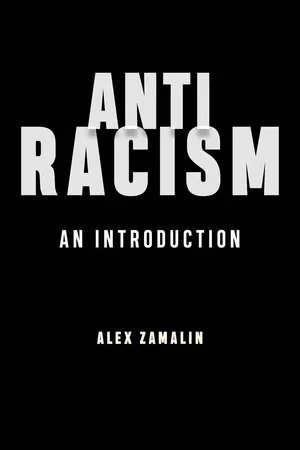
Antiracism is an accessible introduction to the political theory of black American antiracism, through a study of the major figures, texts, and political movements across US history. Zamalin argues that antiracism is a powerful tradition that is crucial for energizing American democracy.
- 224 pages
- English
- ePUB (mobile friendly)
- Available on iOS & Android
eBook - ePub
About this book
Information
1
The Origins of American Antiracism
August 11, 2017, shocked many Americans. Hundreds of white supremacists gathered in the university town of Charlottesville, Virginia, screaming, “Jews will not replace us!” and the Nazi slogan “Blood and Soil!” under the banner of “Unite the Right.” What were once Klan hoods were replaced with khakis and polo shirts. Nazi swastikas were abandoned in favor of Confederate flags. But the message was clear to anyone who paid attention. These white nationalists felt emboldened to go public, especially after the shock of 2016: the election of the Republican president Donald Trump, who ran a campaign dubbed “Make America Great Again!,” which played on the fantasy that certain parts of America had been taken away, besmirched, denigrated, and abused after eight years of the first black president, Barack Obama. Trump’s campaign embraced the racist far right, the so-called alt-right, which calls for reclaiming European American civilization and warns of a “white genocide,” a supposed conspiracy that lax immigration standards, combined with progressive social welfare initiatives, are secretly designed to eliminate the white American majority and make America into a majority-minority nation. What was even more disturbing for many people, however, was that just a week after the Charlottesville rally, which concluded with one of the white supremacists driving over and killing a nonviolent white protestor, Trump delivered a press conference in which he equated white supremacists with the counterprotestors. Both sides were wrong and had bad people, he said. As he put it, “And you had, you had a group on one side that was bad. And you had a group on the other side that was also very violent. And nobody wants to say that, but I’ll say it right now. You had a group—you had a group on the other side that comes charging in without a permit, and they were very, very violent.”1
Charlottesville was a reminder that racism has always been indigenous to US history. But it also revealed racism’s greatest existential threat. Charlottesville counterprotestors were part of a long US tradition of citizens who were not shocked by but expected racism. These citizens countered racist ideas, attacked racial inequality, and threatened racism’s grip on power. They constitute the antiracist American political tradition on which American democracy’s future depends. Antiracism tells their story.
Racism and Antiracism
In order for racism to make sense, it has been based in a philosophy of hierarchy, identity, and difference. Before the seventeenth century, it was justified theologically and biblically. A passage from the book of Genesis, which describes the “Curse of Ham”—whose descendents were condemned to bondage for his mistreatment of his father, Noah—was used to justify the subjugation of people with darker skin. But soon this theological explanation morphed into something more scientific. From the moment the word appeared in a Spanish dictionary in 1611, as raza, a kind of authentic, well-bred horse, race has been associated with subhuman characteristics. The modern idea of racism was born out of the eighteenth-century wish to scientifically categorize humanity’s essential hereditary traits—what was known as racial identity. Among the most important figures in this regard was the Swedish naturalist Carl Linnaeus, who in 1735 tried to categorize the various races—Europeans, Asians, Indians, Africans. Europeans had traits associated with upstanding citizenship, deference to the law, and rationality, while Africans were perceived as lazy and fickle. Johann Friedrich Blumenbach, for his part, did not impute normative value to race in the same way as Linnaeus and, unlike him, believed all humanity descended from a common source. But his On the Natural Varieties of Mankind (1775) nonetheless connected white people to the “Caucasus” and depicted them as the most beautiful and aesthetically pleasing.2
Despite these naturalist arguments’ claim to scientific objectivity and value neutrality, they became the perfect way to endow moral value to skin color and, therefore, to justify the enslavement and economic, political, and cultural exploitation of nonwhite people throughout the globe. Although racism contradicted the Enlightenment idea that all people are born equal with inalienable rights such as freedom and human dignity, it became a total ecosystem that created obscene differences in people’s life chances. White people got political rights and physical safety. What nonwhite people got instead was something brutal: enslavement of their bodies, imperialist exploitation of their natural resources, and dehumanization of their spirit.3
But racism did not go unopposed in the US; it created the antiracist. The first antiracists, antislavery abolitionists from the American founding in the late eighteenth century until emancipation after the end of the Civil War in 1865, struggled against the systematic exploitation of black labor under slavery. The next major wave came after the end of the Reconstruction period (1865–1877) and during the Jim Crow era in the 1890s through the civil rights movement of the 1950s and 1960s, when antiracists challenged the destruction of black bodies under lynching and the dehumanizing second-class citizenship of “separate but equal” public facilities that was formalized by the infamous Supreme Court decision Plessy v. Ferguson (1896). Ever since the 1960s, in what has been described as the “post-civil-rights era,” antiracists have challenged de facto segregation, a condition in which racial equality is formalized within antidiscrimination law. But a long history of racial inequality and its aftereffects has led to the clustering of black citizens in eviscerated segregated neighborhoods and disparities in income, wealth, education, mass incarceration, and rates of police brutality.
Throughout history, antiracists have engaged in various strategies of resistance, some of which were successful and others of which were not. They have championed the idea of liberation but sometimes have been blind to their own exclusionary commitments when it came to gender, class, sexuality, and even race. But their overarching focus has been on challenging racism. Many of their counterarguments and direct actions assaulted racism’s public face, its most visible enforcer: the unmistakable American racist—the slaveholder, lyncher, Ku Klux Klansman, social Darwinist, eugenicist, southern Democrat, and neo-Nazi. But antiracists have also, and perhaps even more importantly, unmasked racism’s secret weapon: the ordinary white American who has sometimes tepidly, conditionally, equivocally, or even shamefully agreed with the unmistakable racist.
Some antiracists have called out racists’ bad faith and malicious fantasy of a white utopia in segregated, enclosed communities free from the burden of black thoughts. Some have rejected as dubious the demands for empirical evidence before believing that the first black US president, Barack Obama, is truly an American citizen, rather than an anticolonial radical Kenyan. Others have debunked the myth that single black mothers, so-called welfare queens, exploit Social Security and Medicaid benefits. Some have rendered absurd the idea that black culture has no interest in educating its youth. And still others have attacked the instruments used to secure racial inequality: voting-booth intimidation, the separation of powers, checks and balances, murder, rape, terrorism, sterilization, redlining, redistricting, jails, prisons, and the police.4
Antiracist Thought and Politics in History
Antiracism has had an extensive intellectual and political history in the US. Colloquially, the term antiracist captures a wide range of meaning—from those who simply claim that they are not racist or oppose racism to those who see it as an injustice inconsistent with American values or try to excise it from their lives and society. From this understanding, almost every American today might call themselves antiracist. Since the gains of the civil rights movement, the end of Jim Crow, and the election of Barack Obama in 2008 and 2012, antiracism has become a public kind of aspiration, even if only in word and rhetoric. This idea stems from the belief that Americans live (or should aspire to live) in a “color-blind” society, that is, a society in which skin color or racial identity no longer matters. Consequently, antiracism has become both ubiquitous and often defanged of its critical and transformative social potential.
For instance, Black Lives Matter activists struggling against police brutality claim the title. But so too do major American corporations through their diversity-training initiatives and hiring of nonwhite CEOs. Educators call for developing an antiracist education by challenging dominant narratives of American progress. Yet opponents of racial equality use Martin Luther King Jr.’s argument that citizens should judge people by the content of their character rather than the color of their skin to argue against affirmative-action measures meant to level the playing field for black schoolchildren after a legacy of racism. The malleability of contemporary antiracist talk is perhaps most striking when Trump can claim that he is the least racist person in the world. Relying on the idea that racism is simply a matter of despising black people, he claims that he loves “blacks” and wants nothing more than for them to succeed.
Treating antiracism simply as an abstract philosophical orientation that names an honest refusal to be racist gives validity to all these expressions of antiracism. But rhetorical antiracism cheapens its historical meaning and specific political ideas. Without question, antiracism can be many things because it has no singular political ideology. But never has antiracist thought and action been entirely abstract and devoid of context for its practitioners who have held its banner in the struggle for racial liberation in US history. Antiracism’s meaning, I argue, is found in this history. And my use of antiracism has a far more radical meaning than is appreciated today. Few Americans who today claim antiracism have even dared to accept such a radical vision because doing so would fundamentally change American politics.
I argue that the antiracist political tradition is defined by a rigorous political philosophy and mode of direct political engagement that provides an exemplary model for tackling racism in all forms.5 Essential to the tradition is a direct and ongoing confrontation with the philosophy of racism, the individuals who embrace its ideas, and the structures and institutions that perpetuate it. Neglecting this history is politically misguided for those who claim to continue its struggle.6
Antiblack racism has always been antiracism’s central focus7—not because it is more morally salient than other forms of racial oppression, such as anti-Semitism, Islamophobia, and anti-Latino racism, but because it has been the most expansive, historically durable, and salient form in America dating back almost four hundred years, since the first enslaved Africans arrived in Jamestown, Virginia, in 1619. In fact, adopting antiblack racism has become one way that many nonblack immigrants have tried to assimilate as white (in the nineteenth century, it was the Irish, Jews, Poles, Italians, and Germans, and today it is Latinos and Arab Americans).8
Strikingly, prevailing cultural and academic understandings of antiracism typically focus on white Americans at the expense of those who have offered the most sustained critique and vision of what racism is and how to dismantle it: black Americans.9 Notwithstanding the recent burgeoning interest in African American political thought and the desire to expand the meaning of the American political tradition beyond its canonical white figures over the past few decades, black antiracist thought has not been given its full due.10
Antiracism recalls figures such as the militant white abolitionist John Brown, whose failed raid of Harper’s Ferry, Virginia, in 1859 to liberate enslaved people was one of the major catalysts for the Civil War. Largely ignored, however, is the radical abolitionist David Walker, whose Appeal to the Coloured Citizens of the World (1829) called for direct struggle against racism by any means necessary; such statements placed a bounty on his head. Scholars have spent a great deal of energy examining the significance of Henry David Thoreau’s refusal to pay taxes as a protest against slavery and the Mexican-American War of 1846. But they have insufficiently explored Anna Julia Cooper, who in A Voice from the South (1892) argued for the importance of black women’s equality when doing so ran against all forms of male domination. Ralph Waldo Emerson, who claimed that slavery was inconsistent with democracy, is the subject of many critical studies in various academic fields, but marginalized is Malcolm X, who argued in the 1960s that racism was deeply entrenched in American hearts and minds when doing so made him public enemy number one. In many documentaries and high-school history textbooks, white Freedom Riders and white civil rights protestors are celebrated for joining hands with the black leaders of the civil rights movement, but save for the most notable figures such as King and Rosa Parks, too often overlooked are the hundreds of thousands of ordinary black people who marched in the streets. Today, white allies who have “Black Lives Matter!” posters on their front yards are heralded as exemplary patriots by other white people. But neglected are the young black men and women who take to the streets when their lives are existentially threatened by the possibility of police brutality and white terrorism.
Focusing on white antiracism is understandable because committed allies from the majority have always been crucial symbolically and politically to facilitate political change. But overlooking the political and philosophical contributions of the black antiracist tradition is a serious mistake. Black antiracists have had the most to gain and the most to lose and, time and time and time again, have demonstrated how to successfully challenge racism and racial inequality.
In this book, I provide an introduction to the antiracist intellectual legacy and its political movements in the US.11 Antiracist critique, citizenship, and action are my sites of analysis. Intellectual history is my method. Contemporary political relevance is placed over abstract philosophical argument. Unifying principles across the tradition are highlighted above incommensurable differences. Major intellectual figures, movements, and core themes are placed above a comprehensive analysis of antiracism’s everyday manifestations. This book is not a comprehensive systematic interpretation of the link between various black political ideologies and the antiracist tradition. A book like that remains to be written, but this book is more concerned with acquainting contemporary readers with a political theoretical tradition whose political legacy still remains obscured, if not forgotten.
I hope in this short book to go a small way toward recovering the antiracist imagination for all to appreciate. My argument is that by remembering antiracism historically, we can help refresh antiracist politics today. Regrettably, few political endeavors are timelier or more necessary.12
Strategies of Political Confrontation
For antiracists, abstract metaphysical arguments mattered less than political ones that could move people to action. Confronting arbitrary power mattered more than simply theorizing it, even though the two went hand in hand. A sense of history and a realistic interpretation of limitation and possibility mattered more than ideological purity, although antiracist idealistic claims themselves usually exceeded what seemed possible or even practical at the time. Antiracists expanded the meaning of politics—from compromise and realistic concessions meant to advance an agenda to the power struggle about what compromise obscures and what is, in fact, realistic.
Antiracists made their arguments in a wide range of ways. Fiction helped gave vivid expression to theoretical truths. Film gave visceral texture, while painting and visual art evoked powerful thoughts and ideas. Poetry and song crystallized core philosophical maxims. Political treatises deduced arguments, while emotional speeches moved publics from passivity to action. Some antiracists were activists, others writers—some both, while others neither. Women were as prevalent as men, although their contributions were often unacknowledged because of patriarchal commitments found in some important male antiracists. For many antiracists, politics and aesthetics were fused. Antiracist art dramatized political ideas. But antiracist politics were a kind of art. Public marches, symbolic protests, sit-ins, signs, chants, turns of phrase, metaphors, and narratives became creative strategies to make political arguments register broadly.13
How antiracists made their arguments is equally important. Rhetoric was a powerful weapon. Narratives sometimes juxtaposed opposing perspectives, sometimes blurred the lines between them, and sometimes textured what was implied or disavowed within them. The genre of romance, which stressed the themes of painless reconciliation and eventual triumph over tension and incommensurable difference...
Table of contents
- Cover
- Title Page
- Copyright Page
- Dedication
- Contents
- 1. The Origins of American Antiracism
- 2. Rejecting the Power of Racism
- 3. Fighting for Freedom
- 4. Political Movements in Struggle
- 5. Antiracism Now
- Acknowledgments
- Notes
- Bibliography
- Index
- About the Author
Trusted by 375,005 students
Access to over 1.5 million titles for a fair monthly price.
Study more efficiently using our study tools.
Frequently asked questions
Yes, you can cancel anytime from the Subscription tab in your account settings on the Perlego website. Your subscription will stay active until the end of your current billing period. Learn how to cancel your subscription
No, books cannot be downloaded as external files, such as PDFs, for use outside of Perlego. However, you can download books within the Perlego app for offline reading on mobile or tablet. Learn how to download books offline
Perlego offers two plans: Essential and Complete
- Essential is ideal for learners and professionals who enjoy exploring a wide range of subjects. Access the Essential Library with 800,000+ trusted titles and best-sellers across business, personal growth, and the humanities. Includes unlimited reading time and Standard Read Aloud voice.
- Complete: Perfect for advanced learners and researchers needing full, unrestricted access. Unlock 1.5M+ books across hundreds of subjects, including academic and specialized titles. The Complete Plan also includes advanced features like Premium Read Aloud and Research Assistant.
We are an online textbook subscription service, where you can get access to an entire online library for less than the price of a single book per month. With over 1.5 million books across 990+ topics, we’ve got you covered! Learn about our mission
Look out for the read-aloud symbol on your next book to see if you can listen to it. The read-aloud tool reads text aloud for you, highlighting the text as it is being read. You can pause it, speed it up and slow it down. Learn more about Read Aloud
Yes! You can use the Perlego app on both iOS and Android devices to read anytime, anywhere — even offline. Perfect for commutes or when you’re on the go.
Please note we cannot support devices running on iOS 13 and Android 7 or earlier. Learn more about using the app
Please note we cannot support devices running on iOS 13 and Android 7 or earlier. Learn more about using the app
Yes, you can access Antiracism by Alex Zamalin in PDF and/or ePUB format, as well as other popular books in Politics & International Relations & Civil Rights in Politics. We have over 1.5 million books available in our catalogue for you to explore.