Argues that South Africans, like everyone else, need democracy for a more equal society
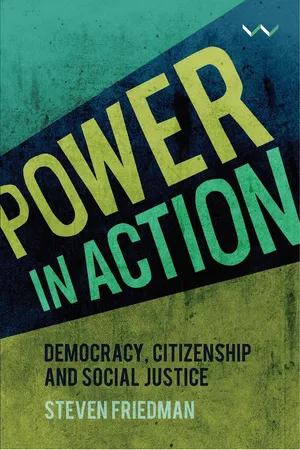
What are democracies meant to do? And how does one know when one is a democratic state? These incisive questions and more by leading political scientist, Steven Friedman, underlie this robust enquiry into what democracy means for South Africa post 1994. Democracy is often viewed through a lens reflecting Western understanding. New democracies are compared to idealized notions by which the system is said to operate in the global North. The democracies of Western Europe and North America are understood to be the finished product and all others are assessed by how far they have progressed towards approximating this model.
Power in Action persuasively argues against this stereotype. Friedman asserts that democracies can only work when every adult has an equal say in the public decisions that affect them.Democracy is achieved not by adopting idealized models derived from other societies–rather, it is the product of collective action by citizens who claim the right to be heard not only through public protest action, but also through the conscious exercise of influence on public and private power holders.
Viewing democracy in this way challenges us to develop a deeper understanding of democracy’s challenges and in so doing to ensure that more citizens can claim a say over more decisions in society.
- 336 pages
- English
- ePUB (mobile friendly)
- Available on iOS & Android
eBook - ePub
About this book
Information
CHAPTER
1
The Journey Lasts Forever: Beyond ‘Democratic Consolidation’
How do we know that a society has become a democracy – or will remain one?
This question is frequently asked in new democracies in general, and South Africa’s in particular.1 Comparing the country to others, particularly in North America and Western Europe, is a national pastime. Whether the country is a ‘real’ democracy is a theme in the public debate. It has also been asked, repeatedly, by Western scholars of democracy anxious to discover whether the democratic systems which have spread to Africa, Asia, Latin America and Eastern Europe are likely to last and are ‘the real thing’, not a cheap ‘Third World’ imitation. They ask the question through a framework, the ‘consolidation’ paradigm, which has influenced the thinking of most South African scholars of democracy2 as well as many elsewhere in Africa. It also, almost unnoticed, has shaped the way non-academic participants in the public debate think of democracy and its challenges. Since the paradigm shapes South African and African attitudes to democracy, what is it and how useful is it as a tool?
For a while, as many more societies adopted democratic rule, the test of whether a country was ‘really’ democratic seemed, to some mainstream scholars and practitioners, simple. Countries were democratic if they held regular elections in which political parties freely established by citizens were allowed to compete. Later, the writings of more than a few scholars – and the concrete experiences of citizens – began to recognise that societies are not democratic simply because they hold multi-party elections. The ‘fallacy of electoralism’ noted in the introduction – the idea that a country has ‘become democratic’ simply because it holds competitive elections – has been largely discredited in the academic literature which sought to understand and explain the spread of formal democracy across the globe.3 The limits of an ‘electoral democracy’ which offers the vote but not the freedoms and the right to choose which must accompany it4 are now widely acknowledged, particularly since elections propelled leaders with little regard for democratic rules to power in the United States and Eastern Europe as well as parts of the global South.
But, if we are unable to rely on the neat division between societies which hold multi-party elections and those which do not, how do we tell the difference between election-holding countries which realise the democratic rights of their citizens and honour their choices and those which do not? How do we tell whether a country has ‘become democratic’ in substance rather than merely in form?
The dominant approach through which scholars have tried to answer this question is the ‘consolidation’ paradigm, which claims to tell us how and whether democracies ‘consolidate’. It is a successor to the ‘transition’ literature of the 1980s, which studied how authoritarian regimes in Latin America, Southern and then Eastern Europe became ‘uncertain’ democracies.5 Having studied how formal democracy emerged out of authoritarianism, it was perhaps predictable that scholars would try to understand whether the democratic promise of the transitions would be realised and sustained. This raised two questions: whether and under what circumstances the new formally democratic orders would remain formal democracies, and whether and how they would become ‘real’ democracies. In one scholar’s view, interest in consolidation originally arose ‘to describe the challenge of making new democracies secure’6 – understanding what was needed to ensure that they remained formal democracies. Later, some scholars came to equate democratic consolidation ‘with completing democracy, with supplying its missing features’.7 In two ways, then, ‘consolidation’ is meant to tell us whether ‘uncertain’ new democracies can become ‘certain’ – by determining both whether they are sure to survive and whether they have become ‘full’ democracies.
But, the ‘consolidation’ approach does not enable us to tell a ‘certain’ from an ‘uncertain’ democracy. It cannot provide sure guides to democracies’ survival prospects, while its attempt to sort out the finished product from the aspirant democracy is unhelpful to new democracies because it is vague, teleological and ethnocentric. It is concerned less with trying to understand new democracies than with testing whether they are progressing towards an idealised image of the democracies of North America and Western Europe, which are always assumed to be consolidated and are, therefore, the benchmark to which new democracies are meant to aspire.
'CONSOLIDATION' AND ITS LIMITS
Literature on ‘consolidation’ is far better at using the term than at explaining what it means or examining it critically. This failure to specify the term’s meaning has been noticed not only by sceptics, but also by those who believe that it helps us to understand democratic prospects. In 1998, Andreas Schedler observed of ‘consolidation’:
At this point, with people using the concept any way they like, nobody can be sure what it means to others, but all maintain the illusion of speaking to one another in some comprehensible way. While ‘democratic consolidation’ may have been a nebulous concept since its very inception, the conceptual fog that veils the term has only become thicker and thicker the more it has spread through the academic as well as the political world.8
Schedler goes on to warn that, if scientific advance depends on participants sharing a common understanding of key terms, ‘the study of democratic consolidation, at its current state of conceptual confusion, is condemned to stagnation’.9 The warning has remained largely unheeded, for no greater conceptual clarity has been attached to ‘consolidation’. And yet it became the dominant prism through which the prospects of new democracies are viewed.
Growing pessimism on democracy’s health and prospects in the countries which are considered the role models to which new democracies should aspire has prompted some doubts on whether the finished product is as finished as it seemed. Besides concerns at the rise of parties and governments in the North which are hostile to democratic values, citizens of ‘consolidated’ democracies are disenchanted with the operation of their political system and the parties which have traditionally dominated it. While an influential academic view is unruffled, claiming that it shows that voters are becoming better able to think for themselves and less willing to tolerate elites,10 some voices worry that democracy in the North may be ‘deconsolidating’.11 They make the ‘heretical’ point that democratic values seem more firmly rooted among young people in China, India and sub-Saharan Africa than in Western Europe and North America.12
These scholars have received some support from Philippe Schmitter, a doyen of ‘transition to democracy’ scholarship who, in a recent article, warned of the ‘tumultuous’ and ‘uncertain’ future of ‘Real-Existing Democracy’ (RED).13 In a response to Fukuyama, he suggests that the democracy which was meant to end history (and is also the ‘finished product’ of the ‘consolidation’ paradigm) ‘is not what it used to be or seemed to be’.14 REDs, he believes, enjoyed an ‘exceptional period of stability’ in the four decades after the Second World War because two factors coincided: the threat of revolution and ‘the resources provided by a continuously expanding Capitalism’. The former gave ruling elites reason to compromise and the latter gave them the resources to afford it. The result was a ‘symbiosis’ between democracy and capitalism which masked the fact that they are based ‘on fundamentally different operative principles’ because ‘democracy promises and promotes equality; capitalism depends on and rewards inequality’.15
Those days, Schmitter believes, are now over: ‘The incentives for reform are not there; neither are the resources to pay for them’, while democracy ‘may still depend on capitalism, but capitalism does not depend on democracy’.16 In this new period, democracy might increasingly obstruct capitalism’s performance. These changes mean that democracy’s future will ‘not be as tranquil and assured as he [Fukuyama] assumed’17 because they have created a crisis in which political rights and entitlements have diminished and more people have become marginalised. Citizens are thus increasingly unhappy with this model of democracy.
Crucially for the ‘consolidation’ paradigm, Schmitter argues that this has created ‘the political paradox of our times’: precisely at the moment when many new democracies ‘emerged with the declared intention of imitating pre-existing ones’, older democracies were ‘entering into the compounded crisis we have described above’.18 Their citizens have been questioning ‘the “normal” institutions and practices that new democratizers have been trying so hard to imitate and have found them…defective’.19 Schmitter believes democracy will survive the crisis because, following the democratic theorist Robert Dahl, he argues that it has always been able to adapt. But his key point, that the ‘consolidation’ paradigm assumes that new democracies must aspire to ways of ordering politics which citizens of older democracies now reject, pulls the rug from under the key assumption which underpins it.
In the mainstream, anxiety about the state of democracy in the North has not challenged the ‘consolidation’ paradigm and its key assumption – that new democracies must be measured by the degree to which they become carbon copies of their democratic elders and betters (or at least of how older democracies see themselves). Nor has it prompted scholars who are wedded to the ‘consolidation’ idea to provide a coherent definition of how we would tell a ‘consolidated’ democracy from one which is not.
A Question of Attitude?
Perhaps the most-used definition of democratic consolidation is Juan Linz and Alfred Stepan’s claim that it occurs when democracy becomes the ‘only game in town’, when ‘none of the major political actors consider that there is any alternative to democratic processes to gain power…’. 20 Similarly, Adam Przeworski sees it as a condition in which ‘no one can imagine acting outside democratic institutions’.21
Both views stress the attitudes of political actors as the test for ‘consolidation’. Other approaches see the degree of ‘institutionalisation’ of formal democracies as the measure of their progress towards ‘consolidation’.22 This seems to move beyond the feelings of political actors by focussing on the degree to which organisations such as opposition parties or institutions such as the courts have become entrenched. But it also ends up relying on sentiments: institutions can be said to be ‘institutionalised’ only when the rules which underpin them are ‘widely shared and deeply rooted’.23
The common thread between these views is that democratic consolidation is a recognition within society that there is no alternative to democracy. This seems sensible, but is less useful than it seems. It is not clear who is meant to regard democracy as ‘the only game in town’ – political elites, citizens or both? References to ‘major political actors’ imply that it is the elites who need to accept that there is no alternative to democratic rules. But the message is often ambiguous. Some studies within the ‘consolidation’ framework measure not elite attitudes but those of citizens – they imply that democracy’s fate depends, at least to a degree, on citizens’ openness to anti-democratic appeals or their willingness to defend democratic rules.24 The pessimistic view of the state of Northern democracies is based to some degree on readings of the attitudes of voters, not elites. This implies that, unless democracy is rooted in the hearts and minds of citizens, it cannot be ‘consolidated’, even if the elites have concluded that they have no other options.
The answer to the question who is meant to view democracy as the only alternative would tell us much about how the ‘consolidation’ approach understands democracy – whether it sees it as a system which relies on citizens or on elites. If the future of democracy depends on elites, citizens are largely reduced to bystanders, able to choose between competing leadership groups if democracy endures, but unable to shape either its ability to survive or whether it moves from ‘partial’ to ‘complete’ democracy. This would make the ‘consolidation’ approach a variety of ‘democratic elitism’, which sees democracy as a system which allows citizens to choose between competing elites but not to take part in public debate and decision-making.25 It may also require a less demanding test of whether a democracy is ‘consolidated’ than those which insist also on citizen support for democratic norms and values. If only elite attitudes matter, formal democracy may survive even if most citizens doubt its worth, particularly if the doubters are not strong enough to act on their misgivings. By contrast, an understanding of democracy’s prospects which insists on citizens recognising that it is irreplaceable would make ‘consolidation’ the product of a lengthier and far more complex process than an acceptance by elites that they have no other options. Who is meant to see democracy as ‘the only game in town’ is, therefore, a fundamental question. But the ‘consolidation’ literature does not tell us.
And how do we know when those who are meant to recognise that there is no alternative to democracy have done so? It is fairly easy to establish when democracy is not ‘the only game in town’: its opponents are often vocal and visible. Where there are large anti-system parties – as in Weimar Germany – or military officers challenge democracy’s merits – as in Indonesia or Spain during their early democratisation – democracy is clearly not ‘consolidated’. But, today, these signs are more the exception than the rule. As the introduction pointed out, even those who have severe doubts about democracy feel obliged to endorse it, including authoritarians who operate within at least a semblance of democratic rule. In most formal democracies, it may be difficult to find elites who admit to believing that there are alternatives to democracy, even if the way they govern shows that they doubt democracy’s merits. The ‘consolidation’ approach is often surprisingly vague on how we might distinguish the attitudes of those who really believe that democracy is the only ‘game in town’ from those who find it convenient to pretend that they do.
Przeworski’s approach uses game theory to test whether political actors have accepted democratic rules. His approach focusses l...
Table of contents
- Cover
- Halftitle Page
- Title Page
- Copyright Page
- Contents
- Introduction
- Chapter 1 The Journey Lasts Forever: Beyond ‘Democratic Consolidation’
- Chapter 2 Deeper and Broader: What Makes Democracies More or Less Democratic?
- Chapter 3 Democracy in Deed: The Centrality of Collective Action
- Chapter 4 Colonisation of a Sympathetic Type? The Culture of Democracy
- Chapter 5 Another Lens: Collective Action and Democracy in Africa
- Chapter 6 Every Day is a Special Day: Collective Action as Democratic Routine
- Chapter 7 Power is Theirs? Why Collective Action is Usually the Preserve of the Few
- Chapter 8 Collective Action as Democratic Citizenship: The Treatment Action Campaign
- Chapter 9 Towards Popular Sovereignty: Building a Deeper and Stronger Democracy
- Notes
- References
- Index
Trusted by 375,005 students
Access to over 1.5 million titles for a fair monthly price.
Study more efficiently using our study tools.
Frequently asked questions
Yes, you can cancel anytime from the Subscription tab in your account settings on the Perlego website. Your subscription will stay active until the end of your current billing period. Learn how to cancel your subscription
No, books cannot be downloaded as external files, such as PDFs, for use outside of Perlego. However, you can download books within the Perlego app for offline reading on mobile or tablet. Learn how to download books offline
We are an online textbook subscription service, where you can get access to an entire online library for less than the price of a single book per month. With over 1.5 million books across 990+ topics, we’ve got you covered! Learn about our mission
Look out for the read-aloud symbol on your next book to see if you can listen to it. The read-aloud tool reads text aloud for you, highlighting the text as it is being read. You can pause it, speed it up and slow it down. Learn more about Read Aloud
Yes! You can use the Perlego app on both iOS and Android devices to read anytime, anywhere — even offline. Perfect for commutes or when you’re on the go.
Please note we cannot support devices running on iOS 13 and Android 7 or earlier. Learn more about using the app
Please note we cannot support devices running on iOS 13 and Android 7 or earlier. Learn more about using the app
Yes, you can access Power in Action by Steven Friedman in PDF and/or ePUB format, as well as other popular books in Politics & International Relations & African Politics. We have over 1.5 million books available in our catalogue for you to explore.