<p>While we know a great deal about the benefits of regional integration, there is a knowledge gap when it comes to areas with weak, dysfunctional, or nonexistent regional fabric in political and economic life. Further, deliberate “un-regioning,” applied by actors external as well as internal to a region, has also gone unnoticed despite its increasingly sophisticated modern application by Russia in its peripheries. </p><p>This volume helps us understand what Anna Ohanyan calls “fractured regions” and their consequences for contemporary global security. Ohanyan introduces a theory of regional fracture to explain how and why regions come apart, consolidate dysfunctional ties within the region, and foster weak states. Russia Abroad specifically examines how Russia employs regional fracture as a strategy to keep states on its periphery in Eurasia and the Middle East weak and in Russia's orbit. It argues that the level of regional maturity in Russia’s vast vicinities is an important determinant of Russian foreign policy in the emergent multipolar world order. </p><p>Many of these fractured regions become global security threats because weak states are more likely to be hubs of transnational crime, havens for militants, or sites of protracted conflict.
The regional fracture theory is offered as a fresh perspective about the post-American world and a way to broaden international relations scholarship on comparative regionalism. </p>
eBook - ePub
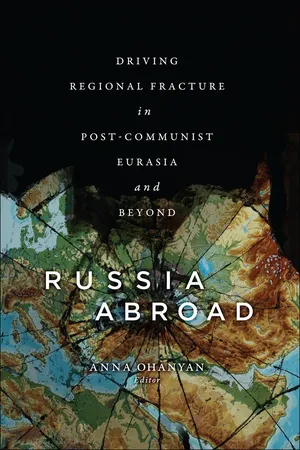
Russia Abroad
Driving Regional Fracture in Post-Communist Eurasia and Beyond
- 220 pages
- English
- ePUB (mobile friendly)
- Available on iOS & Android
eBook - ePub
About this book
Information
Publisher
Georgetown University PressYear
2018Print ISBN
9781626166202
9781626166196
eBook ISBN
9781626166219
PART I
Theory of Regional Fracture
CHAPTER ONE
Theory of Regional Fracture in International Relations: Beyond Russia
In the summer of 2016, while on a tour in the remote Armenian village of Dsegh, I visited the house museum of Hovhannes Tumanyan, the eminent Armenian writer who lived and worked at the turn of the nineteenth century. The guide mentioned in passing that Tumanyan valued his role as a peacemaker in the Caucasus—even more so than his literary contribution, a legacy that has shaped Armenian culture for more than a century. The guide further explained that Tumanyan, who brokered peace agreements between various ethnic communities in the Caucasus and prevented interethnic violence in Russian Transcaucasia, was rewarded by being arrested twice for his public activism and eventually imprisoned by the Tsarist government. This rather stark fact jolted me from my poetic reverie back to my research—though I doubt that my guide fully appreciated the impact of this seemingly minor historical insight.
Tumanyan’s imprisonment by the Russian Empire for his role as a peacemaker in the Caucasus is emblematic of the ways in which Russian imperial power has actively destabilized interethnic communities, in this case by punishing attempts at inter-ethnic reconciliation. The incident foreshadows Russia’s systematic efforts to block regional groupings on its peripheries throughout the twentieth century (Brzezinski 1989) and is an effective way of framing a larger discussion of how deliberate regional fracture has been used as a foreign policy tool by regional powers, though at a very high cost. By default or by design, regional fracture persists, flourishing at increasingly higher levels of institutionalization while undermining global security.
These “micro-moments” of the Russian Empire contrast sharply with a speech given by President Vladimir Putin of Russia on February 10, 2007, at the Munich Security Conference in Germany (Nalbandov 2016). The Russian president cautioned against “unipolarity” as a problematic model of global governance in the twenty-first century, admonishing the West to democratize world politics. He then quickly revealed the limits of his zeal to democratize international relations, calling for the right multipolar combination and the right web of alliances among a few great powers (including Russia but excluding the rest of the world) as a way toward an international peace and stability that, according to this perspective, would then percolate down to the rest of the states in the system. This “trickle-down” approach to politics, preached by mostly structural neorealists, including President Putin, represents a broadly shared perspective on world politics among policy elites on both sides of the Atlantic, from the marble halls of the White House to the red brick walls of the Kremlin.
Indeed, the search for the right combination of global power arrangements and the structure of polarity involving mostly larger states has been central to policy-shaping recommendations in global capitals. Traditionally, strategic restraint (Posen 2014) and accommodation of rising powers (Paul 2016) have been long-held assumptions for negotiating peaceful transition of power. Democratic peace theory, complex interdependence (Keohane and Nye 2012), and norm accommodation among states have been offered as additional mechanisms of peaceful change in the international system, as prescribed by neoliberal institutionalism and social constructivism over the years. Still, mechanisms and agents of peaceful power transition remain poorly understood within the discipline, with the existing knowledge scattered across subfields and theoretical traditions (Paul 2017).
The theory of regional fracture (TRF) developed in this volume suggests that it is essential for a nuanced perspective on peaceful power transitions and for strengthening of the rules-based liberal system of world order, in part because the global context has changed. In an age of hyperconnectivity (Ferguson 2017), heteropolarity (Der Derian, cited in Ohanyan 2015), and networked politics (Reinicke 1998; DeMars 2005; Ohanyan 2008, 2009, 2015; Slaughter 2017), the agency of states and regions, traditionally viewed as peripheral to the world “system,” should be moved into the spotlight. TRF thus advocates for advancing the once “peripheral” agency of states and regions into the forefront of international relations (IR) theories. It does so by developing the concept of fractured regions and explaining its agency for understanding world politics and global security, zooming in on remote villages and borderland communities (rather than global capitals), and highlighting their centrality to the fabric of global security and the world order moving forward.
The Agency of Fractured Regions
Fractured regions, the subject of this volume, can be described as a group of states or societies that are interconnected both by geographic proximity and a degree of mutual interdependence (Nye 1968; Buzan and Wæver 2003).1 They are institutional creatures that are recognizable as political systems within which constituent states and societies exhibit clear patterns of political behavior. They are identifiable by the mechanisms of their regionwide deployment of power resources and by the density and direction of their institutional ties and social connections. Fractured regions, while highly variable, share certain characteristics. At their core, they can be described as debilitated neighborhoods between states or societies; they possess regional ties and connections that are somewhat weak and that yield little value, whether in terms of economic development or problem solving and governance at the political level. Fractured regions are often postcolonial systems that mediate between the former empire’s need to maintain influence over the region and the desire of the successor states to advance their newly found independent statecraft.
The value of regional connections between states is amply demonstrated by economists and political scientists alike (Collier 2008; Østby, Nordås, and Rød 2009; Schiff and Winters 2003; Fawcett 2004), whether for state-building processes, effective diplomacy and democratization, security provision, global governance, or trade and development. Interestingly, Brian Greenhill and Yonatan Lupu (2017) report on studies that document that “states are organizing themselves into more tightly-knit regional groupings than ever before” (183). Unfortunately, there has been less emphasis on the absence or weakness of such ties for economic development or political security and stability in regional neighborhoods. While the regional dimension of armed conflict and its global security implications are gaining momentum in security studies and in conflict analysis and resolution (Ohanyan 2015), the systemic effects and key markers of fractured regions remain under-explored and their agency, in the context of world politics, unrecognized.
Binary thinking has been an obstacle to recognizing the agency of fractured regions as diverse systems with significant implications for global security. Regions have been viewed in the IR scholarship as either fully or partially integrated or lacking in regional ties and therefore not part of a distinct category in world politics. The TRF challenges this binary narrative, focusing on Russia’s assertive involvement in its neighborhoods, from the Donbass to Damascus. With a bit more nuance, TRF argues that fractured regions, like integrated regions, occupy a specific institutional geography and, as such, represent particular political and institutional systems. There is great variance in the way fractured regions are organized, and the study of such variance is essential for building better theories and policies on comparative regionalism in developing countries. Significantly, fractured regions can become highly disruptive to global security due to their particular patterns of organization. Some regional fractures can be more destabilizing than others, but discerning the sometimes subtle differences and variances among them is a necessary first step toward assessing their impact on world politics.
This book also differentiates between regional fracture by default and regional fracture by design. Fracture by design refers to deliberate policies by external hegemons and (post)imperial powers in preventing direct regionwide multilateral or bilateral ties between state entities under their sphere of influence. Examples range from the United States’ policies in Latin America to Japan’s and China’s policies in Southeast Asia and, most notably, Russia’s policies in its post-Communist neighborhoods (Nalbandov 2016; Roeder 1997). Fracture by default refers to poor transportation routes and administrative structures that make the development and maintenance of regionwide ties challenging, if not impossible (Ohanyan 2007).
Whether by default or by design, fractured regions can be highly disruptive to world politics. Diplomacy that fails to recognize the regional dimensions of ongoing conflicts is likely to be ineffective or miss the mark entirely. This chapter develops the concept of fractured regions, delineates its dimensions, and offers a framework in which to unpack the regional dynamics in selected security theaters impacted by direct or indirect Russian involvement. Developing a vocabulary and metrics to explain the phenomenon of regional fracture in its neighborhood helps in “getting post-Soviet Russia right” (Korolev 2015).
The interests of post-Soviet Russia and its leadership have been fluctuating over the past two decades but have always hit three key notes: territorial and national defense, economic prosperity, and regime and leadership survival (Horowitz and Tyburski 2012). In each of these areas, Russia has tried to translate its legacy effects in its immediate neighborhoods into influence (Horowitz and Tyburski 2012), and leveraging its regional ties with the political elite has been an important tool at its disposal. Placing these developments in a regional fracture framework will help to produce a more nuanced understanding of Russia’s policies in the post-Communist space and the Middle East.
Regional fracture in neighborhoods surrounding Russia has strengthened its influence in some cases and weakened it in others. The specific characteristics of such fracture matter. Specifically, regional fracture by default creates an enabling environment for Russian intervention, and this, in fact, has been consistently practiced by Russia as a foreign policy. In this light, the TRF can explain the continuity of Russia’s behavior as a colonial and postcolonial power in Eurasia. “Getting post-Soviet Russia right” requires unpacking fractured regions as an emerging category in IR. It requires an understanding of the way fractured regions are deployed in world politics and the way they shape institutional environments, enabling particular powers at the expense of others, impacting ongoing conflicts, and influencing the conditions of conflict and cooperation between states.
The remainder of this chapter situates the framework of regional fracture within the IR literature and discusses its theoretical value for the discipline. It then proceeds to examine its key dimensions, which will serve as a template for the empirical case studies that follow.
Regional Fracture and International Relations Theory
As I argue elsewhere in this book, fractured regions are not simply unintegrated regions; they exhibit institutional coherence and reflect logical patterns of formation and consolidation. Still, at their core they are spatial organizations around which particular regionwide political, institutional, and social patterns develop. As such, fractured regions compel a discussion about the regional dimension of world politics, a line of inquiry that has benefited from extensive scholarship to date. Comparative regionalism and colonialism are research areas with the most direct implications for the regional fabric of world politics. The following examines the TRF relative to both.
Fractured Regions and the Rise of Regions in IR
The rise of regions as an analytical concept and unit of analysis in IR has experienced ebbs and flows over the past few decades. Having been reenergized in the post–Cold War period (Lepgold 2003; Pouliot 2007), its emphasis on the pacifying and developmental effects for member states has carried over from earlier waves of scholarship. The emphasis on regionalism as integration has shaped the scholarly debates, which are currently moving into discussions on the institutional variations between regional forms around the world (Acharya and Johnston 2007; Lay Hwee Yeo 2010; Ohanyan 2015). By extension, the focus on institutions has directed the discourse toward regional organizations and multilateralism, leaving the contextual conversations that shape regional dynamics largely unattended.
The duality of regions both as a source of instability and a potential driver of development (Fawcett 2004) is a particularly important characteristic of regional politics in the developing world. The scholarship on regional security orders (Morgan 1997) and regional security complexes (RSC) (Barrinha 2014; Buzan and Wæver 2003) captures this sense of duality. Regional security orders that treat regionalism as potential sources of cooperation can best be described as following the dominant patterns and mechanisms of security management in a given area. This scholarship views states as the primary actors building and sustaining regional security orders of any kind, with varied degrees of power delegation to external regional organizations or supranational institutions.
In parallel, Barry Buzan (1991) defines regional security complexes as a “group of states whose primary security concerns link together sufficiently closely that their national securities cannot realistically be considered apart from one another” (190). Two attributes of regional security complexes are relevant for understanding regional fracture. First, reflecting on regional security dynamics in the post–Cold War period, the RSC theory emphasizes geographical proximity as a key characteristic in security projections in the context of both decolonization and the collapse of the Soviet Union. These developments gave rise to new states that emerged as players in the margins of world politics, with a limited capacity to project insecurities across a vast geographical terrain. Geographic proximity is also an important marker for fractured regions as political systems, and, as such, the framework of fractured regions resonates well with the RSC theory. Political geography has long relied on the concept of “shatterbelts” and “shatterzones” to highlight specific geographic areas that are especially prone to armed conflict and interstate warfare (P. Kelly 1986; Bartov and Weitz 2013).
RSC theory also views states as key constituent elements of regional security complexes, a position from which the TRF departs (Buzan and Wæver 2003) by rejecting the coherence of state structures as constituent elements in regional systems and subsystems. Pushing back against neorealist interpretations of regionalism, the TRF highlights the internally unstable nature of constituent states that also suffer from limited internal sovereignty (Risse 2013).
The TRF also highlights the ability of such regions, mostly located outside of Europe, to project insecurities globally. Smaller regions and seemingly isolated conflicts have already shown a propensity to project global insecurities, as has been painfully obvious with the Syrian civil war. This conflict, originally viewed as a self-contained problem in the Middle East, became heavily regionalized (Allison 2013); the flow of refugees into Europe and increased terrorist attacks in Europe demonstrate the capability of geographically contained fractured regions to project insecurity at the global level.
The TRF exposes the deep schisms inside societies with subnational groups and communities that have the capacity to develop their own regional security projects and visions for security provision. This has made it more difficult for external hegemons to control given regions than has been the case historically (Buzan and Wæver 2003; Fawcett 2004). For instance, while the Armenian government has aligned its security interests with Russia, the public backlash against Russian domination of the country, particularly among the younger generation, has been sustained and frequent. Indeed, in the summer of 2015 there was a peaceful protest movement in Yerevan organized in response to projected electricity price increases by a power company owned by the Russian government (Shahnazarian 2016). The government had to back down and transfer the ownership of the company to the Armenian Tashir group, which, along with the government, reversed the hike until July 31, 2016.
In terms of its specific characteristics, regional fracture can be conceptualized as a variable rather than a fixed condition. Regions vary in terms of the extent as well as the nature of their fracture. All regions, integrated or fractured, possess a certain fabric of regional action. In integrated regions, political spaces of regional actions are fully embedded in regional institutions and supported with regional values. Conversely, in fractured regions, regional fabrics of political action, and even regional institutions and values, can be rather patchy, uneven, and ad hoc, often pulling in different directions. As a result, deep and consistent collective action at a regional level tends to be shallow, making the region vulnerable to “great power overlay” (R. Kelly 2007; Morgan 1997).
Fractured Regions and Postcolonial Studies
Much of the IR scholarship, highly Eurocentric in nature, analyzes world politics from the perspective of great powers, hovering, for the most part, over grand geopolitical landscapes without zooming in for the granularity of “local politics” (Cooley 2012). Traditionally, the narrative of world politics has been told from the perspectiv...
Table of contents
- Cover
- Half title
- Title
- Copyright
- Contents
- Acknowledgments
- Introduction: Margins Matter
- Part I Theory of Regional Fracture
- Part II Lenin’s Revenge: Regional Fracture in the Post-Soviet Space
- Part III Postcolonial Roots of Regional Fracture Beyond the Post-Soviet Space
- Conclusion: Overcoming Regional Fracture
- References
- List of Contributors
- Index
Trusted by 375,005 students
Access to over 1.5 million titles for a fair monthly price.
Study more efficiently using our study tools.
Frequently asked questions
Yes, you can cancel anytime from the Subscription tab in your account settings on the Perlego website. Your subscription will stay active until the end of your current billing period. Learn how to cancel your subscription
No, books cannot be downloaded as external files, such as PDFs, for use outside of Perlego. However, you can download books within the Perlego app for offline reading on mobile or tablet. Learn how to download books offline
Perlego offers two plans: Essential and Complete
- Essential is ideal for learners and professionals who enjoy exploring a wide range of subjects. Access the Essential Library with 800,000+ trusted titles and best-sellers across business, personal growth, and the humanities. Includes unlimited reading time and Standard Read Aloud voice.
- Complete: Perfect for advanced learners and researchers needing full, unrestricted access. Unlock 1.5M+ books across hundreds of subjects, including academic and specialized titles. The Complete Plan also includes advanced features like Premium Read Aloud and Research Assistant.
We are an online textbook subscription service, where you can get access to an entire online library for less than the price of a single book per month. With over 1.5 million books across 990+ topics, we’ve got you covered! Learn about our mission
Look out for the read-aloud symbol on your next book to see if you can listen to it. The read-aloud tool reads text aloud for you, highlighting the text as it is being read. You can pause it, speed it up and slow it down. Learn more about Read Aloud
Yes! You can use the Perlego app on both iOS and Android devices to read anytime, anywhere — even offline. Perfect for commutes or when you’re on the go.
Please note we cannot support devices running on iOS 13 and Android 7 or earlier. Learn more about using the app
Please note we cannot support devices running on iOS 13 and Android 7 or earlier. Learn more about using the app
Yes, you can access Russia Abroad by Anna Ohanyan in PDF and/or ePUB format, as well as other popular books in Politics & International Relations & European Politics. We have over 1.5 million books available in our catalogue for you to explore.