Arabic Second Language Learning and Effects of Input, Transfer, and Typology
eBook - ePub

Arabic Second Language Learning and Effects of Input, Transfer, and Typology

  1. 223 pages
  2. English
  3. ePUB (mobile friendly)
  4. Available on iOS & Android
eBook - ePub

Arabic Second Language Learning and Effects of Input, Transfer, and Typology

About this book

Despite the status of Arabic as a global language and the high demand to learn it, the field of Arabic second language acquisition remains underinvestigated. Second language acquisition findings are crucial for informing and advancing the field of Arabic foreign language pedagogy including Arabic language teaching, testing, and syllabus design.

Arabic Second Language Learning and Effects of Input, Transfer, and Typology provides data-driven empirical findings for a number of basic and high-frequency morphosyntactic structures with two novel typological language pairings, examining Arabic second language acquisition data from adult L1 Chinese- and Russian-speaking learners of Arabic as a foreign language. Alhawary’s study examines the different processes, hypotheses, and acquisition tendencies from the two learner groups, and documents the extent of the successes and challenges faced by such learners in their L2 Arabic grammatical development during the first three years of learning the language. In addition, the book offers both theoretical and practical implications related to input exposure, L1 and L2 transfer, and typological and structural proximity effects.

This book serves as a valuable resource for both second language acquisition experts and foreign language teaching practitioners.
Frequently asked questions

Yes, you can cancel anytime from the Subscription tab in your account settings on the Perlego website. Your subscription will stay active until the end of your current billing period. Learn how to cancel your subscription.
No, books cannot be downloaded as external files, such as PDFs, for use outside of Perlego. However, you can download books within the Perlego app for offline reading on mobile or tablet. Learn more here.
Perlego offers two plans: Essential and Complete
  • Essential is ideal for learners and professionals who enjoy exploring a wide range of subjects. Access the Essential Library with 800,000+ trusted titles and best-sellers across business, personal growth, and the humanities. Includes unlimited reading time and Standard Read Aloud voice.
  • Complete: Perfect for advanced learners and researchers needing full, unrestricted access. Unlock 1.4M+ books across hundreds of subjects, including academic and specialized titles. The Complete Plan also includes advanced features like Premium Read Aloud and Research Assistant.
Both plans are available with monthly, semester, or annual billing cycles.
We are an online textbook subscription service, where you can get access to an entire online library for less than the price of a single book per month. With over 1 million books across 1000+ topics, we’ve got you covered! Learn more here.
Look out for the read-aloud symbol on your next book to see if you can listen to it. The read-aloud tool reads text aloud for you, highlighting the text as it is being read. You can pause it, speed it up and slow it down. Learn more here.
Yes! You can use the Perlego app on both iOS or Android devices to read anytime, anywhere — even offline. Perfect for commutes or when you’re on the go.
Please note we cannot support devices running on iOS 13 and Android 7 or earlier. Learn more about using the app.
Yes, you can access Arabic Second Language Learning and Effects of Input, Transfer, and Typology by Mohammad T. Alhawary in PDF and/or ePUB format, as well as other popular books in Languages & Linguistics & Languages. We have over one million books available in our catalogue for you to explore.

Chapter 1

Description of the Target Structures

The target forms discussed in this chapter include nominal gender agreement, verbal gender agreement, tense/aspect, and null subjects. The description provided pertains to Modern Standard Arabic (MSA), comprising the main formal classroom input of the participants as evident in their assigned textbooks (see chapters 36). The description is not intended to be exhaustive. Focus is on those features relevant to the data investigated. The target forms are among the high-frequency and most essential core structures to which Arabic second/foreign learners are exposed in the first years of their learning and are characterized by a great degree of regularity.

1.1 Preliminaries

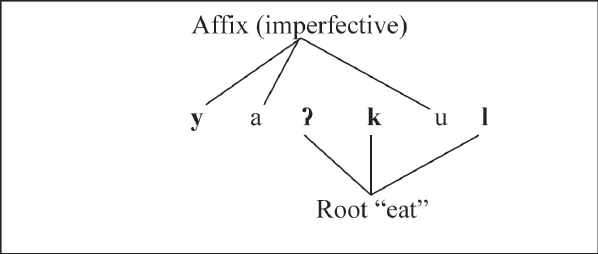
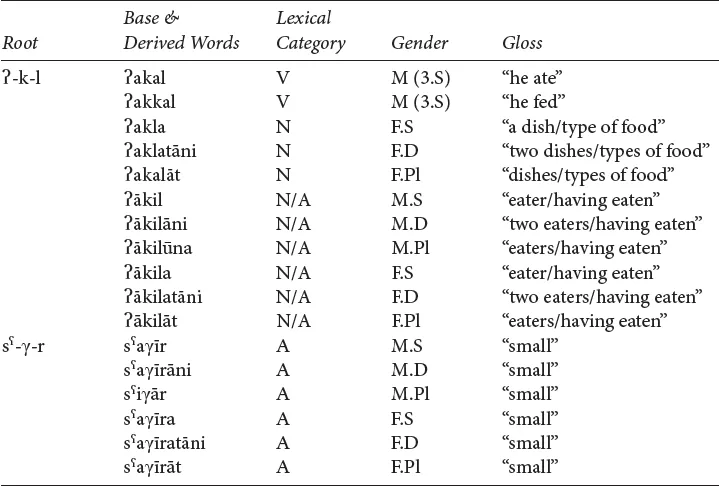
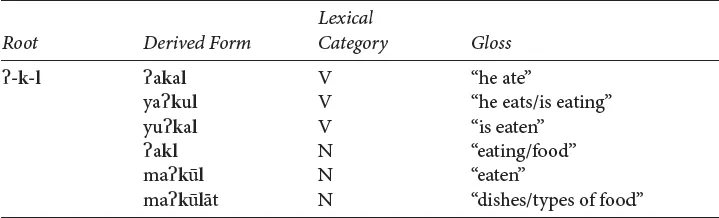
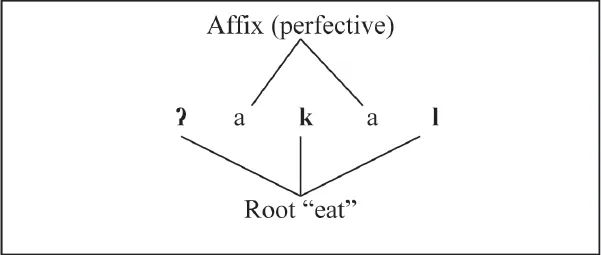
Before discussing the target forms, an overview of Arabic word structure is in order. Words in Arabic (as a Semitic language) have a unique underlying form–meaning relationship derived by combining a root and a pattern. The former (consisting of three to six consonants but most typically three) denotes the core semantic meaning while the latter (consisting of vowels and sometimes, additionally, a derivational affix/auxiliary consonant) carries some additional meaning. In other words, the complete meaning of a given word obtains only from combining both. Accordingly, a given word can have a large number of related words sharing the same root. Table 1.1 shows a list of related words derived from the root ʔ-k-l “that to do with eating.” The derivation is carried out by different types of affixation, including prefixes, suffixes, and infixes or circumfixes. Figures 1.1 and 1.2 (following O’Grady et al. 2009) show how the pattern -a-a- is affixed to the root ʔ-k-l “that to do with eating” to form the perfective/past tense and the pattern ya-u- is affixed to the same root to form the imperfective/present tense, respectively (see also Alhawary 2009a, 2011).
Learners of Arabic do not usually learn Arabic words or their derivation by combining a given root with a pattern from early on. Instead, they start by learning words (and storing them in memory) as base forms. They learn that certain words such as perfective/past tense and imperfective/present tense verbs inflected for third person singular masculine are base forms from which other (derived) verbs as well as active and passive participles are formed. For example, from the base form ʔakal “he ate,” another verb such as ʔakkal “he fed” is derived by duplicating the second root consonant to derive a causative meaning (see table 1.2). Similarly, singular nouns and singular (real) adjectives are introduced as base forms for the dual and plural of such forms (table 1.2).
Table 1.1Lexical derivation based on root
image
image
Figure 1.1Lexical derivation based on combining root- and pattern-bound morphemes to derive the past tense verb ʔakal “he ate”
image
Figure 1.2Lexical derivation based on combining root- and pattern-bound morphemes to derive the present tense verb yaʔkul “he eats/is eating”
Table 1.2Lexical derivation based on word base/stem
image
Although Arabic root system may not be relevant in Arabic L2 mental lexi...

Table of contents

  1. Cover
  2. Half title
  3. Title
  4. Copyright
  5. Dedication
  6. Contents
  7. Acknowledgments
  8. Introduction
  9. Abbreviations
  10. Transliteration Symbols
  11. Chapter 1
  12. Chapter 2
  13. Chapter 3
  14. Chapter 4
  15. Chapter 5
  16. Chapter 6
  17. Chapter 7
  18. Chapter 8
  19. Appendixes
  20. References
  21. Index
  22. About the Author