Since 1978, the end of the Mao era, economic growth in China has outperformed every previous economic expansion in modern history. While the largest Western economies continue to struggle with the effects of the deepest recession since World War II, the People's Republic of China still enjoys growth rates that are massive in comparison. In the country's smog-choked cities, a chaotic climate of buying and selling prevails. Tireless expansion and inventiveness join forces with an attitude of national euphoria in which anything seems possible. No longer merely the "workshop of the world," China is poised to become a global engine for innovation.
In China's Capitalism, Tobias ten Brink considers the history of the socioeconomic order that has emerged in the People's Republic. With empirical evidence and a theoretical foundation based in comparative and international political economy, ten Brink analyzes the main characteristics of China's socioeconomic system over time, identifies the key dynamics shaping this system's structure, and discusses current trends in further capitalist development. He argues that hegemonic state-business alliances mostly at the local level, relative homogeneity of party-state elites, the maintenance of a low-wage regime, and unanticipated coincidences between domestic and global processes are the driving forces behind China's rise. He also surveys the limits to the state's influence over economic and social developments such as industrial overcapacity and social conflict.
Ten Brink's framework reveals how combinations of three heterogeneous actors—party-state institutions, firms, and workers—led to China's distinctive form of capitalism. Presenting a coherent and historically nuanced portrait, China's Capitalism is essential reading for anyone interested in the socioeconomic order of the People's Republic and the significant challenges facing its continuing development.
eBook - PDF
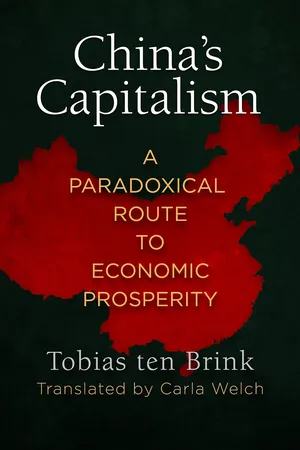
China's Capitalism
A Paradoxical Route to Economic Prosperity
- 327 pages
- English
- PDF
- Available on iOS & Android
eBook - PDF
About this book
Information
Publisher
University of Pennsylvania PressYear
2019Print ISBN
9780812251098
9780812251098
eBook ISBN
9780812295795
Table of contents
- Cover
- Contents
- List of Abbreviations
- Introduction
- Chapter 1. Analyzing China’s Political Economy
- Chapter 2. From Mao to the Hu/Wen Era: The Origins and Trajectory of Capitalist-Driven Modernization
- Chapter 3. Current Developments in Chinese Capitalism
- Conclusion
- Notes
- Bibliography
- Index
- Acknowledgments
Trusted by 375,005 students
Access to over 1.5 million titles for a fair monthly price.
Study more efficiently using our study tools.
Frequently asked questions
Yes, you can cancel anytime from the Subscription tab in your account settings on the Perlego website. Your subscription will stay active until the end of your current billing period. Learn how to cancel your subscription
No, books cannot be downloaded as external files, such as PDFs, for use outside of Perlego. However, you can download books within the Perlego app for offline reading on mobile or tablet. Learn how to download books offline
Perlego offers two plans: Essential and Complete
- Essential is ideal for learners and professionals who enjoy exploring a wide range of subjects. Access the Essential Library with 800,000+ trusted titles and best-sellers across business, personal growth, and the humanities. Includes unlimited reading time and Standard Read Aloud voice.
- Complete: Perfect for advanced learners and researchers needing full, unrestricted access. Unlock 1.5M+ books across hundreds of subjects, including academic and specialized titles. The Complete Plan also includes advanced features like Premium Read Aloud and Research Assistant.
We are an online textbook subscription service, where you can get access to an entire online library for less than the price of a single book per month. With over 1.5 million books across 990+ topics, we’ve got you covered! Learn about our mission
Look out for the read-aloud symbol on your next book to see if you can listen to it. The read-aloud tool reads text aloud for you, highlighting the text as it is being read. You can pause it, speed it up and slow it down. Learn more about Read Aloud
Yes! You can use the Perlego app on both iOS and Android devices to read anytime, anywhere — even offline. Perfect for commutes or when you’re on the go.
Please note we cannot support devices running on iOS 13 and Android 7 or earlier. Learn more about using the app
Please note we cannot support devices running on iOS 13 and Android 7 or earlier. Learn more about using the app
Yes, you can access China's Capitalism by Tobias ten Brink, Carla Welch in PDF and/or ePUB format, as well as other popular books in Economics & Government & Business. We have over 1.5 million books available in our catalogue for you to explore.