
- 224 pages
- English
- ePUB (mobile friendly)
- Available on iOS & Android
eBook - ePub
The Murder of Rosa Luxemburg
About this book
The cold-blooded murder of revolutionary icons Rosa Luxemburg and Karl Liebknecht in the pitched political battles of post-WWI Germany marks one of the greatest tragedies of the 20th century. No other political assassination inflamed popular passions and transformed Germany's political climate as that killing in the night of 15-16 January 1919 in front of the luxurious Hotel Eden. It not only cut short the lives of two of the country's most brilliant political leaders, but also inaugurated a series of further political assassinations designed to snuff out the revolutionary flame and, ultimately, pave the way for the ultra-reactionary forces that would take power in 1933. To commemorate the 100th anniversary of their untimely deaths, Klaus Gietinger has carefully reconstructed the events on that fateful night, digging deep into the archives to identify who exactly was responsible for the murder, and what forces in high-placed positions had a hand in facilitating it and protecting the culprits.
Information
Topic
PhilosophySubtopic
Philosopher Biographies1
The Shock of Revolt
The timing and, more than anything, the source of the sailors’ uprising in Kiel and other German coastal cities that kicked off the Revolution of 1918–19 took the old rulers by surprise: it was, as one historian would later describe it, ‘a spontaneous and elemental revolt from within the armed forces themselves’.1
It sent the ‘Kaiser’s elite’, the naval officers who had hitherto regarded themselves as a kind of knightly order of the German Reich, into a state of shock.2 Martin Niemöller, the anti-Nazi Lutheran pastor, wrote in his autobiography: ‘I accepted all the horrors of the war as a matter of course and without being shaken to the depths of my soul … What did shake my soul to its innermost depths and forced me to seek a clear and definite issue for myself was the revolution, which was not merely an upheaval, but a complete breakup. A whole world sank under me at that time.’3
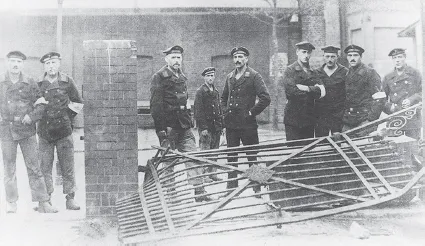
Revolutionary sailors in Wilhelmshaven
After overcoming their initial paralysis, these officers had one thing on their minds: revenge. Revenge for the ‘disgrace’, the ‘humiliation’. They were driven by hatred – a deep hatred for the ‘masses’, for the revolt, and for those who allegedly fomented it: the Independent Social Democrats (USPD) together with Liebknecht and Luxemburg.4
Officers began to organize into brigades. One of the most enterprising figures in this undertaking was a young lieutenant, who appeared to know everything and everyone. So impressed was the Social Democratic official responsible for naval and military affairs, Gustav Noske (see the portrait in the appendix, 155), that he made him his liaison officer in Kiel, and thus into a pivotal element of the counterrevolution. The man’s name was Wilhelm Canaris (see portrait on 151).
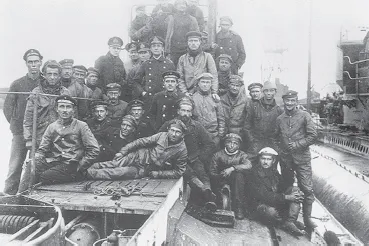
Lieutenant Captain Niemöller and his unit in November 1918
He preferred working in the background, in the shadows. ‘Canaris … was fascinated by these cat-and-mouse games with the enemy … As one who had experimented with invisible inks and assumed false names in his boyhood, he was fond of the mysterious – of veiled allusions and the concealment of ulterior motives and intentions.’5 He also believed that the sailors had been manipulated, that the ‘Marxist-Communist foe had surreptitiously infiltrated the fleet and subverted it with the aid of undercover accomplices on board.’6
A friend of Canaris’s established a relatively small naval officers’ association. These officers were ‘shock troops’,7 forming in a capital city swept up by ‘the red flood’ around the turn of 1918–19.8 They were housed at In den Zelten, no. 4, from where they were ‘called on for special operations’.9
The name of their leader was Lieutenant Commander (‘Kaleu’) Horst von Pflugk-Harttung (see portrait on 161). He and his naval squadron were in turn under the command of a division which would play a decisive role in the ‘battle for the Reich’. In fact, they were led by a captain whom Canaris also knew very well: Waldemar Pabst, the first general staff officer of the Garde-Kavallerie-Schützen-Division.
2
The ‘Little Napoleon’
Originally an elite unit of the Kaiser under the command of Lieutenant General Heinrich von Hofmann, the GKSD had been deployed to the Western Front in 1918.1 But since von Hofmann suffered from a heart ailment, the unit was soon commanded by Pabst, who joined the GKSD in March 1918 on General Erich Ludendorff’s orders.2 Short, vain, ambitious and thirsty for power, Pabst would become one of the most notorious figures of the 1918–19 revolution. His influence and above all his position of strength within the military have tended to be underestimated in the past.3
With the GKSD, the ‘remarkable’4 Pabst held sway over the strongest counterrevolutionary military formation – the ‘backbone of all deployed troops’5 upon which Noske’s authority was based.6
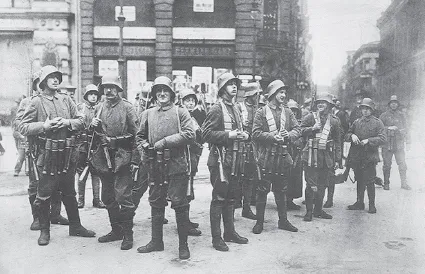
Soldiers of the Garde-Kavallerie-Schützen-Division [GKSD] in Berlin, January 1919.
As soon as news of the revolution reached him, Pabst began driving the GKSD ‘home in forced marches’, fully intent on sweeping away ‘the rule of the inferior’.7 Pabst and the GKSD reached Potsdam’s Wildpark train station on 30 November 1918.
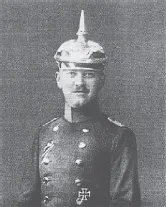
Captain Waldemar Pabst in 1914
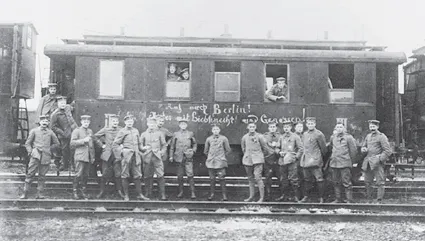
Graffiti on the train car reads ‘Off to Berlin! Down with Liebknecht and comrades!’
Here, Pabst experienced his first encounter with ‘Red Berlin’. Volksbeauftragte or ‘People’s Deputy’ Emil Barth, a member of the newly-formed revolutionary government, had been expecting him.
BARTH: Hey, you, come over here!
PABST: Hey, you, come over here!
BARTH: I am your superior!
PABST: Have you lost your mind?
As soon as Barth introduced Pabst to his companions, including the ‘Councillor of Deserters’, Pabst lost his composure. Pabst: ‘Clear the train platform in three minutes, or expect a thrashing!’8
The GKSD set up its headquarters in Nikolassee, near Berlin’s Wannsee, and ‘agreed as a precaution that no unbidden guests would be permitted’.9 Shortly thereafter, on 10 December 1918, Pabst marched his GKSD into Berlin through the city’s iconic Brandenburg Gate.
Nevertheless, the attempted putsch against the Workers’ and Soldiers’ Councils, plotted by the Supreme Army Command (Oberste Heeresleitung, OHL) with SPD leader Friedrich Ebert’s knowledge, would fail.10
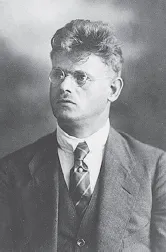
Emil Barth
The old social order’s gleaming defences were falling apart, and Berlin appeared to be in the hands of the masses. Pabst single-handedly held the GKSD together, at least to some extent,11 insulating them from all external influences and imparting continuous ‘educational’ instruction that reflected his reactionary worldview.
Thanks to this, the GKSD would be one of the few combat-ready units left over from the old armed forces. On 24 December 1918, Pabst led the attack on the revolutionary Volksmarinedivision, or ‘People’s Naval Division’, as ordered by Ebert,12 not hesitating to use gas grenades in his artillery strikes.13
Yet the thundering of the artillery did not fade away unheard. ‘Counterrevolution by the officers!’ was the echo it called forth. It flew from mouth to mouth, was taken up by the factory sirens and stirred up the farthest corners of the sea of buildings that was Berlin, and the dragon seed that had been sown over the previous weeks rose up prodigiously … in frantic rage, the unleashed mutiny leapt … at our troops.14
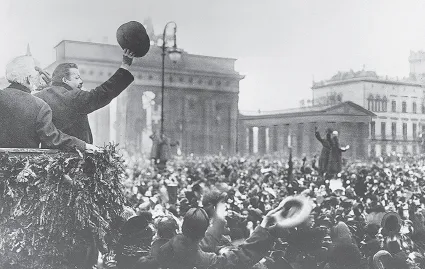
Frie...
Table of contents
- Cover Page
- Halftitle Page
- Title Page
- Copyright Page
- Contents
- Preface to the English Edition 100 Years of Double Homicide
- Introduction
- 1. The Shock of Revolt
- 2. The ‘Little Napoleon’
- 3. The Arrest
- 4. Eden: The Hotel of No Return
- 5. The Day After
- 6. ‘The Strictest Investigation’
- 7. Jorns Is Dragged into the Hunt
- 8. The Trial
- 9. Vogel’s Escape and ‘Pursuit’
- 10. Passing the Buck
- 11. The Seventh Man
- 12. A Visit from On High
- 13. The Confession
- 14. The Assignment
- 15. Fifty Years Later
- 16. Seventy-Four Years Later
- 17. The Deed and Those Responsible
- Appendix: Participants in and Supporters of the Conspiracy
- Documents
- Notes
Trusted by 375,005 students
Access to over 1.5 million titles for a fair monthly price.
Study more efficiently using our study tools.
Frequently asked questions
Yes, you can cancel anytime from the Subscription tab in your account settings on the Perlego website. Your subscription will stay active until the end of your current billing period. Learn how to cancel your subscription
No, books cannot be downloaded as external files, such as PDFs, for use outside of Perlego. However, you can download books within the Perlego app for offline reading on mobile or tablet. Learn how to download books offline
Perlego offers two plans: Essential and Complete
- Essential is ideal for learners and professionals who enjoy exploring a wide range of subjects. Access the Essential Library with 800,000+ trusted titles and best-sellers across business, personal growth, and the humanities. Includes unlimited reading time and Standard Read Aloud voice.
- Complete: Perfect for advanced learners and researchers needing full, unrestricted access. Unlock 1.5M+ books across hundreds of subjects, including academic and specialized titles. The Complete Plan also includes advanced features like Premium Read Aloud and Research Assistant.
We are an online textbook subscription service, where you can get access to an entire online library for less than the price of a single book per month. With over 1.5 million books across 990+ topics, we’ve got you covered! Learn about our mission
Look out for the read-aloud symbol on your next book to see if you can listen to it. The read-aloud tool reads text aloud for you, highlighting the text as it is being read. You can pause it, speed it up and slow it down. Learn more about Read Aloud
Yes! You can use the Perlego app on both iOS and Android devices to read anytime, anywhere — even offline. Perfect for commutes or when you’re on the go.
Please note we cannot support devices running on iOS 13 and Android 7 or earlier. Learn more about using the app
Please note we cannot support devices running on iOS 13 and Android 7 or earlier. Learn more about using the app
Yes, you can access The Murder of Rosa Luxemburg by Klaus Gietinger in PDF and/or ePUB format, as well as other popular books in Philosophy & Philosopher Biographies. We have over 1.5 million books available in our catalogue for you to explore.