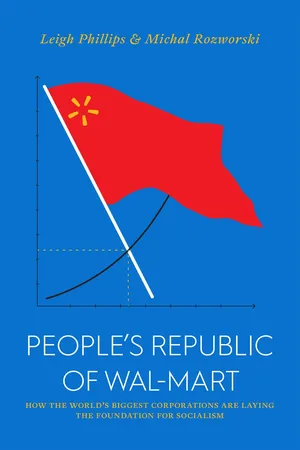
For the left and the right, major multinational companies are held up as the ultimate expressions of free-market capitalism. Their remarkable success appears to vindicate the old idea that modern society is too complex to be subjected to a plan. And yet, as Leigh Phillips and Michal Rozworski argue, much of the economy of the West is centrally planned at present. Not only is planning on vast scales possible, we already have it and it works. The real question is whether planning can be democratic. Can it be transformed to work for us?
An engaging, polemical romp through economic theory, computational complexity, and the history of planning, The People's Republic of Walmart revives the conversation about how society can extend democratic decision-making to all economic matters. With the advances in information technology in recent decades and the emergence of globe-straddling collective enterprises, democratic planning in the interest of all humanity is more important and closer to attainment than ever before.
eBook - ePub
The People's Republic of Walmart
How the World’s Biggest Corporations are Laying the Foundation for Socialism
- 256 pages
- English
- ePUB (mobile friendly)
- Available on iOS & Android
eBook - ePub
The People's Republic of Walmart
How the World’s Biggest Corporations are Laying the Foundation for Socialism
About this book
Information
1
INTRODUCTION
“So you’re writing a book celebrating Walmart, eh?”
“Er, no. Not exactly. Or, well, yes, in a way. You see, the logistical marvel that is Walmart, we do quite like. But it’s so much more complicated than that.”
“Bit of an odd topic for a pair of socialists. How on earth can you defend Walmart, with all their union busting, low wages and destruction of communities? Are they not one of the most evil companies in the world?”
“We’re not defending Walmart, and certainly not union busting. We’re just intrigued by how this epitome of capitalism is also, paradoxically, a vast planned economy. Very intrigued.”
Variations on this conversational theme have repeated themselves since we started writing this book. Invariably among progressive friends of ours, concerned or suspicious eyebrows have been raised.
So let us be clear from the outset: Walmart is an execrable, sinister, low-down dirty villain of a company.
Lamentably, the word “flagitious”—meaning “horribly criminal or wicked,” but also sharing a root with the word “flagellate” or whip, the Latin term flagitium, meaning “shameful thing”—is uncommon these days; yet at the same time that it is apropos for such a flagrantly socially delinquent business, it only begins to express the piercing, wolf-like hatred we two authors feel for Walmart.
Like any firm, Walmart is forced via competition in the market to reduce costs, notably labor costs—that most bendy and squishable portion of an enterprise’s expenditure. While none of this is very nice, it would hardly be fair to describe Walmart as uniquely evil. Sure, it pays poverty wages, depends upon Asian sweatshops and both child and prison labor, and disembowels high streets with all the relish and élan of the third-century torturers of Saint Elmo. But who doesn’t these days? Nevertheless, few other corporations seem to carry out their worker-immiserating, anti-union practices with quite such zeal, such crushing mastery; Walmart regards union busting not only as a necessary accompaniment to their enterprise, but places it at the very core of their business model. “I pay low wages,” said founder Sam Walton. “I can take advantage of that. We’re going to be successful, but the basis is a very low-wage, low-benefit model of employment.”
So no one should conclude, before reading a word of what we say (or indeed after reading every word but misapprehending what we say), that this book intends to be in any way a hip, contrarian apology for Walmart or Amazon or the Pentagon or for any of the other enterprises whose planning and logistics operations we investigate. That is not our purpose. Walmart should offer no inspiration for progressives.
With that throat-clearing out of the way, and now that everyone is content that we have no love for Walmart, we want to talk about how we nevertheless have admiration for Walmart, much as how an epidemiologist concedes an irrefutable genius to the wicked evolutionary dexterity of drug-resistant tuberculosis; or in the way that Milton finds Satan, rather than Jesus, to be the more interesting character; or the manner in which Sherlock Holmes can simultaneously revile and admire the intricate, canny stratagems of the malign savant Professor Moriarty.
If only Walmart’s operational efficiency, its logistical genius, its architecture of agile economic planning could be captured and transformed by those who aim toward a more egalitarian, liberatory society!
But why should anyone care about so dry a subject as what is, in effect, a discussion about enterprise decision making, about the optimal allocation of goods and services? Why should we even favor democratic planning over the free market? Did the end of the Cold War and the collapse of the Soviet Union not put paid to the idea that socialism is viable? Isn’t curtailing the free market’s excesses the best that we can do?
Libraries’ worth of books have been written on the injustices and contradictions of capitalism, not least its ineluctable expansion of inequality (even as poverty can be reduced—as the most extremities of it certainly have been over the last 300 years or so, albeit not least as a result of the pressure of trade unions and the left broadly conceived, dating back to its origins in the French Revolution, to share the wealth), enclosure of democracy, perennial manufacture of economic crisis, and thereby unemployment and even war, but we have no desire to recount these arguments here. So let us restrict ourselves to alighting upon perhaps its central misadventure.
There is certainly overlap between the set of all goods and services that are useful to humanity, on the one hand, and the set of all goods and services that are profitable, on the other. You likely find underwear to be a useful product (though for commandos, this is no certainty); The Gap, meanwhile, finds it profitable to produce such a product—a happy coincidence, of which there are many. But the set of all useful things and the set of all profitable things are not in perfect correspondence. If something is profitable, even if it is not useful or is even harmful, someone will continue producing it so long as the market is left to its own devices.
Fossil fuels are a contemporary example of this irremediable, critical flaw. Wonderful though they have been due to their energy density and portability—freeing us energetically from the caprices of Mother Nature, who may or may not blow windmills or turn waterwheels when we want her to—we now know that the greenhouse gases emitted by fossil fuel combustion will rapidly shift the planet away from an average temperature that has remained optimal for human flourishing since the last ice age. Yet, so long as governments do not intervene to curtail the use of fossil fuels and build out (or at least incentivize the build-out of) the clean electricity infrastructure needed to replace them, the market will continue to produce them. Likewise, it was not the market that ended production of the chlorofluorocarbons that were destroying the ozone layer; instead it was regulatory intervention—planning of a sort—that forced us to use other chemicals for our fridges and cans of hair spray, allowing that part of the stratosphere that is home to high concentrations of ultraviolet ray–deflecting tripartite oxygen molecules to largely mend itself. We could recount similar tales about how the problems of urban air pollution in most Western cities or of acid rain over the Great Lakes were solved, or how car-accident mortality rates or airline crashes have declined: through active state intervention in the market to curb or transform the production of harmful—but profitable—goods and services. The impressive health and safety standards of most modern mining operations in Western countries were achieved not as a result of any noblesse oblige on the part of the owners of the companies, but rather begrudgingly, as a concession following their defeat by militant trade unions.
Conversely, if something is useful but unprofitable, it will not be produced. In the United States, for instance, where there is no universal public healthcare system, healthcare for all would be wonderfully useful. But because it is not profitable, it is not produced. High-speed internet in rural areas is not profitable, so private telecommunications companies are loathe to provide it there, preferring instead to cherry-pick profitable population-dense neighborhoods.
And amid a growing global crisis of antimicrobial resistance, in which microbial evolution is defeating antibiotic after antibiotic and patients are increasingly dying from routine infections, pharmaceutical companies have all but given up research into new families of the life-saving drugs, simply because they are not profitable enough. That amputation or surgery to scrape out infected areas might return as common medical responses is not a pleasant thought. But this course of action was the only one left to the doctors of nineteen-year-old David Ricci of Seattle when they surgically removed part of his leg, following repeated infections from drug-resistant bacteria—acquired in a train accident in India—that could not be treated, even with highly toxic lastresort antibiotics. Each time the infection returned, more and more of the leg had to be cut off. Although Ricci has since recovered, he has lived in perpetual fear of the reappearance of the bugs that can’t be fought. As a 2008 “call to arms” paper from the Infectious Diseases Society of America (IDSA) put it, “[Antibiotics] are less desirable to drug companies and venture capitalists because they are more successful than other drugs.” Antibiotics are successful if they kill off an infection, at which point—days or weeks, or at most months, later—the patient stops taking the drug. For chronic diseases, however, patients may have to take their medicine every day, sometimes for the rest of their lives. Thus, the paper concluded, it is long-term therapy—not cures—that drives interest in drug development. Policy proposals from the likes of the IDSA, the World Health Organization and the European Union amount to begging and bribing the pharmaceutical companies to lift a finger; but even here, however unambitious the approach, it is still external to the market. (Socialization of the pharmaceutical industry would be cheaper, and a much more rapid and effective approach, but most pundits deem it too radical, giving off too much of a whiff of socialism).
Beyond this one sector, we might note that basic research in any field—that blue-sky stuff, where scientists are led by simple curiosity and have no expectation of developing any marketable product, and which is the basis of technologies and medicines that later turn out to be very marketable indeed—simply cannot be done by the private sector. This type of research is extremely expensive but makes no guarantee of any return on such spending. Such research thus is almost entirely a phenomenon characteristic of public institutions or private charities rather than market actors. Similarly, it was not the market that got us to the moon, but a grand public-sector enterprise called NASA. Today, if we are to be honest, we must recognize that due to the vast costs associated with a viable Mars colony such as the one proposed by Elon Musk’s SpaceX (even if the cost of escaping Earth’s gravity is significantly reduced, for instance, through the use of reusable rockets), there still has to be a profitable commodity resulting from that colony that can be sold back on Earth. If there is one, bully for him. If not, his investors will quickly abandon him. So the colonization of Mars will be a public-sector endeavor or it will not happen.
But for many progressives, the story of logistics and planning seems musty and old. Are there not fresh arguments required to convince that barricades must be mounted, forgotten stories of wretched oppression yet to be recounted? It is true that there is little drama or romance to the story of planning—few riveting tales of selfless heroism, brave suffering or righteous fury (although there are not a few episodes of heartbreaking defeat, failure and ruin). But in essence, the story of injustice and its correction is a chronicle of efforts across all time to reduce inequality of all types: of haves and have-nots, of who works and who rests, of who has a say and who does not. And inequality is, in the end, a question of unfair allocation of things themselves or the result of such unfair allocation.
Put simply, a poor person has not been allocated the stuff (or the ability to buy it) that a rich person has. The needs of the rich and poor are met and unmet in wildly different ways: the potential to fully articulate their humanity is cut off at the root for some, while others are granted space to flourish. Inequality limits what a person, and indeed society, could otherwise do; it delimits our freedom. Past generations have fought to expand the realm of freedom—to ensure all adult humans have the same rights and to ensure that any new capabilities delivered through technological advance are to be made available to all. And if we are to continue this battle to correct the titanic, manifest unfairness of the way things are, we must therefore wage a struggle over which method for the allocation of things we want as a society.
So when we ask whether another world is possible, we are also asking: Is there an alternate method to allocate things? How would we distribute things differently? And who would decide how they are distributed? Could the plans that capitalists use every day to get goods and services into the hands of those who can pay for them be transformed to instead ensure that what we produce gets to those who need it most? And in transforming the way we distribute stuff, could we also start to transform everything else about the economy—from what stuff we make and how, to who works and for how long?
Once we have identified alternative ways to distribute things, the planning everywhere around us may telegraph aspects of another mode of production. More urgently, such extant planning may also suggest features of transitional stages on the way to a more all-encompassing transformation of our economy.
Under capitalism, our current mode of production (in essence, the way our society organizes the economy), the primary method used to allocate things is the free market. Ours is a world where prices for goods and services are, in principle, determined in response to supply and demand. Free market advocates claim this leads to a situation where the amount of stuff demanded by buyers matches the amount of stuff produced by suppliers: a condition they describe as “economic equilibrium.”
For a mode of production to be called capitalism, it is not sufficient for a free market to exist; there are, after all, other essential features of capitalism, including exploitation in the workplace and the need to sell one’s labor in order to survive. Nevertheless, the free(-ish) market is a necessary condition for capitalism—one that, as a method of allocation, leads to growing inequality via disparities in the distribution of income. Market interactions inevitably produce winners and losers, leading to concentrations of wealth. Over time, these disparities grow, a product of these same market interactions.
This “perfect” free market only exists in the minds of its most ardent defenders and within the pages of introductory economics textbooks. Real markets are a far cry from this idealized fairy tale: companies regularly collude to keep out competitors, large corporations constantly lobby for government subsidies, and it is the norm that a few big players dominate entire product categories and set prices. One market in particular—the labor market—needed centuries of coercion and dispossession to turn peasants and farmers into workers willing to sell their labor for a wage. Frequently, supply and demand do not reach equilibrium; as a result, the market system regularly leads to crises of overproduction, which in turn provoke recessions and depressions, with wrenching consequences for millions of people. The market’s inherently competitive mechanisms catalyze, take advantage of, and exacerbate a range of inegalitarian prejudices based on identity (race, gender, sexuality and so on); lead to disruption of ecosystem services upon which humans depend; and drive militarist rivalry between nations that precipitates colonization, gives rise to imperialism, and ultimately triggers wars. While the real world is often one of messy disequilibrium, of prices created by fiat rather than emerging from the competitive ether—and, as we’ll see, one configured by capitalists who plan—it remains one where markets determine much of our economic, and thereby social, life.
In general, criticisms of the current way of doing things propose that the market be replaced, or at least reined in. But if allocation does not proceed via the market, then it will occur via economic planning, also known as “direct allocation”—made not by the “invisible hand” but by very visible humans. Indeed, this form of planned allocation already takes place widely in our current system, on the part of elected and unelected individuals alike, by both states and private enterprises, and in centralized and decentralized forms. Even arch-capitalist America is home not only to Walmart and Amazon, but also to the Pentagon: in spite of being incredibly destructive, the US Department of Defense is the single-largest employer in the world, and a centrally planned public sector operation. In fact, almost all countries are mixed economies that include various combinations of markets and planning.
Indeed, planning has accompanied human societies as long as they have existed. Thousands of years ago, the civilizations of ancient Mesopotamia created a nexus of economic institutions that connected the workshops and temples of the cities to peasant agricultural production in the countryside. The Third Dynasty of Ur (Ur III), which flourished around the Tigris and Euphrates Rivers near the end of the third millennium BCE, was among the first to make the breakthrough to widespread permanent record keeping. Clay tablets from Ur III include predictions of crop yields based on averages of soil quality, themselves derived from years of record keeping. Even though the economy was still at the mercy of uncontrollable weather, it could be managed at a rudimentary level. With the advent of detailed accounts, expectations and approximations—both crucial to planning—became features of economic life. Unlike the localized gift-exchange economy of prehistory, ancient Mesopotamia saw systems of centralized redistribution that mimic today’s welfare states: taxes and levies in, transfers of goods and services out.
Alongside writing and mathematics, building blocks of civilization that developed in tandem with economic record keeping, the ancients also developed money—only not in the way some economists imagine. In an oft-repeated passage from The Wealth of Nations, Adam Smith wrote that “the propensity to truck, barter, and exchange one thing for another” led to the division of labor, the invention of money and greater economic complexity. This bit of make-believe has been passed down for centuries and can still be found in most introductory economics textbooks. The problem with this intriguing tale is that it is false. Specialization developed within large household compounds where there was no internal exchange; heads of households distributed total household production among members—they planned. Money, on the other hand, arose largely as a tool for traders, mercenaries and others to settle debts with the ancient temples. As economic complexity grew, money was more widely adopted as a means of keeping track of taxes and other major transactions. Some prices floated in extraordinary times: for example, the price of grain during a very bad harvest. Most of the time, however, prices were highly standardized.
Early planning and early money worked in synergy. In Babylon, for example, one mina of silver was divided into sixty shekels, corresponding to one gur of barley divided into sixty kur. Each kur was a half-day ration of food given to workers. So one gur was a monthly ration worth one mina (under a standardized calendar of thirty-day months, with a New Year festival lasting a few days to realign with the solar year). Such easy equivalencies simplified account keeping and planning.
Increasingly complex economic record-keeping, accounting and social institutions all point to early ancient civilizations producing something that cannot but be described as economic calculation and planning. This is not to say there was some Arcadia of central planning at this time, any more than it is accurate to describe hunter-gatherer society as some peaceful egalitarian Eden. The planning of the ancients was not only rudimentary and partial; it was also far from being a rational way of securing the shared benefit of all. Indeed, ancient planning was at the service of an economic system created for the benefit of a small coterie of elites who were motivated to maintain their wealth and power. Sound familiar?
Despite the persistent inequalities that stretch back to the Ancient World, there are nevertheless reasons for hope today, including the millions whose curiosity has been piqued by references to socialism by Vermont Senator Bernie Sanders during the 2016 presidential primary, and more recently by a series of contenders for political office across the United States. In the UK too, as of this writing, an unabashed socialist, Jeremy Corbyn, heads Her Majesty’s Loyal Opposition. As the political debate becomes more polarized, young people on the whole, even in the Anglo-American center of the capitalist order, now view socialism more favorably than they do capitalism. Across Europe, far-left parties that proffer a rhetoric that endorses socialism, or at least some other way of doing things than business-as-usual capitalism—from Syriza in Greece to Die Link...
Table of contents
- Cover Page
- Halftitle Page
- Title Page
- Copyright Page
- Contents
- Acknowledgements
- 1. Introduction
- 2. Could Walmart Be a Secret Socialist Plot?
- 3. Islands of Tyranny
- 4. Mapping the Amazon
- 5. Index Funds as Sleeper Agents of Planning
- 6. Nationalization Is Not Enough
- 7. Did They Even Plan the Soviet Union?
- 8. Hardly Automated Space Communism
- 9. Allende’s Socialist Internet
- 10. Planning the Good Anthropocene
- 11. Conclusion: Planning Works
Trusted by 375,005 students
Access to over 1.5 million titles for a fair monthly price.
Study more efficiently using our study tools.
Frequently asked questions
Yes, you can cancel anytime from the Subscription tab in your account settings on the Perlego website. Your subscription will stay active until the end of your current billing period. Learn how to cancel your subscription
No, books cannot be downloaded as external files, such as PDFs, for use outside of Perlego. However, you can download books within the Perlego app for offline reading on mobile or tablet. Learn how to download books offline
Perlego offers two plans: Essential and Complete
- Essential is ideal for learners and professionals who enjoy exploring a wide range of subjects. Access the Essential Library with 800,000+ trusted titles and best-sellers across business, personal growth, and the humanities. Includes unlimited reading time and Standard Read Aloud voice.
- Complete: Perfect for advanced learners and researchers needing full, unrestricted access. Unlock 1.5M+ books across hundreds of subjects, including academic and specialized titles. The Complete Plan also includes advanced features like Premium Read Aloud and Research Assistant.
We are an online textbook subscription service, where you can get access to an entire online library for less than the price of a single book per month. With over 1.5 million books across 990+ topics, we’ve got you covered! Learn about our mission
Look out for the read-aloud symbol on your next book to see if you can listen to it. The read-aloud tool reads text aloud for you, highlighting the text as it is being read. You can pause it, speed it up and slow it down. Learn more about Read Aloud
Yes! You can use the Perlego app on both iOS and Android devices to read anytime, anywhere — even offline. Perfect for commutes or when you’re on the go.
Please note we cannot support devices running on iOS 13 and Android 7 or earlier. Learn more about using the app
Please note we cannot support devices running on iOS 13 and Android 7 or earlier. Learn more about using the app
Yes, you can access The People's Republic of Walmart by Leigh Phillips,Michal Rozworski in PDF and/or ePUB format, as well as other popular books in Economics & Political Economy. We have over 1.5 million books available in our catalogue for you to explore.