The post-Cold War era has been difficult for Japan. A country once heralded for evolving a superior form of capitalism and seemingly ready to surpass the United States as the world's largest economy lost its way in the early 1990s. The bursting of the bubble in 1991 ushered in a period of political and economic uncertainty that has lasted for over two decades. There were hopes that the triple catastrophe of March 11, 2011—a massive earthquake, tsunami, and accident at the Fukushima Daiichi nuclear power plant—would break Japan out of its torpor and spur the country to embrace change that would restart the growth and optimism of the go-go years. But several years later, Japan is still waiting for needed transformation, and Brad Glosserman concludes that the fact that even disaster has not spurred radical enough reform reveals something about Japan's political system and Japanese society. Glosserman explains why Japan has not and will not change, concluding that Japanese horizons are shrinking and that the Japanese public has given up the bold ambitions of previous generations and its current leadership. This is a critical insight into contemporary Japan and one that should shape our thinking about this vital country.
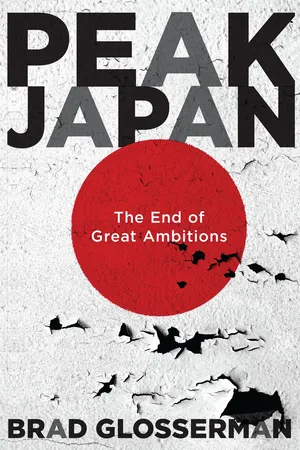
- 272 pages
- English
- ePUB (mobile friendly)
- Available on iOS & Android
eBook - ePub
About this book
Information
1
THE UNHAPPY COUNTRY
The study of history is in many cases the plotting of national trajectories that soar and eventually collapse back into themselves. Few countries have experienced this wrenching dislocation as acutely as Japan has. No country in the last 150 years has enjoyed as many highs nor plummeted to such lows. Kawashima Yutaka, a diplomat who capped a distinguished career as number 2 in his country’s Foreign Ministry, believes that “the ‘ups and downs’ of Japan is the biggest event” of the twentieth century.1
Those swings began in July 1853, when Commodore Matthew Perry arrived in Edo (now Tokyo) Bay and demanded that Japan open its doors to trade with the United States. Perry sought to end the sakoku (closed country), or isolation, policy that had been in place since 1633 and had strictly regulated Japanese commerce and foreign policy. Officially, no foreigner could enter Japan, nor could a Japanese leave, under pain of death. In truth, the country was not completely closed. It conducted some commerce with foreign nations through treaty ports but routinely denied other countries’ demands for access to Japanese markets. On balance it was easy to conclude that “Japan wasn’t part of the world in the 1870s and 1880s.”2 After being stiff-armed on that first visit, Perry returned less than a year later with a flotilla twice the size of his earlier force and obliged Japan—with a little help from the big guns on his ships—to sign the Convention of Kanagawa, which effectively ended sakoku.3 That experience has been burned into the Japanese consciousness. A century and half later, “black ships”—referencing those of Commodore Perry—still symbolize any foreign force that shoulders its way into Japan.
Perry’s guns made a big impression. His demands unleashed a political whirlwind in Japan, one that resulted in the overthrow of the established order. The shogun, a military leader who since 1192 was de facto ruler of the country (despite being appointed by the emperor), was defeated and forced from power by an alliance of Japanese regional leaders who recognized the need for national renewal. The then fifteen-year-old Meiji emperor replaced him.
While Japan may have been forced to join a new Western-dominated international order in East Asia,4 the country embraced reform with a ruthless efficiency and sense of purpose. During the Meiji period, the government scoured the world for learning, technologies, and know-how that would facilitate its modernization of the country and ensure that it was never again at the mercy of larger, more powerful forces.5 As historian E. H. Norman explained,
The makers of Japanese policy saw that if they were to escape the fate of China or Egypt, they must adopt the political methods and economic policy of those powers who had been responsible for Japan’s rude awakening and for the partial colonization of China. History is a relentless task master and all its lessons warned the Meiji statesmen that there was to be no halfway house between the status of a subject nation and that of a growing, victorious empire.6
The payoff was spectacular. Within three decades, Japan’s GDP per capita had grown by 70 percent. (It would double by 1913 and double again by 1938.)7 The country translated that economic success into international stature. By 1895 the Japanese army had defeated China and in the Treaty of Shimonoseki was awarded Formosa (Taiwan), the Pescadores Islands, and the Liaodong Peninsula. The same treaty also liberated Korea from Chinese domination, a move that opened the door to Japan’s control of the peninsula. Less than a decade later, Japan challenged a Western power, Russia—which Tokyo saw as a check on Japanese ambitions in Northeast Asia—and won. Japanese forces inflicted a disastrous military defeat on the Russian Pacific Fleet in Port Arthur. In the Treaty of Portsmouth, negotiated by US president Theodore Roosevelt and signed in 1905, Japan was awarded southern Manchuria, the key cities of Port Arthur and Dalian, and southern Sakhalin. Moscow was also forced to accept Japan’s “paramount interest in Korea,” essentially rendering that country a Japanese protectorate. Korea was fully annexed in 1910. By then, notes historian Warren Cohen, Japan had become a world power.
Japan . . . forced Korea to open its doors and came to dominate that country before the end of the century. It was Japan that became China’s greatest tormentor. And it was Japan that rose to challenge the West’s design for East Asia, repelling the Russian thrust into Korea and Manchuria in the early years of the twentieth century. . . . [T]he Japanese created a state powerful enough not only to stop the Russians, but also to win an alliance with Great Britain and to threaten the interests of the United States in the Pacific.8
Also, and significantly from today’s vantage point, “Japan had moved from being the victim of Western imperialism to [the] victimizer of its neighbors.”9
Significant though those events were, they were only midpoints in Japan’s rise. Tokyo had won revision of the unequal treaties—agreements forced on Asian countries by Western governments that awarded extraterritorial rights to those foreigners (among other things)—in 1899 and regained complete tariff autonomy, a vital symbol of sovereignty, in 1911. Throughout the second decade of the twentieth century, as Japan consolidated its empire in Asia, it was aided by two factors: the terms of the Treaty of Versailles, whose negotiation Japan joined as one of the “Big Five” victors, and the fact that Western powers were distracted by other events and unwilling to defend Chinese sovereignty.
In 1932 Japan created the puppet state of Manchuko in Manchuria to give its rule there a veneer of legitimacy and to then drive deeper into China. It simultaneously expanded its empire to Southeast Asia, eventually announcing the establishment of the Greater East Asia Co-prosperity Sphere in August 1940. That project sought to establish a new order in Southeast Asia, “a self-sufficient block of Asian nations free from Western powers led by Japan.”10 War with the United States followed within sixteen months, but that bold gamble ended in ruin: Japan’s empire was lost and the homeland laid waste. Japan is reckoned to have lost between 2.6 million and 3.1 million people in the war, the equivalent of 3.67–4.37 percent of its 1939 population.11 Perhaps more significant than the numbers were the ways that Japan was attacked: The firebombings of Tokyo and the atomic bombings of Hiroshima and Nagasaki unleashed destruction that was beyond the imagination.
“Japan as Number 1”
In 1945 Japan was devastated. Historian John Dower has reckoned that around a quarter of the nation’s wealth was destroyed in the Pacific War.12 Not only was it utterly defeated and occupied but also the country had no national resources other than the determination of its population and was politically, diplomatically, and economically isolated after a brutal and savage conflict. Yet from the rubble of defeat it constructed “the miracle,” a bold and ultimately successful plan to rebuild the nation that propelled it into the leading ranks of nations and even prompted a reconsideration of development models. Japan’s “development state” became the template for success in other Asian countries. That extraordinary record helped Japan overcome the brutal legacy of World War II and reestablish its position in Asia.
A single-minded bureaucracy working hand in hand with an ambitious political class and determined business sector fused a largely homogeneous society with an ancient culture to rewrite the rules of capitalism. Once famously derided as a nation of transistor salesmen, Japan focused on building a powerful export sector, created manufacturing conglomerates that set world standards, and crushed the competition. Companies such as Sony, Toyota, and Panasonic dominated their industries to become household must haves; even Japanese companies that were not as well known rose to the heights of their respective industries, emerging seemingly from nowhere and using their wealth to gobble up competitors. In 1988 Japan accounted for more than 16 percent of global wealth13—an impressive share for a small, resource-poor country—and this statistic helped validate the characterization of Japan’s postwar economic trajectory as a miracle. Of the ten largest companies in the world in 1989, according to market capitalization, seven were Japanese. The value of NTT Corporation, Japan’s telephone giant, which was privatized during the boom, exceeded the value of AT&T, IBM, Exxon, General Electric, and General Motors combined. By 1990 the world’s five largest banks, measured by total assets, were Japanese.14
Living standards were steadily rising. In a fantastic display of its potential, a plan to double national incomes in a decade (from 1960 to 1970) was declared a success in just eight years as Japan recorded 10 percent annual growth.15 Incredibly this growth was well distributed. Japan managed to sidestep the growing pains and social disparities that characterized most other industrialized economies. Routinely 90 percent of the Japanese—in some cases, even more—when surveyed labeled themselves middle class.16 To commemorate their climb to international preeminence, Japanese companies bought up trophy properties around the world, with Pebble Beach golf courses and Rockefeller Center among them. Japanese tourists traveled in ever-growing numbers, flooding fashion boutiques and Michelin three-star restaurants while enjoying the newfound wealth that followed the near doubling in the value of the yen in 1985 after the Plaza Accord. Tokyo became the world’s largest aid donor, the second-largest contributor to the United Nations (UN), and the only Asian nation to have a seat among the Group of Seven leading industrialized nations. In their essay, “The Japan That Can Say ‘No,’” nationalist writer (and later Tokyo governor) Ishihara Shintaro and Sony founder Morita Akio argued that Japan had the economic and technological strengths to reshape the global balance of power—and should not hesitate to use that power accordingly.17
As the Japanese enjoyed their hard-earned success, others celebrated it. In 1976 the Brookings Institution published Asia’s New Giant, a backbreaking nine-hundred-plus-page analysis by a team of US and Japanese social scientists that explained Japan’s extraordinary economic performance over the previous twenty-five years.18 In 1979 Harvard sociologist Ezra Vogel authored Japan as Number 1, a pathbreaking study that explored and applauded Japan’s record. As Vogel explained, “The more I observed Japan’s success in a variety of fields, the more I became convinced that given its limited resources, Japan has dealt more successfully with more of the basic problems of post-industrial society than any other country.”19
Others were not so sanguine. Clyde Prestowitz, a former US trade negotiator, warned that “the power behind the Japanese juggernaut is much greater than most Americans suspect, and the juggernaut cannot stop of its own volition, for Japan has created a kind of automatic wealth machine, perhaps the first since King Midas.”20 He worried that within the span of a decade—the 1980s—Japan and the United States had traded places as the protégé surpassed its protector and mentor. A then little-known New York real estate developer with political aspirations named Donald Trump took out full-page advertisements in several national newspapers warning that Japan (along with other US allies) was “taking advantage of the United States” and that it was imposing significant costs on the United State...
Table of contents
- Cover
- Half title
- Title
- Copyright
- Contents
- Acknowledgments
- Introduction
- 1 The Unhappy Country
- 2 The Lehman Shock
- 3 The Seiji Shokku
- 4 The Senkaku Shokku
- 5 Higashi Nihon Daishinsai, or the “Great East Japan Earthquake”
- 6 Abe Shinzo’s Triumphant Return
- 7 Peak Japan
- Index
- About the Author
Trusted by 375,005 students
Access to over 1.5 million titles for a fair monthly price.
Study more efficiently using our study tools.
Frequently asked questions
Yes, you can cancel anytime from the Subscription tab in your account settings on the Perlego website. Your subscription will stay active until the end of your current billing period. Learn how to cancel your subscription
No, books cannot be downloaded as external files, such as PDFs, for use outside of Perlego. However, you can download books within the Perlego app for offline reading on mobile or tablet. Learn how to download books offline
We are an online textbook subscription service, where you can get access to an entire online library for less than the price of a single book per month. With over 1.5 million books across 990+ topics, we’ve got you covered! Learn about our mission
Look out for the read-aloud symbol on your next book to see if you can listen to it. The read-aloud tool reads text aloud for you, highlighting the text as it is being read. You can pause it, speed it up and slow it down. Learn more about Read Aloud
Yes! You can use the Perlego app on both iOS and Android devices to read anytime, anywhere — even offline. Perfect for commutes or when you’re on the go.
Please note we cannot support devices running on iOS 13 and Android 7 or earlier. Learn more about using the app
Please note we cannot support devices running on iOS 13 and Android 7 or earlier. Learn more about using the app
Yes, you can access Peak Japan by Brad Glosserman in PDF and/or ePUB format, as well as other popular books in Politics & International Relations & Asian Politics. We have over 1.5 million books available in our catalogue for you to explore.