Preaching has fallen on hard times with many questioning its relevance and even its validity as a New Testament practice. This symposium of specially commissioned essays draws together an international team of thirteen scholars and pastors to address the importance of textual preaching in the history and life of the early church, the historic church, and the contemporary church. Contributions include essays on Old Testament preaching, preaching in Hebrews, gender-sensitive preaching, preaching in the theology of Jonathan Edwards, Charles Spurgeon, Dietrich Bonhoeffer, and in Eastern Orthodoxy. It also includes essays on a range of homiletical challenges that textual preaching raises for the contemporary preacher, including genre, preaching without notes, inhabiting the text, and preaching without platitudes. A final reflection by Dave Hansen on the state of textual preaching rounds out the collection.
The preaching of the gospel stands at the heart of Christian praxis. These essays make a vital contribution to the recovery of the importance of preaching, focused on the text of Scripture. Written with an eye to the pastor and practitioner as well as those in the pews and in the classroom, this is a book that should appeal to a wide range of readers.
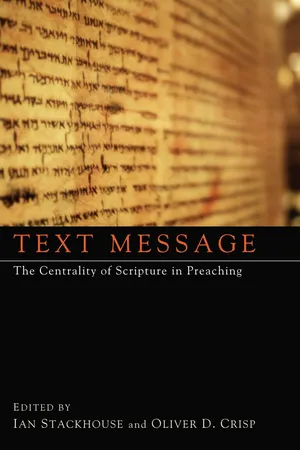
- 264 pages
- English
- ePUB (mobile friendly)
- Available on iOS & Android
eBook - ePub
About this book
Information
Topic
Theology & ReligionSubtopic
Christian MinistryPart One
Biblical and Theological
1
Hebrews as a Model for Expository Pastoral Preaching
The scholarly consensus is that the Letter to the Hebrews might be re-titled the Sermon to the Hebrews.1 When we hear Hebrews we are exposing ourselves to early Christian preaching.2 Hebrews is the nearest we get to an example of first-century preaching.3 Of particular interest here is the author’s own description of what he has been attempting to do: “I appeal to you, brothers, bear with my word of exhortation, for I have written to you briefly” (Heb 13:22).
We might demur over “briefly,” but what attracts serious attention is the phrase tou logou tēs paraklēseōs—“the word (or message) of exhortation (or comfort).” This phrase appears to be a technical name for a sermon preached in a synagogue.4 The phrase occurs at Acts 13:14–15 where Paul and Barnabas are invited to give logos tēs paraklēseōs to the congregation in Pisidian Antioch:
But they went on from Perga and came to Antioch in Pisidia. And on the Sabbath day they went into the synagogue and sat down. After the reading from the Law and the Prophets, the rulers of the synagogue sent a message to them, saying, “Brothers, if you have any word of encouragement for the people, say it.”
In this synagogue context there is an expectation of hearing the word of the Lord derived apparently from an exposition of the lectionary readings drawn from the law and the prophets (Acts 13:15a; see Luke 4:16–21). This is precisely what Paul goes on to offer, in his presentation of Christ as the fulfillment of law and the prophets, and as the climactic chapter of the story. The “word of encouragement” is nothing less than the “message of salvation” (Acts 13:26). The sequel is instructive in suggesting that the language of gospel preaching can easily morph into “word of God” (Acts 13:34; 13:46) and “word of the Lord” terminology (Acts 13:48–49). This is in line with earlier incidents of “word of God” (Acts 13:5–7) and “teaching about the Lord” (Acts 13:12)—a conflation that is typical of Hebrews.
Our working hypothesis then is that Hebrews is a situation-specific sermon, or series of sermons, of an expository kind, sent as a letter to address the traumas of certain Jewish Christians, probably in Rome at or after the Neronic persecution, who were feeling under pressure to draw back from full commitment to Jesus and needed a bracing challenge and strong reassurance.
We may draw attention to some features of oral performance in Hebrews by noticing first the signs of speech rather than writing.
Take, for example, the phrases “of which we are speaking” and “it has been testified somewhere” (Heb 2:5–6). These suggest that at this point the preacher can assume knowledge on the part of his audience or, perhaps, does not want to get side-tracked into a discussion of psalm authorship.
And what of his comment, “About this we have much to say, and it is hard to explain?” (Heb 5:11). Here he seems to be getting his retaliation in first while in the same breath highlighting the seriousness of what he is teaching.
When he says, “Since you have become hard of hearing” (Heb 5:11), we suspect the preacher is needing to wake his audience up by shouting louder or banging on the pulpit! His words, “though we speak in this way” (Heb 6:9) or “now the point of what we are saying is this” (8:1) sound like a classic mid-sermon summary of the main burden of the message.
As for remarks such as “of these things we cannot now speak in detail” (Heb 9:5) or “what more shall I say?” (Heb 11:32), they seem to invite the response, “Tell it preacher, tell it all.” Though “time would fail me to tell . . .” sounds too much like a typical preacher’s complaint!
All the way through, we can hear the pastoral voice making its appeal to those who are “brothers” and “beloved” (e.g., Heb 3:12; 6:9).
“Hebrews,” says Tom Long, “like all good sermons, is a dialogical event in a monological format.”5 It may be worth recalling, at this juncture, Aristotle’s threefold rhetorical analysis which measured oratory in three ways: by logos (word), by pathos (emotion), and by ethos (character).
As far as Hebrews is concerned, the logos of his exhortation is the entire storyline of salvation, climaxing in God’s final word and perfected work in his Son, Jesus Christ.
As for pathos, the preacher to the Hebrews exploits every emotional approach to elicit a response. He appeals, provokes, cajoles, invites, warns, celebrates, and reassures. He seeks to arouse both confidence (Heb 4:18; 10:19), and fear (Heb 4:1), urging his listeners/ readers, as it were, to “fear God rather than men,” not in craven terror (Heb 12:21) but, nonetheless, with healthy reverence and awe” (Heb 12:28). Paradoxically, he invokes the specter of shame—the possible disgrace of not disregarding the dishonor heaped upon them (Heb 10:36–39)—seeking, as it were, to shame them into being unashamed!
As to ethos the author commends himself by his pastoral warmth and empathy. By his frequent use of “we” and “us” he shows his solidarity with them in the fight of faith. This serves to enhance rather than diminish his authority as one who practices what he preaches. As for the character of God, he is trustworthy in promise-keeping (Heb 6:18; 10:23); as for Christ, he is the faithful one par excellence (Heb 2:17; 3:6; 12:1–2).6 In all these ways, the integrity of word and speaker is brought home to the hearers.
Paying closer attention to the various literary genres of Scripture would give our preaching a sharper edge and deeper color.
Hebrews segues from style to style and mood to mood. If we view Hebrews—or any part of Scripture—as a contourless landscape of flat propositions, then we may well end up trying to liven it up by imposing our personality on it.
Richard Lischer has wise words on this:
The preacher who is only concerned with self-expression may be neglecting the rich array of styles available in the Bible. The text will tell you when to be angry, ironic, funny, or sad. It will tell you when to reason with your hearers and when to tease them with parabolic utterance, when to teach your parishioners and when to soar with them to the third heaven.7
Lischer adds: “The preacher makes adjustment in matters of diction (word choice, figures of speech, and manner of speech (tone of voice)) not on the basis of his or her personality or mood but in deference to the nature of the text and the demands of the occasion.”8
What might Lischer’s phrase “in deference to the nature of the text” mean as far as Hebrews is concerned?
It might mean recognizing that the opening catena of texts in Hebrews is less a list of proof texts but more a litany of praise which cries out to be preached as proclamation. It might also mean that the sobering typological comparison of...
Table of contents
- Title Page
- Foreword
- Acknowledgments
- Contributors
- Introduction
- Part 1: Biblical and Theological
- Part 2: Historical
- Part 3: Textual
- Coda
- Bibliography
Trusted by 375,005 students
Access to over 1.5 million titles for a fair monthly price.
Study more efficiently using our study tools.
Frequently asked questions
Yes, you can cancel anytime from the Subscription tab in your account settings on the Perlego website. Your subscription will stay active until the end of your current billing period. Learn how to cancel your subscription
No, books cannot be downloaded as external files, such as PDFs, for use outside of Perlego. However, you can download books within the Perlego app for offline reading on mobile or tablet. Learn how to download books offline
Perlego offers two plans: Essential and Complete
- Essential is ideal for learners and professionals who enjoy exploring a wide range of subjects. Access the Essential Library with 800,000+ trusted titles and best-sellers across business, personal growth, and the humanities. Includes unlimited reading time and Standard Read Aloud voice.
- Complete: Perfect for advanced learners and researchers needing full, unrestricted access. Unlock 1.5M+ books across hundreds of subjects, including academic and specialized titles. The Complete Plan also includes advanced features like Premium Read Aloud and Research Assistant.
We are an online textbook subscription service, where you can get access to an entire online library for less than the price of a single book per month. With over 1.5 million books across 990+ topics, we’ve got you covered! Learn about our mission
Look out for the read-aloud symbol on your next book to see if you can listen to it. The read-aloud tool reads text aloud for you, highlighting the text as it is being read. You can pause it, speed it up and slow it down. Learn more about Read Aloud
Yes! You can use the Perlego app on both iOS and Android devices to read anytime, anywhere — even offline. Perfect for commutes or when you’re on the go.
Please note we cannot support devices running on iOS 13 and Android 7 or earlier. Learn more about using the app
Please note we cannot support devices running on iOS 13 and Android 7 or earlier. Learn more about using the app
Yes, you can access Text Message by Ian Stackhouse,Oliver D. Crisp in PDF and/or ePUB format, as well as other popular books in Theology & Religion & Christian Ministry. We have over 1.5 million books available in our catalogue for you to explore.