eBook - ePub
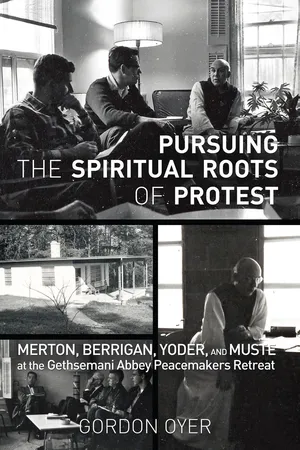
Pursuing the Spiritual Roots of Protest
Merton, Berrigan, Yoder, and Muste at the Gethsemani Abbey Peacemakers Retreat
- 298 pages
- English
- ePUB (mobile friendly)
- Available on iOS & Android
eBook - ePub
Pursuing the Spiritual Roots of Protest
Merton, Berrigan, Yoder, and Muste at the Gethsemani Abbey Peacemakers Retreat
About this book
In the fall of 1964, Trappist monk Thomas Merton prepared to host an unprecedented gathering of peace activists. "About all we have is a great need for roots," he observed, "but to know this is already something." His remark anticipated their agenda--a search for spiritual roots to nurture sound motives for "protest."
This event's originality lay in the varied religious commitments present. Convened in an era of well-kept faith boundaries, members of Catholic (lay and clergy), mainline Protestant, historic peace church, and Unitarian traditions participated. Ages also varied, ranging from twenty-three to seventy-nine. Several among the fourteen who gathered are well known today among faith-based peace advocates: the Berrigan brothers, Jim Forest, Tom Cornell, John Howard Yoder, A. J. Muste, and Merton himself. During their three days together, insights and wisdom from these traditions would intersect and nourish each other. By the time they parted, their effort had set down solid roots and modeled interreligious collaboration for peace work that would blossom in coming decades.
Here for the first time, the details of those vital discussions have been reconstructed and made accessible to again inspire and challenge followers of Christ to confront the powers and injustices of today.
Information
Topic
Theology & ReligionSubtopic
Christian Theology1
The Antiwar “Movement Aborning”
Remnants of the morning’s rain still glistened as a dozen scattered walkers emerged from the monastery retreat house and trod along a pathway through the adjoining garden. Exiting the opposite side through a gap in the monastic enclosure’s gray block walls, they ambled past the abbey reservoir and strode along a dusty lane for several yards, then disappeared into the trees of a wooded hillside. Fallen leaves, slippery wet beneath their feet, slowed their pace as they made their way up the dark and muddy footpath, sheltered from sunlight by the arched canopy of thinning branches that stretched over their heads. About a mile north of the abbey they emerged from their gentle climb into a clearing. Reentering the sunlight they turned toward a small cinder block building perched at the edge of the grassy field, barely visible through a stand of trees on their left. In the middle of the opening, next to a barbed wire fence that bisected the clearing, they noted their host, a robust middle-aged monk in a white Trappist robe and black scapular. He slowly paced across the grass, face downward, glasses donned, intently peering into an open notebook cradled in his extended hands. Deep in thought, his demeanor conveyed a serious focus as he studied the jottings on the pages before him. Upon noticing that his guests had arrived, he waved a friendly greeting and strode toward them. As he joined them, they continued toward the cottage, crossed a sheltered cement porch that extended the full width of the structure, and entered its front door. Once inside they settled into the seating available within its austere walls, and the monk began to share with them his carefully chosen words.1
The individuals assembled at this bucolic Kentucky site had arrived intent on probing religious motives and rationales for challenging some of their nation’s more oppressive habits, particularly that of making war. The pastoral setting, when coupled with the monastic ambience offered by the Abbey of Our Lady of Gethsemani, provided an ideal venue to conduct this retreat from the daily bustle of modern urban life. That morning back at the monastery they had begun their conversation by reviewing an outline headed “The Spiritual Roots of Protest.” The monk in question—Gethsemani’s (and America’s) most renowned monastic figure Thomas Merton—had sketched the outline to guide their three-day discussion. Now, this afternoon at his hermitage, Merton would launch the first of four in-depth dialogues by elaborating on his views about “The Monastic Protest.”
Although the idea for this gathering had taken more than two years to coalesce from inception to fruition, its timing proved ideal. The summer of 1964 had elicited both explicit demands for equal access to civil rights and stirrings to challenge expanding U.S. military support of South Vietnam’s anticommunist regime. In calling for this event, one of the retreat’s initiators, John C. Heidbrink of the Fellowship of Reconciliation, had observed that, “We are faced here and abroad with a super-structure of protest and non-conformity building up daily in nearly every country which can loosely be called a movement for peace.” Lest this activity remain grounded only in secular hopes and materialistic priorities, he had sought a venue for confessing men of peace to examine “the subject of spiritual roots of the US peace movement as well as the international movement aborning.”2 And here, amid the hills, trees, and monastic solitude, they intended to accomplish exactly that.
The Movement at Hand3
The emerging U.S. antiwar movement of the mid-1960s reflected one of several ebbs and flows of American peace activism, and understanding the goals of those gathered at Gethsemani and the conversations they shared first requires a glimpse of activity that came before. Its most recent flow had built upon and superseded what one historian dubbed a “small band of isolated of pacifists” who sustained their convictions during the worst years of the McCarthy era’s anticommunist obsession.4 This revival in peace advocacy responded to mushrooming nuclear arsenals and the atomic testing needed to further develop them. Some of these activists dreamed of dismantling nuclear arms altogether, but most peace advocates of the later fifties and early sixties invested in the more modest goal of eliminating—or at least reducing—nuclear weapons testing. In attempting to describe what motivated them and framed their objectives, historians Charles DeBenedetti and Charles Chatfield have suggested that most of them focused their work primarily through one of two lenses.
The first lens consisted of “liberal internationalism” and generally aligned with what some refer to as “nuclear pacifists.”5 These advocates were often heavily vested in the institutions of liberal democratic society, seeing in them the vehicles through which humanity would advance toward peace and prosperity. They sought collaborative structures to police conflict and regulate atomic energy and research, and their vision focused pragmatically on reformation of political and social institutions to accommodate such oversight. The leading outlet for liberal pacifist impulses was the Committee for a Sane Nuclear Policy, or SANE.6 Though championing liberal agenda, SANE often included radical pacifists as well, while serving as the core of nuclear test ban activism. It shepherded a scattered array of local groups comprised of widely diverse members that promoted various petition drives, community meetings, advertisements in major newspapers, and public demonstrations that called for limits to nuclear testing. By 1960 SANE was mobilizing events with participation in the tens of thousands.7
The second lens that focused the work of peace advocates concerned itself less with broad political reform than with expression of personal moral convictions that rejected violence and required active engagement. Drawing on currents that ranged from historic peace church perspectives to secular conscientious objection to Gandhian nonviolent resistance, those viewing peace through this lens promoted focused actions to directly confront and challenge rather than simply reform existing institutions.8 In contrast to seeking venues for global governance, this “radical pacifist” lens set its sights more intensely toward justice, decentralized power, self-determination for developing countries abroad, and freedom of personal conscience at home. They sought to reconstruct values and elevate human consciousness rather than improve legislation, and they above all embraced an engaged, absolute rejection of violence. For inspiration they often looked to iconic figures such as Abraham J. Muste and Dorothy Day and to like-minded networks such as the religiously based Fellowship of Reconciliation (FOR), Day’s Catholic Worker Movement, the War Resister League, and the American Friends Service Committee.9 The journal Liberation, founded in the mid-fifties, provided a significant voice for their ideas. In particular, radical pacifists channeled their nuclear opposition through the Committee for Non-Violent Action (CNVA),10 which sought venues to confront directly the systems that supported atomic testing by organizing protests and other direct actions at testing sights, Atomic Energy Commission offices (which oversaw the tests), military installations, and elsewhere.11
The views these two lenses promoted would often overlap. Their distinctions were not clear and their boundaries were quite fluid. Some who opposed U.S. militarism simply did not fit well within either. Those loyal to the Old Left opposed atomic testing mainly within a framework of rigid Marxist/socialist ideology. Most in the “nonresistant” peace churches such as Amish and Mennonites absolutely embraced pacifism but rejected direct action and political lobbying. Certain nuclear pacifists no doubt cared little for the grand global vision of internationalism. Other historians would add the nuance of a “progressive” lens that focused beliefs and actions against what such activists considered “imperialist” U.S. intervention.12 But the DeBenedetti and Chatfield “internationalist”/“radical” lenses form something of a fault line that can help unravel the complex web of personalities, organizations, and activity that together formed a peace movement at mid-century. It can also help to better frame the ideas that formed the worldviews of those who gathered at Gethsemani in 1964, just as the unfolding political developments of the early sixties helps better explain the agenda that retreat planners pursued.
In particular, the August 5, 1963 signing of a Partial Test Ban Treaty and its ratification that September deflated and dissolved the primary objective that had focused and unified the energy of peace advocates.13 This treaty served to reinforce a growing political consensus that the most prudent course the United States should pursue rested with efforts toward verifiable arms control rather than disarmament. Although a handful pressed on to eliminate nuclear weaponry, many others rested comfortably on an arms control platform, and the peace movement as a whole atrophied.14 In response, many former test ban supporters soon refocused their energy on civil rights activism rather than issues of war and peace.
The pursuit of equal African American rights within U.S. society had traditionally held a special relationship with peace advocates, especially with radical pacifists who opposed war on moral principles and were predisposed to challenge other failures in social morality, such as rampant racism. The tight intertwining of these movements—or perhaps these two emphases of a larger social agenda—makes it difficult to tease apart their relationship. Radical pacifists naturally welcomed the civil rights movement’s embrace of nonviolence, and they had in fact supported and nurtured nonviolent opposition to racism since the Second World War. For example, the Congress of Racial Equality (CORE), a catalyst for nonviolently pursuing racial justice, originated with support from FOR staff during World War II, and it matured through the input of leaders who worked either for or closely with FOR.15 An even greater source of reciprocal peace/civil rights movement influence emerged in 1960 when students and others “sat in” to integrate Southern lunch counters, giving birth to the Student Non-Violent Coordinating Committee (SNCC).16 Its success and aftermath played a large role in confirming the potential to foster social change nonviolently and...
Table of contents
- Title Page
- Illustrations
- Foreword
- Preface
- Acknowledgments
- Abbreviations
- Chapter 1: The Antiwar “Movement Aborning”
- Chapter 2: Assembling “A Few Strong People with a Passion for Peace”
- Chapter 3: Thomas Merton’s “Planning to Have No Plans”
- Chapter 4: Opening Day—Quo Warranto, Technological Society, and the Monastic Protest
- Chapter 5: Day Two—Christ and His Church in Protest
- Chapter 6: Closing Day and Beyond—Unity and Friendship in a Movement for Peace
- Chapter 7: Impressions That Remained
- Epilogue
- Bibliography
- Afterword
- Appendix A
- Appendix B
- Appendix C
- Appendix D
- Appendix E
Trusted by 375,005 students
Access to over 1.5 million titles for a fair monthly price.
Study more efficiently using our study tools.
Frequently asked questions
Yes, you can cancel anytime from the Subscription tab in your account settings on the Perlego website. Your subscription will stay active until the end of your current billing period. Learn how to cancel your subscription
No, books cannot be downloaded as external files, such as PDFs, for use outside of Perlego. However, you can download books within the Perlego app for offline reading on mobile or tablet. Learn how to download books offline
We are an online textbook subscription service, where you can get access to an entire online library for less than the price of a single book per month. With over 1.5 million books across 990+ topics, we’ve got you covered! Learn about our mission
Look out for the read-aloud symbol on your next book to see if you can listen to it. The read-aloud tool reads text aloud for you, highlighting the text as it is being read. You can pause it, speed it up and slow it down. Learn more about Read Aloud
Yes! You can use the Perlego app on both iOS and Android devices to read anytime, anywhere — even offline. Perfect for commutes or when you’re on the go.
Please note we cannot support devices running on iOS 13 and Android 7 or earlier. Learn more about using the app
Please note we cannot support devices running on iOS 13 and Android 7 or earlier. Learn more about using the app
Yes, you can access Pursuing the Spiritual Roots of Protest by Gordon Oyer in PDF and/or ePUB format, as well as other popular books in Theology & Religion & Christian Theology. We have over 1.5 million books available in our catalogue for you to explore.