- 112 pages
- English
- ePUB (mobile friendly)
- Available on iOS & Android
eBook - ePub
About this book
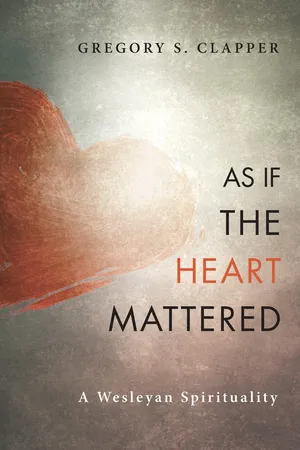
As If the Heart Mattered expounds on John Wesley's image of religion as a house by exploring three main parts: the porch of repentance, the door of faith, and holiness (the house itself). Useful study helps include references to John Wesley sermons and Charles Wesley hymns. But this approach to spiritual life transcends Methodism and provides essential biblical truth applicable to all Christians. Questions for reflection or discussion are provided at the end of each chapter.
Information
Topic
Theology & ReligionSubtopic
Biblical StudiesChapter One
Fears and Hopes about a Religion of the Heart
When the authors of scripture—and John Wesley—used the term heart, they typically were not referring to the muscle that pumps blood throughout the body. They instead used the term to refer to the center of a human being, that core of who we are. The heart is the source of our strongest desires and the guide for our deepest choices, the home of our most intense yearnings and of our greatest hopes, fears, loves, and dreams. The heart carries our identity, that sense of who we are that is composed of both our history (how we have been formed in the furnace of life up to this point) and our vision of what we want to become (how we hope to be formed in the future). The heart is a metaphor for who we really are, that vision of self we see when, in our frankest moments of honesty and insight, we name what we are really after in life, what brings our greatest fulfillment.
This use of metaphor is hardly unusual in religious language for we can find numerous metaphors scattered throughout the discourses of Jesus as the Bible records them. One bundle of metaphors can be found in the Gospel of John where Jesus describes himself as “the bread of life” (John 6:35), “the good shepherd” (John 10:14), and “the true vine” (John 15:1). These passages show that there is nothing intellectually suspect or sloppy about using a metaphor. Indeed, Jesus’ use of these figures of speech shows that sometimes the only way to speak about important realities is through metaphor. However, we also must acknowledge that many people have some bad associations with the particular metaphor on which we will be focusing in this book, namely, “heart.” Even more negative are some people’s associations with the phrase heart religion.
When I have spoken around the country on the topic of Wesleyan heart religion, one of the first things I do is ask people to make two lists of free associations with the phrase heart religion. First, I ask them to list all of the positive connotations they associate with the phrase. In answer to this, I often receive responses such as the following: inner fulfillment; a religion that brings together our emotions and our beliefs without denying one or the other; something that reaches beyond the dead recitation of the creeds or a moralistic understanding of religion; a satisfying of our deepest desires; something that brings about a lasting love and joy and peace.
After several minutes of such sharing, there is a noticeable warming of the atmosphere and most people seem eager to pursue the task at hand. But then when I ask people to name the negative connotations of “heart religion” the energy level elevates drastically! There is usually no hesitancy in naming such things as these: irrationality; self-deception; individualism; authoritarian, shame-based manipulation; a self-absorbed religion of feeling; a vision of Christianity that ignores our social life and our connections with both other believers and those outside of the church. Years of pain, fear, and anger start rolling out of people when I ask them to name the possible problems of a heart religion. To one observing these reactions, it can be seen as a therapeutic moment, but such pain-filled statements are also a crushing indictment of much of our church life.
It is in response to both these hopes for, as well as the many well-founded fears about, “heart religion” that I want to make clear what John Wesley meant by this phrase. His was a powerful yet balanced vision, a view that drew on both an Oxford Fellow’s knowledge of the Christian tradition as well as a humble sinner’s own spiritual experience. Wesley’s understanding of the spiritual life was further refined and strengthened by his many years of leading a reform and renewal movement in which he had to deal with just about every possible extreme, mistake, and problem of Christian living.
John Wesley’s Vision of Heart Religion—”Orthokardia”1
John Wesley affirmed the orthodoxy of the classical creeds of the church, those capsule summaries of Christian doctrine which describe God, humanity, and salvation in brief but powerful words. However, Wesley knew that the “Christianity” that can be put down on paper does not tell the whole story. He also affirmed, espoused, and practiced what has come to be called in the twentieth century orthopraxis, or right action. This is to say that he recognized that certain actions are necessary if one is to consider oneself a Christian. These actions he termed the “works of piety” (e.g., taking the sacraments, attending worship, praying, searching the scriptures) and the “works of mercy” (or “works of charity,” e.g., visiting those imprisoned, feeding the hungry, clothing the naked, entertaining or assisting the stranger, comforting the afflicted).2 I will say more about these tw...
Table of contents
- Title Page
- Introduction: Why Should Anyone Care About a “Wesleyan” Spirituality?
- Chapter 1: Fears and Hopes about a Religion of the Heart
- Chapter 2: The House of Religion: The Porch of Repentance
- Chapter 3: The House of Religion: The Door of Faith
- Chapter 4: The House of Religion: The House of Holiness
- Chapter 5: Living a Heart Religion in the World Today: The Fears and Hopes of Heart Religion Revisited
- Glossary
- About the Author
Trusted by 375,005 students
Access to over 1.5 million titles for a fair monthly price.
Study more efficiently using our study tools.
Frequently asked questions
Yes, you can cancel anytime from the Subscription tab in your account settings on the Perlego website. Your subscription will stay active until the end of your current billing period. Learn how to cancel your subscription
No, books cannot be downloaded as external files, such as PDFs, for use outside of Perlego. However, you can download books within the Perlego app for offline reading on mobile or tablet. Learn how to download books offline
Perlego offers two plans: Essential and Complete
- Essential is ideal for learners and professionals who enjoy exploring a wide range of subjects. Access the Essential Library with 800,000+ trusted titles and best-sellers across business, personal growth, and the humanities. Includes unlimited reading time and Standard Read Aloud voice.
- Complete: Perfect for advanced learners and researchers needing full, unrestricted access. Unlock 1.5M+ books across hundreds of subjects, including academic and specialized titles. The Complete Plan also includes advanced features like Premium Read Aloud and Research Assistant.
We are an online textbook subscription service, where you can get access to an entire online library for less than the price of a single book per month. With over 1.5 million books across 990+ topics, we’ve got you covered! Learn about our mission
Look out for the read-aloud symbol on your next book to see if you can listen to it. The read-aloud tool reads text aloud for you, highlighting the text as it is being read. You can pause it, speed it up and slow it down. Learn more about Read Aloud
Yes! You can use the Perlego app on both iOS and Android devices to read anytime, anywhere — even offline. Perfect for commutes or when you’re on the go.
Please note we cannot support devices running on iOS 13 and Android 7 or earlier. Learn more about using the app
Please note we cannot support devices running on iOS 13 and Android 7 or earlier. Learn more about using the app
Yes, you can access As If the Heart Mattered by Gregory S. Clapper in PDF and/or ePUB format, as well as other popular books in Theology & Religion & Biblical Studies. We have over 1.5 million books available in our catalogue for you to explore.